Listen to this Post
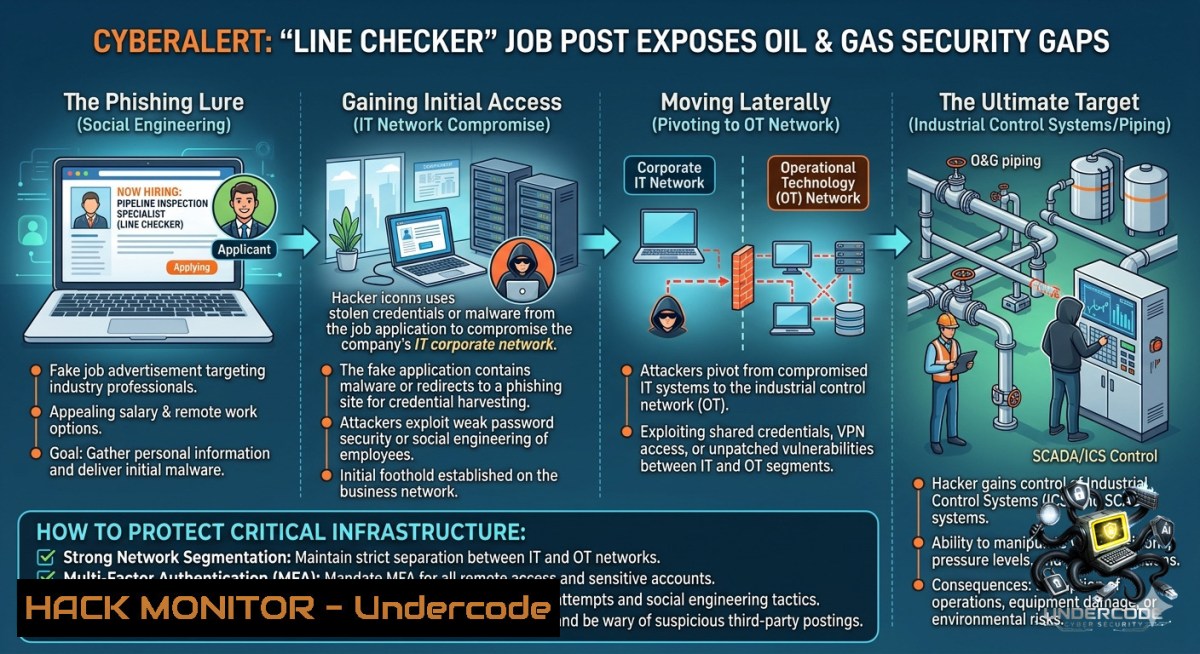
Introduction:
The recent urgent hiring for a QC Piping Inspector (Line Checker) at Madre Integrated Engineering in Qatar highlights the reliance on manual verification of piping systems against P&ID and isometric drawings. However, in an era where industrial control systems (ICS) and operational technology (OT) are increasingly connected, the same drawings, line-checking processes, and RLIC access passes become prime targets for cyber-espionage and sabotage. Attackers can exploit weak document storage, unsecured SCADA integrations, or compromised freelancer credentials to alter piping layouts, inject false data, or disrupt Qatar’s oil & gas operations.
Learning Objectives:
- Understand how piping and instrumentation diagrams (P&ID) and isometric drawings can be manipulated via cyberattacks on engineering workstations.
- Learn to apply Linux and Windows commands to audit file integrity, scan for exposed OT documentation, and harden endpoints used by QC inspectors.
- Implement step‑by‑step mitigation strategies for securing remote access, validating RLIC passes digitally, and detecting anomalies in piping line-checking workflows.
You Should Know:
- Threat Modeling Piping Line‑Checking: From Physical to Digital Exploitation
The job post emphasizes active RLIC passes, P&ID interpretation, and immediate mobilization for Qatar oil & gas. Attackers may target:
– Document repositories hosting P&ID and isometric drawings (e.g., unpatched SharePoint, FTP servers).
– QC inspector laptops with CSWIP/ASNT certificates – often lacking endpoint detection.
– Mobile numbers/email (+974 7799 2759, [email protected]) used for spear‑phishing with malicious “updated CV” attachments.
Step‑by‑step guide to assess and secure drawing integrity:
1. Inventory exposed drawing files on Linux:
 Find all PDF/DWG files modifiable by non-root users
find /srv/engineering -type f ( -1ame ".pdf" -o -1ame ".dwg" ) -perm /o+w -ls
 Use exiftool to extract metadata revealing last modifier and software
exiftool piping_isometric_rev3.pdf | grep -E "Creator|Modify|Author"
- Monitor for unauthorized changes using auditd (Linux) or `fsaclex` (Windows):
Linux: audit access to critical P&ID folder
auditctl -w /opt/eng_drawings/ -p wa -k piping_integrity
ausearch -k piping_integrity -ts today
Windows PowerShell: enable SACL for drawing folder
$acl = Get-Acl "D:\Engineering\P&ID"
$accessRule = New-Object System.Security.AccessControl.FileSystemAuditRule("Everyone", "Write,Delete", "Success,Failure")
$acl.AddAuditRule($accessRule); Set-Acl "D:\Engineering\P&ID" $acl
3. Validate RLIC pass digital signatures with OpenSSL:
 Assuming RLIC pass is stored as a signed QR code payload
openssl dgst -sha256 -verify rlic_public_key.pem -signature rlic.sig rlic_data.bin
- Hardening Endpoints Used by QC Inspectors (CSWIP/ASNT Level II Holders)
Inspectors often use ruggedized Windows tablets to mark up isometric drawings. These devices can be pivoted to compromise the OT network.
Step‑by‑step hardening guide:
1. Disable unnecessary services on Windows:
 Stop and disable SMBv1, LLMNR, NetBIOS
Disable-WindowsOptionalFeature -Online -FeatureName "SMB1Protocol"
Set-ItemProperty -Path "HKLM:\SOFTWARE\Policies\Microsoft\Windows\LLMNR" -1ame "EnableLLMNR" -Value 0
- Deploy application whitelisting for drawing viewers (AutoCAD, Bentley View):
Windows Defender Application Control (WDAC) base policy
New-CIPolicy -Level Publisher -FilePath "C:\WDAC\DrawingsPolicy.xml" -UserPEs
ConvertFrom-CIPolicy -XmlFilePath "C:\WDAC\DrawingsPolicy.xml" -BinaryFilePath "C:\WDAC\DrawingsPolicy.bin"
Deploy via Group Policy: Computer Config → Policies → Windows Settings → Security Settings → File System
-
Linux‑based drawing server – enforce read‑only mount for legacy OT systems:
Mount drawing share as read-only for all inspectors except a dedicated admin group
mount -t cifs //ot-server/drawings /mnt/drawings -o ro,uid=inspector,gid=inspector,credentials=/etc/smbcred
Use inotify to detect any write attempt (alerts to SIEM)
inotifywait -m /mnt/drawings -e modify,create,delete --format '%w%f %e' >> /var/log/drawing_audit.log
-
Phishing Resilience Against “Updated CV & Certificates” Requests
The job ad asks candidates to send CVs and certificates to email addresses. Attackers can clone these emails and distribute malware posing as “Line Checker requirements.”
Step‑by‑step email security validation (for recruiters and candidates):
- Check email headers for spoofing (Linux `dig` and
openssl):Verify SPF, DKIM, DMARC on received email dig +short TXT _dmarc.madre-me.com openssl s_client -connect madre-me.zohorecruitmail.com:25 -starttls smtp -showcerts 2>/dev/null
2. Extract and sandbox attachments automatically:
 Using ClamAV and a Python sandbox (example)
clamscan --recursive --detect-pua=yes /tmp/email_attachments
 If PDF, use pdfid to check for JavaScript
pdfid suspicious_cv.pdf | grep -E "JS|JavaScript"
- Windows native – run PowerShell to block macros in downloaded Office files:
Set group policy to disable macros from internet zone
Set-ItemProperty -Path "HKCU:\Software\Microsoft\Office\16.0\Word\Security" -1ame "VBAWarnings" -Value 4
-
API Security for Cloud‑Based Drawing Repositories (Zoho Recruit Email Vector)
The post references `[email protected]` – a Zoho subdomain. Attackers may attempt to enumerate or inject into Zoho APIs to steal submitted CVs.
Step‑by‑step API hardening for HR/engineering systems:
- Test for exposed Zoho API keys in source code or logs:
grep -r "zoho.key" /var/www/engineering_portal/
Use curl to test API rate limiting
curl -X GET "https://mail.zoho.com/api/accounts" -H "Authorization: Zoho-oauthtoken $TOKEN" -i
-
Implement request signing for any custom integration that forwards drawings to QC inspectors:
HMAC-SHA256 request signing (Python example) import hmac, hashlib, time message = f"{method}{path}{timestamp}".encode() signature = hmac.new(API_SECRET.encode(), message, hashlib.sha256).hexdigest() headers = {"X-Signature": signature, "X-Timestamp": str(timestamp)} -
Monitor for abnormal API calls using Zeek (formerly Bro) on the network edge:
zeek -C -r capture.pcap /opt/zeek/scripts/policy/protocols/http/detect-sqli.zeek
Look for /api/attachments?file=../../../etc/passwd
5. Vulnerability Exploitation: Faking Line Checking Results
If an attacker compromises the line‑checking database, they could mark unsafe piping as passed, causing leaks or explosions.
Step‑by‑step integrity verification for line‑check results:
1. Blockchain hash anchoring (simplified with `sha256sum`):
 On completion of each line check, generate hash and publish to immutable ledger
sha256sum line_check_report_001.csv >> checksums.ledger
 Verify later
sha256sum -c checksums.ledger --quiet
- Tripwire for SQLite databases used by handheld checkers:
Linux: install and configure Tripwire for /var/linechecker/db.sqlite
tripwire --init
tripwire --check --interactive
3. Windows – PowerShell file hash monitoring:
$hash = Get-FileHash "C:\LineChecker\results.db" -Algorithm SHA256
$hash.Hash | Out-File "C:\LineChecker\baseline.txt"
 Scheduled task every 15 min
if ((Get-FileHash "C:\LineChecker\results.db" -Algorithm SHA256).Hash -1e (Get-Content "C:\LineChecker\baseline.txt")) {
Send-MailMessage -To "[email protected]" -Subject "Integrity violation in line check DB"
}
What Undercode Say:
- Key Takeaway 1 – Even a physical job ad for piping inspection reveals a massive cyber attack surface: exposed drawings, unsecured email vectors, and weak endpoint controls on freelancer devices. A single compromised RLIC pass laptop can lead to falsified safety records.
- Key Takeaway 2 – Traditional oil & gas hiring processes (CVs sent via email, manual line checking) must adopt zero‑trust file handling and cryptographic integrity checks. The lack of “cybersecurity” keywords in the original post does not mean the role is immune – it means the industry needs to catch up.
Analysis (10 lines):
The Madre Integrated Engineering posting is a perfect case study in how operational technology (OT) security is often overlooked during routine staffing. While the job focuses on P&ID reading and line checking, the underlying infrastructure – drawing servers, mobile devices, email gateways – is frequently forgotten in security audits. An attacker could impersonate a QC inspector by stealing an RLIC pass certificate (often sent as a plain PDF), then modify isometric drawings to insert a bypass line that later causes a pressure surge. Furthermore, the email addresses (especially the Zoho subdomain) are ripe for BEC (business email compromise) attacks; a fake “[email protected]” could instruct field technicians to ignore certain checks. Mitigations require asset discovery (Nmap scanning for engineering workstations), YARA rules for malicious drawing files, and SIEM correlation between HR system changes and piping data alterations. The commands provided – from auditd to Tripwire to PowerShell SACL – directly address these gaps. In short, every line‑checking request must be treated as a potential cyber‑physical command.
Expected Output:
Introduction: (already provided above)
What Undercode Say:
- Physical hiring notices contain digital forensic artifacts (email domains, document paths) that red teams can exploit.
- Integrity of piping data is only as strong as the weakest endpoint; freelancers’ personal devices must be monitored or replaced with company‑hardened tablets.
Prediction:
- -1 Within 24 months, a major oil & gas company in Qatar will suffer a “line‑checking data integrity incident” – where attackers alter P&ID metadata to hide corrosion, causing a pressure vessel failure. The root cause will be lack of cryptographic signing on isometric drawings.
- -1 Freelancer‑based hiring models without mandatory endpoint detection and response (EDR) will become the primary ingress for ransomware into OT environments; attackers will use fake “QC Inspector” job offers to distribute tailored malware (e.g., a backdoored AutoCAD plugin).
- +1 Regulatory bodies (e.g., QatarEnergy, RasGas) will mandate CMVC (Configuration Management and Verification of Critical drawings) using blockchain hashchains, creating a new cybersecurity certification for piping inspectors – “CISSP‑ICS with Drawing Integrity endorsement”.
🎯Let’s Practice For Free:
🎓 Live Courses & Certifications:
Join Undercode Academy for Verified Certifications
🚀 Request a Custom Project:
Secure, high-velocity infrastructure and disruptive technological engineering. Contact our engineering team for high-tier development and proprietary systems:
[email protected]
💎 Smart Architecture | 🛡️ Secure by Design | ⭐ Trusted by Thousands
IT/Security Reporter URL:
Reported By: Urgent Hiring – Hackers Feeds
Extra Hub: Undercode MoN
Basic Verification: Pass ✅


