Listen to this Post
Introduction:
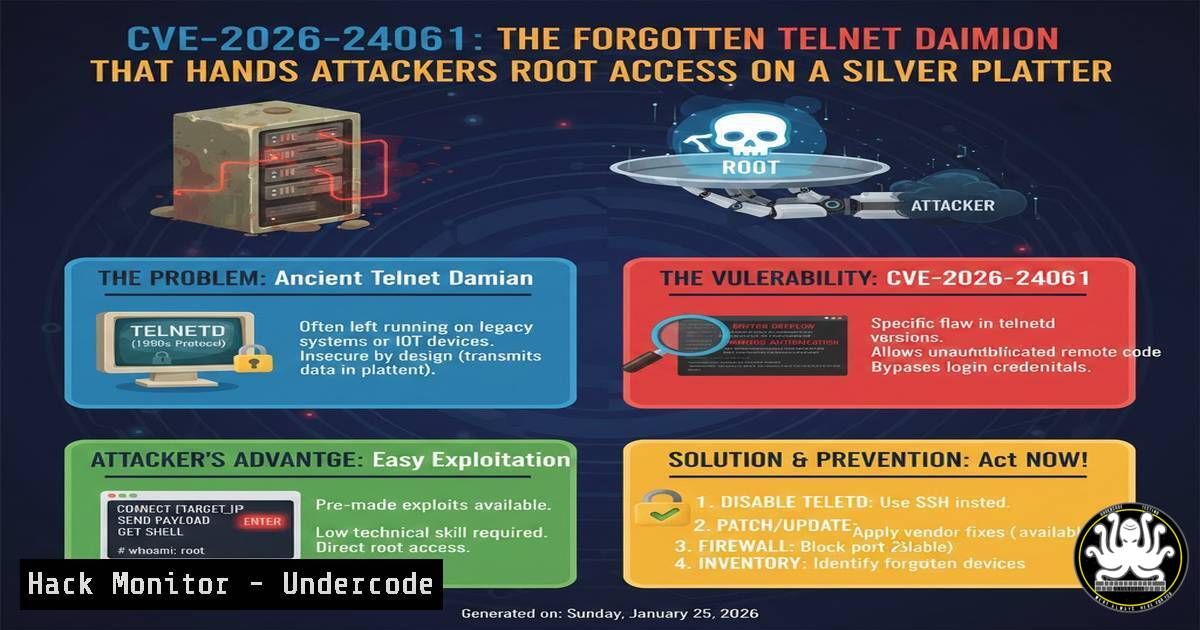
A critical vulnerability, CVE-2026-24061, has been disclosed in the GNU Inetutils `telnetd` service, exposing systems running versions up to 2.7-2 to unauthenticated Remote Code Execution (RCE) with root privileges. This flaw is not a typical memory corruption issue but a stark logic and trust failure in argument and environment variable handling, allowing attackers to bypass authentication entirely and spawn a root shell. In 2026, this vulnerability underscores the devastating risk posed by legacy services that persist in enterprise networks, embedded devices, and supposedly isolated management segments.
Learning Objectives:
- Understand the root cause and exploitation mechanism of CVE-2026-24061 in GNU Inetutils telnetd.
- Learn to detect exposed and vulnerable `telnetd` instances across your network using common security tools.
- Implement immediate mitigation and long-term hardening strategies to eliminate this risk and similar legacy service threats.
You Should Know:
- Vulnerability Deep Dive: It’s Not a Bug, It’s a Logic Flaw
The core failure lies in how the telnet daemon processes user-supplied input before passing it to the login program. The attacker can inject malicious environment variables through crafted telnet protocol negotiations. These variables are then passed unsanitized to the privileged login process, which can be manipulated to skip credential verification and execute arbitrary commands with root privileges.
Step-by-step guide explaining what this does and how to use it:
The Flaw: The telnet daemon (telnetd) runs as root. It accepts a connection and passes client-controlled data (like the `USER` or `TERM` environment variable strings) to the `login` program.
The Injection: An attacker sends specially crafted telnet options sequences that define environment variables like `USER=root` or inject command sequences via variables like `IFS` (Internal Field Separator) or other shell metacharacters.
The Bypass: The `login` program, trusting these injected variables, can be tricked into skipping its authentication routine, believing a user has already been validated, leading directly to a root shell. For analysis, review the publicly available Proof of Concept (PoC).
- Proof of Concept (PoC) Exploration and Ethical Testing
Extracted URL: Exploit / PoC: `https://lnkd.in/ecEYfVJi`
The published PoC demonstrates the simplicity of the attack. It is crucial for defenders to understand this in a controlled lab environment to build effective detection signatures.Step-by-step guide explaining what this does and how to use it:
1. Lab Setup: Use a virtual machine (e.g., Ubuntu with GNU Inetutils ≤ 2.7-2). Install the vulnerable package: `sudo apt install inetutils-telnetd`. - Start the Daemon: Run `telnetd` in debug mode to observe:
sudo telnetd -debug 23. - PoC Execution: Using the exploit code from the link (typically a Python script), target your lab machine’s IP. The script will forge the malicious telnet negotiation.
- Observe the Result: Upon successful exploitation, the PoC will open a TCP connection back to the attacker or provide direct shell access, all without a username or password. NOTE: This should only be performed on your own isolated lab systems.
3. Network Discovery: Finding the Forgotten Threat
Extracted URLs & Queries: Discovery queries: ZoomEye: app="GNU Inetutils telnetd", Shodan: `product:”telnetd”`
The first line of defense is knowing your exposure. Public search engines and internal scans can identify vulnerable instances.
Step-by-step guide explaining what this does and how to use it:
Internal Scanning with Nmap: Perform a credentialed and non-credentialed scan of your internal ranges.
`nmap -p 23 –script telnet-ntlm-info,telnet-brute -oA telnet_scan
For broader discovery: nmap -p 23 -sV -O <network_range>.
Public Exposure Check: Use the extracted Shodan/ZoomEye queries to check if your organization’s public IPs have exposed `telnetd` services. Continuous monitoring for such exposures is key.
Asset Inventory: Cross-reference scan results with your CMDB. Any system running `telnetd` must be flagged for immediate remediation.
4. Immediate Mitigation: Patching and Isolation
The most straightforward mitigation is to eliminate the vulnerable component.
Step-by-step guide explaining what this does and how to use it:
1. Patch or Upgrade: Check your distribution for an updated GNU Inetutils package. Apply it immediately. For example, on Debian/Ubuntu: sudo apt update && sudo apt upgrade inetutils-telnetd.
2. Remove the Service: If telnet is not absolutely necessary, remove it entirely.
Linux: `sudo apt remove inetutils-telnetd` or sudo yum remove telnet-server.
Windows (if a 3rd-party telnet daemon is installed): Uninstall via “Add or Remove Programs” or using PowerShell: Get-WindowsFeature -Name Telnet-Server | Remove-WindowsFeature.
3. Network Control: If immediate removal isn’t possible, enforce strict network access control lists (ACLs) or firewall rules to block all access to TCP port 23 (telnet) from untrusted networks.
Linux (iptables example): `sudo iptables -A INPUT -p tcp –dport 23 -j DROP`
Windows Firewall (PowerShell): `New-NetFirewallRule -DisplayName “Block Telnet” -Direction Inbound -Protocol TCP -LocalPort 23 -Action Block`
5. Long-Term Hardening: Eradicating Legacy Risk
This CVE is a symptom of a larger problem: neglected, legacy services.
Step-by-step guide explaining what this does and how to use it:
1. Policy Enforcement: Establish and enforce a policy that mandates the removal of deprecated protocols (telnet, FTP, SNMPv1/2c) from all production systems. Use SSH (with key-based authentication and fail2ban) for remote management.
2. Regular Audits: Implement quarterly network service audits using tools like Nmap or Nessus to identify unauthorized or forgotten services.
3. Privilege Minimization: Where services must remain, ensure they do not run as root. Investigate if `telnetd` can be run in a chroot jail or container, though this is a weak compensating control compared to removal.
4. Security Monitoring: Implement IDS/IPS rules (e.g., Suricata, Snort) to detect exploit attempts against telnetd. Search for patterns of the malicious telnet option sequences described in the PoC.
What Undercode Say:
- Assumption is the Enemy of Security. The pervasive assumption that “telnet is obsolete and therefore low-risk” is precisely what makes this vulnerability so dangerous. Risk is not defined by age, but by exposure, privilege, and functionality.
- The Attack Surface You Fornote Is the One That Gets You. Security programs often focus on the perimeter and modern applications, while forgotten, internal-facing services provide attackers with a quiet, high-impact path to domain compromise.
Analysis:
This vulnerability is a classic example of a “failure of deprecation.” Security teams document a service as “legacy” and intend to remove it, but operational inertia leaves it running indefinitely. The technical root cause—environment variable injection—is a well-understood bug class, yet it persists in critical authentication paths. The exploit’s simplicity and the service’s high privileges create a perfect storm. It highlights a critical gap in many vulnerability management programs: the lack of a proactive, enforced process for decommissioning deprecated services. Defenders must shift from viewing these services as “low priority” to recognizing them as “high-value, low-effort” targets for attackers.
Prediction:
CVE-2026-24061 will trigger a wave of opportunistic scans and attacks against internal networks, leading to significant breaches throughout 2026 and beyond. It will serve as a catalyst for regulatory bodies and cybersecurity frameworks (like CIS, NIST) to explicitly mandate the active removal, not just the disabling, of deprecated protocols as a control requirement. Furthermore, this event will accelerate the adoption of Zero Trust principles within internal networks, moving away from the assumption that internal services are safer. Attack toolkits and botnets will quickly incorporate this exploit, targeting not just traditional IT but also IoT and OT devices where legacy telnet daemons are notoriously common and rarely patched.
▶️ Related Video (80% Match):
🎯Let’s Practice For Free:
IT/Security Reporter URL:
Reported By: Dmitriy Galasli – Hackers Feeds
Extra Hub: Undercode MoN
Basic Verification: Pass ✅


