
Listen to this Post
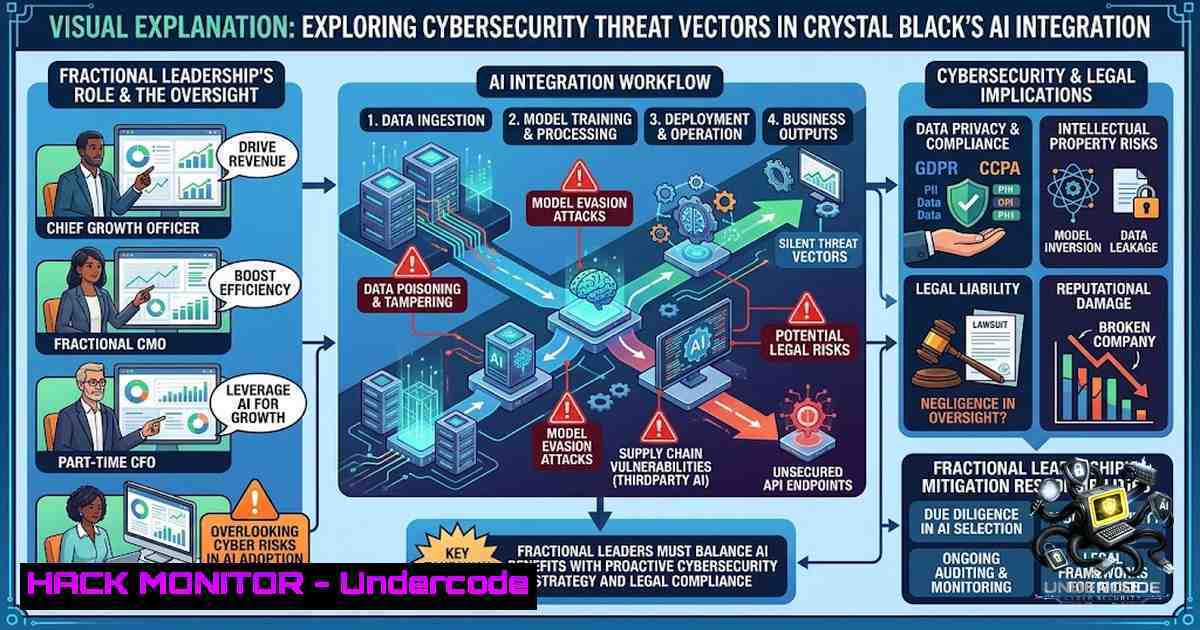
Introduction:
The convergence of Human Resources (HR) and Fractional leadership around Artificial Intelligence (AI) adoption, as seen in the upcoming “Fractional Meets HR” event, signals a critical shift in operational strategy. While these discussions focus on workforce optimization and strategic alignment, they often neglect the burgeoning attack surface introduced by AI tools. This article dissects the technical underpinnings of AI adoption in a fractional context, providing a cybersecurity-focused guide to securing the “human-AI” interface that these leaders are about to navigate.
Learning Objectives & Secrets:
- Objective 1: Mapping the AI Data Pipeline. Understand how AI tools ingest, process, and store sensitive HR and business data, identifying critical points of exposure.
- Objective 2 Secret Tips: Implement robust API key rotation and access policies using `jq` and `curl` to prevent automated credential scraping from AI platforms.
- Objective 3 Secret Tips: Harden your cloud storage (AWS S3, Azure Blob) by enforcing default encryption and disabling public ACLs using the `aws s3api` and `az storage` CLI commands before feeding data into any third-party AI service.
You Should Know:
1. The Threat Modeling for AI-Enabled Workforces
Before integrating AI into any operational workflow—especially in fractional roles where data is shared across multiple client environments—a formal threat model is essential. The primary concern is Data Poisoning and Prompt Injection. Attackers can manipulate training data or input prompts to alter AI outputs, leading to the exfiltration of sensitive HR data.
Step‑by‑step guide to model your AI threat landscape:
- Identify Assets: Map all data sources used by AI (e.g., employee records, financial projections).
- Identify Entry Points: Every API call to an AI model is an entry point.
- Mitigation: Use a Web Application Firewall (WAF) with AI-specific rule sets to filter suspicious input patterns.
2. Securing the API Gateway
The backbone of AI integration is the API. Whether you are using OpenAI, Anthropic, or local LLMs, the API keys and endpoints are prime targets. Fractional leaders must implement Zero-Trust principles for API access.
Step‑by‑step guide for API security:
- Generate a temporary API key (Linux/macOS):
openssl rand -base64 32
- Store it securely using a vault (e.g., HashiCorp Vault) rather than environment variables.
- Implement Rate Limiting (Linux):
iptables -A INPUT -p tcp --dport 443 -m limit --limit 10/minute -j ACCEPT
- Windows (PowerShell) – Monitor API traffic:
Get-1etTCPConnection -State Established | Where-Object {$_.LocalPort -eq 443}This command helps you monitor active connections to ensure no unauthorized API calls are being made.
3. Auditing AI Data Inputs with Linux Tools
To prevent sensitive data leakage, you must audit what is being sent to AI models. This is crucial when HR data is being used to generate strategy.
Step‑by‑step guide to audit text inputs:
- Create a regex pattern to detect PII (e.g., SSNs) in Linux:
grep -E -r '\b[0-9]{3}-[0-9]{2}-[0-9]{4}\b' /path/to/hr_data/ - Automate the sanitization process using `sed` to redact found patterns:
sed -i 's/[0-9]{3}-[0-9]{2}-[0-9]{4}/[bash]/g' /path/to/hr_data/file.txt
4. Configuring Cloud Hardening for AI Workloads
Given that AI models often run on cloud infrastructure, misconfigurations are the leading cause of data breaches. If you are leveraging AI to analyze HR data, ensure your cloud posture is hardened.
Step‑by‑step guide for AWS S3 Hardening:
- Ensure all buckets are private:
aws s3api get-bucket-acl --bucket YOUR_BUCKET_NAME
- Enable default encryption:
aws s3api put-bucket-encryption --bucket YOUR_BUCKET_NAME --server-side-encryption-configuration '{"Rules": [{"ApplyServerSideEncryptionByDefault": {"SSEAlgorithm": "AES256"}}]}' - Azure (Windows):
az storage blob update --account-1ame YOUR_ACCOUNT --container-1ame YOUR_CONTAINER --1ame YOUR_BLOB --public-access off
5. Exploitation & Mitigation: The SQL Injection Loop
While AI is new, the data driving it often sits in traditional SQL databases. A well-crafted SQL injection attack against a front-end used to query AI can lead to data extraction.
Step‑by‑step guide to test for SQLi vulnerabilities:
- Use `sqlmap` (Linux) to automate detection:
sqlmap -u "http://target.com/ai-query?id=1" --dbs --batch
- Mitigation: Implement Parameterized Queries. In Python, use:
import sqlite3
conn = sqlite3.connect("ai_database.db")
c = conn.cursor()
c.execute("SELECT  FROM users WHERE id=?", (user_id,))
6. Monitoring User Behavior and AI Access
Fractional leaders often lack continuous monitoring. Implementing Security Information and Event Management (SIEM) logs is non-1egotiable.
Step‑by‑step guide for log monitoring (Linux):
- Tail and filter for unusual API access:
tail -f /var/log/nginx/access.log | grep "POST /api/ai"
- Windows (Event Viewer):
Get-WinEvent -LogName Security | Where-Object { $_.Id -eq 4624 } Successful Logons
What Undercode Say:
- Key Takeaway 1: The “AI is rewriting how work gets done” narrative is a double-edged sword; while it optimizes strategy, it exponentially increases the blast radius of a single compromised API key.
- Key Takeaway 2: The disconnect between HR/Fractional strategy and cybersecurity is a critical gap that attackers will exploit. The “Fractional Meets HR” event is a perfect storm for human error—unless we implement automated guardrails.
Analysis:
The integration of AI in HR and operational strategy necessitates a shift from “passive adoption” to “active defense.” The tools used to generate efficiency (APIs, cloud storage) are the same tools that, if misconfigured, can be weaponized. Fractional leaders must embrace “Secure by Design” principles, treating every AI interaction as a potential data leak. The lack of technical depth in mainstream AI discussions leaves organizations vulnerable to zero-day exploits in the AI supply chain. If we are to trust AI with workforce data, we must first trust the infrastructure it runs on.
Prediction:
- +1 By 2027, we will see a significant surge in “AI Security Auditors” as a dedicated fractional role, bridging the gap between strategy and implementation.
- -1 The “human-AI” collaboration discussed at such events will inadvertently become the primary vector for Business Email Compromise (BEC) and social engineering attacks in the next 12 months.
- +1 Automated AI-driven security solutions will mature, enabling real-time governance for HR AI applications.
- -1 A major breach targeting a fractional leader’s client base via AI API exposure is almost inevitable within Q4 2026.
- -1 The “free drinks” and networking atmosphere will lead to relaxed security protocols, exposing organizational data via unsecured mobile devices and weak Wi-Fi protocols.
- +1 The tools highlighted (Vault, AWS CLI, sqlmap) will become standard requirements for any fractional leader auditing their tech stack.
- -1 Cloud misconfigurations related to AI storage will remain the 1 root cause of data leaks, outpacing internal malicious actors.
▶️ Related Video (70% Match):
🎯Let’s Practice For Free:
🎓 Live Courses & Certifications:
Join Undercode Academy for Verified Certifications
🚀 Request a Custom Project:
Secure, high-velocity infrastructure and disruptive technological engineering. Contact our engineering team for high-tier development and proprietary systems:
[email protected]
💎 Smart Architecture | 🛡️ Secure by Design | ⭐ Trusted by Thousands
IT/Security Reporter URL:
Reported By: https://lnkd.in/p/ekjiQEiX – Hackers Feeds
Extra Hub: Undercode MoN
Basic Verification: Pass ✅


