Listen to this Post
Introduction:
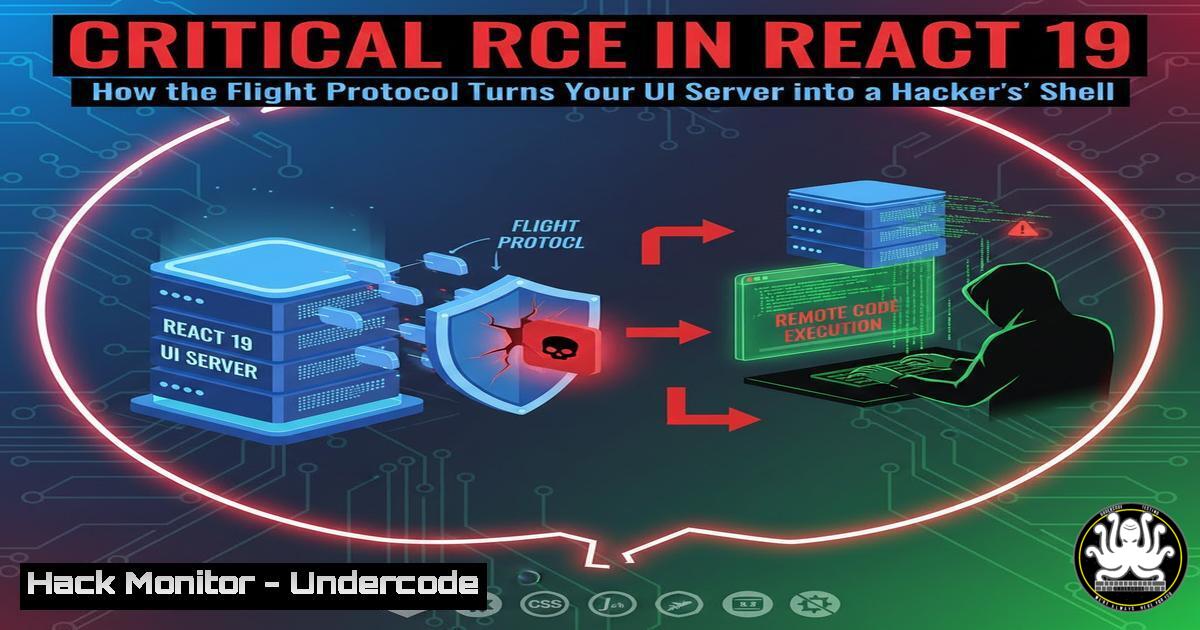
The paradigm of server-side rendering has taken a dangerous turn with the discovery of critical Remote Code Execution (RCE) vulnerabilities in React Server Components (CVE-2025-55182). This flaw in the React “Flight” protocol, which serializes data between client and server, allows attackers to transform a benign component state update into a full system compromise. As organizations rush to adopt React 19 and Next.js for performance benefits, they are inadvertently exposing new, complex attack surfaces that traditional web security models are ill-equipped to handle.
Learning Objectives:
- Understand the architectural flaw in React Server Components (RSC) and the Flight protocol that enables RCE.
- Implement effective detection strategies for malicious RSC payloads in both development and production environments.
- Apply immediate mitigations and hardening techniques for React-based applications.
You Should Know:
- The Architecture of the Flaw: RSC and the Flight Protocol
React Server Components (RSC) represent a shift where components can be rendered on the server, with their state and logic serialized and sent to the client. The “Flight” protocol is the binary transport mechanism that handles this serialization. The vulnerability exists because the deserialization process on the server can be manipulated to execute arbitrary code, effectively allowing a maliciously crafted Flight payload to breach the server boundary.
Step‑by‑step guide explaining what this does and how to use it.
The attack vector exploits how the server deserializes “server function” references and their arguments. An attacker intercepts or crafts a POST request to an RSC endpoint (/_next/rsc in Next.js, for example). By injecting a manipulated Flight wire format payload, they can trick the server into deserializing an object that, when processed, executes system commands.
Example malicious request structure:
POST /_next/rsc HTTP/1.1
Host: vulnerable-app.com
Content-Type: text/x-component
RSC: 1

[Malformed Flight payload containing serialized exploit code]
2. Detection: Network and Runtime Monitoring Signatures
Proactive detection is crucial. Security teams must monitor for anomalies in RSC traffic patterns and payload content.
Step‑by‑step guide explaining what this does and how to use it.
At the WAF/Network Level: Deploy custom rules to inspect RSC routes. Flag requests with high entropy in the payload (indicative of encoded exploit code) or those containing anomalous patterns that deviate from normal Flight serialization.
Example Sigma rule concept for detection:
title: High Entropy Payload to RSC Endpoint
logsource:
category: webserver
detection:
uri_path:
- '/_next/rsc'
- '/rsc'
request_body_entropy: high
condition: uri_path and request_body_entropy
Runtime Application Monitoring: Instrument your Node.js server to log and alert on sudden spikes in deserialization errors from the `react-server-dom-webpack` or `react-server-dom-` packages.
3. Immediate Mitigation: Patching and Configuration Hardening
The first and most critical step is to eliminate the vulnerability in your application’s foundation.
Step‑by‑step guide explaining what this does and how to use it.
1. Upgrade Dependencies: Immediately update all React-related packages.
 Using npm
npm update react@latest react-dom@latest next@latest react-server-dom-webpack@latest

Using yarn
yarn upgrade react react-dom next react-server-dom-webpack --latest
2. Validate Package Versions: Ensure no vulnerable versions are present.
npm list react react-dom react-server-dom-webpack next
 Look for versions patched for CVE-2025-55182
- Advanced Mitigation: WAF Rule Crafting for RSC Endpoints
A Web Application Firewall is a vital defensive layer to block exploit attempts before they reach your application server.
Step‑by‑step guide explaining what this does and how to use it.
Configure your WAF (e.g., AWS WAF, Cloudflare, ModSecurity) with a rule that scrutinizes requests to RSC endpoints. The rule should:
– Target: URI paths containing `/rsc` or _next/rsc.
– Inspect: The request body and headers (RSC, Content-Type: text/x-component).
– Block: Payloads containing known dangerous patterns (e.g., base64-encoded shell commands, abnormal serialization markers).
Example Cloudflare WAF rule expression concept:
(http.request.uri.path contains "/_next/rsc" or http.request.uri.path contains "/rsc")
and
not (
http.request.headers["content-type"] contains "text/x-component"
and
any(cf.waf.matches_expr("<PATTERN_DETECTING_VALID_RSC>"))
)
5. Exploitation Insight: Understanding the Attacker’s Playbook
To defend effectively, one must understand the attack. The exploit likely involves chaining improper input validation during the deserialization of React elements and their props.
Step‑by‑step guide explaining what this does and how to use it.
An attacker’s workflow:
- Reconnaissance: Identify the application as using Next.js/React 19+ (e.g., by checking for `/_next/static` files or specific headers).
2. Endpoint Discovery: Probe for active RSC endpoints.
- Payload Crafting: Use a modified version of the React Flight client library or a custom script to generate a malicious Flight payload that embeds a system command.
- Delivery: Send the payload via a forged HTTP request to the server endpoint.
- Execution: The server deserializes the payload, executing the embedded code in the server context, potentially yielding a reverse shell.
-
Hardening the Server: Principle of Least Privilege and Isolation
Assume breaches can happen; limit their impact by hardening the server environment where your React application runs.
Step‑by‑step guide explaining what this does and how to use it.
– Run as Non-Root: Never run your Node.js process as the root user.
 Create a dedicated user
sudo useradd -r -s /bin/false nodeapp
sudo chown -R nodeapp:nodeapp /path/to/your/app
 Use in your systemd service or process manager
User=nodeapp
Group=nodeapp
– Container Isolation: Run the application in a tightly configured container with minimal capabilities.
FROM node:20-alpine
RUN addgroup -g 1001 -S nodejs && adduser -S -u 1001 nodeapp -G nodejs
USER nodeapp
 ... copy app files
– System Call Filtering: Use seccomp profiles or AppArmor to restrict the Node.js process from executing critical system calls like `execve` or spawning shells.
- Proactive Defense: Integrating Security into the CI/CD Pipeline
Shift left by catching vulnerable code and dependencies before deployment.
Step‑by‑step guide explaining what this does and how to use it.
1. SAST/SCA Scanning: Use tools like Snyk, GitHub Advanced Security, or GitLab SAST to scan for vulnerable versions of React packages in your `package.json` and lock files.
 Example GitHub Action step
- name: Run Snyk to check for vulnerabilities
uses: snyk/actions/node@master
env:
SNYK_TOKEN: ${{ secrets.SNYK_TOKEN }}
2. Custom Security Testing: Create integration tests that send malformed RSC payloads to your development/staging endpoints and verify they are rejected or logged.
3. Dependency Lockdown: Use `npm audit –production` or `yarn audit` in your pipeline to fail builds on critical vulnerabilities.
What Undercode Say:
- The Threat is in the Transport: The most insidious vulnerabilities are not in your business logic, but in the underlying frameworks and protocols you trust to communicate it. This RCE proves that even meta-frameworks from major vendors introduce profound risks.
- Serialization is the New Injection: Deserialization of trusted data is a primary threat vector in modern applications, on par with SQL Injection in the past. Frameworks must be designed with security-first serialization, and developers must treat all serialized data from the client as potentially hostile.
Analysis: This vulnerability is a watershed moment for the React ecosystem and the “server components” model at large. It exposes a fundamental tension between developer experience (seamless client-server state management) and security (the immense danger of server-side deserialization). While the immediate fix is patching, the long-term lesson is that adopting any new rendering paradigm requires a parallel investment in understanding its security model. Security teams must now add “Flight protocol payloads” to their list of monitored attack vectors, alongside SQLi and XSS. The simplicity of the exploit, given the right payload, means automated scanners will soon incorporate this check, making unpatched applications low-hanging fruit for botnets and ransomware initial access brokers.
Prediction:
The discovery of CVE-2025-55182 will force a paradigm shift in how security researchers and attackers view modern JavaScript frameworks. We predict a surge in focused research on the security of serialization protocols in other meta-frameworks (like Vue’s Nuxt or SvelteKit). Within 12-18 months, standardized security controls for server-side rendering protocols will emerge, potentially becoming a required compliance checkpoint. Furthermore, this will accelerate the adoption of “zero-trust” principles within application architecture itself, moving beyond network perimeters to include strict runtime integrity checks for component rendering, making exploit chains significantly harder to execute.
🎯Let’s Practice For Free:
IT/Security Reporter URL:
Reported By: Lubin A – Hackers Feeds
Extra Hub: Undercode MoN
Basic Verification: Pass ✅


