Listen to this Post
Introduction:
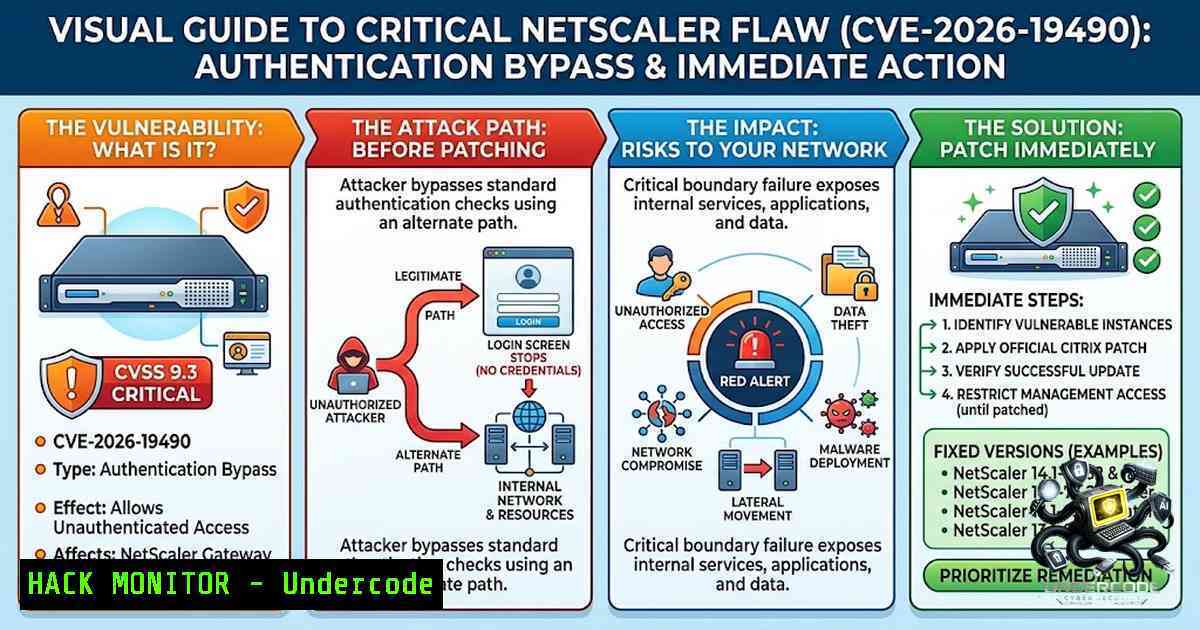
A critical authentication bypass vulnerability has been discovered in Citrix NetScaler ADC and NetScaler Gateway, tracked as CVE-2026-19490 with a CVSS v4.0 base score of 9.3 (Critical). The flaw, classified as CWE-288 (Authentication Bypass Using an Alternate Path or Channel), allows an unauthenticated remote attacker to circumvent authentication controls on affected appliances configured as Gateways (SSL VPN, ICA Proxy, CVPN, or RDP Proxy) or AAA virtual servers. Successful exploitation could grant unauthorized access to internal corporate resources that would normally be protected behind NetScaler’s authentication layer. While no active exploitation has been observed in the wild as of August 19, 2026, Citrix vulnerabilities historically attract rapid attacker attention—a separate NetScaler flaw (CVE-2026-8451) witnessed active exploitation attempts within 24 hours of public disclosure. Administrators must prioritize patching affected customer-managed NetScaler deployments immediately.
Learning Objectives & Secrets:
- Objective 1 — Identify Affected Deployments: Learn to determine whether your NetScaler ADC or Gateway appliance is vulnerable by checking firmware versions and configuration preconditions, including SAML action and virtual server settings.
-
Objective 2 — Upgrade to Patched Builds (Secret Tip): Apply the fixed releases—14.1-73.32, 13.1-63.21, or later—but before upgrading, snapshot your current configuration and test in a staging environment. Some organizations reported that newer builds (14.1-73.33) broke compatibility with older Secure Access Clients (e.g., 24.2.1.15). Plan for client-side validation post-upgrade.
-
Objective 3 — Leverage Global Deny Lists for Zero-Day Protection (Secret Tip): If your NetScaler firmware is 14.1-60.52 or later, or 13.1-63.16 or later, the Global Deny Lists feature is enabled by default. This feature consumes signature-based threat intelligence and automatically applies protections to managed appliances via NetScaler Console. Enable and monitor this capability as an additional defensive layer against future zero-day exploits.
You Should Know:
- Understanding the Vulnerability: CVE-2026-19490 — Authentication Bypass via Alternate Path
CVE-2026-19490 allows an attacker to bypass authentication checks through an alternate path rather than defeating the primary authentication mechanism directly. The attack vector is network-based, requires no authentication, no user interaction, and has low attack complexity. Exploitation can lead to unauthorized access to internal resources, with high impact on confidentiality, integrity, and availability.
Affected Versions:
| Product | Vulnerable Versions | Fixed Version |
||||
| NetScaler ADC / Gateway 14.1 | BEFORE 14.1-73.32 | 14.1-73.32 or later |
| NetScaler ADC / Gateway 13.1 | BEFORE 13.1-63.21 | 13.1-63.21 or later |
| NetScaler ADC FIPS 14.1 | BEFORE 14.1-73.32 FIPS | 14.1-73.32 FIPS or later |
| NetScaler ADC FIPS / NDcPP 13.1 | BEFORE 13.1-37.277 | 13.1-37.277 or later |
Exploitation Preconditions depend on the firmware build:
- 14.1-43.56 or later AND 13.1-61.28 or later: Vulnerability exploitable only when a SAML action is configured.
- 14.1-43.55 or earlier AND 13.1-61.27 or earlier: Vulnerability exploitable when any Gateway or AAA virtual server is configured (SAML not required).
- 13.1 FIPS: Applicable when configured with Gateway or AAA vserver (SAML not required).
> Step‑by‑Step Guide to Check Your Exposure:
>
- Check your NetScaler firmware version via CLI:
> “`
> show version
> “`
Or via GUI: Navigate to System → System Information.
- Check for SAML action configuration (determines if precondition applies on newer builds):
> “`
> show authentication samlAction
> “`
> Or search your configuration file for:
> “`
> add authentication samlAction.
> “`
- Check for Gateway or AAA virtual server configuration:
> “`
> show authentication vserver
> show vpn vserver
> “`
> Or search for:
> “`
> add authentication vserver .
> add vpn vserver .
> “`
- If both conditions match your version and configuration, your appliance is vulnerable and requires immediate patching.
- Secondary Threat: CVE-2026-19489 — Memory Overflow Leading to DoS
The second vulnerability, CVE-2026-19489 (CVSS score: 8.8), is a memory overflow flaw that may lead to unpredictable behavior or denial-of-service (DoS) conditions. Unlike CVE-2026-19490, this flaw does not bypass authentication; instead, it affects the availability and stability of vulnerable appliances.
Exploitation Precondition: SIP ALG (Session Initiation Protocol Application Layer Gateway) must be enabled on a Large Scale NAT (LSN) group configuration.
> Step‑by‑Step Guide to Check for CVE-2026-19489 Exposure:
>
- Check if SIP ALG is enabled on an LSN group by searching your NetScaler configuration for:
> “`
> add lsn group.sipalg.
> “`
- If the configuration string is present, your appliance is vulnerable to DoS exploitation.
Mitigation: If immediate patching is not possible, consider disabling SIP ALG on LSN groups where business requirements allow, or apply the fixed firmware version.
3. Patching Strategy and Upgrade Commands
Citrix has released fixed builds that address both vulnerabilities. Cloud Software Group has already patched its cloud-managed services and Adaptive Authentication offerings, so only customer-managed NetScaler deployments require action.
> Step‑by‑Step Upgrade Guide:
>
- Download the appropriate firmware from the Citrix download portal:
– NetScaler ADC/Gateway 14.1: Build 14.1-73.32 or later
– NetScaler ADC/Gateway 13.1: Build 13.1-63.21 or later
> – FIPS variants: Corresponding FIPS builds
>
> 2. Back up current configuration before proceeding:
> “`
> save config
> “`
Export the configuration file via System → Diagnostics → Export Configuration.
- Upload the new firmware to the appliance via System → Software Update or using SCP:
> “`
> scp build-14.1-73.32.tgz nsroot@:/var/nsinstall/
> “`
>
> 4. Install the firmware via CLI:
> “`
> install ns
> “`
> Or use the GUI wizard.
>
> 5. Reboot the appliance after installation:
> “`
> reboot
> “`
>
> 6. Verify the upgrade:
> “`
> show version
> “`
Confirm the build number matches the fixed release.
- Test client compatibility: Some organizations reported that Secure Access Clients (e.g., version 24.2.1.15) stopped working after upgrading to 14.1-73.33. Validate client connectivity post-upgrade.
4. Leveraging Global Deny Lists for Proactive Defense
NetScaler Console’s Global Deny Lists feature provides an additional layer of protection by automatically consuming signature-based threat intelligence and applying it to managed appliances.
Step‑by‑Step Guide to Enable and Monitor Global Deny Lists:
- Check if your firmware supports Global Deny Lists:
– Version must be 14.1-60.52 or later, or 13.1-63.16 or higher.
- Access NetScaler Console (Service or on-premises deployment).
Navigate to Security → Global Deny Lists.
Verify the feature is enabled (it is enabled by default on supported versions).
Monitor signature application: The feature automatically applies signatures to NetScaler appliances managed via NetScaler Console.
Review logs for any blocked requests that may indicate attempted exploitation attempts.
5. Post-Patch Monitoring and Incident Response
Given the critical, unauthenticated, network-exploitable nature of CVE-2026-19490, organizations should conduct thorough log reviews following patch deployment.
> Step‑by‑Step Monitoring Guide:
>
- Review authentication logs on internet-facing NetScaler Gateway and AAA virtual servers for anomalous access patterns:
> “`
> shell
> cat /var/log/ns.log | grep -i “authentication failed”
> cat /var/log/ns.log | grep -i “aaa”
> “`
>
- Check for Indicators of Compromise (IoC) using NetScaler Console’s built-in IoC detection capability.
Monitor for unexpected VPN sessions or unauthorized resource access.
Enable enhanced logging temporarily to capture detailed authentication events during the post-patch window.
What Undercode Say:
-
Key Takeaway 1 — Patch Now, Don’t Wait: CVE-2026-19490 carries a CVSS score of 9.3 and requires no authentication or user interaction to exploit. With Citrix vulnerabilities historically attracting rapid attacker attention—the recent CVE-2026-8451 saw exploitation within 24 hours of disclosure—delaying patching is not an option. Prioritize internet-facing Gateway and AAA virtual server appliances first.
-
Key Takeaway 2 — Understand Your Configuration Before Patching: The vulnerability’s exploitability depends on both firmware version AND configuration. Newer builds (14.1-43.56+ and 13.1-61.28+) require a SAML action to be present; earlier builds are vulnerable with any Gateway or AAA vserver configuration. Administrators must check both version and configuration—not just version alone—to accurately assess risk. Use the
show authentication samlAction,show authentication vserver, and `show vpn vserver` commands to verify exposure.
Analysis: This dual-vulnerability disclosure highlights a recurring pattern in enterprise infrastructure security: configuration-dependent flaws that require administrators to understand not just version numbers but also feature enablement and deployment architecture. The SAML precondition on newer builds may create a false sense of security for organizations running updated firmware but still using SAML-based authentication—these remain vulnerable. Additionally, the Global Deny Lists feature represents a positive shift toward proactive, signature-based protection, but it is only available on newer firmware versions, creating a “patch gap” for older deployments. Organizations should treat this incident as a reminder to inventory all NetScaler appliances, document authentication configurations, and establish a rapid-response patching cadence for critical CVEs.
Prediction:
- -1 Attackers will likely develop and release proof-of-concept exploits for CVE-2026-19490 within 7–14 days of public disclosure, given the low attack complexity and high impact. Organizations that fail to patch within this window face elevated risk of opportunistic exploitation.
-
-1 The SAML configuration precondition on newer builds may be misinterpreted by some administrators as a “safe harbor,” leading to delayed patching. This creates a window of exposure for SAML-enabled Gateway deployments that remain unpatched.
-
+1 The Global Deny Lists feature, if widely adopted, could become a standard defense-in-depth mechanism for NetScaler environments, reducing the urgency gap between vulnerability disclosure and patch availability for future CVEs.
-
-1 Client compatibility issues observed with newer builds (e.g., Secure Access Client breakage) may cause some organizations to delay upgrades, increasing their exposure window. Thorough staging and client validation are essential to avoid operational disruptions.
-
+1 Citrix’s proactive disclosure and clear version-specific guidance (including configuration check strings) enable security teams to rapidly triage and remediate—a positive example of vendor transparency in vulnerability management.
-
-1 The memory overflow flaw (CVE-2026-19489) may be leveraged in conjunction with the authentication bypass to chain exploits, potentially enabling both unauthorized access and service disruption in targeted attacks.
-
+1 Organizations that leverage NetScaler Console’s IoC detection and Global Deny Lists will gain early-warning visibility into potential exploitation attempts, improving their incident response posture.
-
-1 The historical pattern of rapid exploitation of Citrix NetScaler vulnerabilities (e.g., CVE-2026-8451) suggests that CVE-2026-19490 will attract significant attacker attention, especially from ransomware groups targeting VPN appliances as initial access vectors.
-
+1 The vulnerability does not affect Citrix-managed cloud services or Adaptive Authentication, reducing the overall attack surface for organizations that have migrated to Citrix’s cloud offerings.
-
-1 For organizations running end-of-life NetScaler versions that are not eligible for security updates, this vulnerability represents a critical risk with no available patch—migration to supported versions is urgently required.
▶️ Related Video (78% Match):
https://www.youtube.com/watch?v=4BJ6JONIGzU
🎯Let’s Practice For Free:
🎓 Live Courses & Certifications:
Join Undercode Academy for Verified Certifications
🚀 Request a Custom Project:
Secure, high-velocity infrastructure and disruptive technological engineering. Contact our engineering team for high-tier development and proprietary systems:
[email protected]
💎 Smart Architecture | 🛡️ Secure by Design | ⭐ Trusted by Thousands
IT/Security Reporter URL:
Reported By: https://lnkd.in/p/eu4gUN9B – Hackers Feeds
Extra Hub: Undercode MoN
Basic Verification: Pass ✅


