Listen to this Post
Introduction
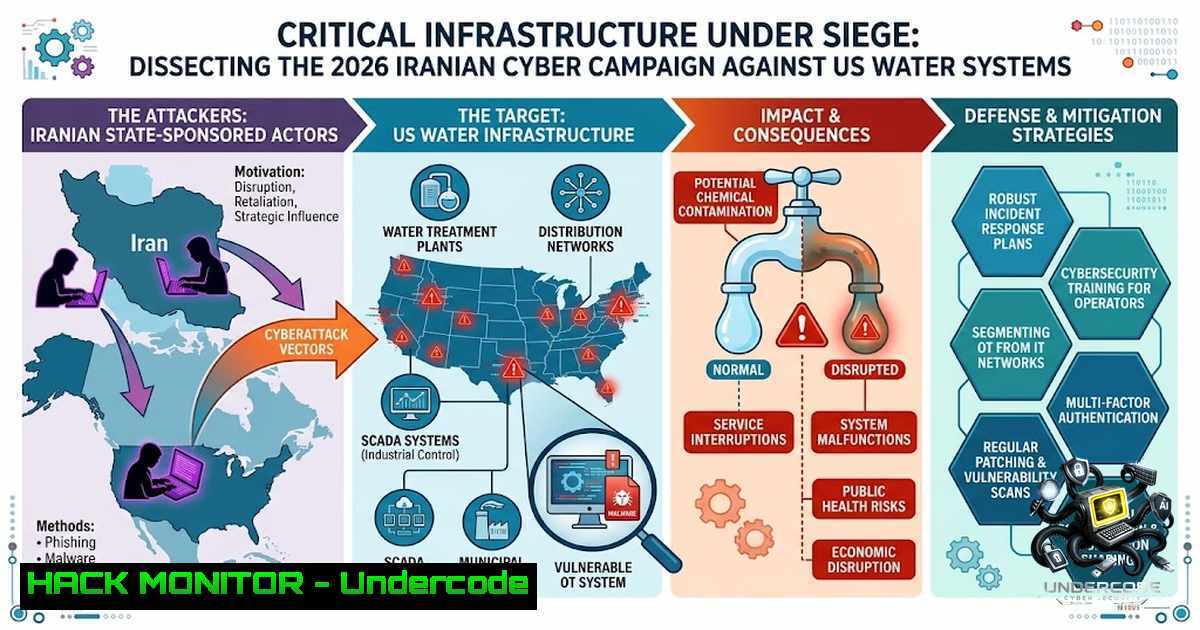
Since the summer of 2026, a coordinated wave of cyberattacks has targeted water and wastewater facilities across at least a dozen U.S. states, with federal agencies—including the FBI, CISA, NSA, and EPA—pointing to Iranian state-sponsored threat actors as the likely culprits. The attackers have systematically exploited internet-facing programmable logic controllers (PLCs), primarily Rockwell Automation/Allen-Bradley MicroLogix 1100 and 1400 series devices, to remotely alter configurations, change IP addresses, and reset passwords—effectively blinding operators to the status of their own equipment. This campaign represents a dangerous escalation in the weaponization of cyberspace against civilian infrastructure, demonstrating that geopolitical conflicts now manifest through direct, disruptive attacks on the systems that deliver clean water to millions of Americans.
Learning Objectives
- Understand the technical mechanics of the 2026 Iranian cyber campaign against U.S. water systems, including the exploitation of internet-exposed PLCs and SCADA environments.
- Master practical hardening techniques for ICS/SCADA environments across Linux and Windows platforms, including firewall configurations, access controls, and network segmentation.
- Develop an actionable incident response framework for water utilities and critical infrastructure operators, incorporating CISA-recommended mitigations and Zero Trust principles.
You Should Know
- The PLC Exploitation Chain: How Attackers Gain Control
The 2026 attacks did not rely on zero-day exploits. Instead, attackers leveraged a combination of poor security hygiene and architectural oversights that have plagued industrial control systems for decades. The attack chain typically unfolds as follows:
Step 1: Reconnaissance – Threat actors use internet scanning tools such as Shodan, Censys, or custom Nmap scripts to identify internet-facing PLCs and human-machine interfaces (HMIs). In one assessment, researchers found live process graphics from water treatment plants—including tank levels, chlorine pump status, and active alarms—accessible to anyone with a web browser.
Step 2: Initial Access – Attackers gain entry using default or weak credentials. Many water utilities never changed factory-default passwords on their PLCs and HMIs, providing an open door. In some cases, attackers also exploited exposed remote access tools like TeamViewer, using credentials obtained from former employees.
Step 3: Configuration Manipulation – Once inside, attackers modify device configurations, including changing IP addresses, setting new passwords, and altering operational parameters. This results in loss of visibility and control over connected equipment, with reported impacts including reduced water pressure and flooding.
Step 4: Persistence and Lateral Movement – Attackers establish backdoors and move laterally across OT networks, seeking to compromise additional controllers and expand their foothold.
Step 5: Operational Disruption – The final stage involves executing commands that disrupt water treatment processes, potentially leading to untreated groundwater infiltration, pump failures, or deliberate contamination.
Verified Reconnaissance Commands (Linux):
 Scan for exposed Modbus/TCP (port 502) devices
nmap -p 502 --script modbus-discover 192.168.1.0/24

Identify SMB services on OT networks (often misconfigured)
nmap -p 445 --script smb-os-discovery 192.168.1.0/24

Scan for common SCADA/ICS ports
nmap -p 502,102,44818,2222,4840,47808,9600 192.168.1.0/24
Verified Reconnaissance Commands (Windows – PowerShell):
 Test-1etConnection for common OT ports
Test-1etConnection -Port 502 192.168.1.10
Test-1etConnection -Port 44818 192.168.1.10

Basic network scan using PowerShell (requires admin)
1..254 | ForEach-Object { Test-Connection -ComputerName "192.168.1.$_" -Count 1 -Quiet }
What This Does: These commands identify exposed industrial devices on your network. The Nmap script `modbus-discover` queries Modbus/TCP devices for basic information, while SMB discovery helps identify Windows-based SCADA hosts that may be vulnerable to credential-based attacks. Regular scanning of your OT network perimeter is essential for identifying unauthorized exposures before attackers do.
2. Hardening Internet-Facing PLCs and HMIs
CISA has issued urgent guidance urging water utilities to immediately disconnect PLCs from the public internet and implement layered defenses. The following step-by-step hardening approach addresses the specific attack vectors observed in the 2026 campaign:
Step 1: Remove Direct Internet Exposure – All PLCs and HMIs must be disconnected from direct internet access. Remote access should be routed exclusively through a VPN or secure gateway device. This single measure would have prevented the majority of the 2026 attacks.
Step 2: Enforce Strong Password Policies – Replace all default passwords with strong, unique credentials. Implement password complexity requirements and regular rotation schedules.
Step 3: Implement IP Allowlisting – Restrict remote access to only known engineering workstations and critical OT assets using IP allowlists.
Step 4: Deploy Network Segmentation – Isolate OT networks from IT networks and the internet using firewalls and network access control lists (ACLs). Implement Zero Trust principles by eliminating implicit trust and continuously validating access.
Step 5: Enable Multi-Factor Authentication (MFA) – Require MFA for all remote access to OT systems.
Verified Firewall Hardening Commands (Linux – iptables):
 Block all Modbus/TCP traffic (port 502) except from authorized engineering subnet
sudo iptables -A INPUT -p tcp --dport 502 -s 192.168.10.0/24 -j ACCEPT
sudo iptables -A INPUT -p tcp --dport 502 -j DROP

Block SMB (port 445) to prevent lateral movement from OT to IT
sudo iptables -A INPUT -p tcp --dport 445 -j DROP

Block EtherNet/IP (port 44818) except from authorized sources
sudo iptables -A INPUT -p tcp --dport 44818 -s 192.168.10.0/24 -j ACCEPT
sudo iptables -A INPUT -p tcp --dport 44818 -j DROP

Save iptables rules persistently
sudo iptables-save > /etc/iptables/rules.v4
Verified Firewall Hardening Commands (Windows – netsh/ PowerShell):
 Block SMB port 445 (inbound)
netsh advfirewall firewall add rule name="Block SMB OT" dir=in action=block protocol=TCP localport=445

Block Modbus/TCP port 502 (inbound)
netsh advfirewall firewall add rule name="Block Modbus OT" dir=in action=block protocol=TCP localport=502

Allow only specific IPs for RDP access to SCADA hosts
netsh advfirewall firewall add rule name="Allow RDP from Engineering" dir=in action=allow protocol=TCP localport=3389 remoteip=192.168.10.0/24
 PowerShell alternative: Disable LLMNR and NetBIOS to prevent responder attacks
Set-ItemProperty -Path "HKLM:\Software\Policies\Microsoft\Windows NT\DNSClient" -1ame "EnableMulticast" -Value 0

Require SMB signing to prevent man-in-the-middle attacks
Set-ItemProperty -Path "HKLM:\SYSTEM\CurrentControlSet\Services\LanmanServer\Parameters" -1ame "RequireSecuritySignature" -Value 1
What This Does: These firewall rules restrict access to critical OT protocols (Modbus/TCP on port 502, EtherNet/IP on 44818, and SMB on 445) to only authorized engineering subnets. The Windows PowerShell commands disable legacy protocols that attackers frequently abuse for credential harvesting and man-in-the-middle attacks. Implementing these controls significantly reduces the attack surface available to threat actors scanning for internet-exposed industrial devices.
3. Securing Remote Access Architectures
The 2026 attacks highlighted the dangers of allowing direct remote access to OT systems. Utilities must transition to secure remote access architectures that separate management from operational functions.
Step 1: Deploy a Jump Host / Bastion Host – All remote access should terminate on a hardened jump host in a demilitarized zone (DMZ), which then proxies connections to OT systems.
Step 2: Implement VPN with MFA – Require all remote users to authenticate via VPN with MFA before reaching the jump host.
Step 3: Apply Principle of Least Privilege – Restrict remote users to only the specific systems and functions required for their role.
Step 4: Enable Comprehensive Logging – Log all remote access attempts, including successful and failed authentications, and forward logs to a SIEM for analysis.
Step 5: Conduct Regular Access Reviews – Audit remote access accounts quarterly and revoke access for terminated employees immediately.
Verified SSH Hardening (Linux Jump Host):
 Edit /etc/ssh/sshd_config
 Disable root login
PermitRootLogin no

Use key-based authentication only
PasswordAuthentication no
PubkeyAuthentication yes

Limit SSH access to specific users
AllowUsers engineer1 engineer2 admin

Change default SSH port (optional, but reduces scan noise)
Port 2222

Restart SSH service
sudo systemctl restart sshd
Verified RDP Hardening (Windows):
 Disable RDP for non-admin users (Group Policy alternative)
Set-ItemProperty -Path "HKLM:\SYSTEM\CurrentControlSet\Control\Terminal Server" -1ame "fDenyTSConnections" -Value 0

Set RDP encryption level to High
Set-ItemProperty -Path "HKLM:\SYSTEM\CurrentControlSet\Control\Terminal Server\WinStations\RDP-Tcp" -1ame "MinEncryptionLevel" -Value 3

Restrict RDP access to specific security groups (using local policy)
 Add "Remote Desktop Users" group and limit membership
What This Does: These configurations harden remote access points—the most common entry vectors for attackers. Disabling password authentication for SSH eliminates brute-force attack vectors, while RDP encryption settings ensure that session data cannot be easily intercepted or decrypted. The jump host architecture creates an additional layer of defense between the internet and your critical OT assets.
4. Monitoring, Detection, and Incident Response
Given that adversaries may already be inside OT networks, utilities must implement continuous monitoring and maintain tested incident response capabilities.
Step 1: Deploy OT-Specific Monitoring – Implement network monitoring tools that understand industrial protocols (Modbus, DNP3, EtherNet/IP, etc.) and can detect anomalous command sequences.
Step 2: Establish Baselines – Document normal operational behavior, including typical pump cycles, pressure ranges, and communication patterns, to identify deviations.
Step 3: Implement Log Aggregation – Centralize logs from PLCs, HMIs, firewalls, and authentication systems.
Step 4: Conduct Regular Tabletop Exercises – Simulate cyberattacks on water systems to test response procedures and identify gaps.
Step 5: Maintain Offline Backups – Ensure backups of critical system configurations and data are stored offline and tested regularly.
Verified Log Monitoring Commands (Linux):
 Monitor SSH authentication logs in real-time
sudo tail -f /var/log/auth.log | grep -E "Failed|Accepted"

Check for unusual outbound connections from OT network
sudo tcpdump -i eth0 -1 'dst net not 192.168.0.0/16' -c 100

Audit su/sudo usage
sudo grep -E "sudo|su" /var/log/auth.log
Verified Log Monitoring Commands (Windows – PowerShell):
 Query Security Event Log for failed logons (Event ID 4625)
Get-WinEvent -FilterHashtable @{LogName='Security'; ID=4625} -MaxEvents 50 | Format-List

Query for successful logons outside business hours
Get-WinEvent -FilterHashtable @{LogName='Security'; ID=4624} | Where-Object { $<em>.TimeCreated.Hour -lt 6 -or $</em>.TimeCreated.Hour -gt 18 }

Check for service installation events (potential persistence)
Get-WinEvent -FilterHashtable @{LogName='System'; ID=7045} -MaxEvents 20
What This Does: These monitoring commands help detect unauthorized access attempts, anomalous network traffic, and potential persistence mechanisms. The Linux `tcpdump` command alerts you to unexpected outbound connections—a common indicator of compromise. The Windows Event Log queries can reveal brute-force attempts (failed logons) and attacker footholds (service installations). Continuous monitoring is the cornerstone of early detection and rapid response.
- Leveraging CISA and EPA Guidance and Assessment Tools
Multiple federal resources are available to help water utilities assess and improve their cybersecurity posture at no cost.
Step 1: Conduct a Cybersecurity Vulnerability Assessment (CVA) – Use EPA’s Water Cybersecurity Assessment Tool (WCAT), a free self-assessment tool designed specifically for water utilities.
Step 2: Implement CISA’s Cybersecurity Performance Goals (CPG 2.0) – These core security practices provide a baseline for critical infrastructure protection.
Step 3: Adopt NIST Special Publication 1800-45 – This NIST NCCoE publication provides practical architecture guidance for secure remote access in water and wastewater systems.
Step 4: Join Threat Intelligence Sharing Networks – Participate in organizations like WaterISAC to receive sector-specific threat intelligence.
Step 5: Build Relationships with Federal and State Agencies – Establish contacts with CISA, EPA, and state-level cybersecurity authorities before an incident occurs.
Key Resources:
- EPA Water Cybersecurity Assessment Tool (WCAT): Free self-assessment for all utilities
- CISA Cyber Security Evaluation Tool (CSET): Comprehensive assessment framework
- AWWA Cybersecurity Risk Management Tool: Sector-specific risk management
- NIST SP 800-82: Guide to Industrial Control Systems Security
- ISA/IEC 62443: International standard for industrial automation and control systems security
What This Does: These tools and frameworks provide structured approaches to identifying vulnerabilities, prioritizing remediation, and building a sustainable cybersecurity program. The EPA’s WCAT, for example, guides utilities through a step-by-step assessment of their OT environments, identifying specific gaps that attackers could exploit. Regular use of these tools transforms cybersecurity from an ad-hoc activity into a systematic, measurable process.
What Undercode Say
- The oceans do not protect us from unjust wars anymore. The 2026 cyberattacks on U.S. water systems prove that geopolitical conflict now transcends physical borders. A nation-state can disrupt civilian infrastructure thousands of miles away without firing a single shot, and the attackers are leveraging the most basic security failures—default passwords, internet-exposed PLCs, and inadequate network segmentation. This is not a failure of advanced technology; it is a failure of fundamental security hygiene. The attackers didn’t need zero-day exploits because the doors were already wide open.
-
Wag the dog war to protect billionaires and their “SPECIAL FRIENDS.” While the immediate cause of these attacks appears to be geopolitical retaliation, the underlying vulnerability is a systemic failure to prioritize critical infrastructure security. For decades, water utilities have operated on thin margins, with little regulatory pressure to invest in cybersecurity. The result is a patchwork of aging, insecure systems that are increasingly connected to the internet without adequate protection. This is not a technical problem—it is a governance and prioritization problem that requires urgent attention from policymakers, regulators, and utility leadership.
-
Failed leadership. The 2026 attacks are a stark reminder that cybersecurity for critical infrastructure cannot be an afterthought. With over 152,000 public drinking water systems and more than 16,000 wastewater treatment facilities across the U.S., the attack surface is vast and largely unprotected. The attackers targeted smaller, less-resourced utilities precisely because they are easier to compromise. Federal agencies have issued guidance, but guidance without enforcement and resources is merely advice. The question is not whether another attack will occur, but when—and what the consequences will be.
The 2026 Iranian cyber campaign against U.S. water systems represents a watershed moment in critical infrastructure security. It demonstrates that nation-state adversaries are willing and able to disrupt the daily lives of civilians through cyber means, and that the technical barriers to such attacks are shockingly low. The attackers exploited internet-exposed PLCs with default passwords—a vulnerability that should have been eliminated decades ago. The response must be equally fundamental: disconnect OT systems from the internet, enforce strong authentication, segment networks, monitor continuously, and treat cybersecurity as an operational necessity rather than an optional expense. The water sector can no longer afford to wait for the next attack to take action.
Prediction
- -1 The 2026 attacks will likely accelerate as geopolitical tensions escalate, with threat actors expanding their targets to include additional critical infrastructure sectors such as energy, transportation, and healthcare. The low barrier to entry—exploiting default credentials and exposed devices—means that even less sophisticated adversaries can replicate these tactics.
-
-1 Smaller water utilities, which lack the resources for comprehensive cybersecurity programs, will remain the most vulnerable targets. Without federal funding and regulatory mandates, these facilities will continue to operate with significant security gaps, inviting further exploitation.
-
+1 The attacks will serve as a catalyst for legislative action, potentially leading to mandatory cybersecurity standards for water utilities and increased federal funding for infrastructure hardening. This could finally address the systemic underinvestment that has left critical infrastructure exposed for decades.
-
+1 The adoption of Zero Trust architectures in OT environments will accelerate, driven by CISA guidance and industry best practices. Utilities that embrace network segmentation, continuous validation, and least-privilege access will be better positioned to withstand future attacks.
-
-1 The rise of AI-powered attack tools will lower the skill barrier further, enabling adversaries to automate reconnaissance, exploit discovery, and attack execution at scale. Water utilities must prepare for a future where the speed and sophistication of attacks outpace traditional defense mechanisms.
-
+1 The 2026 campaign will drive innovation in OT security, including the development of low-cost assessment platforms like Red-Pi and digital twin-based intrusion detection systems. These technologies will make security more accessible to resource-constrained utilities.
▶️ Related Video (80% Match):
https://www.youtube.com/watch?v=0hNbPyZV5Lc
🎯Let’s Practice For Free:
🎓 Live Courses & Certifications:
Join Undercode Academy for Verified Certifications
🚀 Request a Custom Project:
Secure, high-velocity infrastructure and disruptive technological engineering. Contact our engineering team for high-tier development and proprietary systems:
[email protected]
💎 Smart Architecture | 🛡️ Secure by Design | ⭐ Trusted by Thousands
IT/Security Reporter URL:
Reported By: https://lnkd.in/p/dr9N9K9d – Hackers Feeds
Extra Hub: Undercode MoN
Basic Verification: Pass ✅


