Listen to this Post
Introduction:
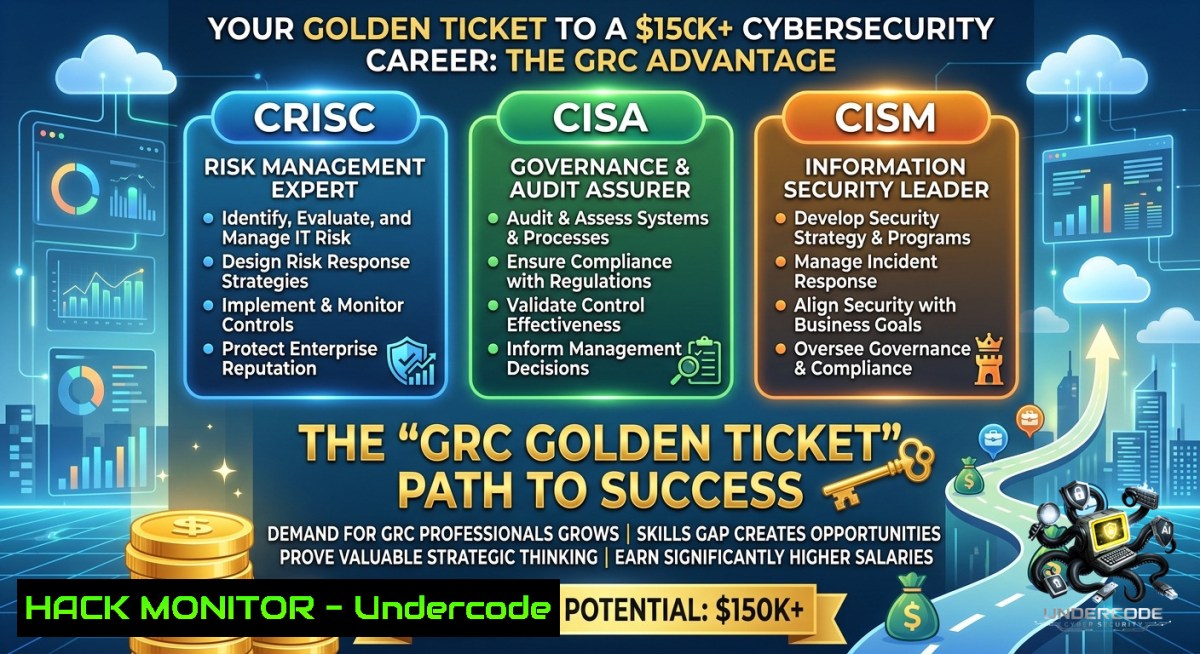
Governance, Risk, and Compliance (GRC) is no longer a back-office function—it is the strategic backbone of modern cybersecurity, ensuring that organizations balance regulatory mandates with business resilience. As data privacy laws tighten and cyber-risks evolve, professionals armed with certifications like CRISC, CISA, CISM, CGRC, and ISO 27001 lead the charge in auditing, risk mitigation, and governance frameworks.
Learning Objectives:
– Understand the core differences between CRISC, CISA, CISM, CGRC, and ISO 27001 Lead Implementer/Auditor certifications.
– Acquire hands-on technical skills to implement GRC controls using Linux/Windows commands and compliance automation tools.
– Learn step-by-step methods to conduct risk assessments, audit information systems, and harden cloud environments against regulatory violations.
You Should Know:
1. Mastering CRISC – Enterprise Risk Assessment with Command-Line Auditing
CRISC focuses on identifying and managing IT risks. To operationalize risk assessments, you must gather system vulnerabilities and asset inventories.
Step‑by‑step guide (Linux – vulnerability & asset enumeration):
 Scan for open ports and services (risk exposure identification)
sudo nmap -sV -p- 192.168.1.0/24 -oA network_risk_scan

 Extract installed packages for vulnerability correlation (CVE mapping)
rpm -qa --last > installed_packages_linux.txt  RHEL/CentOS
dpkg-query -l > installed_packages_debian.txt  Debian/Ubuntu

 Check for World-writable files and misconfigured permissions (risk of data leakage)
find / -type f -perm -0002 -ls 2>/dev/null > world_writable_files.log
Windows (PowerShell) – Asset risk inventory:
 List all installed software for risk-based patch management
Get-WmiObject -Class Win32_Product | Select-Object Name, Version, Vendor | Export-Csv -Path software_inventory.csv

 Check for disabled security controls (high risk)
Get-MpPreference | Select-Object DisableRealtimeMonitoring, DisableBehaviorMonitoring
2. CISA in Action – Auditing Information Systems Using Native Tools
CISA is the gold standard for IS auditing. Simulate an auditor’s checklist by reviewing logs, user entitlements, and system changes.
Step‑by‑step audit using Linux `auditd`:
 Install auditd if missing
sudo apt install auditd -y  Debian/Ubuntu
sudo yum install audit -y  RHEL/CentOS

 Watch critical files for unauthorized changes (e.g., /etc/passwd, /etc/shadow)
sudo auditctl -w /etc/passwd -p wa -k passwd_changes
sudo auditctl -w /etc/ssh/sshd_config -p wa -k sshd_changes

 Generate audit report
sudo aureport --summary --failed
sudo ausearch -k passwd_changes --format raw > audit_log_export.txt
Windows – Audit policy configuration (requires admin):
 Enable detailed audit policies for login events and privilege use
auditpol /set /category:"Logon/Logoff" /subcategory:"Logon" /success:enable /failure:enable
auditpol /set /category:"Privilege Use" /subcategory:"Sensitive Privilege Use" /success:enable /failure:enable

 Review security event log for failed logins (Event ID 4625)
Get-WinEvent -FilterHashtable @{LogName='Security'; ID=4625} | Format-List TimeCreated, Message
3. CISM Governance – Implementing ISO 27001 Annex A Controls via Scripts
CISM emphasizes information security governance. A practical step is automating Annex A control checks (e.g., A.9 Access Control, A.12 Operations Security).
Linux script to verify password policies (Annex A.9.4.3):
!/bin/bash
 Check password max age and complexity
echo "Password max days: $(grep ^PASS_MAX_DAYS /etc/login.defs | awk '{print $2}')"
echo "SHA512 password hashing: $(grep 'ENCRYPT_METHOD SHA512' /etc/login.defs)"
 List users with empty passwords (non-compliant)
awk -F: '($2 == "") {print $1}' /etc/shadow
Windows – Enforce NIST-compliant password policy (PowerShell):
secedit /export /cfg secpol.inf  Export current policy
 Modify secpol.inf: PasswordComplexity=1, MinimumPasswordLength=12
secedit /configure /db secpol.sdb /cfg secpol.inf /overwrite
secedit /refreshpolicy machine_policy /enforce
4. CGRC & Compliance Automation – Using OpenSCAP for Regulatory Scans
CGRC focuses on regulatory requirements (HIPAA, PCI-DSS, GDPR). OpenSCAP automates compliance checks against SCAP security guides.
Step‑by‑step (Linux – RHEL/CentOS/Ubuntu):
 Install OpenSCAP
sudo apt install libopenscap8 scap-security-guide -y  Ubuntu
sudo yum install openscap-scanner scap-security-guide -y  RHEL

 List available profiles (e.g., PCI-DSS, CIS, STIG)
oscap info /usr/share/xml/scap/ssg/content/ssg-ubuntu2204-ds.xml

 Run a scan against CIS profile and generate HTML report
sudo oscap xccdf eval --profile xccdf_org.ssgproject.content_profile_cis --report compliance_report.html /usr/share/xml/scap/ssg/content/ssg-ubuntu2204-ds.xml
Cloud hardening (AWS – using AWS Config for compliance):
 Enable AWS Config recorder (CLI)
aws configservice put-configuration-recorder --configuration-recorder name=default,roleARN=arn:aws:iam::123456789012:role/config-role --recording-group allSupported=true
 Check S3 bucket public access compliance
aws s3api get-public-access-block --bucket your-bucket-1ame
5. ISO 27001 Lead Implementer – Building an ISMS with GRC Tools (Eramba / SimpleRisk)
Implement an Information Security Management System (ISMS) using open-source GRC platforms.
Step‑by‑step deploy Eramba (Linux – Docker):
 Install Docker & Docker-Compose
sudo apt install docker.io docker-compose -y
 Clone Eramba community edition
git clone https://github.com/eramba/eramba-docker.git
cd eramba-docker
 Edit docker-compose.yml to set strong database passwords
nano docker-compose.yml
 Deploy ISMS environment
sudo docker-compose up -d
Post‑deployment tasks:
– Define scope: Asset inventory (using previously generated CSV).
– Create risk register: Enter findings from `audit.log` and OpenSCAP report.
– Map controls: Annex A controls to technical scans (e.g., A.12.6.1 – information leak via world-writable files).
6. API Security for GRC – Automating Compliance Checks with Python
Modern GRC requires continuous monitoring of APIs (GDPR 32 – security of processing). Use Python to test API authentication and data exposure.
Python script to validate JWT expiry and scope:
import requests
import jwt

 Test OAuth2 endpoint for insecure direct object reference (IDOR)
api_url = "https://api.example.com/v1/user/12345"
headers = {"Authorization": "Bearer <your_JWT>"}
response = requests.get(api_url, headers=headers)
if response.status_code == 200 and "ssn" in response.text:
print("-1: PII leakage detected – non-compliant with GDPR/CCPA")

 Decode JWT without verification (to check algorithm confusion)
decoded = jwt.decode(response.headers.get('X-Token'), options={"verify_signature": False})
print(f"Token claims: {decoded} - check 'exp' for expiry compliance")
7. Windows Group Policy for Compliance Automation (CISM/CISA domain)
Automate security baseline enforcement using Group Policy Objects (GPO) to meet CISA audit requirements.
Step‑by‑step via PowerShell (Domain Controller):
 Create a GPO for CIS Level 1 benchmark
New-GPO -1ame "CIS_Baseline" | New-GPLink -Target "OU=Workstations,DC=domain,DC=com"

 Set audit policy for success/failure logons
Set-GPRegistryValue -1ame "CIS_Baseline" -Key "HKLM\SOFTWARE\Policies\Microsoft\Windows\EventLog\Security" -ValueName "MaxSize" -Type DWord -Value 20971520
Set-GPRegistryValue -1ame "CIS_Baseline" -Key "HKLM\System\CurrentControlSet\Control\Lsa" -ValueName "LimitBlankPasswordUse" -Type DWord -Value 1

 Force policy update on all client workstations
Invoke-GPUpdate -All -Force
What Undercode Say:
– GRC certifications are not just resume badges; they translate directly to technical audits, risk quantification, and regulatory defense.
– The highest ROI comes from pairing certification theory (CRISC risk registers, CISA audit checklists) with practical command-line and API-based compliance automation.
Analysis (approx. 10 lines):
The post correctly identifies CRISC, CISA, CISM, CGRC, and ISO 27001 as top-tier credentials. However, many professionals study these but fail to operationalize them. Real-world GRC requires bridging frameworks to technical execution—e.g., using `auditd` for CISA log reviews, OpenSCAP for ISO 27001 Annex A compliance, and Python scripts for API security testing (GDPR). The commands provided above transform passive certification knowledge into active risk mitigation. Without hands-on skills, GRC remains theoretical. Organizations increasingly demand “GRC engineers” who can write remediation scripts, interpret vulnerability scans, and automate evidence collection. Future GRC leaders will merge compliance expertise with DevSecOps toolchains (Terraform, OPA, Kyverno). The greatest career impact comes from CISM (governance) plus cloud audit skills, not just multiple certs.
Expected Output:
Introduction:
Governance, Risk, and Compliance (GRC) practitioners who rely solely on PowerPoint audits are becoming obsolete; regulators now expect continuous, automated evidence of security controls. The certifications listed—CRISC, CISA, CISM, CGRC, and ISO 27001—are essential, but they must be paired with technical scripts, system hardening commands, and compliance-as-code workflows to drive organizational resilience.
What Undercode Say:
– Earning a GRC certification is a force multiplier when you can demonstrate an automated vulnerability remediation pipeline using tools like OpenSCAP or AWS Config.
– The shift toward “GRC automation” means professionals who master both frameworks (NIST, ISO) and scripting (Bash, PowerShell, Python) will command salaries 30% higher than pure policy writers.
Prediction:
+1 By 2028, 70% of mid-sized enterprises will require GRC professionals to possess at least one cloud security certification (CCSP, AWS Security Specialty) alongside CRISC/CISA.
+1 The integration of AI-driven risk scoring (e.g., using large language models to parse audit logs) will create a new “AI GRC Analyst” role, blending CISM principles with prompt engineering.
-1 Traditional manual compliance audits will drop in demand by 40% as real-time attestation platforms (e.g., Tugboat Logic, Drata) replace annual certifications.
-1 Failure to adopt infrastructure-as-code scanning (e.g., Checkov, Terrascan) may render CGRC-certified professionals irrelevant for DevOps-heavy organizations.
🎯Let’s Practice For Free:
🎓 Live Courses & Certifications:
[Join Undercode Academy for Verified Certifications](https://undercode.co.uk/certifications/)
🚀 Request a Custom Project:
Secure, high-velocity infrastructure and disruptive technological engineering. Contact our engineering team for high-tier development and proprietary systems:
[[email protected]](mailto:[email protected])
💎 Smart Architecture | 🛡️ Secure by Design | ⭐ Trusted by Thousands
IT/Security Reporter URL:
Reported By: [Gmfaruk Grc](https://www.linkedin.com/posts/gmfaruk_grc-riskmanagement-compliance-share-7469236319592894464-oeLq/) – Hackers Feeds
Extra Hub: Undercode MoN
Basic Verification: Pass ✅
🔐JOIN OUR CYBER WORLD [ CVE News • HackMonitor • UndercodeNews ]
[💬 Whatsapp](https://undercode.help/whatsapp) | [💬 Telegram](https://t.me/UndercodeCommunity)
📢 Follow UndercodeTesting & Stay Tuned:
[𝕏 formerly Twitter 🐦](https://x.com/undercodeupdate) | [@ Threads](https://www.threads.net/@undercodetesting) | [🔗 Linkedin](https://www.linkedin.com/company/undercodetesting/) | [🦋BlueSky](https://bsky.app/profile/undercode.bsky.social)


