
Listen to this Post
Introduction:
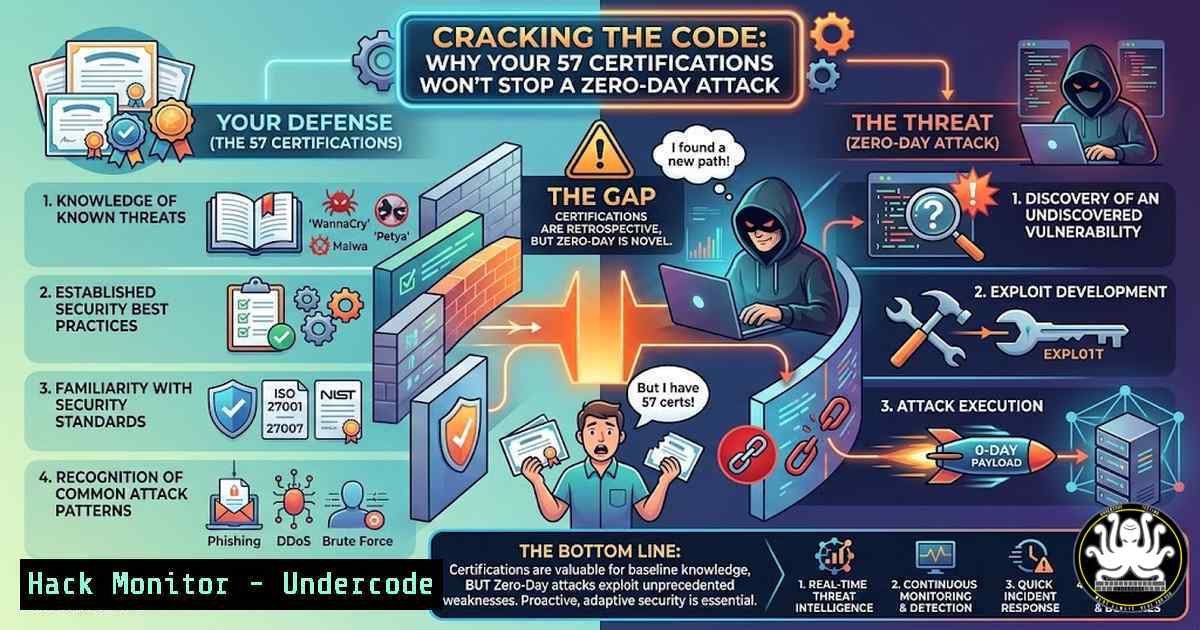
In an era where professionals boast an alphabet soup of credentials—CEH, CISSP, OSCP—the hard truth is that certification accumulation rarely translates to operational security resilience. While the pursuit of knowledge is commendable, the modern threat landscape exploits the gap between theoretical frameworks and hands-on execution. This article dissects why a wall of certifications may crumble against a single zero-day exploit and provides the technical roadmap to bridge the chasm between “certified” and “capable.”
Learning Objectives:
- Understand the disparity between certification exam objectives and real-world adversarial tactics.
- Learn to implement active defense mechanisms beyond standard compliance checklists.
- Master practical command-line techniques for incident response across Linux and Windows environments.
You Should Know:
- The “Paper Tiger” Phenomenon: Reconciling Theory with Practice
Many certification paths, while rigorous, focus heavily on established knowledge—known vulnerabilities, legacy attack vectors, and theoretical risk management. They often fail to simulate the chaos of a live breach where an attacker uses a never-before-seen technique. This gap is where damage occurs. To move from theory to practice, one must regularly engage in “Red vs. Blue” exercises that test not just knowledge, but reflexes.
Step‑by‑step guide: Simulating a Basic Incident Response (IR) Triage
To understand the difference between knowing “what” an incident is and “how” to handle one, perform this basic triage on a sandboxed machine:
On Linux (System Compromise Check):
1. Check for Suspicious Processes:
`ps aux –forest | grep -E “nc|ncat|bash|sh” | grep -v grep`
(Look for processes with unusual parent-child relationships or listening shells.)
2. Analyze Network Connections:
`sudo netstat -tulpn | grep LISTEN`
(Identifies services running on unexpected ports.)
3. Review Authentication Logs:
`sudo tail -50 /var/log/auth.log | grep “Failed password”`
(Quantify brute-force attempts to gauge attacker persistence.)
On Windows (Using PowerShell):
1. List Active Network Connections:
`Get-NetTCPConnection | Where-Object {$_.State -eq “Listen”} | Format-Table`
- Check for Scheduled Tasks Created by Unknown Users:
`Get-ScheduledTask | Where-Object {$_.TaskPath -notlike “Microsoft”} | Format-Table TaskName, State`
3. Examine Security Event Logs for Logins:
`Get-EventLog -LogName Security -InstanceId 4625 -Newest 20 | Format-Table TimeGenerated, Message -Wrap`
(Instance ID 4625 indicates failed logon attempts.)
2. Weaponizing AI: The New Frontline in Defense
The same AI tools that automate certification study guides are now being used to generate polymorphic malware. Defenders must leverage AI for anomaly detection rather than just documentation. Tools like Darktrace or open-source equivalents (e.g., Security Onion with AI models) analyze baselines to detect deviations in real-time, something a static certification exam cannot teach.
Step‑by‑step guide: Deploying an Open-Source NIDS with Anomaly Detection
1. Install Zeek (formerly Bro):
`sudo apt-get update && sudo apt-get install zeek`
2. Configure Zeek to Monitor an Interface:
Edit `/opt/zeek/etc/node.cfg` and set `interface=eth0` (or your active interface).
3. Integrate with RITA (Real Intelligence Threat Analytics):
RITA uses Zeek logs to hunt for beaconing malware.
– Download and install MongoDB: `sudo apt-get install mongodb`
– Clone RITA: `git clone https://github.com/activecm/rita.git`
– Run a script to parse Zeek logs and look for C2 channels:
`rita import -f /opt/zeek/logs/ /var/lib/rita/logs/</h2>
<h2 style="color: yellow;">rita show-beacons `
<h2 style="color: yellow;">
(This command lists potential command-and-control traffic based on connection timing and data size.)
3. Cloud Hardening: Beyond the Shared Responsibility Model
Certifications often gloss over the nuances of cloud misconfigurations. The infamous Capital One breach was not due to a sophisticated zero-day, but a misconfigured Web Application Firewall. Securing the cloud requires granular Identity and Access Management (IAM) and Infrastructure as Code (IaC) scanning.
Step‑by‑step guide: Scanning IaC for Vulnerabilities (Terraform/CloudFormation)
Using Checkov, a static code analysis tool for infrastructure:
1. Install Checkov:
`pip install checkov`
2. Scan a Terraform Directory:
`checkov -d ./terraform/`
(This will output a list of misconfigurations, such as S3 buckets with public access or EC2 instances with overly permissive security groups.)
3. Example Remediation:
If Checkov flags an S3 bucket as public (AWS:S3.1), modify your Terraform code to include:
resource "aws_s3_bucket_public_access_block" "example" {
bucket = aws_s3_bucket.example.id
block_public_acls = true
block_public_policy = true
}
4. API Security: The Silent Killer
Most modern breaches involve APIs, yet many security courses treat them as an afterthought. APIs are direct pathways to backend databases. Testing them requires moving beyond standard web scans to include business logic flaws.
Step‑by‑step guide: Manual API Fuzzing with Burp Suite
- Intercept Traffic: Configure Burp Suite as a proxy and capture an API request (e.g.,
GET /api/users/123). - Send to Intruder: Right-click the request and select “Send to Intruder.”
- Set Payload Positions: Highlight the resource ID (
123) and add it as a payload position. - Load Payloads: Use a list of common IDs (e.g., 1, 2, 3, 4) or special characters for SQLi (
',",--).
5. Analyze Response Lengths:
- A change in response length for ID `456` (belonging to another user) indicates an Insecure Direct Object Reference (IDOR) vulnerability.
- Server errors (500) on special characters may indicate an injection flaw.
- Vulnerability Exploitation and Mitigation: Living Off the Land
Understanding how attackers “live off the land” using native system tools is critical. Instead of dropping malware, they use PowerShell, WMI, or Python to remain undetected. Certifications often teach you to look for malware, but not for malicious use of legitimate tools.
Step‑by‑step guide: Detecting “Living off the Land” Binaries (LOLBAS)
1. Monitor for Suspicious Parent Processes (Windows):
Attackers often use `wmic.exe` to execute processes. Use Sysmon and Event Logs.
– Enable Sysmon: `sysmon64 -accepteula -i`
– Query for wmic usage:
`Get-WinEvent -FilterHashtable @{LogName=”Microsoft-Windows-Sysmon/Operational”; ID=1} | Where-Object {$_.Message -like “wmic.exe”} | Select-Object TimeCreated, Message`
2. Linux – Checking for Unusual Uses of System Binaries:
Attackers may use `curl` or `wget` to download second-stage payloads.
– Audit Command History:
`find /home -name “.bash_history” -exec grep -H “wget\|curl” {} \;`
(This searches all user history files for file download commands.)
What Undercode Say:
- Certifications are floor, not ceiling: They establish a baseline vocabulary but do not guarantee the ability to adapt to novel threats. True security proficiency is measured by the speed of response, not the number of acronyms on a resume.
- Practice beats theory daily: The professional who regularly runs `tcpdump` to analyze traffic or scripts `iptables` rules in a test lab will outperform a certified peer who only reads about firewalls. The market is beginning to value demonstrable skill—such as GitHub repositories of detection scripts or participation in bug bounty programs—over static credentials.
- Automation is the new multiplier: With AI generating attacks at machine speed, manual analysis must be augmented by automated threat hunting. The security expert of tomorrow is a hybrid—part coder, part analyst, and part systems engineer—who uses AI to filter noise and focus on high-fidelity alerts.
Prediction:
Within the next 24 months, we will witness a significant devaluation of standalone, exam-only certifications in the cybersecurity hiring market. Organizations, burned by breaches that bypassed “certified” teams, will shift recruitment focus toward practical assessments, live-fire exercises, and contributions to the open-source security community. The “57 certifications” profile will be replaced by the “57 GitHub repositories” profile, where practical code and detection logic are the new currency of trust.
▶️ Related Video (84% Match):
🎯Let’s Practice For Free:
IT/Security Reporter URL:
Reported By: Patrick Pascal – Hackers Feeds
Extra Hub: Undercode MoN
Basic Verification: Pass ✅


