
Listen to this Post
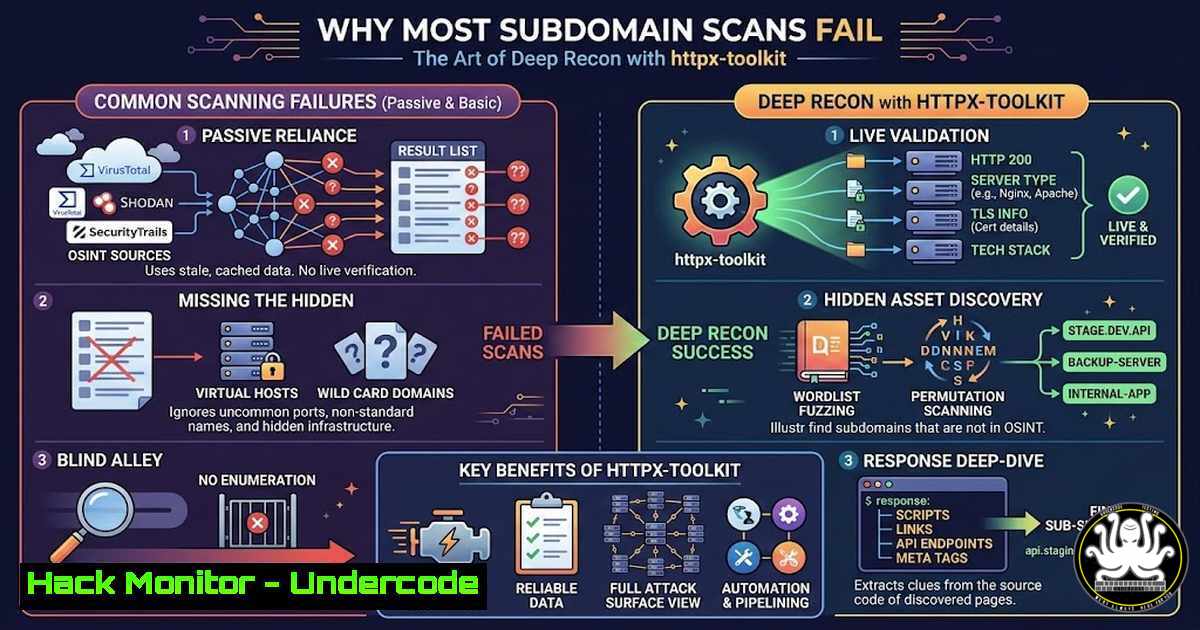
Introduction:
Many bug bounty hunters and penetration testers believe that subdomain enumeration is the end of reconnaissance. In reality, it’s just the beginning. The true value lies in analyzing the HTTP responses, server headers, error pages, and technology stacks of each discovered subdomain. As highlighted in a recent post by Deepak Saini, using httpx-toolkit to probe subdomains can reveal critical misconfigurations, exposed server details, and potential entry points that automated scanners often miss. This article delves into advanced recon techniques, turning raw subdomain lists into actionable intelligence.
Learning Objectives:
- Understand why passive subdomain collection is insufficient for finding vulnerabilities.
- Learn to leverage httpx-toolkit for deep HTTP analysis, including status codes, tech detection, and error page inspection.
- Identify common Apache misconfigurations and information leaks through error pages and server responses.
You Should Know:
1. Moving Beyond Subdomain Lists: Why Analysis Matters
Collecting subdomains with tools like Subfinder or Assetfinder is a common first step, but it only provides a list of domain names. The real attack surface is revealed only when you probe each subdomain for live HTTP services and examine the returned data. Deepak’s approach uses httpx-toolkit (part of the ProjectDiscovery suite) to send requests and capture critical metadata. This transforms a simple list into a rich dataset of status codes, technologies, server banners, and error pages. For instance, a 403 Forbidden might indicate a directory with access restrictions, while a 500 Internal Server Error could leak stack traces. Installing httpx-toolkit is straightforward:
 Install via Go
go install -v github.com/projectdiscovery/httpx/cmd/httpx@latest

Or using apt (Kali Linux)
sudo apt install httpx-toolkit

Basic usage to probe a list
httpx-toolkit -l subdomains.txt -status-code -tech-detect -server -title -follow-redirects -o enriched.txt
The output file now contains columns with URL, status code, detected technologies, server software, and page title—ready for deeper inspection.
2. Decoding Error Pages: A Goldmine of Information
Error pages are often dismissed as useless, but they frequently disclose valuable internal details. A 404 page might reveal the exact web server version, a 403 could expose the existence of protected directories, and a 500 error might show a full file path or database error. Using httpx, you can intentionally trigger errors by requesting non-existent paths:
httpx-toolkit -l subdomains.txt -path /nonexistent -status-code -response-time -o error_analysis.txt
Then manually inspect the responses for clues. For example, an Apache error page might include “Apache/2.4.41 (Ubuntu)” – a version number that can be checked against known vulnerabilities. On Windows, you can use PowerShell with curl to achieve similar results:
Get-Content subdomains.txt | ForEach-Object { curl -UseBasicParsing -Uri "http://$_/nonexistent" -ErrorAction SilentlyContinue | Select-Object -Property StatusCode, Headers }
This step often uncovers hidden infrastructure patterns and potential misconfigurations.
3. Extracting Technology Stack and Server Headers
Knowing the technology behind a subdomain is key to selecting appropriate attack vectors. httpx’s `-tech-detect` flag uses fingerprinting to identify frameworks like WordPress, Laravel, or React. Additionally, server headers can reveal the exact software version and enabled modules. To extract this data systematically:
httpx-toolkit -l subdomains.txt -tech-detect -server -headers -o tech_report.txt
You can then filter for specific technologies, e.g., `grep “apache” tech_report.txt` to focus on Apache hosts. For a manual check, use cURL:
curl -I https://target-subdomain.com
Look for fields like Server, X-Powered-By, and `Set-Cookie` (which may indicate the backend language). This information guides subsequent testing—e.g., an outdated Apache version might be vulnerable to CVE-2021-41773.
4. Identifying Misconfigured Apache Subdomains
Apache servers are ubiquitous, but they often harbor misconfigurations that can be exploited. After filtering for Apache-based subdomains, perform targeted checks for common issues:
– Directory listing: `httpx-toolkit -l apache_subdomains.txt -path / -status-code -ls`
– Exposed .git/config: `httpx-toolkit -l apache_subdomains.txt -path /.git/config -status-code -content-length`
– Server-status page: `httpx-toolkit -l apache_subdomains.txt -path /server-status -status-code`
– PHP info: `httpx-toolkit -l apache_subdomains.txt -path /phpinfo.php -status-code -title`
If any of these return a 200 OK, investigate further. For instance, a readable `.git/config` might leak repository URLs or credentials. Use `curl` to download and examine the file.
5. Automating Recon with httpx and Other Tools
To scale this process, create a pipeline that combines subdomain discovery, HTTP probing, and vulnerability scanning. A typical workflow:
 Find subdomains
subfinder -d example.com -silent | tee subs.txt
 Probe with httpx
cat subs.txt | httpx-toolkit -status-code -tech-detect -server -title -o httpx_out.txt
 Extract URLs with interesting status codes (e.g., 403, 500)
grep -E "403|500" httpx_out.txt | awk '{print $1}' > interesting.txt
 Run nuclei for template-based scanning
nuclei -l interesting.txt -t exposures/ -t misconfiguration/
This automation saves time and ensures no stone is left unturned. For Windows, you can use WSL or download the binaries and run similar commands in PowerShell with `Get-Content` and ForEach-Object.
6. Windows Alternatives and Tooling
While most security tools are Linux-first, Windows users can still participate effectively. Download the latest httpx Windows executable from the ProjectDiscovery GitHub releases. Then, in PowerShell:
Get-Content subdomains.txt | .\httpx.exe -status-code -tech-detect -server -title -o results.csv
For processing, use `Import-Csv` to filter results. You can also integrate with other Windows tools like `curl.exe` or `Invoke-WebRequest` for manual checks. To mimic grep, use Select-String. This allows a full recon workflow without leaving Windows.
- From Recon to Exploitation: Turning Findings into Bugs
The ultimate goal is to convert reconnaissance findings into verified vulnerabilities. For example:
– If you find an outdated Apache version, search for exploits: `searchsploit apache 2.4.49`
– Exposed `.git` folders can be downloaded and parsed for sensitive data using tools like git-dumper.
– Error pages revealing SQL errors may indicate SQL injection points.
– Server headers showing `X-Debug-Token` could lead to Symfony profiler exposure.
Always validate findings manually. A simple `curl` request might confirm a vulnerability. Document each step and, if in a bug bounty program, report with clear proof-of-concept.
What Undercode Say:
- Key Takeaway 1: Reconnaissance is a multi-layered process; collecting subdomains is merely the foundation. The real value emerges when you analyze the behavior and responses of each live host.
- Key Takeaway 2: Error pages and server headers are often overlooked but can leak critical information about infrastructure, software versions, and misconfigurations, providing a direct path to exploitation.
Analysis: The approach demonstrated by Deepak Saini underscores a fundamental shift in bug hunting—from volume-based asset collection to intelligence-driven analysis. Tools like httpx-toolkit lower the barrier to entry, but the human element remains irreplaceable. Interpreting a 500 error page requires context and creativity. As defenders become more aware, they may strip error details, forcing researchers to find other subtle leaks. The community aspect (e.g., WhatsApp groups, YouTube tutorials) accelerates learning and keeps hunters updated on emerging techniques. Ultimately, the hunters who succeed are those who treat recon as an investigative process, not a checklist.
Prediction:
As bug bounty platforms grow and more researchers join, automated scanning will become saturated. The future will belong to those who can correlate disparate data points—like correlating error page patterns with specific software versions—and use AI to detect anomalies at scale. We may see the rise of tools that not only collect HTTP data but also provide context-aware exploit suggestions. Simultaneously, organizations will harden their error handling, pushing researchers to explore more subtle vectors such as rate-limiting issues, business logic flaws, and API misconfigurations. The cat-and-mouse game will continue, but deep recon will remain a cornerstone of successful hunting.
▶️ Related Video (84% Match):
🎯Let’s Practice For Free:
IT/Security Reporter URL:
Reported By: Deepak Saini – Hackers Feeds
Extra Hub: Undercode MoN
Basic Verification: Pass ✅


