Listen to this Post
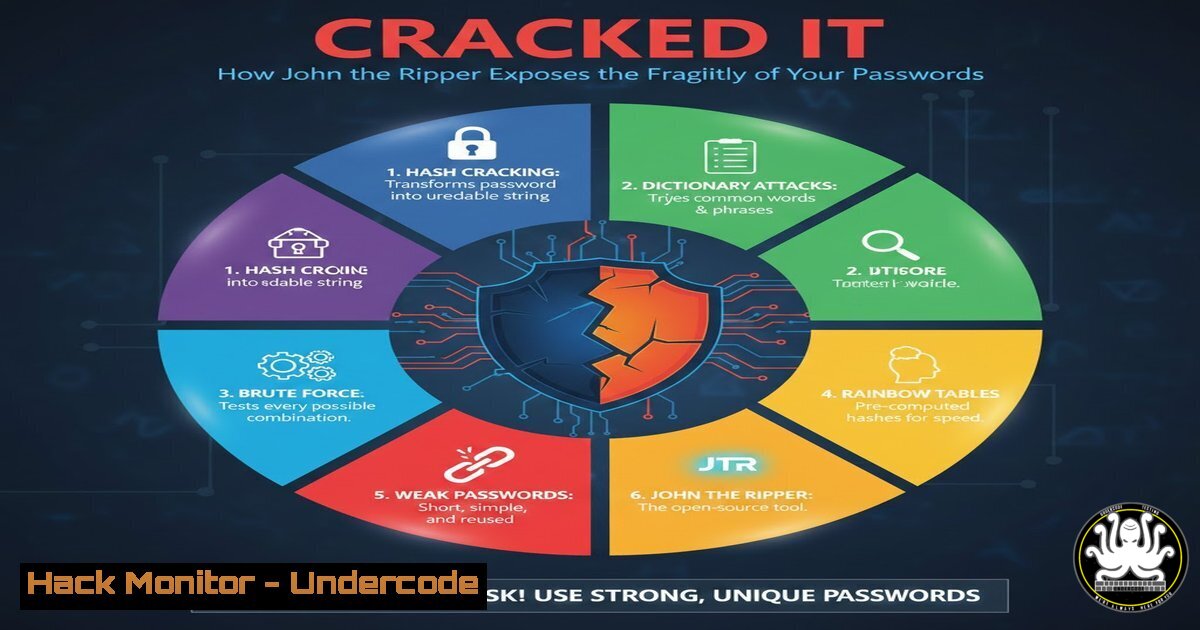
Introduction:
In the digital age, the humble password remains the most ubiquitous yet vulnerable line of defense. Security tools like John the Ripper, a premier password-cracking utility, starkly demonstrate how weak credential practices can be systematically dismantled. This hands-on exploration is not just for ethical hackers; it’s a crucial lesson for any IT professional on the imperative of robust authentication mechanisms, exposing the mechanics of hashing algorithms and the relentless efficiency of modern cracking techniques.
Learning Objectives:
- Understand the fundamental process of password hashing and how John the Ripper exploits its weaknesses.
- Learn to execute basic and advanced password cracking attacks using John the Ripper in a controlled, ethical environment.
- Implement critical defensive strategies and best practices to mitigate the risks exposed by such tools.
You Should Know:
- The Anatomy of a Password Hash & Cracking Methodology
At its core, password storage relies on hashing—a one-way mathematical function. Systems store the hash, not the plaintext password. John the Ripper’s mission is to reverse this process by guessing passwords, hashing the guesses, and comparing the results to a stolen hash list.
Step-by-step guide:
- Acquire Hashes: In a lab environment (e.g., TryHackMe), you might extract hashes from a compromised system’s `/etc/shadow` file (Linux) or SAM database (Windows).
- Prepare the Hash File: Create a text file (e.g.,
hashes.txt) and paste the target hashes. - Identify the Hash: Use John’s built-in identifier or tools like `hashid` to determine the hash type (e.g., md5crypt, sha512crypt, NTLM).
john --format=raw-md5 --wordlist=/usr/share/wordlists/rockyou.txt hashes.txt
2. Launching Your First Dictionary Attack
The simplest and often most effective attack is a dictionary attack, which uses a pre-compiled list of common passwords.
Step-by-step guide:
- Obtain a Wordlist: The `rockyou.txt` wordlist is a standard (found in Kali Linux at
/usr/share/wordlists/rockyou.txt). - Run John: Execute John with the correct format and wordlist against your hash file.
john --wordlist=/usr/share/wordlists/rockyou.txt --format=sha512crypt hashes.txt
- Review Results: Cracked passwords are stored in John’s “pot” file. View them with:
john --show hashes.txt
3. Escalating to Bruteforce and Rule-Based Attacks
When dictionaries fail, John can perform incremental (bruteforce) mode, trying all character combinations. More powerfully, it can apply “mangling rules” to wordlists, creating clever variations like P@ssw0rd2024!.
Step-by-step guide:
- Enable Mangling Rules: John’s configuration file (
/etc/john/john.conf) contains powerful rule sets. - Execute a Rule-Based Attack: Use the `–rules` flag to activate these transformations.
john --wordlist=mywords.txt --rules=Single --format=nt hashes.txt
4. Cracking Windows Passwords and Archives
John is versatile. It can crack Windows NTLM/LM hashes and password-protected files like ZIP or RAR archives.
Step-by-step guide for ZIP cracking:
- Extract the Hash: Use `zip2john` to convert the protected archive into a hash John can understand.
zip2john protected.zip > zip_hash.txt
- Crack the Hash: Run John against the extracted hash file.
john --wordlist=rockyou.txt zip_hash.txt
- For Windows Hashes: The process is similar using `secretsdump.py` (from Impacket) to extract hashes and John with the `nt` format.
5. Defensive Countermeasures: Building an Impenetrable Wall
Understanding the attack is the first step towards building a formidable defense.
Step-by-step mitigation guide:
- Enforce Strong Password Policies: Mandate minimum length (12+ characters), complexity, and prevent common patterns. Use Windows Group Policy or Linux’s `pam_pwquality` module.
Linux Example (`/etc/security/pwquality.conf`):
minlen = 12
minclass = 4
maxrepeat = 2
2. Use Slow, Salty Hashes: Implement modern, computationally expensive key derivation functions (KDFs) like bcrypt, scrypt, or Argon2. These drastically increase John’s cracking time per guess.
3. Enable Multi-Factor Authentication (MFA): MFA is the ultimate defense, rendering a cracked password useless on its own.
4. Regular Security Audits: Proactively use John (ethically!) on your own password audit test files to identify weak passwords before attackers do. Never run it on live production systems without explicit authorization.
What Undercode Say:
- The Illusion of Complexity: A short password with symbols is often weaker than a long, random passphrase. John’s rules efficiently handle
P@ssw0rd!-style transformations. - Speed is the Enemy: The choice of hashing algorithm is a direct determinant of how many guesses per second an attacker can make. Legacy hashes like MD5 or NTLM are dangerously fast to crack on modern hardware.
The practical use of John the Ripper shifts password security from an abstract policy to a tangible, urgent priority. It reveals that the primary risk is not sophisticated zero-days, but predictable human behavior and legacy system configurations. The tool doesn’t just crack passwords; it cracks open the mindset of complacency, forcing a move beyond “complexity” to true resilience through length, modern KDFs, and layered authentication. In the arms race between hash generation speed and cracking power, defense must intentionally choose to be slow.
Prediction:
The efficacy of tools like John the Ripper will continue to accelerate with advancements in GPU and specialized hardware (like ASICs for hashing), making weak passwords instantly breakable. This will force a near-universal shift towards passwordless authentication (FIDO2/WebAuthn) and mandatory MFA as the baseline standard. However, legacy systems and human reluctance will ensure password-based attacks remain a dominant initial attack vector for at least the next decade, making defensive password hygiene and hash management more critical than ever in the interim. AI will also play a dual role, both in generating smarter, contextual password guesses and in dynamically detecting and blocking brute-force attack patterns.
▶️ Related Video (82% Match):
🎯Let’s Practice For Free:
IT/Security Reporter URL:
Reported By: Onkar Kamble – Hackers Feeds
Extra Hub: Undercode MoN
Basic Verification: Pass ✅


