Listen to this Post
Introduction:
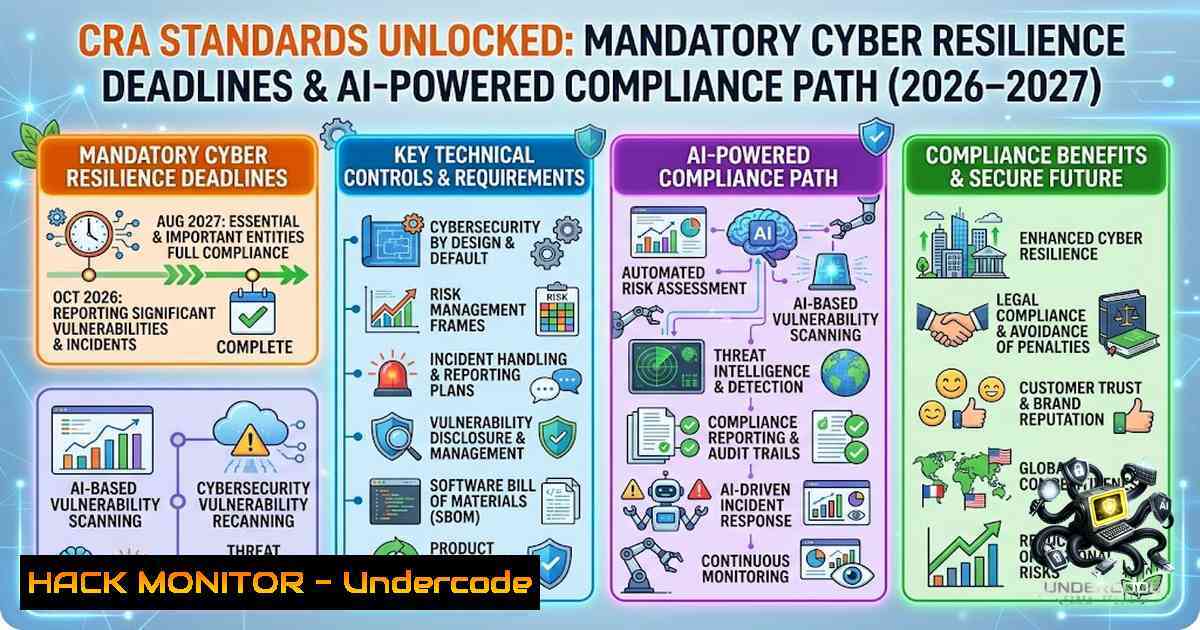
The EU Cyber Resilience Act (CRA, Regulation (EU) 2024/2847) is no longer a distant regulatory horizon—it is active law, with mandatory vulnerability reporting obligations commencing 11 September 2026 and full CE marking enforcement arriving by 11 December 2027. For manufacturers of products with digital elements (PDE)—from consumer IoT devices to industrial control systems and embedded firmware—the CRA introduces binding lifecycle-wide cybersecurity requirements that demand immediate technical action. This article dissects the regulation’s core technical mandates, delivers actionable Linux and Windows commands for compliance auditing, and explores how the EU-funded CRA-AI project is automating the path to CE marking for SMEs and enterprises alike.
Learning Objectives:
- Understand the CRA’s essential cybersecurity requirements (Annex I) and how harmonised standards translate them into testable technical provisions.
- Implement vulnerability management, SBOM generation, and incident reporting workflows using open-source and native OS tools.
- Apply system hardening and secure coding practices aligned with CRA expectations across Linux and Windows environments.
- Leverage the CRA-AI Attestra platform to automate risk assessment, documentation, and conformity assessment.
- Navigate the CE marking process and conformity assessment routes for Default, Important, and Critical product classifications.
You Should Know:
- Decoding CRA Scope and Essential Security Requirements (Annex I)
The CRA applies to any product with digital elements—hardware, software, or both—placed on the EU market. The regulation’s Annex I sets out horizontal, objective-oriented cybersecurity requirements covering confidentiality, integrity, access control, secure defaults, and vulnerability handling. These high-level mandates are operationalised through harmonised technical standards drafted by ETSI, CEN, and CENELEC, with approximately 40 new standards currently in development.
Step‑by‑step guide to determine if your product is in scope:
- Inventory all products that include software, firmware, or remote data processing services.
- Assess connectivity – the CRA covers products with direct or indirect logical or physical connection to a device or network.
- Classify your product – Default (self-assessment), Important Class I/II (third-party assessment), or Critical (EU-type examination).
- Map to Annex I requirements – document how your product meets each essential requirement, including security patching, cryptographic controls for data at rest and in transit, and secure update mechanisms.
Command‑line tip – Inventory software components on Linux:
 Generate a list of all installed packages (Debian/Ubuntu)
dpkg-query -f '${Package}\t${Version}\n' -W > installed_packages.txt

For RHEL/CentOS/Fedora
rpm -qa --queryformat '%{NAME}\t%{VERSION}\n' > installed_packages.txt

Scan for known vulnerabilities in installed packages (requires OVAL definitions)
sudo apt-get install oval-graph  Debian/Ubuntu
oscap oval eval --results results.xml --report report.html /usr/share/openscap/oval/.xml
Windows equivalent – Generate an SBOM using Microsoft’s SBOM tool:
 Install sbom-tool (requires .NET SDK)
dotnet tool install --global Microsoft.Sbom.Tool

Generate SBOM for a project directory
sbom-tool generate -b . -bc MyProject -pn "YourProductName" -pv "1.0.0" -ps "YourCompany" -1sb https://your-1amespace
- Vulnerability Management and Incident Reporting Under the CRA
From 11 September 2026, manufacturers must report actively exploited vulnerabilities and severe incidents affecting the security of in-scope products. The CRA mandates a documented vulnerability management process for the entire support period—typically a minimum of five years for many product categories. This includes a coordinated vulnerability disclosure policy, a clear point of contact, and technical documentation demonstrating compliance.
Step‑by‑step guide to operationalise CRA vulnerability reporting:
- Establish a vulnerability handling process covering discovery, triage, patch development, and coordinated disclosure.
- Define your product’s support period (minimum 5 years) and communicate end-of-support dates to users.
- Implement continuous vulnerability scanning using both SAST (Static Application Security Testing) and DAST (Dynamic Application Security Testing) tools.
- Set up an incident reporting workflow to notify ENISA and national CSIRTs within the mandated timeframes.
Linux command – Vulnerability scanning with OpenSCAP:
 Install OpenSCAP
sudo apt-get install openscap-scanner  Debian/Ubuntu
sudo yum install openscap-scanner  RHEL/CentOS

Perform a system compliance scan against a CRA-aligned profile (e.g., CIS benchmark)
oscap xccdf eval --profile xccdf_org.cisecurity.benchmarks_profile_Level_1_Server \
--results scan_results.xml --report scan_report.html /usr/share/openscap/scap/.xml
Windows command – Vulnerability scanning with built-in tools:
 Use PowerShell to check for missing security updates
Get-WindowsUpdate -IsInstalled -Category "Security Updates" | Select-Object ,KB

Generate a system inventory for vulnerability assessment
Get-HotFix | Export-Csv -Path hotfixes.csv -1oTypeInformation

Use the Microsoft Safety Scanner (download from Microsoft) for offline scanning
msert.exe /q /n
3. System Hardening for CRA Compliance
The CRA emphasises secure by design and by default principles. System hardening—removing unnecessary services, enforcing least privilege, and applying secure configurations—is a foundational technical control.
Step‑by‑step guide for Linux hardening:
1. Disable unnecessary services to reduce attack surface.
- Enforce strong authentication (e.g., key-based SSH, multi-factor authentication).
- Apply kernel hardening (e.g., sysctl tweaks for network security).
- Implement file integrity monitoring (e.g., AIDE or Tripwire).
- Configure logging and auditing (auditd, rsyslog) to meet CRA’s traceability requirements.
Linux hardening commands:
 List and disable unnecessary services
systemctl list-unit-files --type=service --state=enabled
sudo systemctl disable [unnecessary-service]

Harden SSH configuration
sudo nano /etc/ssh/sshd_config
 Set: PermitRootLogin no, PasswordAuthentication no, PubkeyAuthentication yes

Apply kernel security parameters
sudo sysctl -w net.ipv4.tcp_syncookies=1
sudo sysctl -w net.ipv4.conf.all.rp_filter=1
sudo sysctl -w net.ipv4.conf.default.rp_filter=1
sudo sysctl -w net.ipv4.icmp_echo_ignore_broadcasts=1

Install and configure AIDE for file integrity monitoring
sudo apt-get install aide  Debian/Ubuntu
sudo aideinit
sudo aide --check
Windows hardening commands (PowerShell):
 Disable unnecessary services
Get-Service | Where-Object {$<em>.StartType -eq 'Automatic' -and $</em>.Status -eq 'Running'} | Stop-Service -WhatIf

Configure Windows Defender real-time protection
Set-MpPreference -DisableRealtimeMonitoring $false

Enable Windows Firewall with advanced security
Set-1etFirewallProfile -Profile Domain,Public,Private -Enabled True

Audit local security policy (use secedit)
secedit /export /cfg secpol.inf
 Review and modify settings, then import
secedit /configure /db secpol.sdb /cfg secpol.inf
4. Leveraging the CRA-AI Platform for Automated Compliance
The EU-funded CRA-AI project is developing an AI-enabled software platform—Attestra—designed to guide organisations, particularly SMEs without dedicated cyber teams, through every step of the CRA compliance journey. The platform automates product inventory, risk assessment, testing, documentation, vulnerability reporting, and disclosure.
Step‑by‑step guide to using CRA‑AI Attestra:
- Register for the Early Adopter Programme – open to manufacturers of in-scope products.
- Input product details – the AI engine maps your product to CRA classification and applicable standards.
- Automated risk assessment – the platform generates a preliminary risk profile aligned with Annex I.
- Generate technical documentation – Attestra produces the required EU declaration of conformity and technical file.
- Continuous monitoring – the platform tracks vulnerability disclosures and regulatory updates.
API integration example – querying the CRA-AI risk assessment endpoint (conceptual):
 Authenticate and retrieve a compliance status report
curl -X GET "https://api.attestra.cra-ai.eu/v1/compliance/status" \
-H "Authorization: Bearer YOUR_API_TOKEN" \
-H "Content-Type: application/json" \
-d '{"product_id": "PDE-2026-001"}'
Windows PowerShell equivalent:
$headers = @{
"Authorization" = "Bearer YOUR_API_TOKEN"
"Content-Type" = "application/json"
}
$body = @{ product_id = "PDE-2026-001" } | ConvertTo-Json
Invoke-RestMethod -Uri "https://api.attestra.cra-ai.eu/v1/compliance/status" -Method Get -Headers $headers -Body $body
5. CE Marking and Conformity Assessment
CRA compliance is a regulatory precondition for CE marking. The CE mark, recognised across the European Economic Area, signifies that a product meets the CRA’s essential cybersecurity requirements. Manufacturers must produce technical documentation, define a support period, and—for Important and Critical products—engage notified bodies for third-party assessment.
Step‑by‑step guide to CE marking under the CRA:
- Determine your product’s classification (Default, Important Class I/II, Critical).
- Select the conformity assessment route – internal production control (Default) or EU-type examination (Important/Critical).
- Compile technical documentation – including risk assessment, design specifications, test reports, and vulnerability handling procedures.
- Issue the EU declaration of conformity and affix the CE mark.
- Maintain documentation and update it as the product evolves.
Command‑line tip – Cryptographic validation for CE marking:
 Verify TLS/SSL configuration (essential for data in transit)
openssl s_client -connect yourproduct.com:443 -tls1_2
openssl s_client -connect yourproduct.com:443 -tls1_3

Check for weak ciphers
nmap --script ssl-enum-ciphers -p 443 yourproduct.com

Generate a cryptographic key pair for secure updates (RSA 2048 or ECDSA)
openssl genpkey -algorithm RSA -out private_key.pem -pkeyopt rsa_keygen_bits:2048
openssl rsa -pubout -in private_key.pem -out public_key.pem
Windows – Check cryptographic settings:
 List enabled TLS protocols
Get-TlsCipherSuite | Format-Table Name, Exchange, Cipher, Hash

Enable TLS 1.2 and 1.3 (if not already)
Set-ItemProperty -Path "HKLM:\SYSTEM\CurrentControlSet\Control\SecurityProviders\SCHANNEL\Protocols\TLS 1.2\Client" -1ame "Enabled" -Value 1 -Type DWord
Set-ItemProperty -Path "HKLM:\SYSTEM\CurrentControlSet\Control\SecurityProviders\SCHANNEL\Protocols\TLS 1.3\Client" -1ame "Enabled" -Value 1 -Type DWord
6. Securing the Supply Chain and Third‑Party Components
The CRA mandates a supply chain approach to compliance. Manufacturers must ensure that third‑party components—libraries, SDKs, and open‑source dependencies—meet the same cybersecurity standards.
Step‑by‑step guide for supply chain security:
- Maintain a Software Bill of Materials (SBOM) for every product.
- Automate vulnerability scanning of all dependencies using tools like OWASP Dependency‑Check, Trivy, or Snyk.
- Establish vendor security questionnaires and contractual clauses requiring CRA compliance from suppliers.
- Continuously monitor for disclosed vulnerabilities in used components.
Linux – Scan dependencies with OWASP Dependency‑Check:
 Install OWASP Dependency-Check
wget https://github.com/jeremylong/DependencyCheck/releases/download/v9.0.0/dependency-check-9.0.0-release.zip
unzip dependency-check-.zip
cd dependency-check/bin

Scan a project directory
./dependency-check.sh --scan /path/to/your/project --format HTML --out /path/to/report
Windows – Use Trivy for container and filesystem scanning:
 Install Trivy (via Chocolatey)
choco install trivy

Scan a filesystem directory for vulnerabilities
trivy fs --format table --exit-code 0 /path/to/project

Generate an SBOM in SPDX format
trivy sbom /path/to/project --format spdx-json > sbom.spdx.json
7. Continuous Monitoring and Post‑Market Obligations
The CRA imposes post‑market obligations, including ongoing vulnerability monitoring, security updates, and incident reporting throughout the product’s support period.
Step‑by‑step guide to post‑market CRA compliance:
- Deploy a vulnerability disclosure program with a security@ email address and PGP key.
- Implement automated monitoring of CVE databases and security advisories relevant to your product stack.
- Establish a patch management lifecycle with timelines for critical and high‑severity vulnerabilities.
- Maintain an incident response plan that includes reporting to ENISA within the mandated timeframes.
Linux – Automate CVE monitoring with cve‑checker:
 Install cve-checker (or use OVAL feeds)
sudo apt-get install cve-checker  if available
 Alternatively, use the National Vulnerability Database API
curl "https://services.nvd.nist.gov/rest/json/cves/2.0?keywordSearch=your_product_name" | jq '.vulnerabilities[] | .cve.id'
Windows – Monitor CVEs with PowerShell and NVD API:
$apiUrl = "https://services.nvd.nist.gov/rest/json/cves/2.0?keywordSearch=YourProduct"
$response = Invoke-RestMethod -Uri $apiUrl
$response.vulnerabilities | ForEach-Object { $_.cve.id }
What Undercode Say:
- The CRA is not optional – it is binding law with clear deadlines. Manufacturers must treat CRA compliance as a product lifecycle imperative, not a one‑time audit exercise.
- Harmonised standards are the bridge – the broad Annex I requirements become concrete through ETSI, CEN, and CENELEC technical specifications. Engaging with these standards early is critical.
- AI‑powered automation is a game‑changer – projects like CRA‑AI are democratising compliance, particularly for resource‑constrained SMEs, by automating risk assessment, documentation, and monitoring.
- Supply chain security is non‑negotiable – the CRA’s supply chain obligations mean that manufacturers must extend compliance requirements to all third‑party components and vendors.
- CE marking now carries cybersecurity weight – the CE mark is no longer just about safety and environmental standards; it is a seal of cybersecurity resilience.
Prediction:
- +1 The CRA will accelerate the consolidation of cybersecurity standards globally, with non‑EU manufacturers voluntarily adopting CRA‑aligned practices to access the European market.
- +1 AI‑driven compliance platforms like Attestra will become the industry standard, reducing the cost and complexity of CRA adherence and enabling faster time‑to‑market for secure products.
- -1 Manufacturers that delay CRA implementation face significant market access disruption from September 2026, with potential fines, product recalls, and reputational damage.
- +1 The harmonised standards developed under the CRA will influence future global cybersecurity frameworks, positioning the EU as a regulatory leader in product security.
- -1 The complexity of the CRA’s 40+ new standards may overwhelm SMEs without dedicated compliance resources, widening the gap between large enterprises and smaller players.
- +1 The CRA‑AI project’s open‑source and community‑driven approach will foster a collaborative ecosystem, accelerating innovation in automated security validation and continuous compliance.
- +1 Vulnerability reporting and coordinated disclosure under the CRA will improve overall threat intelligence sharing, benefiting the entire cybersecurity community.
- -1 The reporting obligations may lead to an initial surge in notifications, straining ENISA and national CSIRT capacities before processes mature.
▶️ Related Video (76% Match):
🎯Let’s Practice For Free:
🎓 Live Courses & Certifications:
Join Undercode Academy for Verified Certifications
🚀 Request a Custom Project:
Secure, high-velocity infrastructure and disruptive technological engineering. Contact our engineering team for high-tier development and proprietary systems:
[email protected]
💎 Smart Architecture | 🛡️ Secure by Design | ⭐ Trusted by Thousands
IT/Security Reporter URL:
Reported By: Morenobuffolo Cra – Hackers Feeds
Extra Hub: Undercode MoN
Basic Verification: Pass ✅


