Listen to this Post
Introduction:
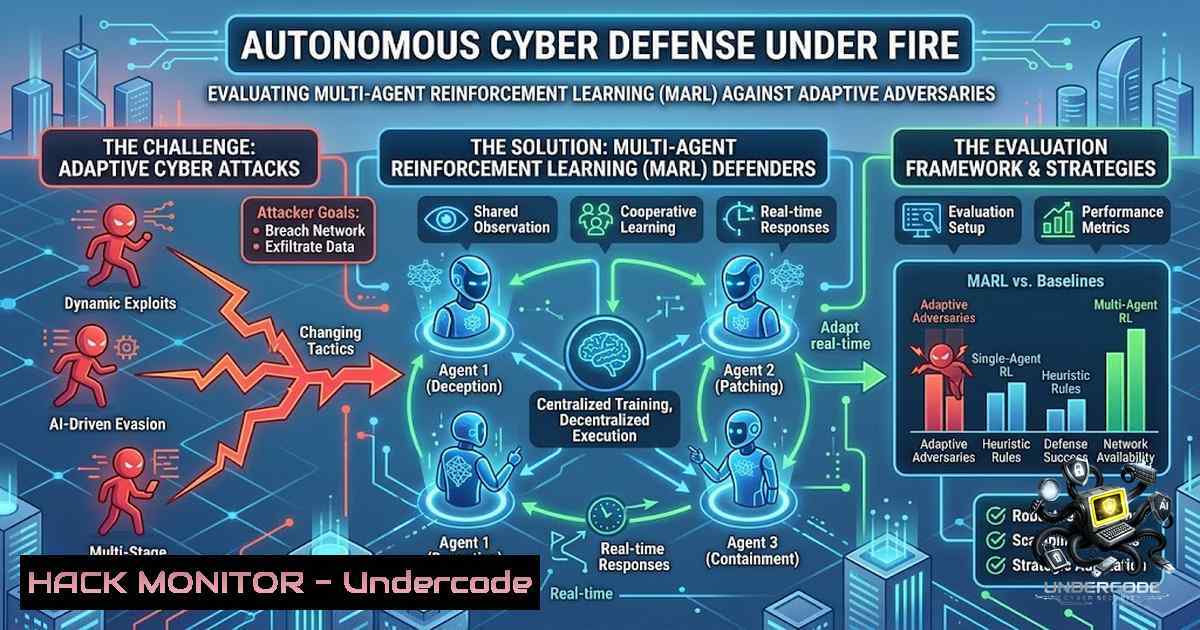
As cyber threats grow in sophistication and velocity, organizations are increasingly turning to autonomous AI agents to defend networks at machine speed. Multi-Agent Reinforcement Learning (MARL) has emerged as a promising paradigm for distributed cyber defense, enabling teams of agents to coordinate responses across segmented network zones. However, a critical question remains: how robust are these autonomous defenders when facing adversaries that actively adapt their strategies? The award-winning research presented at IEEE CSR 2026 by Silja Kluge and colleagues from Thales cortAIx directly addresses this gap, systematically evaluating MARL-based defense agents under adversarial strategy variation with a focus on robustness and explainability—a milestone that signals the maturation of AI-driven cyber resilience from theoretical concept to rigorously validated practice.
Learning Objectives:
- Understand the fundamentals of Multi-Agent Reinforcement Learning (MARL) applied to autonomous cyber defense and the unique challenges of coordinating distributed defensive agents.
- Learn how to evaluate the robustness of cyber defense agents against adaptive adversarial strategies using simulation environments like CybORG and CAGE Challenge 4.
- Explore explainability techniques for AI-driven defense systems, including causal modeling, Policy Divergence Scores, and human-in-the-loop escalation signals.
- Gain hands-on experience with practical Linux/Windows commands, tool configurations, and cloud hardening techniques relevant to autonomous defense deployment.
You Should Know:
- Building the MARL Cyber Defense Environment: CybORG and CAGE Challenge 4
The foundation of autonomous cyber defense research lies in high-fidelity simulation environments. CybORG (Cyber Operations Research Gym) provides a simulated cyber operations environment for training and evaluating reinforcement learning agents. The CAGE Challenge 4 (CC4) extends this to a Multi-Agent Reinforcement Learning scenario set in a defense industry enterprise environment with segmented security zones.
The CC4 network topology consists of four interconnected networks: two deployed networks (each with restricted and operational zones), a Headquarters network (Public Access, Admin, and Office zones), and an undefended Contractor network. Five defensive agents protect different zones, while red team agents begin with access to a random machine in the contractor network and attempt to pivot throughout the network. Hosts are a mix of Linux and Windows systems with unique exploits for each OS.
Step-by-Step Setup Guide:
 Clone the CAGE Challenge 4 repository
git clone https://github.com/cage-challenge/cage-challenge-4.git
cd cage-challenge-4

Create and activate a Python virtual environment
python3 -m venv venv
source venv/bin/activate  On Windows: venv\Scripts\activate

Install the CybORG package and dependencies
pip install -e CybORG/
pip install torch numpy gymnasium stable-baselines3

Verify installation
python -c "from CybORG import CybORG; print('CybORG imported successfully')"
Training a Basic Defender Agent:
from CybORG import CybORG
from CybORG.Agents import BaseAgent
import numpy as np

Initialize the CybORG environment with CC4 scenario
cyborg = CybORG('CAGE-Challenge-4', 'sim', agents={'Blue': BaseAgent})

Basic training loop structure
for episode in range(1000):
observation = cyborg.reset()
done = False
total_reward = 0
while not done:
action = np.random.choice(cyborg.get_action_space('Blue'))
observation, reward, done, info = cyborg.step('Blue', action)
total_reward += reward
print(f"Episode {episode}: Total Reward = {total_reward}")
2. Adversarial Robustness Evaluation: Stress-Testing Autonomous Defenders
The core contribution of the award-winning research is a systematic methodology for evaluating how MARL-based defense agents perform when adversarial strategies vary. Traditional approaches train agents against predictable, scripted adversaries, limiting their adaptability to evolving threats. Robustness evaluation requires testing against realistic and worst-case attacks.
Adversarial attacks against reinforcement learning agents can target multiple components: the state space (observation poisoning), action space, reward function, or the policy model itself. The research employs a dual-perspective taxonomy that integrates threat models with perturbation targets, systematically categorizing attacks.
Practical Adversarial Testing Commands:
 Linux: Monitor for anomalous network patterns that could indicate adversarial manipulation
sudo tcpdump -i eth0 -1 -c 1000 | grep -E "SYN|ACK|RST" | sort | uniq -c

Windows: Check for suspicious process creation patterns
Get-WinEvent -FilterHashtable @{LogName='Security'; ID=4688} |
Select-Object TimeCreated, @{N='Process';E={$_.Properties[bash].Value}} |
Group-Object Process | Sort-Object Count -Descending

Monitor for reward function poisoning indicators in training logs
grep -E "reward|loss" training.log | tail -20 | awk '{print $NF}' | sort -1r
Implementing Adversarial Training (RADAR Framework):
The RADAR (Reinforcement Learning-based Adversarial Attack Robustness) framework couples robust optimization with reinforcement learning to increase cyber defense AI agent robustness against adversarial attacks. Incorporating RADAR in malware detectors has shown robustness increases of up to seven times.
 Simplified adversarial training loop with observation perturbation
class AdversarialDefender:
def <strong>init</strong>(self, epsilon=0.1):
self.epsilon = epsilon  Perturbation magnitude

def add_adversarial_noise(self, observation):
noise = np.random.normal(0, self.epsilon, observation.shape)
return np.clip(observation + noise, 0, 1)

def train_robust(self, env, episodes=1000):
for episode in range(episodes):
obs = env.reset()
while True:
 Add adversarial perturbation during training
adv_obs = self.add_adversarial_noise(obs)
action = self.policy(adv_obs)
next_obs, reward, done, _ = env.step(action)
 Update policy with adversarial experience
self.update_policy(adv_obs, action, reward, next_obs, done)
if done:
break
- Explainable AI for Autonomous Cyber Defense: Building Trust in Machine-Speed Decisions
A critical requirement for deploying autonomous defense agents in production environments is explainability. Security analysts must understand why an agent took a particular action, especially under uncertainty. The Causal Multi-Agent Decision Framework (C-MADF) addresses this by integrating causal modeling with adversarial dual-policy control.
C-MADF learns a Structural Causal Model (SCM) from historical telemetry and compiles it into a Directed Acyclic Graph (DAG) that defines admissible response transitions. A dual-agent system counterbalances a threat-optimizing Blue-Team policy with a conservatively shaped Red-Team policy. Inter-policy disagreement is quantified through a Policy Divergence Score and exposed via an Explainability-Transparency Score (ETS) that serves as an escalation signal under uncertainty.
On real-world datasets, C-MADF reduced false-positive rates from 11.2% to just 1.8% while achieving 0.997 precision.
Implementing Explainability Metrics:
 Calculate Policy Divergence Score between Blue and Red agents
def policy_divergence(blue_policy, red_policy, state):
blue_action_probs = blue_policy.get_action_probabilities(state)
red_action_probs = red_policy.get_action_probabilities(state)
 Jensen-Shannon divergence
m = 0.5  (blue_action_probs + red_action_probs)
divergence = 0.5  (kl_divergence(blue_action_probs, m) +
kl_divergence(red_action_probs, m))
return divergence

Generate human-readable explanation of defense decisions
def explain_decision(action, state, ets_score):
explanation = f"""
Decision: {action}
Confidence (ETS): {ets_score:.3f}
Rationale: The agent identified {state['threat_indicators']}
and prioritized {state['critical_assets']} protection.
"""
return explanation
4. Red Teaming Autonomous Defenders: The Adversarial Perspective
To truly evaluate robustness, defenders must be tested against adaptive red team agents that can learn and evolve their attack strategies. A red teaming framework integrating Large Language Models (LLMs) with Reinforcement Learning generates adaptive, multi-stage attack campaigns against autonomous defenders. A hierarchical design combines an LLM-based planner for strategic intent with an RL controller for tactical execution.
Setting Up Red Team Evaluation:
from CybORG.Agents import RedAgent, BlueAgent

Configure different red agent strategies
RED_STRATEGIES = {
'scripted': 'HeuristicRedAgent',  Predictable, rule-based
'rl_based': 'RLRedAgent',  Learns from interactions
'adaptive': 'AdaptiveRedAgent'  Adjusts strategy based on defender behavior
}

def evaluate_defender_robustness(blue_agent, red_strategy, episodes=100):
results = {}
for strategy_name, agent_class in RED_STRATEGIES.items():
red_agent = agent_class()
total_reward, compromises = run_evaluation(blue_agent, red_agent, episodes)
results[bash] = {'reward': total_reward, 'compromises': compromises}
return results
Linux/Windows Commands for Red Team Simulation:
 Linux: Simulate lateral movement detection
sudo netstat -tunap | grep ESTABLISHED | awk '{print $5}' | sort | uniq -c

Windows: Monitor for privilege escalation attempts
Get-WinEvent -FilterHashtable @{LogName='Security'; ID=4672} |
Select-Object TimeCreated, @{N='User';E={$_.Properties[bash].Value}}

Track adversarial strategy variation in logs
grep -E "strategy|policy|adapt" defense_logs/.log | tail -50
5. Cloud Hardening and Zero-Trust Integration
As autonomous defense agents move from simulation to production, integration with cloud infrastructure and zero-trust architectures becomes essential. ZT-GNN-MARL couples Graph Neural Networks for relational threat reasoning with MARL for automated, distributed zero-trust policy decision-making.
Cloud Hardening Commands:
 AWS: Implement zero-trust network segmentation
aws ec2 create-security-group --group-1ame autonomous-defense-sg --description "MARL defense agents"
aws ec2 authorize-security-group-ingress --group-id sg-xxx --protocol tcp --port 22 --cidr 10.0.0.0/16
aws ec2 authorize-security-group-egress --group-id sg-xxx --protocol -1 --cidr 0.0.0.0/0

Azure: Deploy defense agents as container instances
az container create --resource-group defense-rg --1ame marl-defender \
--image marl-defense:latest --cpu 2 --memory 4 \
--environment-variables AGENT_TYPE=blue TEAM_SIZE=5

GCP: Configure VPC firewall rules for agent communication
gcloud compute firewall-rules create allow-agent-communication \
--1etwork defense-vpc --allow tcp:5000-5100 \
--source-tags=defense-agents --target-tags=defense-agents
Monitoring and Logging Configuration:
import logging
import json
from datetime import datetime

class DefenseLogger:
def <strong>init</strong>(self, log_file='defense_actions.log'):
logging.basicConfig(filename=log_file, level=logging.INFO)

def log_action(self, agent_id, action, state, reward, ets_score):
log_entry = {
'timestamp': datetime.utcnow().isoformat(),
'agent_id': agent_id,
'action': action,
'state': state,
'reward': reward,
'ets_score': ets_score,
'explainability': self.generate_explanation(action, state)
}
logging.info(json.dumps(log_entry))

def generate_explanation(self, action, state):
 Causal explanation generation
return f"Action {action} taken due to {state['threat_level']} threat level"
6. API Security and Autonomous Response
Autonomous defense agents often interact with security APIs for threat intelligence and response execution. Securing these API endpoints against adversarial manipulation is critical.
API Security Best Practices:
 Linux: Monitor API endpoints for anomalous requests
sudo tail -f /var/log/nginx/access.log | grep -E "POST|PUT|DELETE" |
awk '{print $1, $7}' | sort | uniq -c | sort -1r

Windows: Audit API authentication attempts
Get-WinEvent -FilterHashtable @{LogName='Security'; ID=4624} |
Where-Object {$<em>.Properties[bash].Value -like "api"} |
Select-Object TimeCreated, @{N='User';E={$</em>.Properties[bash].Value}}

Implement rate limiting for defense API
iptables -A INPUT -p tcp --dport 8080 -m state --state NEW -m recent --set
iptables -A INPUT -p tcp --dport 8080 -m state --state NEW -m recent --update \
--seconds 60 --hitcount 10 -j DROP
What Undercode Say:
- Robustness is not a binary property—it must be evaluated across a spectrum of adversarial strategies, from scripted to adaptive, to truly understand an agent’s limitations.
- Explainability is the bridge to deployment—without understanding why an AI agent acts, security teams cannot trust it with critical infrastructure, making XAI non-1egotiable for production systems.
- The arms race is inevitable—as defenders become more sophisticated with MARL, attackers will evolve with LLM-powered adaptive strategies, creating a continuous co-evolution cycle.
Analysis: The award-winning research from Thales cortAIx represents a pivotal moment in autonomous cyber defense. By systematically evaluating robustness under adversarial strategy variation and embedding explainability into the decision process, the work addresses the two biggest barriers to AI adoption in security: trust and resilience. The integration of causal modeling (C-MADF) with multi-agent reinforcement learning demonstrates that autonomous systems can achieve both high performance (99.7% precision) and transparency. For practitioners, this means moving beyond proof-of-concept demonstrations toward deployable systems that security teams can actually trust. The research also highlights a critical gap: most existing evaluations use scripted adversaries, creating a false sense of security. As red teaming frameworks evolve with LLM-RL hybrid approaches, the bar for robustness will continue to rise. Organizations planning to deploy autonomous defense agents must invest in continuous robustness evaluation as part of their security lifecycle, not just a one-time validation.
Prediction:
- +1 Autonomous cyber defense agents will become standard components of enterprise security stacks within 3-5 years, with MARL-based systems handling initial threat triage and response at machine speed.
- +1 Explainable AI will become a regulatory requirement for AI-driven security systems, with frameworks like C-MADF setting the standard for transparent decision-making.
- -1 The sophistication gap between AI defenders and AI attackers will widen initially, as adversarial LLM-RL systems evolve faster than defensive implementations.
- -1 Organizations that deploy autonomous defense agents without rigorous robustness evaluation will face catastrophic failures when facing adaptive adversaries.
- +1 The CAGE Challenge series and similar benchmarks will become the de facto standard for evaluating autonomous cyber defense agents, driving innovation and accountability.
- -1 The complexity of MARL systems will create new attack surfaces, including agent communication channels and reward function manipulation.
- +1 Hybrid approaches combining MARL with symbolic AI and causal modeling will outperform pure RL systems, as demonstrated by the C-MADF framework.
- +1 The integration of autonomous defense with zero-trust architectures (ZT-GNN-MARL) will accelerate cloud-1ative security adoption.
- -1 Skills shortage in AI security will become acute, as practitioners need expertise in both cybersecurity and advanced reinforcement learning.
- +1 The Thales cortAIx model of industry-academia collaboration will become the template for developing trustworthy AI for critical systems.
▶️ Related Video (84% Match):
🎯Let’s Practice For Free:
🎓 Live Courses & Certifications:
Join Undercode Academy for Verified Certifications
🚀 Request a Custom Project:
Secure, high-velocity infrastructure and disruptive technological engineering. Contact our engineering team for high-tier development and proprietary systems:
[email protected]
💎 Smart Architecture | 🛡️ Secure by Design | ⭐ Trusted by Thousands
IT/Security Reporter URL:
Reported By: Silja Kluge – Hackers Feeds
Extra Hub: Undercode MoN
Basic Verification: Pass ✅


