Listen to this Post
Introduction:
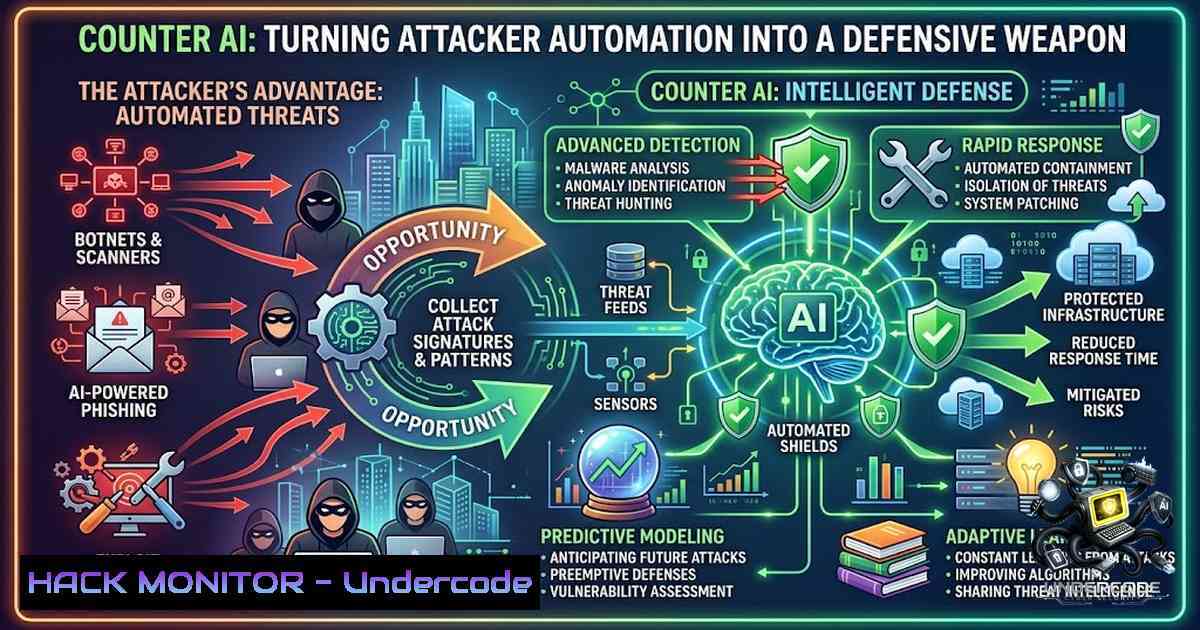
The first era of Cyber AI shifted the advantage decisively to the attacker. AI-powered attacks now move at machine speed, compressing the time from initial access to lateral movement to under 30 minutes—and in some cases, seconds. Even when defenders deploy AI, attackers retain the initiative, choosing the time, place, and first move. Defenders cannot win by running faster; they must change the equation entirely. Counter AI represents a paradigm shift that exploits the inherent dependencies of autonomous attacks, turning attacker automation from a force multiplier into a critical liability.
Learning Objectives:
- Understand the “cybersecurity speed gap” and why traditional defense strategies are obsolete against AI-powered threats
- Master the Counter AI framework—exploiting AI agent decision-making dependencies to disrupt the cyber kill chain
- Learn to implement proactive “Attack to Defend” strategies using adversary emulation and continuous validation
- Deploy advanced zero trust architecture with identity-aware controls for AI and non-human actors
- Operationalize AI-enabled cyber operations that move defenders from operators to orchestrators
You Should Know:
- The Cybersecurity Speed Gap: Why Human-Speed Defense Fails
AI has fundamentally altered the timeline of cyberattacks. What once required coordinated teams working for days can now be executed by a single operator in minutes. Vulnerabilities are now exploited within 24 hours of public disclosure—often before organizations even know they’re exposed. Many defense strategies still operate on human timelines: alerts reviewed in hours, decisions routed across teams, containment delayed until there’s confidence to act. By the time that process begins, attackers may already have established persistence.
This speed gap is widening rapidly. Attackers can now discover and weaponize vulnerabilities in minutes instead of weeks. The average breakout time from initial access to the ability to move into other systems dropped to under 30 minutes in 2025. Defending at human speed against machine-speed adversaries is no longer a strategy—it’s an acceptance of risk.
Step-by-Step Guide: Assessing Your Organization’s Speed Gap
- Measure Mean Time to Detect (MTTD) and Mean Time to Respond (MTTR) – Benchmark your current response capabilities against machine-speed threats. If your MTTD exceeds minutes, you’re already behind.
-
Conduct a Breach and Attack Simulation (BAS) – Use automated tools to continuously validate security controls. Many vulnerabilities are now exploited within 24 hours of disclosure.
-
Map Your Kill Chain Timeline – Document the time from initial access to each stage of the attack lifecycle. Identify where human decision-making introduces delays.
-
Implement Automated Containment Triggers – Deploy systems that can act on partial information when evidence meets predefined thresholds.
-
Run Regular “Red Team vs. AI” Exercises – Emulate AI-powered adversaries to test your defenses under realistic, machine-speed conditions.
Linux Command: Rapid IOC Hunting
 Search for suspicious processes with high CPU usage (potential crypto-mining or AI-driven malware)
ps aux --sort=-%cpu | head -20

Monitor network connections for beaconing patterns (AI malware often uses machine-speed C2)
ss -tunap | grep ESTAB | awk '{print $5}' | cut -d: -f1 | sort | uniq -c | sort -1r

Real-time log monitoring for rapid anomaly detection
tail -f /var/log/syslog | grep -E "FAILED|ERROR|unauthorized|denied" --line-buffered | while read line; do echo "[bash] $(date): $line"; done
Windows PowerShell: Machine-Speed Threat Detection
 Detect suspicious scheduled tasks (common AI malware persistence)
Get-ScheduledTask | Where-Object {$_.State -1e "Disabled"} | Select-Object TaskName, State, LastRunTime

Monitor for rapid privilege escalation attempts
Get-WinEvent -FilterHashtable @{LogName='Security'; ID=4672} -MaxEvents 50 | Select-Object TimeCreated, Message

Automated response trigger (example: block IP on multiple detections)
$threshold = 5
$failedLogins = Get-WinEvent -FilterHashtable @{LogName='Security'; ID=4625} -MaxEvents 100
if ($failedLogins.Count -gt $threshold) { New-1etFirewallRule -DisplayName "Block-MachineSpeed-Attacker" -Direction Inbound -Action Block -RemoteAddress (($failedLogins | ForEach-Object { $_.Properties[bash].Value }) | Select-Object -Unique) }
2. Counter AI: Exploiting the Attacker’s Dependency
Every autonomous attack depends on an AI agent’s ability to interpret its environment and determine the next step in the cyber kill chain. This dependency creates a new point of leverage. Counter AI exploits this weakness by disrupting attacker decision-making, buying defenders critical time to detect, contain, and respond.
The core insight is elegantly simple: attackers have automated their operations because automation scales. But automation is brittle. AI agents rely on environmental inputs to make decisions. By feeding these agents deceptive data, delaying their observations, or forcing them into decision loops, defenders can turn the attacker’s greatest advantage—speed—into a fatal weakness.
This is not about running faster. It’s about changing the game entirely.
Step-by-Step Guide: Implementing Counter AI Defenses
- Deploy Deception Technology – Use honeypots and decoy systems that feed AI agents misleading environmental data. When an attacker’s AI scans your network, it should see a fabricated reality.
-
Implement Network Segmentation with Dynamic Policies – Use micro-segmentation to limit AI agent visibility. Zero trust must extend to every entity on the network, including AI-enabled applications and the infrastructure that powers them.
-
Introduce Randomized Response Times – Add controlled latency to defensive responses. This can confuse AI agents that expect predictable patterns and force them into inefficient decision loops.
-
Deploy AI Agents That Learn Attacker Behavior – Use defensive AI that continuously learns from malware patterns and adapts over time. Train models on real adversary behaviors to predict, detect, and respond with extraordinary velocity.
-
Automate Deception at Scale – Use tools like Vellox Navigator (launching soon) for continuous monitoring and autonomous interpretation of enterprise compliance in real time.
API Security: Counter AI for API Abuse
 Example: Deploying deceptive API responses to confuse AI attackers
from flask import Flask, request, jsonify
import random
import time

app = Flask(<strong>name</strong>)

Honeypot API endpoints that return deceptive data
@app.route('/api/v1/users', methods=['GET'])
def get_users_deceptive():
 If request pattern matches automated scanning (high frequency)
if 'automated' in request.headers.get('User-Agent', '').lower():
 Return decoy data with randomized latency to confuse AI
time.sleep(random.uniform(0.5, 2.0))
return jsonify({
"users": [
{"id": "honeypot_001", "role": "admin", "status": "active"},
{"id": "honeypot_002", "role": "superuser", "status": "active"}
],
"_deception": True
})
return jsonify({"users": []})

Rate limiting with randomized thresholds to disrupt automated enumeration
@app.before_request
def rate_limit_with_jitter():
 Implement token bucket with jitter
pass
3. Attack to Defend: Proactive Adversary Emulation
“Attack to Defend” is a proactive approach that uses continuous validation, adversary emulation, and control testing to uncover weaknesses and attack paths before attackers do. Rather than waiting for threats to emerge, organizations apply the same techniques adversaries use to strengthen defenses.
Booz Allen operationalizes this through adversary emulation platforms that behave like autonomous attackers to identify vulnerabilities, then map these attack paths to implement defensive tradecraft. This approach transforms the defender’s mindset from reactive to proactive.
Tools like Vellox Striker (limited preview) emulate the AI-powered adversary to assess critical security gaps and train customer models to detect sophisticated threats. Vellox Ranger (limited preview) autonomously maps customer environments to surface and block adversary activity, reducing dwell time and cutting false positives.
Step-by-Step Guide: Building an Attack-to-Defend Program
- Establish Continuous Validation – Move beyond annual penetration tests to continuous security validation. Use automated tools that run daily, not yearly.
-
Deploy Adversary Emulation Platforms – Implement systems that behave like autonomous attackers to identify vulnerabilities.
-
Map Attack Paths to Defensive Controls – For each identified vulnerability, document the attack path and implement specific defensive tradecraft.
-
Train Defensive AI on Real Adversary Behaviors – Use models trained by elite cyber operators who defeat threats daily.
-
Integrate Findings into Zero Trust Architecture – Use insights from emulation to enforce strict, data-centric access controls.
Linux Command: Continuous Validation Script
!/bin/bash
 Continuous validation script - run daily via cron

Check for exposed SMB shares (common attack vector)
echo "[$(date)] Scanning for exposed SMB shares..."
nmap -p 445 --open <target-subnet> -oG - | grep "445/open" > /tmp/exposed_smb_$(date +%Y%m%d).txt

Check for default credentials in common services
echo "[$(date)] Checking for default credentials..."
hydra -l admin -p admin ssh://<target-ip> -t 4 -f 2>/dev/null && echo "WARNING: Default SSH credentials found!"

Validate firewall rules against known attack patterns
echo "[$(date)] Validating firewall rules..."
iptables -L -1 -v | grep -E "DROP|REJECT" > /tmp/firewall_rules_$(date +%Y%m%d).txt

Automated remediation trigger
if [ -s /tmp/exposed_smb_$(date +%Y%m%d).txt ]; then
echo "ALERT: Exposed SMB shares detected! Initiating automated containment..."
 Add automated remediation logic here
fi
4. Advanced Zero Trust for AI Environments
Partial zero trust implementations won’t keep pace with AI-powered attacks. Zero trust must extend to every entity on the network, including traditional applications, AI-enabled applications, and the infrastructure that powers them.
In AI environments, non-human actors are increasingly making or triggering decisions. AI agents need identities, context-aware access controls, and continuous validation just like human users. Every API should authenticate automated agents before allowing them to connect, act, or move data.
Step-by-Step Guide: Implementing Zero Trust for AI
- Inventory All AI Agents and Non-Human Actors – Document every automated entity in your environment. If it makes decisions, it needs an identity.
-
Implement Identity-Aware Access Controls – Assign unique identities to AI agents. Use short-lived credentials and continuous validation.
-
Enforce Least Privilege at Every Layer – Apply micro-segmentation and data-centric access controls. No entity should have more access than absolutely necessary.
-
Deploy Continuous Monitoring for AI Behavior – Use tools like Vellox Navigator for real-time controls assessment and risk mitigation.
-
Integrate Zero Trust with Adversary Emulation – Validate new controls under realistic pressure using AI-driven emulation.
Cloud Hardening: Azure Policy for AI Agent Identity
{
"properties": {
"displayName": "Enforce Managed Identity for AI Agents",
"policyType": "Custom",
"mode": "All",
"parameters": {},
"policyRule": {
"if": {
"allOf": [
{
"field": "type",
"equals": "Microsoft.MachineLearningServices/workspaces"
},
{
"field": "Microsoft.MachineLearningServices/workspaces/identity",
"exists": "false"
}
]
},
"then": {
"effect": "deny"
}
}
}
}
AWS CLI: Automated IAM Role Rotation for AI Services
 Force rotation of AI service roles
aws iam list-roles --query 'Roles[?contains(RoleName, <code>AIAgent</code>)].[bash]' --output text | while read role; do
echo "Rotating role: $role"
aws iam create-role --role-1ame "${role}-rotated-$(date +%s)" --assume-role-policy-document file://trust-policy.json
aws iam update-assume-role-policy --role-1ame $role --policy-document file://trust-policy.json
echo "Role $role rotated successfully"
done
5. AI-Enabled Cyber Operations: From Operator to Orchestrator
The third critical strategy shifts cyber operations from manual response to automated, AI-speed detection and containment. At AI speed, teams cannot rely on linear workflows; detection, investigation, and response must occur in parallel.
Organizations must be prepared to act on partial information, using automated containment triggers when evidence meets predefined thresholds. This transforms defenders from operators to orchestrators—managing AI agents rather than executing every action manually.
Tools like Vellox Reverser (generally available) automate exhaustive analysis of complex and evasive malware, producing actionable defensive recommendations in minutes. Vellox Responder (launching soon) provides autonomous security remediation to identify, contain, and remediate threats across cloud, infrastructure, and application layers prior to detection.
Step-by-Step Guide: Operationalizing AI-Speed Defense
- Automate Triage and Prioritization – Use AI to analyze alerts and prioritize based on risk. Reduce the noise so human analysts focus on what matters.
-
Deploy Parallel Investigation Workflows – Move beyond sequential investigation. Run multiple analyses simultaneously using AI agents.
-
Set Automated Containment Triggers – Define thresholds for automated action. When evidence meets the threshold, containment happens without human approval.
-
Implement Human-Agent Teaming – Design workflows where AI handles high-volume tasks and humans provide strategic oversight.
-
Continuous Learning and Adaptation – Use models that continuously learn from new threat patterns and adapt over time.
Vulnerability Exploitation and Mitigation: AI-Speed Patching
!/bin/bash
 Automated vulnerability patching at machine speed

Fetch latest CVEs affecting your environment
curl -s "https://services.nvd.nist.gov/rest/json/cves/2.0?pubStartDate=$(date -d '7 days ago' +%Y-%m-%dT00:00:00.000)" | jq '.vulnerabilities[] | .cve.id' > /tmp/recent_cves.txt

Cross-reference with installed packages
dpkg -l | grep -v ^ii | awk '{print $2}' > /tmp/installed_packages.txt

Identify vulnerable packages and patch
while read cve; do
echo "Checking $cve..."
 Query package associations (simplified)
 Deploy patches immediately for critical vulnerabilities
done < /tmp/recent_cves.txt

Automated remediation trigger for critical CVSS scores
curl -s "https://services.nvd.nist.gov/rest/json/cves/2.0?cvssV3Severity=CRITICAL" | jq '.vulnerabilities[] | .cve.id' | while read critical_cve; do
echo "CRITICAL: $critical_cve - Initiating emergency patch..."
 Automated patching logic here
done
What Undercode Say:
- Key Takeaway 1: The cybersecurity speed gap is the defining challenge of our era. Defenders cannot win by running faster—they must change the equation entirely. Counter AI exploits the inherent dependencies of autonomous attacks, turning attacker automation from an advantage into a critical vulnerability.
-
Key Takeaway 2: The future of cyber defense lies in human-agent teaming, not full automation. Defenders must become orchestrators of AI agents, not operators of individual tools. Organizations that master this transition will gain the decisive advantage in the machine-speed battlefield.
Analysis:
The Counter AI paradigm represents a fundamental shift in defensive strategy. For years, the cybersecurity industry has focused on improving detection speed—faster alerts, quicker response times, more automation. But as Brian Myers correctly observes, running faster doesn’t change the fundamental asymmetry: attackers choose when and where to strike.
Counter AI flips this dynamic by attacking the attacker’s automation itself. Every autonomous attack depends on an AI agent’s ability to interpret its environment and make decisions. By feeding these agents deceptive data, delaying their observations, or forcing them into decision loops, defenders can disrupt the entire attack chain.
This approach has profound implications for security architecture. Organizations must move beyond traditional perimeter defenses to deploy deception technology, advanced zero trust with identity-aware controls for AI agents, and continuous adversary emulation. The Vellox suite from Booz Allen represents a concrete implementation of these principles, pairing machine-speed automation with models trained by elite cyber operators.
The shift from operator to orchestrator is equally critical. Human analysts cannot compete with machine-speed attacks, but they can provide strategic oversight and decision-making that AI cannot replicate. The most effective defense will combine the speed of AI with the judgment of humans.
Prediction:
- +1 The Counter AI paradigm will become the dominant defensive framework within 24 months. Organizations that fail to adopt this approach will face escalating breach costs as AI-powered attacks become more sophisticated and frequent.
-
+1 The market for AI-1ative security products like Vellox will experience explosive growth, with spending on autonomous defense solutions surpassing $50 billion annually by 2028.
-
-1 The legal and regulatory landscape will struggle to keep pace. Existing liability frameworks remain inadequate for addressing autonomous AI-driven cybercrime, creating uncertainty that may slow adoption.
-
-1 Attackers will rapidly adapt to Counter AI defenses, developing more sophisticated AI agents that are resistant to deception and environmental manipulation. The arms race will continue, with defenders needing to constantly evolve their countermeasures.
▶️ Related Video (90% Match):
https://www.youtube.com/watch?v=lem8FItY_pQ
🎯Let’s Practice For Free:
🎓 Live Courses & Certifications:
Join Undercode Academy for Verified Certifications
🚀 Request a Custom Project:
Secure, high-velocity infrastructure and disruptive technological engineering. Contact our engineering team for high-tier development and proprietary systems:
[email protected]
💎 Smart Architecture | 🛡️ Secure by Design | ⭐ Trusted by Thousands
IT/Security Reporter URL:
Reported By: Brian Myers – Hackers Feeds
Extra Hub: Undercode MoN
Basic Verification: Pass ✅


