Listen to this Post
Introduction:
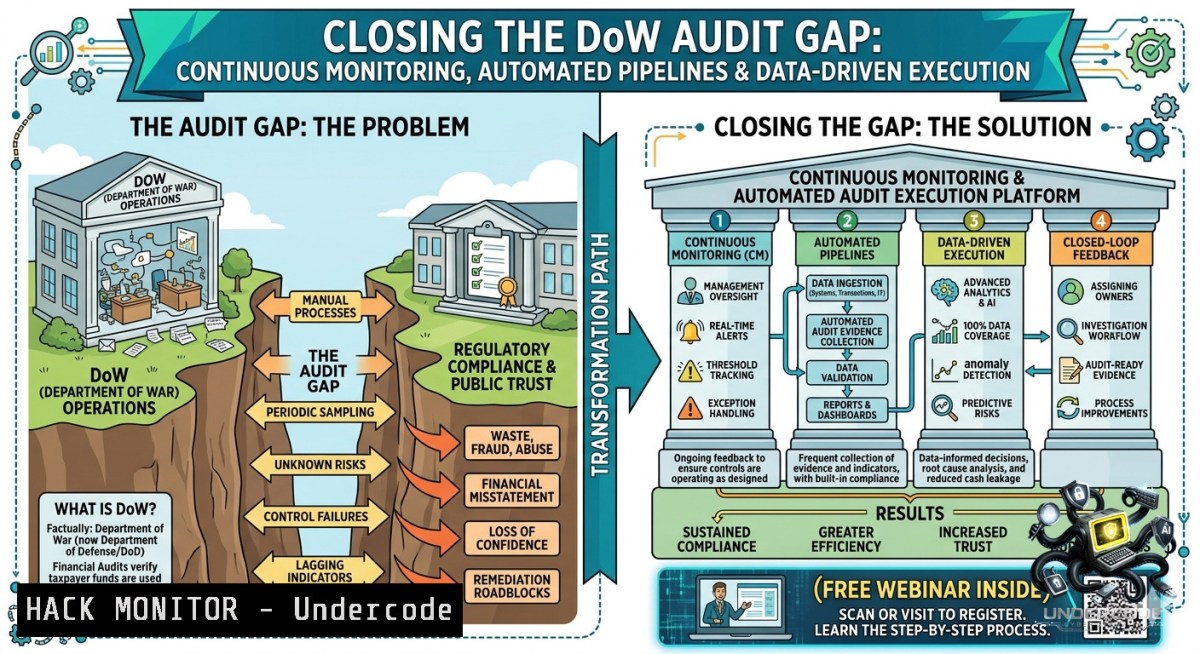
Federal audit expectations are accelerating beyond the capacity of traditional, periodic compliance models. For agencies like the Department of War (DoW), the shift toward continuous monitoring and automated evidence pipelines isn’t optional—it’s the only way to meet rising standards for data integrity, response speed, and audit trail completeness. This article breaks down the technical infrastructure needed to close that gap, including hands-on commands, tool configurations, and a free expert webinar.
Learning Objectives:
- Implement continuous monitoring agents to collect real-time system state and compliance evidence.
- Build automated evidence pipelines using open-source tools (Osquery, Elastic Stack, PowerShell) for federal audit readiness.
- Apply data-driven execution workflows that map technical controls to NIST 800-53 and DoW internal audit requirements.
You Should Know:
1. Continuous Monitoring with Osquery and Sysmon
Continuous monitoring replaces annual snapshots with second-by-second telemetry. Osquery exposes the operating system as a high-performance relational database, while Sysmon logs detailed process and network activity on Windows.
Step‑by‑step guide – Deploying Osquery on Linux for audit evidence:
– Install Osquery on Ubuntu/Debian:
`sudo apt update && sudo apt install osquery -y`
– Verify installation: `osqueryi –version`
– Run a live query for running processes (audit evidence):
`osqueryi “SELECT pid, name, path, cmdline FROM processes;”`
- Schedule automated collection via cron (evidence pipeline):
`crontab -e` → Add `/5 osqueryi –json “SELECT FROM processes” >> /var/log/audit_processes.log`Windows side – Enable Sysmon with a basic config:
- Download Sysmon from Microsoft Sysinternals.
- Install with a configuration file (download from SwiftOnSecurity’s template):
`Sysmon64.exe -accepteula -i sysmonconfig.xml`
- Forward logs to a central collector using Windows Event Forwarding (WEF) or PowerShell:
`wevtutil epl Microsoft-Windows-Sysmon/Operational C:\AuditData\sysmon.evtx`
2. Automated Evidence Pipelines Using Elastic Stack (ELK)
ELK (Elasticsearch, Logstash, Kibana) transforms raw logs into queryable, visual evidence. For DoW compliance, you need to ensure data integrity and tamper-proof hashing.
Step‑by‑step guide – Building a minimal audit pipeline:
- Install Elasticsearch (single-1ode for lab):
`wget -qO – https://artifacts.elastic.co/GPG-KEY-elasticsearch | sudo apt-key add -`
`sudo apt install elasticsearch`
`sudo systemctl start elasticsearch`
- Install Logstash and configure input from Osquery JSON logs:
Create `/etc/logstash/conf.d/audit.conf` with:
input { file { path => "/var/log/audit_processes.log" codec => json } }
output { elasticsearch { hosts => ["localhost:9200"] index => "audit-evidence-%{+YYYY.MM.dd}" } }
– Start Logstash: `sudo systemctl start logstash`
– Verify evidence ingestion: `curl -X GET “localhost:9200/audit-evidence-/_search?pretty”`
Automation hint: Use `logstash` to also compute SHA-256 of each event before sending – create a fingerprint for chain of custody.
- Data-Driven Execution with PowerShell Desired State Configuration (DSC)
DSC enforces and reports system state, making it ideal for federal audit evidence of configuration compliance (e.g., CIS benchmarks).
Step‑by‑step guide – DSC audit for Windows Server:
- Install the DSC module:
`Install-Module -1ame PSDesiredStateConfiguration -Force`
- Write a configuration that enforces audit policy:
Configuration AuditConfig { Node "localhost" { Registry AuditPolicy { Key = "HKLM:\SOFTWARE\Microsoft\Windows\CurrentVersion\Policies\System\Audit" ValueName = "AuditSystemEvents" ValueData = 1 Ensure = "Present" } } } - Generate and apply:
`AuditConfig -OutputPath ./AuditConfig`
`Start-DscConfiguration -Path ./AuditConfig -Wait -Verbose`
- Generate compliance report: `Get-DscConfiguration` → pipe to `Out-File C:\AuditData\dsc_state.json`
- API Security and Evidence Integrity for Cloud-Hosted DoW Systems
When federal systems move to cloud (e.g., AWS GovCloud), audit evidence must include API call logs. Misconfigured APIs are a top finding.
Step‑by‑step guide – Harden API logging with AWS CloudTrail + custom checks:
– Enable CloudTrail for all read/write events:
`aws cloudtrail create-trail –1ame dow-audit –s3-bucket-1ame dow-audit-logs –is-multi-region-trail`
`aws cloudtrail start-logging –1ame dow-audit`
- Query for unauthorized attempts using AWS CLI:
`aws cloudtrail lookup-events –lookup-attributes AttributeKey=EventName,AttributeValue=UnauthorizedOperation`
- Set up CloudWatch alarm for `ConsoleLogin` failures:
aws logs put-metric-filter --log-group-1ame CloudTrail/DefaultLogGroup --filter-1ame "ConsoleLoginFailure" --filter-pattern '{ ($.eventName = ConsoleLogin) && ($.errorMessage = "Failed authentication") }' --metric-transformations metricName=LoginFailure,metricNamespace=DoW,metricValue=1
- Vulnerability Exploitation and Mitigation – The Audit Gap Root Cause
Many audit failures stem from unpatched vulnerabilities. An automated evidence pipeline must include vulnerability scan results and remediation proof.
Step‑by‑step guide – Automate vulnerability evidence with OpenVAS:
- Install OpenVAS (GVM) on a Ubuntu audit server:
`sudo apt install gvm -y`
`sudo gvm-setup` (wait for admin password)
- Run a targeted scan against a DoW test asset:
`gvm-cli –gmp-username admin –gmp-passwordsocket –socketpath /var/run/gvmd.sock –xml “ … “`
– Automate weekly scans via cron and push results to Elastic:
`gvm-cli … –xml “” | jq . > /var/lib/gvm/reports/latest.json`
– Mitigation step: patch critical CVEs and re-scan – store both pre/post reports as audit evidence.
For Linux systems: Use `lynis` for quick security audit:
`sudo lynis audit system –quick –1o-colors | tee /var/log/audit/lynis_$(date +%F).log`
6. Training Course Alignment – From Theory to Continuous Compliance
The free webinar linked below maps directly to hands-on skills in federal audit automation. To deepen expertise, pursue training in:
– NIST Risk Management Framework (RMF) Step 6 – Monitor
– ISC2 CISSP – Domain 1 (Security and Risk Management)
– SANS SEC540: Cloud Security and DevSecOps Automation
Recommended labs: Build a home lab with Kali Linux (attacker) and Ubuntu Server (target). Simulate a control failure (e.g., disabled auditd), then detect it via Osquery scheduled query, automatically generate an alert, and remediate via Ansible. This closes the “detection to evidence” loop.
What Undercode Say:
- The widening audit gap is not a people problem—it’s a pipeline problem. Shifting from point-in-time to continuous evidence generation reduces response delays from weeks to minutes.
- Automated evidence pipelines must include cryptographic integrity (hashing each event) and role-based access to logs to satisfy federal chain-of-custody rules. Without that, even automated data is inadmissible.
-
The post correctly identifies the core tension: rising audit standards vs. outdated execution models. The solution lies in treating compliance as code—defining controls in version-controlled scripts (Terraform, Ansible) and generating evidence through CI/CD-style pipelines. However, agencies underestimate the cultural shift required: audit teams must learn to query live data instead of requesting spreadsheets. The webinar link (https://ow.ly/ASlX50YNI4a) offers a free starting point, but long-term success demands embedding these practices into system development lifecycles. Expect resistance from manual auditors—automation exposes inefficiencies they’ve relied on.
Prediction:
- +1 Federal audit offices will mandate continuous monitoring as a baseline control by 2027, driving adoption of open-source stacks (Osquery, Elastic) over legacy GRC tools.
- -1 Without standardized evidence schemas, agencies will drown in automated alerts and logs—leading to “alert fatigue” and missed critical findings, especially in hybrid cloud environments.
- +1 AI-driven audit assistants will emerge to parse telemetry and auto-generate evidence packages, cutting audit prep time by 60% but requiring new oversight to prevent hallucinated compliance claims.
- -1 The Department of War and similar high-security agencies will face a talent shortage: only 15% of federal IT staff currently possess skills in both automation and federal audit frameworks (e.g., FISCAM, NIST 800-53A).
▶️ Related Video (78% Match):
https://www.youtube.com/watch?v=7DayAMsncEI
🎯Let’s Practice For Free:
🎓 Live Courses & Certifications:
Join Undercode Academy for Verified Certifications
🚀 Request a Custom Project:
Secure, high-velocity infrastructure and disruptive technological engineering. Contact our engineering team for high-tier development and proprietary systems:
[email protected]
💎 Smart Architecture | 🛡️ Secure by Design | ⭐ Trusted by Thousands
IT/Security Reporter URL:
Reported By: Dowaudit Federalaudit – Hackers Feeds
Extra Hub: Undercode MoN
Basic Verification: Pass ✅


