Listen to this Post
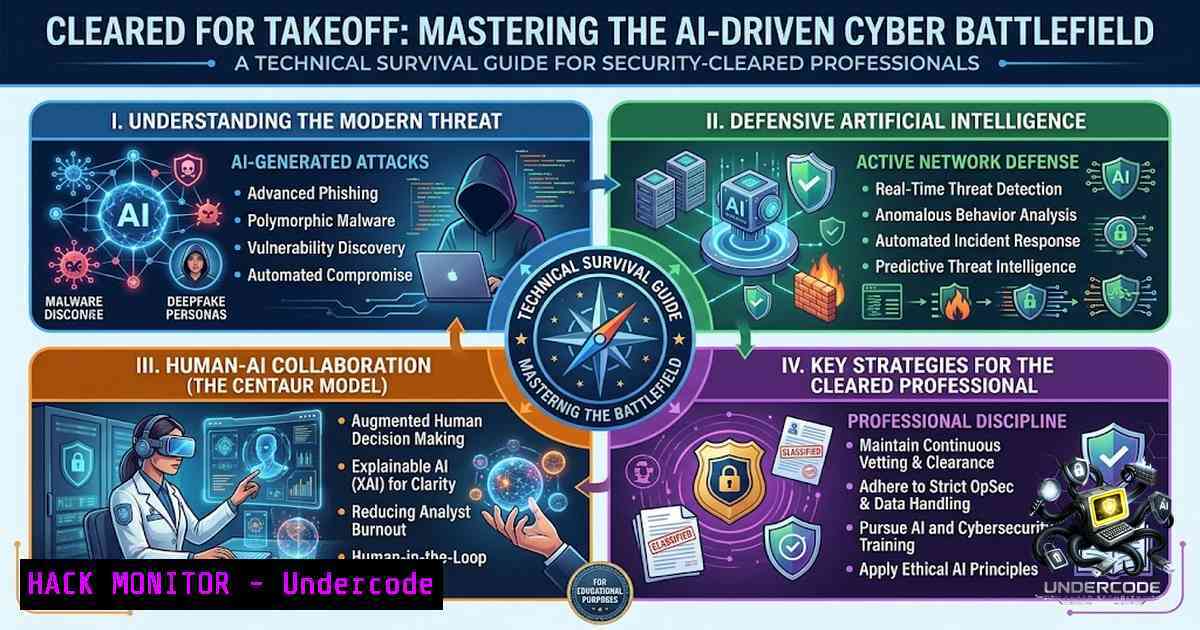
Introduction:
The modern cybersecurity landscape is no longer a static fortress; it is a dynamic, AI-infused battlefield where threat actors and defenders engage in an asymmetric war of attrition. For professionals holding active U.S. security clearances, the convergence of artificial intelligence, cloud-1ative architectures, and sophisticated cyber-physical systems has created a paradigm shift, demanding a skillset that transcends traditional perimeter defense. As organizations like Leidos, BAE Systems, and the Applied Research Laboratory aggressively recruit for roles ranging from Senior AI Engineers to DevSecOps architects, the ability to demonstrate hands-on proficiency with everything from Kubernetes security to quantum-resistant cryptography is no longer optional—it is the new baseline for career survival and advancement【7†L1-L5】【11†L1-L6】.
Learning Objectives:
- Master the core technical competencies required for modern cleared roles, including AI/ML security, DevSecOps pipelines, and cloud hardening.
- Acquire actionable, step-by-step methodologies for configuring secure systems, auditing network perimeters, and automating threat intelligence feeds.
- Understand the intersection of quantum computing risks and current cryptographic standards, and how to future-proof critical infrastructure.
You Should Know:
- Hardening the AI Supply Chain: From Model Poisoning to Adversarial Robustness
The proliferation of AI engineers in cleared spaces introduces a new attack surface: the machine learning (ML) pipeline. Threat actors are increasingly targeting the data and models themselves, employing techniques like data poisoning, model inversion, and adversarial example generation to compromise decision-making systems. A Senior AI Engineer at Leidos, for instance, must not only build models but also fortify them against these emergent threats【7†L1】.
Step‑by‑step guide to implement a basic adversarial robustness validation layer:
This process involves integrating a defensive distillation or adversarial training step into your ML pipeline. Below is a conceptual Python snippet using the `cleverhans` library to evaluate a model’s vulnerability to a Fast Gradient Sign Method (FGSM) attack.
 Install required libraries: pip install tensorflow cleverhans
import tensorflow as tf
from cleverhans.future.tf2.attacks import fast_gradient_method
from cleverhans.future.tf2.utils import get_model

<ol>
<li>Load your pre-trained model (assuming a standard Keras model)
model = tf.keras.models.load_model('path/to/your/cleared_model.h5')</p></li>
<li><p>Wrap the model for CleverHans compatibility
clever_model = get_model(model)</p></li>
<li><p>Generate a sample input (e.g., a single image or data point)
sample_input = tf.random.normal([1, 28, 28, 1])  Example for MNIST</p></li>
<li><p>Generate adversarial examples using FGSM (epsilon controls perturbation magnitude)
epsilon = 0.1  Small perturbation to evade detection
adv_example = fast_gradient_method(clever_model, sample_input, epsilon, np.inf)</p></li>
<li><p>Evaluate model performance on adversarial vs. clean inputs
clean_prediction = model.predict(sample_input)
adv_prediction = model.predict(adv_example)
print(f"Clean confidence: {tf.reduce_max(clean_prediction, axis=1)}")
print(f"Adversarial confidence: {tf.reduce_max(adv_prediction, axis=1)}")
What this does: This script generates a perturbed input that is visually identical to the original but designed to fool the model. By integrating this into a CI/CD pipeline, you can establish a baseline robustness score that must be met before any model is deployed to production, directly mitigating the risk of adversarial AI attacks highlighted in roles like the Quantum & Multiphysics R&D Engineer at Penn State【7†L20】.
2. DevSecOps Pipeline Hardening: Securing the Build-to-Deploy Lifecycle
The DevSecOps Engineer role at BAE Systems underscores a critical industry shift: security must be embedded into every stage of the software development lifecycle【11†L4】. This means moving beyond simple SAST/DAST scans to implementing runtime application self-protection (RASP) and policy-as-code. A compromised CI/CD pipeline can be a golden ticket for attackers, allowing them to inject malicious code directly into production artifacts.
Step‑by‑step guide for implementing policy-as-code with Open Policy Agent (OPA) in a Kubernetes environment:
This tutorial focuses on enforcing a security policy that prevents the deployment of containers running as root—a common and critical misconfiguration.
- Install OPA and Gatekeeper: Deploy OPA as an admission controller in your Kubernetes cluster.
Using Helm to install Gatekeeper
helm repo add gatekeeper https://open-policy-agent.github.io/gatekeeper/charts
helm install gatekeeper/gatekeeper --1ame-template=gatekeeper --1amespace gatekeeper-system --create-1amespace
-
Create a ConstraintTemplate: This defines the reusable logic for your policy. Save the following as
constraint-template.yaml.apiVersion: templates.gatekeeper.sh/v1 kind: ConstraintTemplate metadata: name: k8srequiredlabels spec: crd: spec: names: kind: K8sRequiredLabels targets:</p></li> </ol> <p>- target: admission.k8s.gatekeeper.sh rego: | package k8srequiredlabels violation[{"msg": msg, "details": {"missing_labels": missing}}] { provided := {label | input.review.object.metadata.labels[bash]} required := {label | label := input.parameters.labels[bash]} missing := required - provided count(missing) > 0 msg := sprintf("you must provide labels: %v", [bash]) }(Note: This is a basic template; for root enforcement, the Rego policy would check
input.review.object.spec.containers.securityContext.runAsNonRoot</code>). <ol> <li>Apply the Constraint: Enforce the policy on a specific namespace. [bash] kubectl apply -f constraint-template.yaml
What this does: This setup ensures that any deployment violating the defined security policy (e.g., running as root) is automatically rejected by the Kubernetes API server. This shifts security left, reducing the attack surface and aligning with the stringent requirements of roles like the DevSecOps Engineer【11†L4】.
- Cloud and Linux Systems Hardening: Beyond the Baseline
The Senior Linux/Cloud Sys Admin role at Penn State requires more than just provisioning instances; it demands a deep understanding of system hardening in multi-tenant, classified environments【7†L16】. With the ubiquity of cloud-1ative technologies, misconfigured S3 buckets and overly permissive IAM roles remain top attack vectors. Automated compliance scanning using tools like `OpenSCAP` and `cloudsplaining` is essential.
Step‑by‑step guide for auditing Linux system security against the DISA STIG benchmark:
The Defense Information Systems Agency (DISA) Security Technical Implementation Guides (STIGs) are the gold standard for DoD systems. Here’s how to automate a STIG compliance scan on a RHEL/CentOS system.
- Install OpenSCAP: This is the upstream version of the SCAP Security Guide.
sudo yum install openscap-scanner scap-security-guide -y
-
Run a STIG Scan: Execute a scan using the DISA STIG profile for RHEL 8.
sudo oscap xccdf eval --profile xccdf_org.ssgproject.content_profile_stig --results stig-results.xml --report stig-report.html /usr/share/xml/scap/ssg/content/ssg-rhel8-ds.xml
-
Review the Report: Open the generated `stig-report.html` in a browser. It will provide a detailed list of passing and failing rules, complete with remediation steps.
Example remediation for a failed rule (e.g., ensuring auditd is installed)
sudo yum install auditd -y
sudo systemctl enable auditd && sudo systemctl start auditd
What this does: This scan provides a comprehensive, government-standard security posture assessment. Automating this as a weekly cron job ensures continuous compliance, directly addressing the core responsibilities of a Linux/Cloud Sys Admin in a cleared environment【7†L16】.
4. Network Perimeter Defense: Zero Trust and Micro-Segmentation
The Network Systems Engineer – Cyber role at Leidos and the Network Transport Engineer at Penn State highlight the critical need for network-level defenses that operate on a Zero Trust model【7†L3】【7†L18】. This involves moving away from implicit trust based on network location to explicit verification of every request. Micro-segmentation, often implemented via software-defined networking (SDN) and tools like `Calico` or Cilium, is key to containing breaches.
Step‑by‑step guide for implementing network policies in Kubernetes for micro-segmentation:
This example uses Kubernetes NetworkPolicies to restrict traffic between pods, a fundamental Zero Trust control.
- Ensure your CNI supports NetworkPolicy: Calico and Cilium are popular choices. Verify with:
kubectl get pods --1amespace=kube-system | grep calico
-
Create a Default Deny Policy: This ensures that all ingress traffic is blocked unless explicitly allowed. Save as
default-deny.yaml.apiVersion: networking.k8s.io/v1 kind: NetworkPolicy metadata: name: default-deny-ingress spec: podSelector: {} policyTypes:</p></li> </ol> <p>- IngressApply it: `kubectl apply -f default-deny.yaml`
- Create an Allow Policy for a Specific Application: Allow traffic only from the frontend pod to the backend pod on port 8080.
apiVersion: networking.k8s.io/v1
kind: NetworkPolicy
metadata:
name: allow-frontend-to-backend
spec:
podSelector:
matchLabels:
app: backend
policyTypes:</li>
</ol>

- Ingress
ingress:
- from:
- podSelector:
matchLabels:
app: frontend
ports:
- protocol: TCP
port: 8080
What this does: This enforces strict micro-segmentation, ensuring that even if an attacker compromises the frontend pod, they cannot laterally move to other services without an explicit policy. This is a foundational practice for any network security role in a cleared setting【7†L3】.
- Securing the Windows Ecosystem: Active Directory and Endpoint Hardening
Despite the cloud push, Windows systems remain pervasive, particularly in roles like the Windows Systems Administrator at Leidos and Amentum【7†L6】【7†L14】. Active Directory (AD) remains a prime target for attackers using techniques like Kerberoasting and Pass-the-Hash. Hardening Windows endpoints and AD is non-1egotiable.
Step‑by‑step guide for mitigating Kerberoasting attacks:
Kerberoasting allows an attacker with a valid domain account to request a service ticket (TGS) for any service account and then crack it offline. Here’s how to audit and harden your environment.
- Audit Service Accounts with Weak Passwords: Use PowerShell to find accounts with `ServicePrincipalName` (SPN) set and check their password age.
Run from a Domain Controller or with RSAT tools Get-ADUser -Filter {ServicePrincipalName -1e "$null"} -Properties ServicePrincipalName, PasswordLastSet, Enabled | Select-Object Name, ServicePrincipalName, PasswordLastSet, Enabled | Export-Csv -Path "C:\Temp\ServiceAccounts.csv" -1oTypeInformation -
Implement Managed Service Accounts (gMSA): Where possible, migrate services to use Group Managed Service Accounts. These automatically manage password rotation, eliminating the human-created weak passwords.
Create a gMSA (requires Domain Controller running Windows Server 2012+)
New-ADServiceAccount -1ame "svc_App01" -DNSHostName "app01.contoso.com" -PrincipalsAllowedToRetrieveManagedPassword "Domain Computers"
Install the gMSA on a specific server
Install-ADServiceAccount -Identity "svc_App01"
-
Enable Advanced Audit Policies: Monitor for Event ID 4769 (Kerberos service ticket request) to detect suspicious TGS requests.
Configure advanced audit policy via Group Policy or local policy
auditpol /set /subcategory:"Kerberos Service Ticket Operations" /success:enable /failure:enable
What this does: This process identifies vulnerable service accounts and migrates them to a secure, automatically managed solution, dramatically reducing the risk of credential theft and lateral movement—a key concern for any Windows Systems Administrator【7†L6】.
What Undercode Say:
- The "Shift-Left" Imperative is Now a Contractual Obligation: In the cleared space, security isn't just a best practice; it's a compliance mandate. The job descriptions from DCMA and others explicitly require embedding security into the earliest phases of development and operations, turning DevSecOps from a buzzword into a billable skill【7†L28】【11†L4】.
- Quantum Readiness is the Next Frontier: The inclusion of a "Quantum & Multiphysics R&D Engineer" role at Penn State is a bellwether【7†L20】. While practical quantum computers aren't yet breaking RSA, the race to develop post-quantum cryptography (PQC) has begun. Professionals who understand lattice-based cryptography and the implications of Shor's algorithm will be the vanguard of the next decade's cyber defense.
Prediction:
- +1 The demand for AI security specialists will outpace supply by 300% within the next three years, driving massive salary premiums for those who can demonstrate practical model-hardening skills.
- -1 The integration of AI into cyber operations will inevitably lead to a major, publicly disclosed incident where an AI system is successfully poisoned, prompting a temporary regulatory freeze on autonomous defense systems.
- +1 The adoption of Zero Trust architectures, fueled by mandates like Executive Order 14028, will create a sustained boom for network engineers and cloud architects with deep expertise in micro-segmentation and identity-aware proxies.
- -1 The complexity of modern DevSecOps pipelines will introduce new classes of software supply chain vulnerabilities, with malicious packages targeting build environments becoming the primary vector for nation-state actors.
- +1 Quantum-resistant algorithms will be standardized by NIST within the next 18 months, initiating a massive, multi-year migration effort that will require a specialized workforce of cryptographers and systems engineers, directly benefiting those with the foresight to upskill now.
▶️ Related Video (76% Match):
🎯Let’s Practice For Free:
🎓 Live Courses & Certifications:
Join Undercode Academy for Verified Certifications
🚀 Request a Custom Project:
Secure, high-velocity infrastructure and disruptive technological engineering. Contact our engineering team for high-tier development and proprietary systems:
[email protected]
💎 Smart Architecture | 🛡️ Secure by Design | ⭐ Trusted by ThousandsIT/Security Reporter URL:
Reported By: Kennethfuller Your - Hackers Feeds
Extra Hub: Undercode MoN
Basic Verification: Pass ✅🔐JOIN OUR CYBER WORLD [ CVE News • HackMonitor • UndercodeNews ]
📢 Follow UndercodeTesting & Stay Tuned:
- Create an Allow Policy for a Specific Application: Allow traffic only from the frontend pod to the backend pod on port 8080.


