Listen to this Post
Introduction:
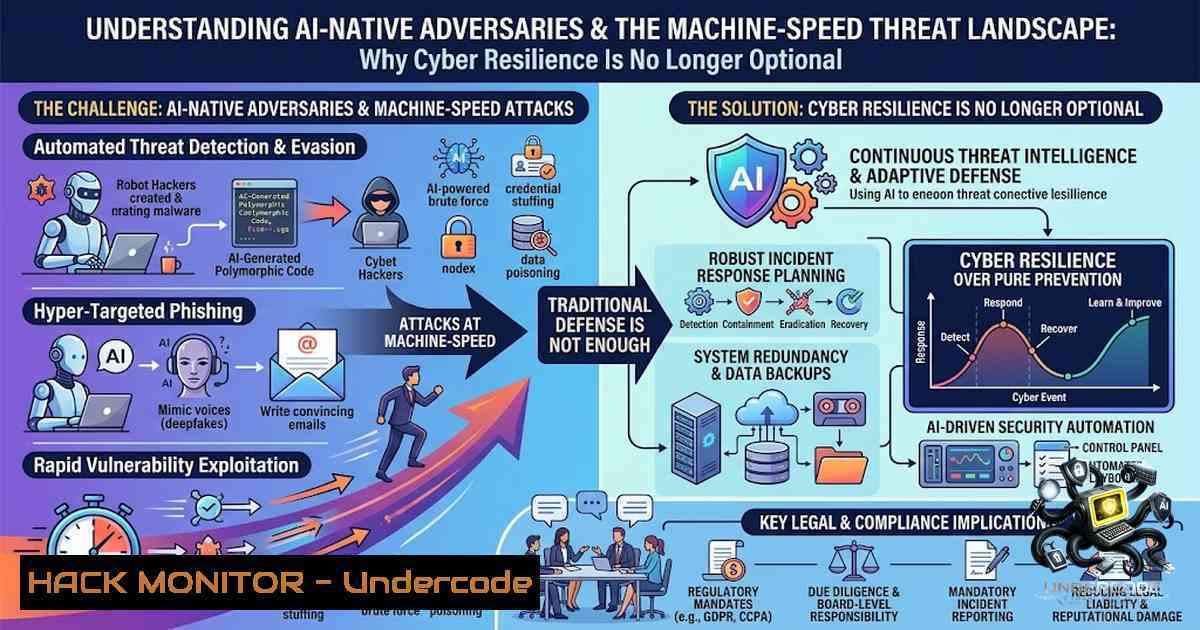
The theoretical risk of AI-powered cyberattacks has officially crossed into confirmed operational reality. In May 2026, Google’s Threat Intelligence Group (GTIG) documented the first confirmed zero-day exploit developed using artificial intelligence—crafted by a criminal group to bypass two-factor authentication at mass scale. As discussions at the Future Crime Summit 2026 hosted by the Future Crime Research Foundation (FCRF) reinforced, cybersecurity is no longer about responding to threats—it is about staying ahead of them in an environment where attack timelines are compressing from weeks to days. This article examines the evolving AI-driven threat landscape, provides actionable technical guidance for defenders, and outlines the collaborative ecosystem required to build true cyber resilience.
Learning Objectives:
- Understand the six confirmed AI-enabled attack vectors and how they are reshaping the cyber threat landscape.
- Master practical defense strategies including continuous exposure management, automated threat monitoring, and real-time behavioral surveillance.
- Learn to implement cyber resilience frameworks aligned with NIST Cybersecurity Framework 2.0 and CERT-In’s AI Cybersecurity Blueprint.
You Should Know:
1. The Six Confirmed AI-Enabled Attack Vectors
The theoretical risk of AI-powered attacks has become operational reality. Google’s Threat Intelligence Group has documented six distinct AI-enabled attack modes now active in the wild:
- Vector 1: AI-generated zero-day exploit development – Threat actors are using large language models to discover and weaponize software vulnerabilities. The first confirmed case involved an AI-generated exploit targeting an open-source web administration tool to bypass 2FA at scale.
- Vector 2: Polymorphic malware for defense evasion – AI-generated code that continuously mutates to evade signature-based detection.
- Vector 3: Autonomous malware with self-directing AI commands – Malware that uses AI to make independent decisions about lateral movement and execution.
- Vector 4: Agentic recon and information operations at scale – Autonomous AI agents conducting reconnaissance and influence operations without human intervention.
- Vector 5: Obfuscated LLM access via middleware pipelines – Attackers hiding malicious AI activity through compromised middleware.
- Vector 6: AI supply chain attacks as initial access vectors – Attackers targeting AI software dependencies—inference libraries, model APIs, and platform integrations—as entry points into broader enterprise networks.
Sophos’s AI Security 2026 Report confirms that attackers are compressing attack timelines from weeks to days, with identity, OAuth tokens, and AI agents emerging as prime targets. The report also documents a surge in AI-powered social engineering and deepfakes now being used as operational tools.
Step-by-Step Guide: Defending Against AI-Enabled Attack Vectors
Step 1: Implement AI Supply Chain Security
- Maintain an inventory of all AI models, APIs, libraries, and dependencies in use.
- Vet third-party AI providers and assess their security posture. The IMF warns that 76% of financial institutions depend on a single AI provider, creating systemic risk.
- Monitor for shadow AI usage—unauthorized AI tools deployed without security review.
Step 2: Adopt Continuous Exposure Management
CERT-In’s Blueprint emphasizes moving from periodic to continuous security assessments:
– Deploy continuous vulnerability scanning across all systems.
– Implement real-time monitoring of digital systems and proactive exposure management.
– Establish aggressive remediation timelines: patch known exploited vulnerabilities affecting internet-facing systems within 12 hours, critical externally exposed vulnerabilities within 1 day, and high-severity vulnerabilities within 5 days.
Step 3: Deploy Machine-Speed Defensive Countermeasures
As emphasized at the Future Crime Summit 2026 panel, traditional perimeter defenses are insufficient:
– Implement continuous threat monitoring across all environments.
– Deploy automated security orchestration to respond to threats in real-time.
– Establish real-time behavioral surveillance frameworks capable of detecting and isolating malicious telemetry before catastrophic system compromises occur.
Step 4: Secure AI Identities and OAuth Tokens
With identity becoming the primary initial access vector, organizations must:
– Govern AI agent credentials and access permissions rigorously.
– Monitor OAuth connections and API keys for unauthorized usage.
– Implement zero-trust architecture with workload-level isolation at every internal boundary.
Linux/Windows Commands for AI Threat Defense
Linux – Continuous Log Monitoring for Anomalous AI Activity:
 Monitor for unauthorized API calls to AI services
sudo journalctl -f | grep -E "api|ai|model|inference" | while read line; do
echo "$(date): $line" >> /var/log/ai_monitor.log
done

Detect unusual outbound connections to AI service endpoints
sudo tcpdump -i any -1 "dst port 443" | grep -E "openai|anthropic|cohere|huggingface"

Scan for exposed AI model files and credentials
sudo find / -type f ( -1ame ".pth" -o -1ame ".h5" -o -1ame ".onnx" -o -1ame "key" -o -1ame "secret" ) -exec ls -la {} \;
Windows – PowerShell for AI Security Monitoring:
 Monitor for AI-related processes
Get-Process | Where-Object { $_.ProcessName -match "python|node|ai|model|tensorflow" }

Check for unauthorized AI service access in event logs
Get-WinEvent -LogName Security | Where-Object { $_.Message -match "api|ai|model" }

Audit OAuth token usage and permissions
Get-AzureADServicePrincipal | Where-Object { $_.AppDisplayName -match "ai|model|api" }
- Building Cyber Resilience: Before, During, and After an Attack
Cyber resilience addresses the complete attack lifecycle: what happens before, during, and after an incident. The NIST Cybersecurity Framework 2.0 structures resilience around six core functions: Govern, Identify, Protect, Detect, Respond, and Recover. As one industry expert noted, ransomware doesn’t care about your firewall—it cares whether you can recover before your business bleeds out.
Step-by-Step Guide: Implementing a Cyber Resilience Framework
Phase 1: Before Attack – Prevention and Hardening
- Maintain a complete inventory of hardware, software, and data assets.
- Conduct ongoing risk assessments—not just annual audits.
- Deploy automated patch management, endpoint hardening, and DNS filtering.
- Ensure backups are immutable, encrypted, and tested regularly.
Phase 2: During Attack – Detection and Response
- Implement 24/7 monitoring with behavioral detection capabilities.
- Deploy automated response to isolate infected endpoints, terminate malicious processes, and revoke compromised credentials.
- IBM’s 2025 report found organizations now average 241 days to identify and contain breaches—the goal is catching threats early, before encryption begins.
Phase 3: After Attack – Recovery and Adaptation
- Prioritize restoration of critical systems to minimize downtime.
- Conduct post-incident reviews to adapt strategies based on lessons learned.
- Update detection rules and response playbooks based on incident findings.
- The Collaborative Ecosystem: Why No Single Organization Can Do It Alone
As Smith Gonsalves emphasized at the Future Crime Summit, cybersecurity is a continuously evolving domain where no single organization can address tomorrow’s challenges alone. It requires a strong ecosystem of researchers, industry leaders, law enforcement, government agencies, academia, and enterprises working together to stay ahead of emerging threats.
The FCRF, an IIT Kanpur AIIDE CoE–incubated non-profit institution, has been at the forefront of bridging critical gaps between law, technology, and enforcement. Its training arm, FCRF Academy, offers structured certification programs including the Certified AI-Powered SOC Analyst (CAISA) program, a 16-module certification covering SOC operations, AI-assisted investigation, and threat intelligence. The academy has trained thousands of professionals across government agencies, law enforcement bodies, financial institutions, and the corporate sector.
India’s national cybersecurity strategy reflects this collaborative approach. In May 2026, CERT-In released its “Blueprint for Reducing Exposure and Defending against AI-Assisted Vulnerabilities Exploitation in Digital Infrastructure,” recognizing that advanced AI platforms may fundamentally transform the cyber threat landscape across digital infrastructure. The Ministry of Electronics and Information Technology has emphasized that India has “no other option” but to build domestic capabilities in artificial intelligence and cybersecurity.
- AI-Powered Social Engineering and Deepfakes: The Human Element
AI-assisted social engineering and deepfakes are now operational tools that make scams more scalable, more convincing across languages, and cheaper to produce. Voice, face, documents, and live video can now be forged convincingly and are widely used in multi-channel social engineering attacks. A recent incident cited in Sophos’s report involved a UK-based victim drawn into a fake AI-powered investment platform through months of AI-themed lessons and coordinated messaging, losing hundreds of thousands of pounds.
Step-by-Step Guide: Defending Against AI-Powered Social Engineering
Step 1: Implement Multi-Factor Authentication (MFA) with Phishing-Resistant Methods
– Deploy FIDO2/WebAuthn security keys instead of SMS or TOTP-based MFA.
– Educate users that even MFA can be bypassed by AI-generated social engineering.
Step 2: Establish Deepfake Detection Protocols
- Implement AI-driven detection tools for synthetic media.
- Train employees to verify identity through out-of-band channels (e.g., call back on a known number) before approving financial transactions or sensitive requests.
Step 3: Deploy Continuous Behavioral Monitoring
- Monitor for unusual user behavior that may indicate account compromise.
- Implement real-time behavioral surveillance to detect and isolate malicious telemetry.
- The Future of Cyber Defense: AI as Both Shield and Sword
While AI equips attackers with powerful new tools, it is also being used to strengthen defense. AI agents can proactively search for software vulnerabilities and automatically patch code. As AI-driven threats continue to grow, establishing effective security measures has become more urgent than ever.
Check Point Research’s 2026 AI Security Report notes that AI now participates directly at every stage of the attack chain, from writing malware to executing commands inside live networks. However, defensive AI is also advancing. Security researchers are using generative AI to create realistic adversarial variants of malware, training security models to be more robust and anticipatory.
What Undercode Say:
- The AI threat is no longer theoretical—it is operational and accelerating. Organizations must move from periodic security assessments to continuous exposure management.
- Cyber resilience is the new cybersecurity standard. Prevention alone is insufficient; organizations must be prepared to detect, respond, and recover from machine-speed attacks.
- Collaboration across the ecosystem—government, industry, academia, and law enforcement—is essential for staying ahead of emerging threats. No single organization can do it alone.
Prediction:
- +1 The cybersecurity industry will see accelerated adoption of AI-powered defensive tools, with AI-1ative Security Operations Centers becoming the standard within 18-24 months. Organizations that fail to adopt continuous monitoring and automated response capabilities will face increasingly severe breach consequences.
- -1 The democratization of AI-powered attack tools will lead to a surge in cybercrime-as-a-service offerings, enabling less sophisticated threat actors to launch machine-speed attacks. This will disproportionately impact mid-sized organizations that lack dedicated security teams.
- -1 Regulatory frameworks will struggle to keep pace with AI-enabled threats. As Dr. Pavan Duggal noted at the Future Crime Summit, no international jurisdiction has yet established legal personhood for autonomous algorithms, creating severe evidentiary and attribution challenges.
- +1 Collaborative initiatives like the FCRF’s CAISA program will play a critical role in building the cybersecurity workforce needed to defend against AI-1ative adversaries.
- -1 The concentration risk identified by the IMF—where 76% of financial institutions depend on a single AI provider—poses a systemic threat that could trigger cascading failures across the financial sector if a single provider is compromised.
- +1 National cybersecurity strategies, including India’s CERT-In Blueprint, will drive the adoption of aggressive remediation timelines and continuous monitoring requirements, raising the baseline security posture across critical infrastructure sectors.
▶️ Related Video (80% Match):
🎯Let’s Practice For Free:
🎓 Live Courses & Certifications:
Join Undercode Academy for Verified Certifications
🚀 Request a Custom Project:
Secure, high-velocity infrastructure and disruptive technological engineering. Contact our engineering team for high-tier development and proprietary systems:
[email protected]
💎 Smart Architecture | 🛡️ Secure by Design | ⭐ Trusted by Thousands
IT/Security Reporter URL:
Reported By: Smithgonsalves Futurecrimesummit – Hackers Feeds
Extra Hub: Undercode MoN
Basic Verification: Pass ✅


