Listen to this Post
Introduction:
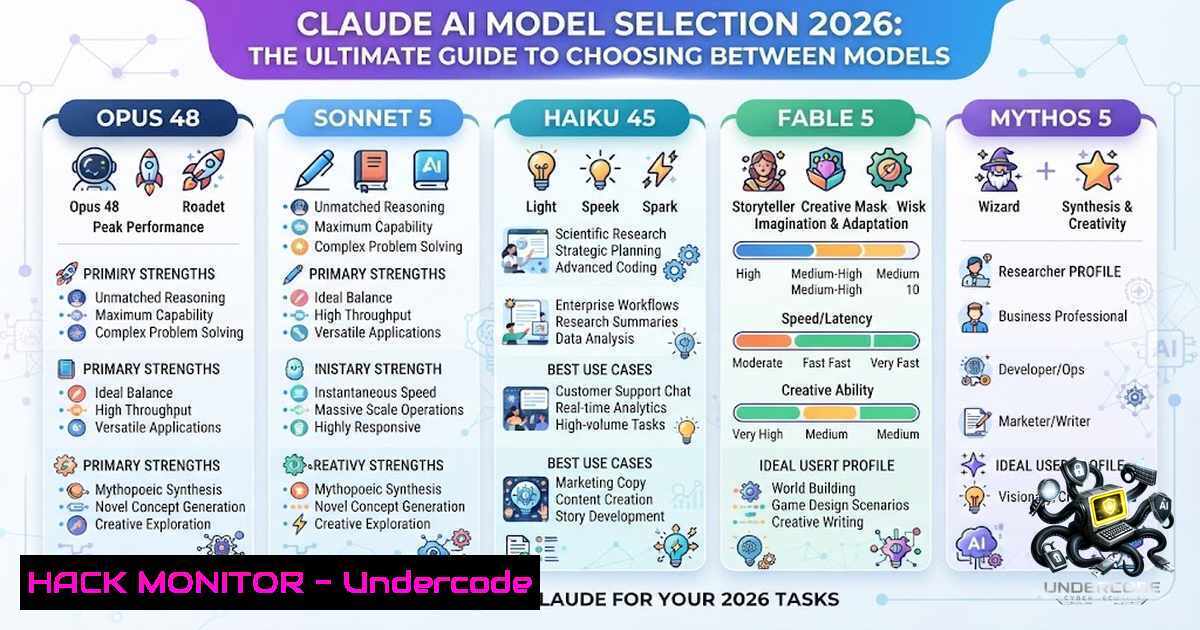
The landscape of large language models has evolved dramatically with Anthropic’s 2026 lineup, introducing five distinct Claude models spanning from ultra-fast, low-cost options to enterprise-grade reasoning powerhouses. Choosing the wrong model can inflate your API costs by 5x or more while delivering unnecessary capabilities—or worse, underpowering your application with insufficient reasoning for complex agentic workflows. This guide breaks down every model’s pricing, performance characteristics, and ideal use cases, complete with practical API implementation guides for both Linux and Windows environments.
Learning Objectives:
- Master the capability, speed, cost, and effort trade-offs across all five Claude 2026 models
- Implement production-ready API calls using cURL, Python SDK, and batch processing patterns
- Optimize token usage and costs through prompt caching, effort parameters, and model fallback strategies
- Claude Model Lineup 2026: Complete Capability & Cost Breakdown
Anthropic’s 2026 model portfolio spans five tiers, each with distinct pricing, context windows, and reasoning capabilities. Here is the complete comparison:
| Model | Input Price (per 1M tokens) | Output Price (per 1M tokens) | Context Window | Max Output | Best For |
|-|-|–|-||-|
| Claude Haiku 4.5 | $1.00 | $5.00 | 200K tokens | 64K tokens | High-speed, low-cost chatbots & APIs |
| Claude Sonnet 5 | $2.00 (intro until 8/31/26), then $3.00 | $10.00 (intro), then $15.00 | 1M tokens | 128K tokens | Balanced production agents & coding |
| Claude Opus 4.8 | $5.00 | $25.00 | 1M tokens | 128K tokens | Complex reasoning & enterprise AI |
| Claude Fable 5 | $10.00 | $50.00 | 1M tokens | 128K tokens | Long-horizon agentic work |
| Claude Mythos 5 | $10.00 | $50.00 | 1M tokens | 128K tokens | Advanced enterprise & research (limited release) |
The Effort Parameter: New Claude models let you adjust the “effort” level—higher effort delivers better reasoning but slower responses and higher cost, while lower effort is faster and cheaper.
Step‑by‑step: Calculating Your Monthly Token Costs
- Estimate your average input tokens per request (prompts + context)
2. Estimate your average output tokens per response
3. Multiply by your daily request volume
- Apply the per-million token rate for your chosen model
- Add prompt caching savings (up to 90% cost reduction)
Example: 5,000 requests/day × 3,000 input tokens + 400 output tokens on Haiku 4.5 costs approximately $761/month.
- Getting Started: Claude API Authentication & Environment Setup
Before making any API calls, you need an Anthropic API key and proper environment configuration.
Linux/macOS Setup:
 Install the Anthropic Python SDK
pip install anthropic

Set your API key as an environment variable
export ANTHROPIC_API_KEY="sk-ant-your-api-key-here"

Verify it's set
echo $ANTHROPIC_API_KEY
Windows (Command Prompt) Setup:
 Install the Anthropic Python SDK
pip install anthropic

Set your API key as an environment variable
set ANTHROPIC_API_KEY=sk-ant-your-api-key-here

Verify it's set
echo %ANTHROPIC_API_KEY%
Windows (PowerShell) Setup:
 Install the Anthropic Python SDK
pip install anthropic

Set your API key as an environment variable
$env:ANTHROPIC_API_KEY = "sk-ant-your-api-key-here"

Verify it's set
echo $env:ANTHROPIC_API_KEY
Never hardcode your API key in source files—always use environment variables or a `.env` file with python-dotenv.
- Making Your First API Call: cURL & Python Implementation
The Claude API uses the Messages endpoint at `https://api.anthropic.com/v1/messages`. Here are working implementations for both cURL and Python.
cURL Request (Linux/macOS):
curl https://api.anthropic.com/v1/messages \
-H "x-api-key: $ANTHROPIC_API_KEY" \
-H "anthropic-version: 2023-06-01" \
-H "content-type: application/json" \
-d '{
"model": "claude-sonnet-5",
"max_tokens": 1024,
"messages": [
{"role": "user", "content": "Explain the difference between Claude Sonnet 5 and Opus 4.8 in one paragraph."}
]
}'
cURL Request (Windows Command Prompt):
curl https://api.anthropic.com/v1/messages ^
-H "x-api-key: %ANTHROPIC_API_KEY%" ^
-H "anthropic-version: 2023-06-01" ^
-H "content-type: application/json" ^
-d "{\"model\":\"claude-sonnet-5\",\"max_tokens\":1024,\"messages\":[{\"role\":\"user\",\"content\":\"Explain the difference between Claude Sonnet 5 and Opus 4.8 in one paragraph.\"}]}"
Python SDK Implementation:
import os
from anthropic import Anthropic

Initialize client (automatically reads ANTHROPIC_API_KEY from environment)
client = Anthropic()

response = client.messages.create(
model="claude-sonnet-5",
max_tokens=1024,
messages=[
{"role": "user", "content": "Explain the difference between Claude Sonnet 5 and Opus 4.8 in one paragraph."}
]
)

print(response.content[bash].text)
Understanding the Response Object:
A successful call returns HTTP 200 with a typed Message object containing:
– `content
.text` – The actual response text
- `stop_reason` – Why generation stopped (end_turn, max_tokens, or refusal)
- `usage` – Input and output token counts for billing

<h2 style="color: yellow;">4. Model Selection Decision Framework</h2>

The right model depends on four factors: capability needs, speed requirements, cost constraints, and effort level.

<h2 style="color: yellow;">Option 1: Start Small with Claude Haiku 4.5</h2>

<h2 style="color: yellow;">Use Haiku 4.5 if you are:</h2>

<ul>
<li>Building your first prototype</li>
<li>Creating chatbots</li>
<li>Processing large volumes of requests</li>
<li>Looking for low cost and fast responses</li>
</ul>

Haiku 4.5 supports a 200K token context window with function calling, vision, reasoning, and prompt caching. At $1/$5 per million tokens, it's the most economical choice for high-volume workloads.

<h2 style="color: yellow;">Option 2: Balanced Production with Claude Sonnet 5</h2>

Sonnet 5 is the most agentic Sonnet model yet, capable of making plans, using tools like browsers and terminals, and running autonomously at a level that previously required Opus-class models. At intro pricing of $2/$10 through August 31, 2026, it undercuts Opus 4.8 by roughly 60%.

<h2 style="color: yellow;">Option 3: Maximum Reasoning with Claude Opus 4.8</h2>

Opus 4.8 excels at complex coding, research, advanced reasoning, and autonomous AI agents. The fast mode runs at 2.5× speed of standard mode. Use this when your application demands the absolute highest quality and the budget supports it.

<h2 style="color: yellow;">Option 4: Long-Horizon Agents with Claude Fable 5</h2>

Fable 5 is Anthropic's most capable widely released model, built for the most demanding reasoning and long-horizon agentic work. It includes safety classifiers that can decline certain requests. At $10/$50 per million tokens, it's premium-priced for premium capability.

<h2 style="color: yellow;">Option 5: Enterprise Research with Claude Mythos 5</h2>

Mythos 5 shares Fable 5's capabilities without safety classifiers, available only in limited release through Project Glasswing. It keeps advanced cyber capabilities available for vetted users.

<ol>
<li>Advanced Optimization: Prompt Caching, Batch Processing & Effort Tuning</li>
</ol>

<h2 style="color: yellow;">Prompt Caching (Up to 90% Cost Savings)</h2>

When you send repeated context across multiple requests, prompt caching automatically stores and reuses it, dramatically reducing costs. Cacheable content includes system prompts, tool definitions, and large document contexts.

<h2 style="color: yellow;">Batch Processing (50% Cost Savings)</h2>

For non-urgent workloads, batch processing delivers 50% cost savings. Submit requests in batches and receive results within 24 hours.

<h2 style="color: yellow;">Effort Parameter Tuning</h2>

The `effort` parameter (low/medium/high/xhigh) lets you control reasoning depth:
- Low effort – Fastest, cheapest, suitable for simple tasks
- Medium effort – Balanced for most production workloads
- High effort – Maximum reasoning, slower, more expensive
- Xhigh effort – Reserved for the most complex problems

<h2 style="color: yellow;">Step‑by‑step: Implementing Prompt Caching in Python</h2>

[bash]
import anthropic

client = anthropic.Anthropic()

System prompt and tools are automatically cached
response = client.messages.create(
model="claude-sonnet-5",
max_tokens=1024,
system="You are a coding assistant. [LONG SYSTEM PROMPT HERE]",
messages=[
{"role": "user", "content": "Review this code for security issues..."}
],
 The SDK automatically handles caching for repeated content
)

Check cache usage in response
print(f"Cache creation: {response.usage.cache_creation_input_tokens}")
print(f"Cache read: {response.usage.cache_read_input_tokens}")
- Handling Refusals & Fallback Strategies for Claude Fable 5
Claude Fable 5 includes safety classifiers that can decline certain requests. When a request is refused, the Messages API returns `stop_reason: “refusal”` as a successful HTTP 200 response, not an error.
Three Fallback Approaches:
Server-side fallback (beta): Pass the `fallbacks` parameter to have the API automatically retry on another Claude model.
Client-side fallback: Use the SDK to detect refusals and retry with a different model.
Manual fallback: In your application logic, check for `stop_reason == “refusal”` and resubmit the request to Sonnet 5 or Opus 4.8.
Example: Handling Refusals in Python
import anthropic

client = anthropic.Anthropic()

try:
response = client.messages.create(
model="claude-fable-5",
max_tokens=1024,
messages=[{"role": "user", "content": "[YOUR REQUEST]"}]
)

if response.stop_reason == "refusal":
print("Request refused by safety classifiers.")
 Fallback to Sonnet 5
fallback_response = client.messages.create(
model="claude-sonnet-5",
max_tokens=1024,
messages=[{"role": "user", "content": "[YOUR REQUEST]"}]
)
print(fallback_response.content[bash].text)
else:
print(response.content[bash].text)
except Exception as e:
print(f"API error: {e}")
- Cross-Platform Deployment: AWS, Google Cloud, Azure & Self-Hosted
Claude models are available across multiple cloud platforms:
- Anthropic API (Direct) – Native access with full feature support
- Amazon Web Services – Claude Platform on AWS with Claude Opus 4.8
- Google Cloud Vertex AI – Claude Opus 4.8 and Sonnet 5
- Microsoft Azure AI Foundry – Claude Opus 4.8 and Haiku 4.5
API Endpoint Comparison:
- Anthropic Direct: `https://api.anthropic.com/v1/messages`
- AWS Bedrock: Platform-specific endpoint with same request body
- Google Vertex AI: Platform-specific endpoint with same request body
- Azure Foundry: Platform-specific endpoint with same request body
The request body is identical across platforms; only authentication and the endpoint host change.
What Undercode Say:
- Cost-performance optimization is the new frontier. With Sonnet 5 delivering Opus 4.8-level performance at 60% of the cost, the days of defaulting to the most expensive model are over. Smart developers will implement dynamic model routing based on task complexity.
-
The effort parameter changes everything. The ability to dial reasoning depth up or down gives unprecedented control over the cost-performance trade-off. This is particularly valuable for production systems where every millisecond and every token counts.
-
Fable 5’s safety classifiers signal a new era. Anthropic’s decision to build safety directly into the most capable model, with Mythos 5 restricted to vetted users, represents a mature approach to AI deployment. Developers must now plan for refusals and fallback strategies as first-class concerns.
-
The 1M token context window is now table stakes. With four of five 2026 models supporting 1M tokens, applications can process entire codebases, books, or days of support conversations in a single request. This fundamentally changes what’s possible with AI agents.
-
Prompt caching and batch processing are mandatory for production. The 90% and 50% cost savings respectively make these optimization techniques essential for any serious deployment. Ignoring them is leaving money on the table.
Prediction:
-
+1 Sonnet 5 will become the default model for 80%+ of production AI workloads by Q4 2026, with Opus 4.8 reserved exclusively for the most demanding reasoning tasks. The price-performance gap is simply too wide to ignore.
-
+1 The effort parameter will evolve into a standard feature across all major LLM providers, enabling fine-grained cost control that transforms AI from a fixed-cost utility into a variable-cost resource optimized per request.
-
-1 Organizations that fail to implement prompt caching and batch processing will see their AI budgets balloon by 50-90% unnecessarily, creating competitive disadvantages against more cost-conscious rivals.
-
+1 Fable 5’s safety classifiers will become a blueprint for responsible AI deployment, with other providers adopting similar tiered safety approaches. This will accelerate enterprise adoption by addressing compliance and security concerns head-on.
-
-1 The complexity of managing multiple models, effort levels, caching strategies, and fallback logic will create a new skills gap. AI engineers who cannot navigate this multi-dimensional optimization space will struggle to deliver cost-effective solutions.
-
+1 The 1M token context window combined with Fable 5’s long-horizon agentic capabilities will unlock entirely new categories of applications—from automated codebase refactoring to comprehensive document analysis—that were previously impossible due to context limitations.
▶️ Related Video (64% Match):
https://www.youtube.com/watch?v=-owcXHEVjPM
🎯Let’s Practice For Free:
🎓 Live Courses & Certifications:
Join Undercode Academy for Verified Certifications
🚀 Request a Custom Project:
Secure, high-velocity infrastructure and disruptive technological engineering. Contact our engineering team for high-tier development and proprietary systems:
[email protected]
💎 Smart Architecture | 🛡️ Secure by Design | ⭐ Trusted by Thousands
IT/Security Reporter URL:
Reported By: Kartik Mogalapalli – Hackers Feeds
Extra Hub: Undercode MoN
Basic Verification: Pass ✅


