Listen to this Post
Introduction:
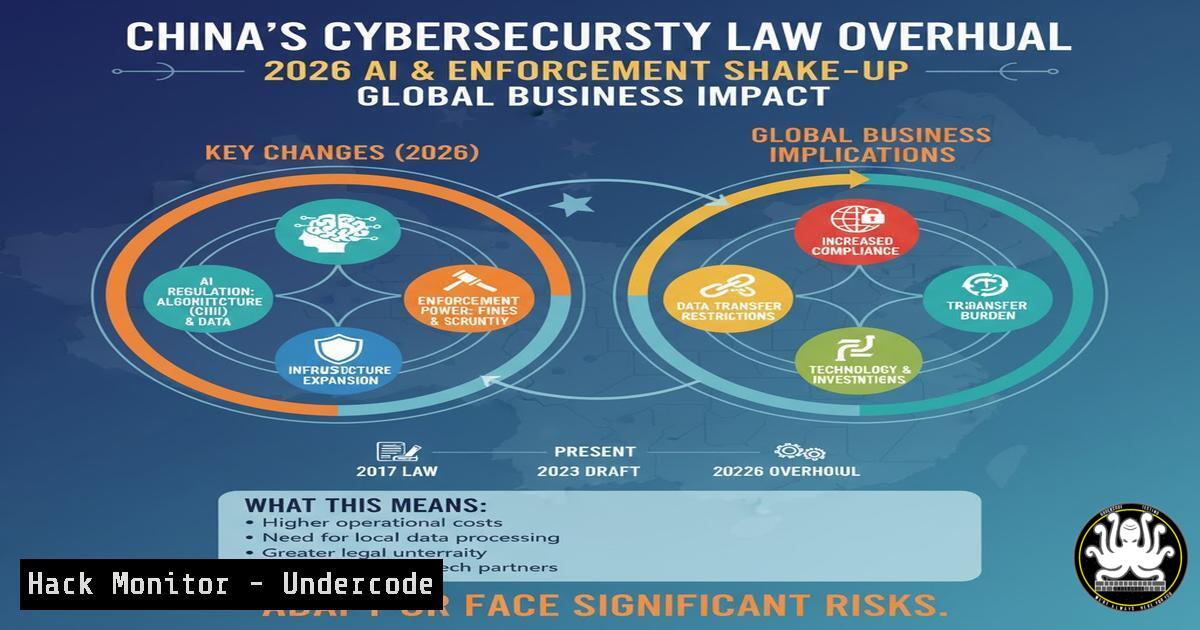
China has enacted the first major revision of its Cybersecurity Law since 2017, setting a new global precedent for digital governance. The updated legislation, effective January 1, 2026, directly regulates artificial intelligence for the first time and grants regulators expansive new enforcement and extraterritorial powers. This legal shift demands immediate attention from any organization operating in or with China, requiring a strategic reassessment of data governance, AI deployment, and compliance frameworks.
Learning Objectives:
- Understand the new AI governance and safety requirements under the revised law.
- Analyze the expanded enforcement mechanisms, including heightened penalties and extraterritorial reach.
- Develop a technical and procedural action plan to achieve and maintain compliance.
You Should Know:
1. Decoding the New AI Governance Mandates
The amendment formally brings AI systems under the umbrella of state-guided cybersecurity, emphasizing “ethical guidelines, safety checks, and governance mechanisms.” While detailed technical standards are forthcoming, organizations must proactively establish governance frameworks. This involves creating auditable trails for AI decision-making and implementing robust testing protocols.
Step‑by‑step guide explaining what this does and how to use it.
Step 1: Establish an AI Model Inventory. Catalog all AI and machine learning models in use, including their data sources, purposes, and risk classifications. A simple command to search for common ML framework files in a project directory could be:
`find /path/to/project -name “.py” | xargs grep -l “import tensorflow\|import torch\|from sklearn”`
Step 2: Implement Model Versioning and Auditing. Use tools like MLflow or DVC (Data Version Control) to track model lineages, including the exact data and code used for each training iteration. This creates the necessary audit trail.
Step 3: Integrate Pre-deployment Safety Checks. Develop a mandatory testing pipeline that includes bias detection, adversarial robustness testing, and output validation before any model is deployed to a production environment.
2. Navigating Expanded Enforcement and Penalty Regimes
The revised law significantly raises the stakes for non-compliance. Regulators now have the authority to impose heavier fines on both companies and responsible individuals, moving beyond critical infrastructure to encompass a wider range of network operations.
Step‑by‑step guide explaining what this does and how to use it.
Step 1: Conduct a Comprehensive Gap Analysis. Map your current security controls against the high-level requirements of the new law and the existing 2017 framework (e.g., Multi-Level Protection Scheme – MLPS 2.0). Identify areas of highest risk.
Step 2: Enhance Internal Audit Logging. Ensure all administrative actions, access to sensitive data, and system changes are logged immutably. On a Linux system, configure `auditd` to monitor critical files:
`sudo auditctl -w /etc/passwd -p wa -k identity_access`
`sudo auditctl -w /etc/shadow -p wa -k identity_access`
Step 3: Develop an Incident Response Playbook for Regulatory Scrutiny. This playbook should outline steps for evidence preservation, internal communication, and engagement with Chinese authorities, ensuring a coordinated and compliant response.
3. Preparing for the Law’s Broadened Extraterritorial Scope
A critical change allows Chinese authorities to take action against foreign activities deemed a “network security threat,” even without a direct link to China’s Critical Information Infrastructure (CII). This means foreign companies with minimal presence in China could face sanctions if their services or software are implicated in a security incident affecting Chinese entities.
Step‑by‑step guide explaining what this does and how to use it.
Step 1: Map Data Flows with Chinese Entities. Identify all points of interaction: APIs, data transfers, software supply chains, and user access from Chinese IP ranges. For web servers, regularly review logs for traffic originating from China:
`awk ‘{print $1}’ /var/log/nginx/access.log | grep -f chinese_ip_ranges.txt | sort | uniq -c | sort -nr`
Step 2: Harden Internet-Facing APIs. APIs are a primary attack vector. Implement strict authentication (OAuth 2.0), rate limiting, and comprehensive input validation. Use a tool like OWASP ZAP to test for vulnerabilities:
`zap-baseline.py -t https://yourapi.example.com`
Step 3: Software Supply Chain Security. Harden your software development lifecycle (SDLC). Scan dependencies for vulnerabilities and mandate code signing.
` Scan a Python project for vulnerable dependencies using safety<h2 style="color: yellow;">safety check -r requirements.txt`
4. Leveraging AI for Proactive Cybersecurity Management
The law encourages using AI to bolster cybersecurity defenses. This presents an opportunity to align compliance with advanced threat detection and operational efficiency.
Step‑by‑step guide explaining what this does and how to use it.
Step 1: Deploy AI-Powered SIEM/SOAR. Integrate Security Information and Event Management (SIEM) systems with AI-driven analytics to detect anomalies and automate responses (SOAR) to common threats, reducing mean time to respond (MTTR).
Step 2: Implement User and Entity Behavior Analytics (UEBA). Use machine learning to establish baselines of normal behavior for users and systems, flagging deviations that may indicate a compromised account or insider threat.
Step 3: Automate Vulnerability Management. Utilize AI tools to prioritize patching based on exploitability, asset criticality, and active threat intelligence, ensuring resources are focused on the most critical risks.
5. Technical Hardening for Critical Systems
While the law’s specifics are pending, aligning with global best practices for system hardening is a prudent step towards compliance.
Step‑by‑step guide explaining what this does and how to use it.
Step 1: Enforce Principle of Least Privilege. Regularly review user and service account permissions. On Windows, use PowerShell to audit local administrator group memberships:
`Get-LocalGroupMember -Group “Administrators”`
Step 2: Encrypt Data at Rest and in Transit. Mandate TLS 1.3 for all web services and use full-disk encryption or database-level encryption for sensitive data stores.
Step 3: Network Segmentation. Isolate critical network segments to limit the lateral movement of attackers. Use firewall rules to enforce segmentation and monitor for unauthorized connection attempts.
What Undercode Say:
- Compliance is Now a Strategic Feature, Not a Checkbox. For businesses in or touching China, demonstrating robust compliance with this law will become a competitive differentiator and a prerequisite for market access.
- The Global Standard is Being Rewritten. China is using its market size to export its digital governance model. Other nations may emulate its AI-first approach to cybersecurity regulation, making understanding this law essential even for organizations outside its direct jurisdiction.
Analysis: The 2026 update to China’s Cybersecurity Law represents a fundamental shift from a domestic framework to a tool of global techno-governance. By explicitly integrating AI and asserting extraterritorial authority, China is forcing the world to play by its digital rules. For multinational corporations, this creates a complex compliance web where a software vulnerability discovered in a product sold globally could trigger sanctions from Beijing. The vague definition of what constitutes a “network security threat” grants regulators maximum flexibility, introducing significant legal and operational uncertainty. Organizations must now treat their entire digital footprint as a potential vector for regulatory action, necessitating a unified, company-wide strategy that merges legal, technical, and risk management functions.
Prediction:
The 2026 enforcement of China’s revised Cybersecurity Law will accelerate the fragmentation of the global internet into distinct regulatory spheres. We predict a rise in “digital sovereignty” laws from other major economies, mirroring China’s approach. This will force multinational tech firms to develop region-specific product versions and data handling procedures, increasing costs and complexity. Within two years, we anticipate the first major sanctions against a well-known foreign tech company under the extraterritoriality clause, creating a landmark case that will define the practical boundaries of the law and spark international diplomatic tensions.
🎯Let’s Practice For Free:
IT/Security Reporter URL:
Reported By: Richardstaynings China – Hackers Feeds
Extra Hub: Undercode MoN
Basic Verification: Pass ✅


