
Listen to this Post
Introduction:
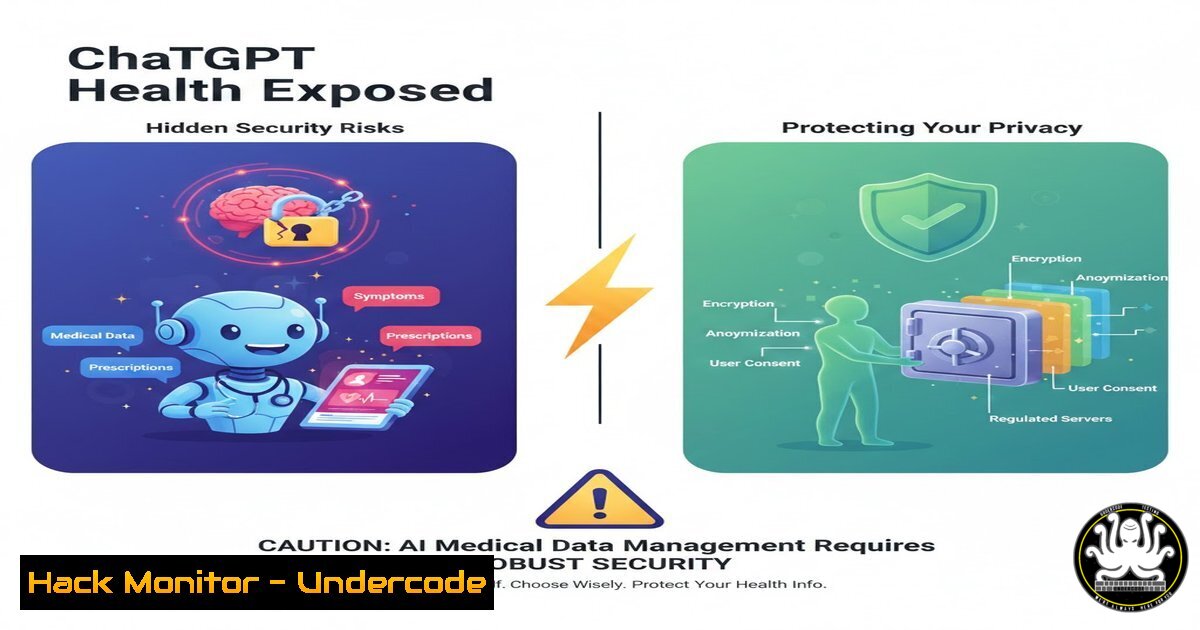
OpenAI’s launch of ChatGPT Health introduces a paradigm where artificial intelligence directly interfaces with sensitive personal health data, promising to demystify medical terminology and streamline wellness planning. This convergence of AI and healthcare data, while innovative, creates a complex threat landscape where data privacy, secure API integrations, and robust access controls are not just features but critical safeguards. The technical architecture enabling connections to platforms like Apple Health and MyFitnessPal must be scrutinized through the lens of cybersecurity to prevent sensitive biometric and medical information from becoming a new attack vector.
Learning Objectives:
- Understand the critical security architecture required for AI-health data integrations, including API security and data segregation.
- Learn to implement and verify robust data sanitization and deletion procedures for sensitive health information.
- Develop a framework for auditing AI-driven health applications for compliance with regulations like HIPAA and GDPR.
You Should Know:
- The Architecture of Health Data Segregation & Privacy Boundaries
The post highlights that “health chats stay completely separate from regular conversations, with their own privacy boundaries.” Technically, this implies logical and physical data isolation at the database, processing, and network levels.
Step‑by‑step guide explaining what this does and how to use it.
Concept: Data segregation prevents a compromise in the general ChatGPT environment from spilling over into health data. This is typically achieved through separate database schemas, encryption key sets, and strict access control lists (ACLs).
Implementation Check (Linux): If you were hosting a similar service, you could audit process isolation. For a containerized setup using Docker, you might list containers and inspect their network namespaces.
 List all Docker containers and their labels
docker ps --format "table {{.Names}}\t{{.Labels}}"
 Inspect the network namespace of a specific container (e.g., 'chatgpt-health-core')
docker inspect --format '{{.NetworkSettings.SandboxKey}}' chatgpt-health-core
What this does: The first command lists running containers, where you might look for distinct containers labeled for health data processing. The second command reveals the path to the network namespace, indicating isolation from other containers.
- Securing Third-Party API Integrations (Apple Health, Peloton, MyFitnessPal)
The service connects to external health apps. Each connection point is a potential OAuth token leak or data exfiltration channel if not hardened.
Step‑by‑step guide explaining what this does and how to use it.
Concept: API integrations must use strict OAuth 2.0 scopes, short-lived tokens, and audit all data requests. The principle of least privilege is paramount.
Security Verification Commands (Using `curl` for API Testing): You can simulate and test API security posture.
 1. Test for overly permissive CORS headers on the API endpoint (replace with dummy endpoint)
curl -H "Origin: https://malicious-site.com" -X OPTIONS https://api.chatgpt-health.com/v1/data -I | grep -i "access-control-allow-origin"
 2. Check if HTTP Strict Transport Security (HSTS) is enforced
curl -I https://api.chatgpt-health.com | grep -i "strict-transport-security"
What this does: The first command checks if the API incorrectly allows requests from any origin (“), a critical misconfiguration. The second verifies the use of HSTS, which forces HTTPS and prevents downgrade attacks.
3. Data Sanitization & Immutable Deletion Procedures
A commenter asks, “can you fully delete it versus just hiding it from view?” This is a core data integrity and privacy requirement.
Step‑by‑step guide explaining what this does and how to use it.
Concept: “Soft deletes” (flagging data as inactive) are insufficient for regulated health data. True deletion requires secure erasure from primary storage, backups, and logs.
Implementation Example (Pseudocode & Linux Command): A secure deletion routine must be part of the data lifecycle.
 Pseudocode for a secure deletion pipeline
def secure_health_data_deletion(user_id, record_id):
 1. Cryptographically shred data before deletion (overwrite with random data)
overwrite_sectors_in_database(record_id, passes=3)
 2. Remove entry from primary database
db.execute("DELETE FROM health_records WHERE id = ?", record_id)
 3. Trigger deletion from indexed search (e.g., Elasticsearch)
es.delete(index="health-data", id=record_id)
 4. Log the deletion event immutably for audit
log_to_immutable_audit_trail(user_id, "PERMANENT_DELETION", record_id)
On-Disk Verification (Linux): For self-hosted solutions, use `shred` on database files before disposal.
shred -v -n 3 -z /path/to/decommissioned_health_data.dump
What this does: The `shred` command overwrites the specified file 3 times (-n 3) with random data, then with zeros (-z), before deletion, making forensic recovery nearly impossible.
- Auditing and Monitoring for Unauthorized Health Data Access
Every access to health data must be logged and anomalous behavior detected.
Step‑by‑step guide explaining what this does and how to use it.
Concept: Implement detailed audit logs capturing who accessed what data, when, and from where. Use SIEM tools to correlate logs.
Example Audit Query (Linux CLI with `jq` for JSON logs): Assume access logs are in JSON format.
 Find all access to a specific user's health data in the last 24 hours
cat /var/log/chatgpt-health/access.log | jq 'select(.timestamp > (now - 86400) and .resourceType == "HealthRecord" and .userId == "USER_123")'
 Count data export actions by IP address (potential data hoarding)
cat /var/log/chatgpt-health/audit.log | jq 'select(.action == "EXPORT") | .source_ip' | sort | uniq -c | sort -nr
What this does: The first command filters logs for a specific user’s data access. The second identifies IP addresses performing high volumes of export actions, a potential indicator of data exfiltration.
5. Hardening the Client-Side Environment
The AI interface is only as secure as the user’s device. Adversaries may seek to hijack sessions or inject malicious prompts.
Step‑by‑step guide explaining what this does and how to use it.
Concept: Enforce client-side security measures like Content Security Policy (CSP) to prevent cross-site scripting (XSS) and strict session timeouts.
Browser Developer Tools Verification: Users and admins can check security headers.
1. Open ChatGPT Health in a browser.
2. Open Developer Tools (F12) > Network tab.
- Reload the page and click on any document request (e.g., the main HTML file).
- In the Headers tab, look for `Content-Security-Policy` and `Strict-Transport-Security` headers.
Windows PowerShell – Check for Suspicious Processes: On a Windows client, be vigilant for malware that might keylog health conversations.Get a list of running processes and their command lines, looking for known keyloggers or injectors Get-WmiObject Win32_Process | Select-Object Name, CommandLine | Where-Object { $_.Name -match "log|key|inject|script" } | Format-ListWhat this does: This PowerShell command helps identify potentially malicious software running on the endpoint that could compromise the security of the AI health session.
What Undercode Say:
- Key Takeaway 1: The integration of AI with sensitive health data pivots the attack surface from pure infrastructure to the application logic layer—insecure APIs, flawed data segregation, and weak deletion routines now pose the highest risk.
- Key Takeaway 2: Trust in such platforms cannot be based on promises alone; it must be verifiable through transparent security practices, auditable logging, and strict adherence to the principles of zero-trust architecture, where every data request is authenticated and authorized.
The discussion rightly centers on trust, but from a technical standpoint, trust is a function of verifiable security controls. The comment highlighting the distinction between “deleting versus hiding” data cuts to the core of data governance. The platform’s claim of “secure connections” to third-party apps must be demonstrably backed by employing certificate pinning, encrypted data-in-transit and at-rest, and minimal data retention policies. The primary risk is not the AI giving “bad advice” in isolation, but a systemic data breach resulting from chaining these integrated services together without robust, security-by-design principles at every data handoff point.
Prediction:
Within the next 12-18 months, as AI health assistants evolve from preparation tools to diagnostic companions (with FDA clearance), they will become prime targets for advanced persistent threat (APT) groups. We will likely see the first major breach involving exfiltrated AI-health data being used for highly targeted spear-phishing, blackmail, or insurance fraud. This will trigger a regulatory crackdown, leading to mandatory, standardized security frameworks (beyond HIPAA) specifically for AI-mediated health platforms, forcing architectural transparency and third-party penetration testing as a condition for market access. The future of AI in healthcare hinges not on its intelligence, but on its defensibility.
▶️ Related Video (80% Match):
🎯Let’s Practice For Free:
IT/Security Reporter URL:
Reported By: Ata Muhiuldin – Hackers Feeds
Extra Hub: Undercode MoN
Basic Verification: Pass ✅


