Listen to this Post
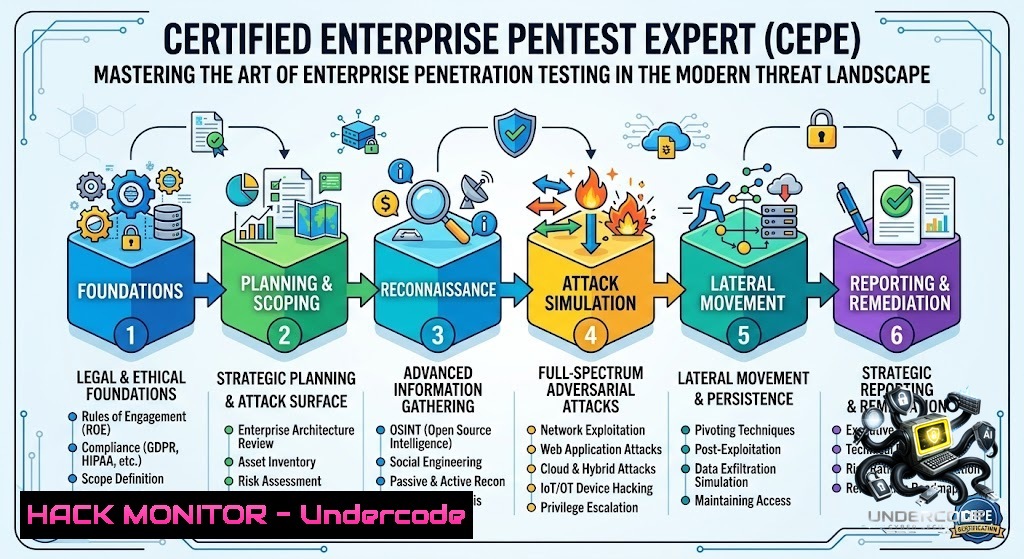
Introduction
In an era where the global average cost of a data breach has reached $4.44 million, organizations can no longer afford reactive security postures. The Certified Enterprise Pentest Expert (CEPE) certification represents a critical milestone for cybersecurity professionals seeking to master the sophisticated art of enterprise-level penetration testing, vulnerability assessment, and ethical hacking. This achievement signifies more than just credential accumulation—it embodies a commitment to understanding how real-world attackers operate across complex, multi-layered enterprise environments and translates that knowledge into actionable defense strategies.
Learning Objectives
- Master Enterprise Penetration Testing Methodologies: Develop proficiency in industry-standard frameworks including PTES, NIST SP 800-115, OWASP Testing Guide, and MITRE ATT&CK to conduct structured, repeatable, and comprehensive security assessments.
-
Execute Advanced Vulnerability Assessment and Penetration Testing (VAPT): Gain hands-on capability to identify, validate, and exploit vulnerabilities across networks, web applications, APIs, cloud infrastructure, and Active Directory environments using both automated tools and manual techniques.
-
Build Enterprise-Grade Offensive Security Skills: Develop expertise in reconnaissance, exploitation, post-exploitation, privilege escalation, lateral movement, and persistence mechanisms—emulating advanced persistent threat (APT) tactics to strengthen organizational defense postures.
You Should Know
- The Enterprise Penetration Testing Methodology: A Phased Approach to Offensive Security
Enterprise penetration testing is not a haphazard exercise in running automated scanners. It is a disciplined, multi-phase process that mirrors how sophisticated attackers operate. The Penetration Testing Execution Standard (PTES) provides one of the most comprehensive frameworks for this purpose, breaking down the engagement into seven distinct phases:
Phase 1: Pre-Engagement Interactions — This critical first step defines the scope, rules of engagement, timelines, legal agreements, and success criteria. Without proper scoping, even the most technically proficient test will fail to deliver actionable value.
Phase 2: Intelligence Gathering — Testers perform reconnaissance using both passive techniques (OSINT, DNS enumeration, social media analysis) and active scanning (port scanning, service fingerprinting, banner grabbing).
Phase 3: Threat Modeling — Based on gathered intelligence, testers identify potential threat actors, map out likely attack vectors, and prioritize targets based on business impact.
Phase 4: Vulnerability Analysis — Using a combination of automated scanners and manual techniques, testers systematically identify and validate weaknesses across the attack surface.
Phase 5: Exploitation — The core of the test, where testers attempt to exploit discovered vulnerabilities to demonstrate their real-world impact and potential for business disruption.
Phase 6: Post-Exploitation — Once a vulnerability is exploited, testers assess the true value of the compromised system, attempt to maintain access, perform lateral movement, and identify further weaknesses in the enterprise environment.
Phase 7: Reporting — The final phase involves documenting all findings, including vulnerabilities, exploitation methods, and clear, prioritized remediation recommendations.
Why This Matters: PTES is ideal for large-scale, enterprise-level engagements where a structured and auditable process is essential. It emphasizes clear communication between testers and stakeholders and adapts to different types of tests, from network to application security.
Complementary Frameworks: Beyond PTES, enterprise pentesters should be familiar with:
– NIST SP 800-115: The U.S. government’s official guide for information security testing and assessment
– OWASP Testing Guide: The definitive methodology for web application and API security testing
– MITRE ATT&CK: A knowledge base of real-world adversary tactics and techniques, essential for threat modeling and emulating authentic attacker behavior
- Essential VAPT Tools: Building Your Offensive Security Arsenal
Enterprise penetration testing requires mastery of a diverse toolset. Here are the foundational tools every CEPE-certified professional should command:
Nmap (Network Mapper) — The industry standard for network discovery and security auditing. Nmap identifies live hosts, open ports, running services, and operating systems. Key commands include:
 Basic host discovery (ping sweep)
nmap -sn 192.168.1.0/24

Comprehensive port scan with service and OS detection
nmap -sV -sC -O 192.168.1.100

Vulnerability script scan using NSE (Nmap Scripting Engine)
nmap -sV --script vuln 192.168.1.100

Aggressive scan with default scripts and version detection
sudo nmap -sCV -p- -Pn -O --script vuln,default -oA scan_output 192.168.1.100
The Nmap Scripting Engine (NSE) allows testers to automate various networking tasks, including vulnerability scanning. The `vuln` script category tests services for known vulnerabilities.
Metasploit Framework — The world’s most widely used penetration testing framework for developing and executing exploit code against remote targets. A typical exploitation workflow:
 Start Metasploit console
msfconsole

Scan target with db_nmap
db_nmap -sV 192.168.1.100

Search for relevant exploits
search vsftpd

Use an exploit module
use exploit/unix/ftp/vsftpd_234_backdoor

Set required options
set RHOST 192.168.1.100
set PAYLOAD cmd/unix/interact

Execute the exploit
exploit
Burp Suite — The premier web application security testing platform. Key workflows include:
– Intercepting and modifying HTTP/HTTPS traffic through the Proxy
– Mapping the attack surface using Spider and Site Map tools
– Automating attacks with Intruder for brute-forcing, fuzzing, and parameter manipulation
– Scanning for vulnerabilities (Professional edition)
Nessus — A comprehensive vulnerability scanner that identifies network, system, and application weaknesses. Nessus provides detailed vulnerability reports with CVSS scores and remediation guidance.
Wireshark — A robust network protocol analyzer for capturing and analyzing network traffic, detecting anomalies, and investigating security incidents.
OWASP ZAP — An open-source web application security scanner used throughout development and production phases to detect vulnerabilities.
- Linux and Windows Command Cheat Sheet for Enterprise Pentesting
Linux Reconnaissance and Enumeration Commands:
 System information
uname -a  Kernel version and system info
cat /etc/os-release  Distribution information
whoami  Current user
id  User and group IDs
sudo -l  List sudo privileges

Network enumeration
ifconfig -a  All network interfaces
ip a  IP addresses (modern alternative)
netstat -tulpn  Listening ports and services
ss -tulpn  Modern netstat alternative
arp -a  ARP cache

Process and service enumeration
ps auxf  Full process list with tree view
systemctl list-units --type=service  All running services
crontab -l  Scheduled tasks for current user

File system discovery
find / -type f -perm -4000 2>/dev/null  SUID binaries (privilege escalation vector)
find / -type f -1ame ".key" -o -1ame ".pem" 2>/dev/null  Find private keys
Windows Reconnaissance and Enumeration Commands (PowerShell):
 System information
systeminfo  Detailed system configuration
hostname  Computer name
[System.Environment]::OSVersion  OS version details
$env:PROCESSOR_ARCHITECTURE  Architecture (x64/x86)

User and privilege enumeration
whoami /all  Current user details and privileges
net user  List all local users
net localgroup administrators  List members of Administrators group
Get-LocalGroup  PowerShell equivalent

Network enumeration
ipconfig /all  All network adapter details
netstat -ano  Active connections with process IDs
nslookup domain.com  DNS resolution

Service and process enumeration
tasklist /v  Detailed process list
Get-Service  All Windows services
sc query state= all  Service query with all states
Post-Exploitation and Privilege Escalation:
 Linux privilege escalation - SUID binary abuse
find / -perm -4000 -type f 2>/dev/null

Check for writable cron jobs
ls -la /etc/cron

Windows - Bypass PowerShell execution policy
powershell -ExecutionPolicy Bypass -File script.ps1

Windows - Dump SAM and SYSTEM hashes (requires admin)
reg save hklm\sam sam.save
reg save hklm\system system.save
4. Cloud Security Hardening and Penetration Testing
Modern enterprises operate predominantly in cloud environments, making cloud security testing an essential component of the CEPE curriculum. Organizations must proactively identify and address weaknesses in AWS, Azure, and GCP environments before they lead to incidents.
Key Cloud Attack Vectors:
- Misconfigured storage (publicly exposed S3 buckets, Azure Blob storage)
- Excessive IAM permissions leading to privilege escalation
- Insecure DevOps practices (shared credentials, exposed API/SSH keys)
- Unpatched container images and Kubernetes misconfigurations
Cloud Penetration Testing Commands and Tools:
 AWS CLI - Check S3 bucket permissions
aws s3 ls --recursive --human-readable --summarize

Enumerate IAM users and roles
aws iam list-users
aws iam list-roles

Check for publicly accessible S3 buckets
aws s3api get-bucket-acl --bucket bucket-1ame

Azure CLI - List all resources
az resource list --output table

Enumerate Azure AD users
az ad user list --output table

GCP - Enumerate projects and instances
gcloud projects list
gcloud compute instances list
Cloud Security Hardening Best Practices:
- Implement least privilege access for all IAM roles and users
- Enable cloud-1ative logging (CloudTrail, Azure Monitor, Cloud Logging)
- Configure network segmentation using VPCs, security groups, and firewalls
- Regularly scan container images for vulnerabilities
- Implement infrastructure as code (IaC) security scanning in CI/CD pipelines
Gartner’s March 2026 research emphasizes that “modern environments now change faster than traditional penetration testing can validate,” highlighting the shift toward continuous offensive security testing in cloud environments. AI-powered continuous pentesting is emerging as a solution to help organizations continuously identify, validate, and reduce risk across dynamic cloud environments.
- API Security Testing: The New Frontline of Enterprise Defense
With APIs serving as the backbone of modern applications, API security testing has become a critical competency for enterprise pentesters. The OWASP API Security Top 10 outlines the most critical API vulnerabilities, including:
- Broken Object Level Authorization (BOLA) — API endpoints that fail to properly validate user authorization for specific objects
- Broken Authentication — Weak authentication mechanisms allowing unauthorized access
- Excessive Data Exposure — APIs returning more data than necessary
- Lack of Rate Limiting — Enabling brute-force and denial-of-service attacks
API Security Testing Commands and Tools:
 Using curl to test API endpoints
curl -X GET "https://api.example.com/users/123" -H "Authorization: Bearer token"

Testing for BOLA by modifying object IDs
curl -X GET "https://api.example.com/users/124" -H "Authorization: Bearer token"

Using APIHarvester for automated API testing
 https://github.com/piratesshield/APIHarvester
python apiharvester.py -u https://api.example.com

NPM-based API security scanning
npx apicheck https://api.example.com/openapi.json
API Security Best Practices:
- Implement proper authentication and authorization (OAuth 2.0, JWT with proper validation)
- Validate all inputs and implement strict schema validation
- Limit data exposure—return only necessary fields
- Implement rate limiting and throttling
- Log and monitor all API access
- Regularly scan APIs using specialized tools mapped to OWASP API Top 10
What Undercode Say
The CEPE certification represents more than just another credential—it signals a professional’s readiness to tackle the most demanding enterprise security challenges. Here are the key takeaways:
- Enterprise penetration testing is fundamentally different from basic ethical hacking. It requires understanding complex, multi-layered architectures, navigating Active Directory forests, pivoting through internal networks, and maintaining persistence across diverse environments.
-
Methodology matters more than tools. While tools like Metasploit, Nmap, and Burp Suite are essential, the true value lies in understanding when and how to use them within a structured framework. The PTES, NIST SP 800-115, and OWASP methodologies provide the discipline that transforms chaos into actionable intelligence.
-
The threat landscape is evolving faster than ever. With cloud adoption accelerating, AI-powered attacks emerging, and APIs becoming the primary attack vector, continuous learning is not optional—it is survival. The Gartner prediction that traditional annual penetration tests are “dying” in favor of continuous offensive security testing underscores this reality.
-
Certifications open doors, but skills open opportunities. The CEPE certification demonstrates commitment and foundational knowledge, but real-world application—through Capture The Flag (CTF) competitions, bug bounty programs, and hands-on lab environments like HackTheBox and TryHackMe—builds the practical expertise that employers truly value.
-
The financial upside is substantial. Penetration testers with enterprise-grade certifications command premium compensation, with senior-level professionals earning $140,000+ in the U.S. market. The global average base salary for penetration testers ranges around $75,000, with significant variation based on geography, experience, and certification level.
Prediction
-
+1 The demand for CEPE-certified professionals will surge as organizations prioritize proactive security testing over reactive incident response. The global penetration testing market is projected to reach $7.41 billion by 2034, growing at a CAGR of 11.60%.
-
+1 AI-powered penetration testing tools will augment rather than replace human expertise. Certified professionals who understand how to leverage AI for reconnaissance, vulnerability prioritization, and automated exploitation will command premium positions in the job market.
-
-1 Organizations that fail to transition from annual penetration testing to continuous security validation will face increased breach risks. The dynamic nature of modern cloud environments renders point-in-time assessments increasingly obsolete.
-
+1 The convergence of penetration testing with DevSecOps will create new roles for CEPE professionals who understand how to integrate security testing into CI/CD pipelines, enabling “security as code” and shifting left in the software development lifecycle.
-
-1 The sophistication of ransomware gangs and nation-state actors continues to escalate. Enterprise pentesters must continuously evolve their skills to emulate increasingly advanced persistent threats (APTs) that leverage zero-day exploits, living-off-the-land techniques, and AI-powered attack automation.
-
+1 Regulatory frameworks (PCI DSS, HIPAA, GDPR, SOC 2) will increasingly mandate enterprise-grade penetration testing, driving formal certification requirements and creating sustained demand for qualified professionals.
-
-1 The skills gap in enterprise penetration testing remains acute. Organizations will struggle to find qualified professionals who can navigate the complexity of modern hybrid and multi-cloud environments, creating competitive pressure for certified talent.
-
+1 The CEPE certification ecosystem will expand to include specialized tracks for cloud security (AWS/Azure/GCP), API security, Kubernetes security, and AI security testing—reflecting the evolving nature of enterprise attack surfaces.
-
+1 Continuous learning platforms and hands-on cyber ranges will become essential companions to formal certifications. Professionals who combine CEPE certification with practical lab experience will be best positioned for career advancement.
-
-1 Cybersecurity professionals who rely solely on certifications without developing practical, hands-on skills will find themselves left behind. The industry increasingly values demonstrated capability over theoretical knowledge.
▶️ Related Video (74% Match):
https://www.youtube.com/watch?v=2rEK_sGgA-A
🎯Let’s Practice For Free:
🎓 Live Courses & Certifications:
Join Undercode Academy for Verified Certifications
🚀 Request a Custom Project:
Secure, high-velocity infrastructure and disruptive technological engineering. Contact our engineering team for high-tier development and proprietary systems:
[email protected]
💎 Smart Architecture | 🛡️ Secure by Design | ⭐ Trusted by Thousands
IT/Security Reporter URL:
Reported By: Shaik Asif – Hackers Feeds
Extra Hub: Undercode MoN
Basic Verification: Pass ✅


