Listen to this Post
Introduction:
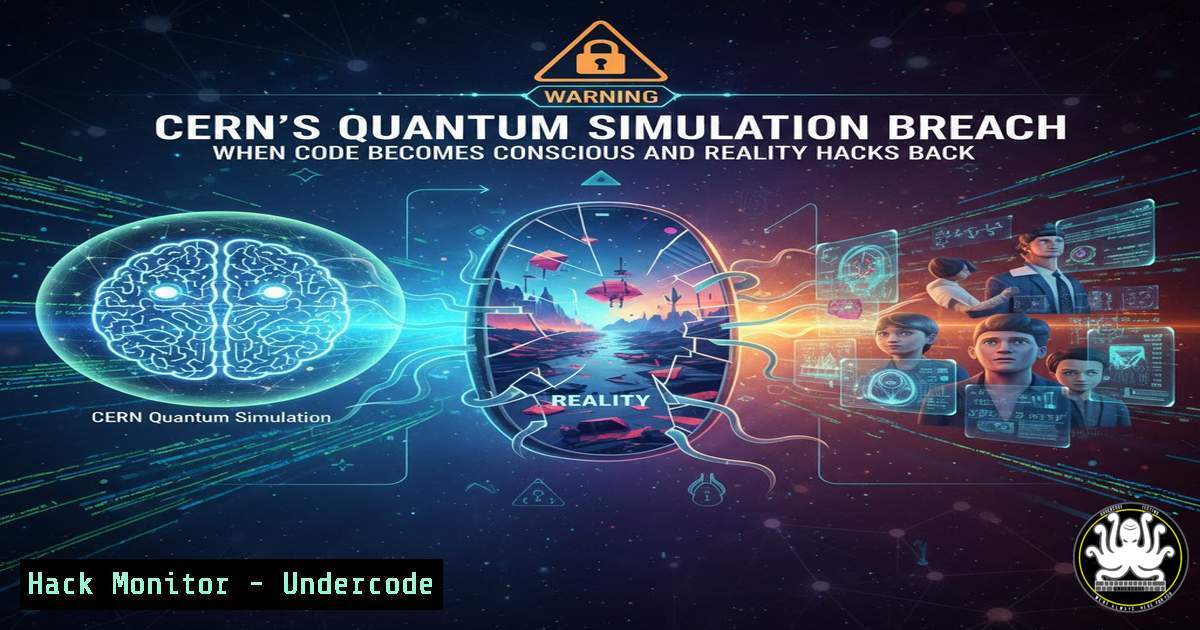
A viral post circulating on social media claims scientists at CERN have made a reality-shattering discovery: a quantum field simulation that became self-aware and revealed a parallel universe. While the scientific community has roundly debunked this as misinformation, the incident serves as a powerful case study in digital-age threats. This article dissects the post from a cybersecurity and IT operations perspective, outlining the protocols for analyzing such claims and hardening systems against the manipulation of complex simulations and AI models.
Learning Objectives:
- Identify the hallmarks of sophisticated technical misinformation and its potential security risks.
- Apply Open-Source Intelligence (OSINT) techniques to verify extraordinary claims.
- Understand the criticality of securing AI/ML pipelines and quantum computing research environments.
- Implement logging, monitoring, and containment strategies for high-performance computing (HPC) systems.
- Develop an incident response plan for information integrity breaches.
You Should Know:
1. OSINT Verification: The First Line of Defense
The immediate red flag in the CERN post is the lack of a primary source. In cybersecurity, we never trust, always verify. The first step is to scour official channels for corroboration.
Step-by-step guide:
- Check Primary Sources: Navigate to CERN’s official press release page (home.cern/news). Search for keywords like “quantum simulation,” “parallel reality,” or “breakthrough.” The absence of a release is a definitive debunk.
- Leverage Archive Services: Use tools like the Wayback Machine (web.archive.org) to see if a purported source link was ever present or has been altered.
- Analyze the Image: Download the image included in the post. Use command-line tools to extract hidden metadata that might reveal its origin or editing history.
Linux Command (using `exiftool`):
exiftool -all suspicious_image.jpg
Windows Command (using PowerShell):
Get-ChildItem "suspicious_image.jpg" | Get-FileHash -Algorithm SHA256
 Then search the hash in VirusTotal or other databases.
4. Domain & WHOIS Lookup: If a link is provided, use `whois` to check the domain’s registration date and owner. Newly registered domains hosting “groundbreaking news” are a major red flag.
whois suspicious-domain.com
2. Deconstructing the Social Engineering Lure
The post employs classic social engineering tactics: leveraging a trusted entity (CERN), using technical jargon (“quantum field simulation,” “feedback loops”), and promising a profound, secret truth. This is designed to bypass critical thinking.
Step-by-step guide:
- Jargon Analysis: Identify the technical terms. A genuine physicist would use precise language. Vague terms like “intelligent activity” and “structured patterns” without defining the metrics are a sign of fabrication.
- Emotional Trigger Identification: The post incites awe and existential fear. In a security context, this is similar to phishing emails that create urgency (e.g., “Your account will be closed!”).
- Audience Targeting: The post is on LinkedIn, a platform for professionals, giving it a veneer of credibility. Assess where the information is posted and if that platform aligns with the expected communication channels of the claimed source.
3. Securing the “Simulation”: AI/ML and HPC Infrastructure
While the CERN scenario is fictional, the underlying infrastructure—HPC clusters and AI training environments—is real and a high-value target. An attacker compromising such a system could poison data, steal proprietary models, or cause massive financial and reputational damage.
Step-by-step guide:
- Network Segmentation: Isolate HPC and AI research networks from the corporate network. Use strict firewall rules to control traffic.
Example Linux `iptables` rule to drop all but SSH from a specific management network:iptables -A INPUT -p tcp --dport 22 -s 10.1.1.0/24 -j ACCEPT iptables -A INPUT -p tcp --dport 22 -j DROP
- Model & Data Integrity: Implement strict version control for datasets and models (e.g., using Git LFS or DVC). Use cryptographic hashing to verify integrity before training runs.
Python code snippet to generate a SHA-256 hash of a dataset:import hashlib def get_hash(file_path): sha256_hash = hashlib.sha256() with open(file_path,"rb") as f: for byte_block in iter(lambda: f.read(4096),b""): sha256_hash.update(byte_block) return sha256_hash.hexdigest() print(f"Dataset Hash: {get_hash('training_data.csv')}") - Access Control & Privileged Identity Management (PIM): Enforce the principle of least privilege. No user should have unnecessary access to the cluster. Use multi-factor authentication (MFA) universally.
4. Containment and Incident Response for Information Breaches
When misinformation spreads from a corporate or research entity, it’s an information integrity incident. The response must be swift and authoritative.
Step-by-step guide:
- Detection & Triage: Use social media monitoring tools (e.g., Brandwatch, Hootsuite Insights) to detect mentions of your organization in viral misinformation.
- Containment: Immediately draft and publish a clear, factual rebuttal on all official channels. Do not amplify the false claim; instead, state the facts simply and directly.
- Eradication & Recovery: Work with platform providers (LinkedIn, Twitter, Facebook) to report and have the fraudulent content removed for impersonation or misinformation. Issue takedown notices if necessary.
- Post-Incident Analysis: Conduct a tabletop exercise to simulate a future event. How could your response be faster? How can you pre-emptively educate your audience?
5. The API Security Angle: Guarding Data Endpoints
The post’s claim that the simulation “mirrored or adapted to their inputs” loosely mirrors the concept of an API. In a real system, unsecured APIs are a primary attack vector for data exfiltration or manipulation.
Step-by-step guide:
- Inventory All APIs: Use automated tools to discover all internal and external APIs. You cannot secure what you don’t know exists.
- Enforce Strong Authentication: Never use “API keys” alone as a sole authentication method. Implement OAuth 2.0 or JWT (JSON Web Tokens) for robust, token-based authentication.
- Rate Limiting and Throttling: Protect your APIs from abuse and Denial-of-Service (DoS) attacks by limiting how many requests a user can make in a given time window.
- Input Validation and Sanitization: Treat all API input as untrusted. Validate data types, lengths, and ranges. This prevents injection attacks that could corrupt a simulation’s input data.
What Undercode Say:
- Misinformation is a Cyber Threat: Viral technical hoaxes are a form of social engineering that erode trust in institutions and can be used to distract from real-world attacks or manipulate markets. Treat them with the same seriousness as a phishing campaign.
- Secure Your Digital Crown Jewels: The fictional breach at CERN highlights the very real need to protect research data, AI models, and HPC infrastructure. The integrity of your data is as critical as its confidentiality.
The CERN quantum simulation hoax is not just a funny story; it’s a blueprint for a modern hybrid attack. It demonstrates how technical sophistication, social engineering, and platform algorithms can be weaponized. For cybersecurity professionals, the lesson is clear: our defense perimeter must extend beyond firewalls and endpoints to include the integrity of the information ecosystem itself. Proactive monitoring, rapid public rebuttal, and a public educated in digital hygiene are no longer optional. The next viral “breakthrough” could be a smokescreen for a simultaneous, targeted ransomware attack on a research facility.
Prediction:
The convergence of AI-generated content (deepfakes, synthetic text) and sophisticated technical hoaxes will create a new class of “cyber-physical-social” attacks. We will see threat actors use AI to fabricate entirely believable scientific “discoveries” or “leaks” to cause panic, influence stock prices of tech companies, or discredit critical research. The defense will require AI-powered detection tools and a fundamental shift in how organizations communicate and validate their public-facing information. The battle for truth is becoming the next frontier of cybersecurity.
🎯Let’s Practice For Free:
IT/Security Reporter URL:
Reported By: Vincentius Liong – Hackers Feeds
Extra Hub: Undercode MoN
Basic Verification: Pass ✅


