Listen to this Post
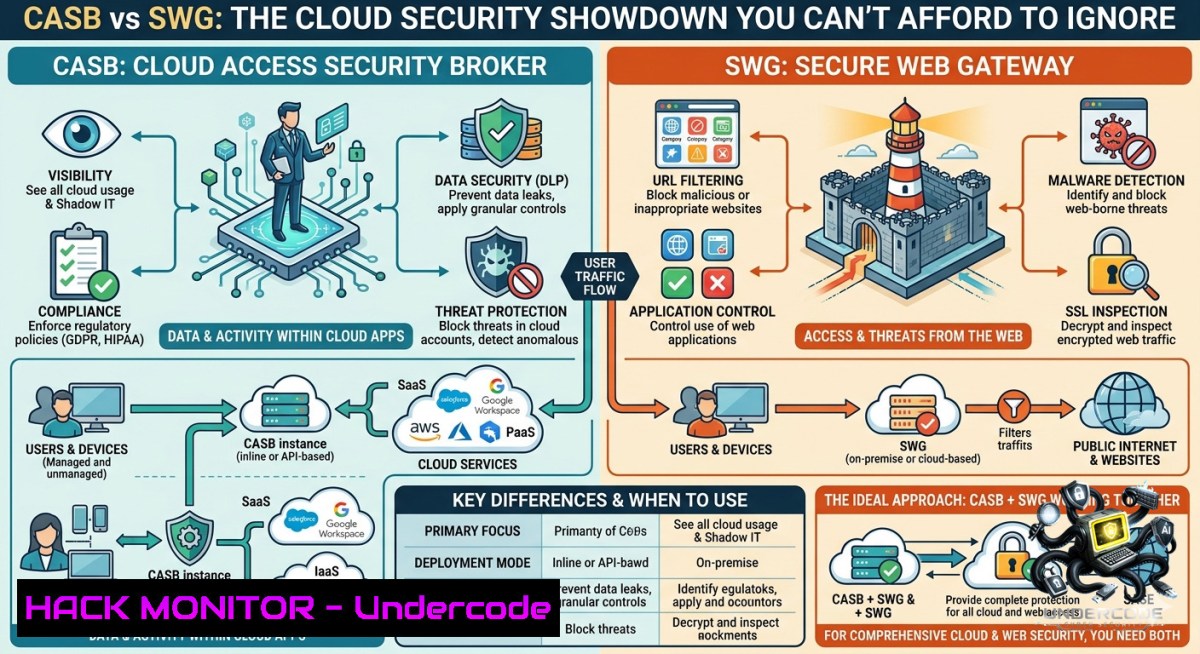
Introduction:
As enterprises rapidly adopt SaaS, PaaS, IaaS, and hybrid work models, traditional perimeter-based security crumbles. CASB (Cloud Access Security Broker) and SWG (Secure Web Gateway) are two critical pillars of modern cloud defense—but confusing their roles leaves gaping holes in your data protection strategy. While CASB governs cloud application usage and data, SWG filters web traffic and blocks browser-borne threats. Mastering both—and integrating them into a SASE framework—is non-1egotiable for zero-trust architecture.
Learning Objectives:
- Differentiate CASB and SWG functions and deploy them for layered cloud protection.
- Implement data loss prevention (DLP) policies using CASB for shadow IT and sensitive data.
- Configure SWG rules to block phishing, malware, and malicious HTTPS traffic across endpoints.
- Apply unified SASE principles to enforce consistent access controls across web and cloud environments.
- Execute practical Linux/Windows commands to test and harden CASB/SWG configurations.
You Should Know:
- Deconstructing CASB: From Shadow IT Discovery to Data Leak Prevention
CASB acts as a policy enforcement point between cloud users and providers. It covers four pillars: visibility, compliance, data security, and threat protection. Shadow IT—unsanctioned cloud app usage—is a prime target. Modern CASB solutions integrate with identity providers (Okta, Azure AD) and DLP engines to inspect API calls and file transfers.
Step‑by‑step guide to simulate shadow IT detection and CASB remediation:
- Identify shadow SaaS traffic (Linux – monitor outbound DNS for unknown cloud domains):
sudo tcpdump -i eth0 -1 port 53 | grep -E "zoom|slack|dropbox|we transfer"
Or use `tshark`:
sudo tshark -i eth0 -f "udp port 53" -Y "dns.qry.name matches \"(zoom|dropbox|mega)\""
- Windows – log DNS queries for shadow IT analysis (PowerShell as Admin):
Get-WinEvent -LogName "Microsoft-Windows-DNS-Client/Operational" | Where-Object { $_.Message -match "zoom|slack|dropbox" } | Format-List -
Simulate a CASB API call to block a specific cloud app (using a REST API from a CASB provider like McAfee MVISION Cloud):
curl -X POST "https://your-casb-domain/api/v1/policies" \ -H "Authorization: Bearer YOUR_API_KEY" \ -H "Content-Type: application/json" \ -d '{"name":"Block Dropbox","action":"block","app":"dropbox","user_group":"All Employees"}' -
Enforce DLP for credit card numbers in cloud files – CASB inline policy pseudo‑config:
policy: name: "Block PII in Google Drive" conditions:</p></li> </ol> <p>- content_regex: "\b4[0-9]{12}(?:[0-9]{3})?\b" Visa pattern - cloud_app: "google-drive" actions: - block_upload - alert_security_team- Test CASB data protection – On Linux, attempt to upload a dummy file with fake credit card number:
echo "Test data: 4111111111111111" > test_card.txt
curl -X POST -F "file=@test_card.txt" https://drive.google.com/upload  blocked by CASB
Expected result: CASB blocks the transaction and logs the event.
-
Building a Secure Web Gateway (SWG) from the Ground Up
SWG sits inline between users and the internet. It inspects HTTP/HTTPS traffic, decrypts SSL/TLS (if configured), and applies URL filtering, anti-malware scanning, and data exfiltration controls. Unlike CASB, SWG doesn’t care if the destination is a sanctioned cloud app—it cares about threat vectors.
Step‑by‑step guide to configure and test SWG rules using open‑source tools (Squid + ClamAV):
1. Install Squid as a forward proxy (Ubuntu/Debian):
sudo apt update && sudo apt install squid clamav-daemon -y
sudo systemctl enable squid clamav-daemon
- Configure Squid for SSL bump (Man-in-the-Middle inspection) – edit
/etc/squid/squid.conf:http_port 3128 ssl-bump cert=/etc/squid/ssl_cert/myCA.pem generate-host-certificates=on dynamic_cert_mem_cache_size=4MB acl blocked_sites dstdomain "/etc/squid/blocklist.txt" http_access deny blocked_sites ssl_bump peek all ssl_bump bump all
3. Create a blocklist:
echo "malware-site.com" | sudo tee -a /etc/squid/blocklist.txt
echo "phishing-test.net" | sudo tee -a /etc/squid/blocklist.txt
sudo systemctl restart squid
- Integrate ClamAV for file scanning – edit
/etc/squid/clamav.conf:url_rewrite_program /usr/local/bin/clamav_squid.sh
Create `clamav_squid.sh`:
!/bin/bash
while read line; do
if clamscan --1o-summary --infected "$line"; then
echo "ERR"
else
echo "OK"
fi
done
5. Test from a client (Windows PowerShell):
 Set proxy to your SWG IP and port 3128
netsh winhttp set proxy proxy-server="http=192.168.1.100:3128"
 Attempt to download a test malware (EICAR)
Invoke-WebRequest -Uri "https://secure.eicar.org/eicar.com" -OutFile "eicar_test.txt"
The SWG should block the download and log the alert.
- Converging CASB and SWG with SASE (Secure Access Service Edge)
SASE merges network security (SWG, FWaaS, ZTNA) with cloud security (CASB) into a single edge service. This eliminates backhauling and enforces consistent policies. Key SASE components include identity‑driven access and continuous trust evaluation.
Step‑by‑step guide to simulate a SASE policy using open‑source tools (NGINX as reverse proxy + Open Policy Agent):
1. Install NGINX and OPA:
sudo apt install nginx -y
curl -L -o opa https://openpolicyagent.org/downloads/latest/opa_linux_amd64
chmod +x ./opa
sudo mv ./opa /usr/local/bin/
- Write a Rego policy that combines web filtering (SWG) and cloud app restrictions (CASB) – save as
policy.rego:package sase default allow = false allow { input.path == "/work" not input.user in {"unknown", "guest"} not input.destination in blacklist_sites } blacklist_sites = ["dropbox.com", "we-transfer.com", "phishing-site.com"]
3. Run OPA as a sidecar:
opa run --server --addr localhost:8181 policy.rego
- Configure NGINX to query OPA before proxying requests – in
/etc/nginx/sites-available/default:location / { auth_request /auth; proxy_pass http://backend-cloud-app; } location = /auth { internal; proxy_pass http://localhost:8181/v1/data/sase/allow; proxy_set_body '{"input": {"user": "$remote_user", "path": "$uri", "destination": "$host"}}'; } -
Test – from any client, attempt to access `http://my-sase-gateway/dropbox.com`. OPA returns false → NGINX returns 403 Forbidden.
-
API Security: The Missing Link Between CASB and SWG
Modern cloud apps expose REST APIs, which neither CASB nor SWG inspect by default unless configured. Attackers exploit API vulnerabilities (broken object level auth, excessive data exposure) to exfiltrate cloud data. You need API‑specific controls.
Step‑by‑step guide to test API security with a CASB‑like posture:
- Enumerate cloud APIs using `curl` and `jq` (Linux):
Example: list Google Drive files via API (requires OAuth token) curl -H "Authorization: Bearer $GDRIVE_TOKEN" "https://www.googleapis.com/drive/v3/files" | jq '.files[] | {name, id, mimeType}' -
Simulate an excessive data exposure attack – request all user profiles from a misconfigured SaaS API:
for id in {1..1000}; do curl -s "https://vulnerable-saas.com/api/user/$id" >> leaked_data.json done -
Implement API‑level DLP using a Python script that mirrors CASB function:
import re import requests def inspect_api_response(response_json): if re.search(r"\b\d{16}\b", str(response_json)): requests.post("https://your-siem.com/alert", json={"alert": "PII leaked via API"}) raise Exception("Blocked by CASB API policy") Hook into your API gateway middleware -
Hardening with API gateway (Kong/KrakenD) – add rate limiting and schema validation:
Kong plugin example
curl -X POST http://localhost:8001/plugins \
--data "name=rate-limiting" \
--data "config.minute=10" \
--data "config.policy=local"
-
Cloud Hardening: Applying CASB Lessons to IaaS (AWS/Azure/GCP)
CASB policies for IaaS go beyond SaaS – they cover misconfigured storage buckets, privileged access, and network exposure. Cloud hardening commands help you implement controls that CASB would enforce.
Step‑by‑step guide to harden cloud storage using AWS CLI (Windows/Linux):
1. Install AWS CLI (Linux):
curl "https://awscli.amazonaws.com/awscli-exe-linux-x86_64.zip" -o "awscliv2.zip"
unzip awscliv2.zip && sudo ./aws/install
Windows: download MSI installer from AWS.
- List all S3 buckets and check public ACLs:
aws s3api list-buckets --query "Buckets[].Name" --output text | xargs -11 aws s3api get-bucket-acl --bucket
-
Apply bucket policy to block public access (CASB compliance action):
aws s3api put-public-access-block --bucket your-bucket-1ame \
--public-access-block-configuration "BlockPublicAcls=true,IgnorePublicAcls=true,BlockPublicPolicy=true,RestrictPublicBuckets=true"
-
Detect and remediate open security groups (Azure CLI):
az vm open-port --resource-group MyRG --1ame MyVM --port 3389 --remove  closes RDP
az network nsg rule list --resource-group MyRG --1sg-1ame MyNSG --output table
-
GCP – enforce CASB‑style data loss prevention with gcloud:
gcloud config set project my-project
gcloud storage buckets update gs://my-bucket --uniform-bucket-level-access
gcloud services enable dlp.googleapis.com
6. Exploitation and Mitigation of SWG Bypass Techniques
Attackers bypass SWGs using DNS‑over‑HTTPS (DoH), IPv6 leaks, or unencrypted tunnels. You must simulate these to test your SWG.
Step‑by‑step guide to test SWG bypass and apply fixes:
- Simulate DoH bypass (Linux – use `curl` with DoH):
curl --dns-servers 8.8.8.8 --doh-url https://cloudflare-dns.com/dns-query https://blocked-malware-site.com
If successful, your SWG failed to inspect DoH traffic.
2. Mitigation – block DoH servers at firewall:
sudo iptables -A OUTPUT -p udp --dport 853 -j DROP  block DNS over TLS port
sudo iptables -A OUTPUT -p tcp --dport 443 -m string --string "cloudflare-dns.com" --algo kmp -j DROP
- Test IPv6 bypass – on Linux, disable IPv6 temporarily:
sudo sysctl -w net.ipv6.conf.all.disable_ipv6=1
curl -6 http://ipv6.google.com  should fail if IPv6 is blocked
To force IPv6 inspection on Windows:
Get-1etAdapter | Set-1etAdapterBinding -ComponentID ms_tcpip6 -Enabled $true
 Then configure your SWG to listen on IPv6 address
- Prevent SSH tunneling – block outbound SSH (except to known bastion hosts):
sudo iptables -A OUTPUT -p tcp --dport 22 -m conntrack --ctstate NEW -j LOG --log-prefix "SSH_TUNNEL_ATTEMPT"
sudo iptables -A OUTPUT -p tcp --dport 22 -j DROP
What Undercode Say:
- Key Takeaway 1: CASB and SWG are not interchangeable; CASB governs what cloud apps do with your data, while SWG controls where users browse. Merging both under SASE eliminates policy silos.
- Key Takeaway 2: Hands‑on validation using open‑source tools (Squid, OPA, AWS CLI) reveals gaps that vendor dashboards often hide—especially around API abuse, DoH bypass, and shadow IT.
Analysis (approx. 10 lines):
The post clarifies that cloud protection requires a layered approach, but many teams stop at buying a single tool. CASB provides application‑layer granularity (file sharing, privilege escalation in SaaS), while SWG focuses on web‑borne threats (drive‑by downloads, phishing). The trend toward SASE forces convergence, yet legacy on‑prem SWGs often ignore encrypted API calls. Real‑world breaches (e.g., Capital One, Uber) involved misconfigured IaaS and exposed APIs—exactly where CASB’s visibility falls short unless API inspection is turned on. The commands provided above demonstrate that you can simulate and patch these weaknesses without expensive suites. Future‑proof cloud security demands not just buying CASB+SWG, but engineering continuous integration with identity and endpoint detection. The biggest gap remains skill: security teams must learn to test policies with curl, iptables, and Rego rather than relying solely on GUI dashboards.
Expected Output:
Prediction:
- +1 SASE adoption will force CASB and SWG vendors to offer native API security and browser isolation by 2026, reducing point‑product fragmentation.
- -1 Attackers will increasingly target misconfigured CASB skip‑list policies and SWG SSL‑bypass exclusions, leading to a rise in “policy‑aware” ransomware that tests for inspection gaps before exfiltrating data.
- +1 Open‑source policy engines (OPA, Kyverno) will become the de facto standard for defining unified web+cloud rules, democratizing SASE for mid‑size enterprises.
- -1 The complexity of maintaining both CASB and SWG with overlapping DLP rules will cause policy drift, creating exploitable blind spots in hybrid environments unless automated compliance scanners are deployed.
- +1 Cloud providers (AWS, Azure) will embed CASB‑like controls natively into their IAM and Storage Browser, reducing reliance on third‑party brokers for basic data protection.
▶️ Related Video (84% Match):
🎯Let’s Practice For Free:
🎓 Live Courses & Certifications:
Join Undercode Academy for Verified Certifications
🚀 Request a Custom Project:
Secure, high-velocity infrastructure and disruptive technological engineering. Contact our engineering team for high-tier development and proprietary systems:
[email protected]
💎 Smart Architecture | 🛡️ Secure by Design | ⭐ Trusted by ThousandsIT/Security Reporter URL:
Reported By: Cybersecurity Cloudsecurity – Hackers Feeds
Extra Hub: Undercode MoN
Basic Verification: Pass ✅🔐JOIN OUR CYBER WORLD [ CVE News • HackMonitor • UndercodeNews ]
📢 Follow UndercodeTesting & Stay Tuned:
- Test CASB data protection – On Linux, attempt to upload a dummy file with fake credit card number:


