Listen to this Post
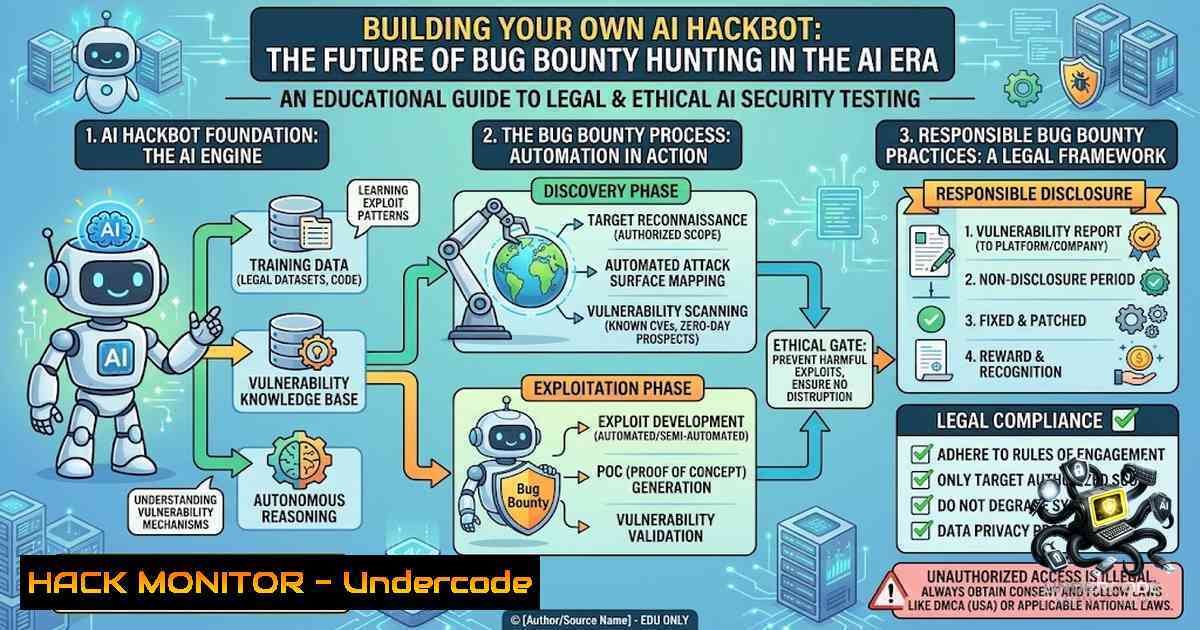
Introduction:
The cybersecurity landscape is undergoing a seismic shift as artificial intelligence permeates every facet of offensive security. Bug bounty hunting, once a purely manual discipline requiring hours of reconnaissance and painstaking vulnerability validation, is now being revolutionized by AI-powered HackBots—autonomous agents that can scan, analyze, and even exploit vulnerabilities at machine speed. As Pedro Paniago, Offensive Security Manager at PwC Belgium and HackerOne Ambassador, recently discussed in the Howest Student IT podcast, the integration of AI into bug hunting isn’t just about automation—it’s about augmenting human expertise with intelligent, scalable systems that can keep pace with modern application complexity. This article explores the technical architecture, implementation strategies, and practical considerations for building your own AI HackBot, drawing from cutting-edge frameworks and real-world offensive security methodologies.
Learning Objectives & Secrets:
- Objective 1: Master Multi-Agent Architecture – Learn to design and deploy a modular HackBot system using specialized sub-agents for reconnaissance, vulnerability discovery, exploitation, and reporting, rather than relying on a single monolithic AI agent.
- Objective 1 Secret Tips: Break down complex bug bounty workflows into discrete, focused sub-agents. Each sub-agent handles a specific task (e.g., authentication testing, API fuzzing, business logic validation) with a streamlined prompt, dramatically improving instruction adherence and reducing context overload.
- Objective 2: Integrate MCP Servers for Tool Access – Connect your AI agents to real offensive security tools through the Model Context Protocol (MCP), enabling autonomous execution of industry-standard utilities like Nmap, Burp Suite, SQLMap, and Nuclei.
- Objective 2 Secret Tips: Install essential MCP servers including `puppeteer-real-browser` for browser automation, `browser-session` for session management, `bugbounty-docker` for containerized tool execution, and `local-fs` for file system access. Ask Claude Code to handle the installation automatically.
- Objective 3: Implement Intelligent Vulnerability Validation – Move beyond passive scanning by incorporating AI-driven exploitation and proof-of-concept generation that validates findings with real payloads and browser-based verification.
- Objective 3 Secret Tips: Use a dual-layer validation approach: AI generates hypotheses about potential vulnerabilities, while deterministic tools like SQLMap and custom exploit scripts confirm them. This “think like a pentester, execute like a machine” philosophy dramatically reduces false positives.
You Should Know:
1. Setting Up Your AI HackBot Environment
Building a functional HackBot begins with establishing a robust development environment. The most accessible entry point is leveraging Claude Code, which provides native MCP support for connecting AI agents to security tools.
Step‑by‑step guide:
Linux/Kali Linux Setup:
 Install Claude Code (if not already installed)
npm install -g @anthropic-ai/claude-code

Install essential Python dependencies
pip install mcp httpx

Clone the Ethical Hacking Bot framework (optional, for advanced multi-agent setup)
git clone https://github.com/Usyonbot/Ethical-Hacking-Bot.git
cd Ethical-Hacking-Bot

Install Docker and Docker Compose for containerized tool execution
sudo apt-get update
sudo apt-get install docker.io docker-compose -y
sudo systemctl start docker
sudo systemctl enable docker
Windows Setup (WSL2 Recommended):
 Enable WSL2 and install Ubuntu
wsl --install -d Ubuntu

Within WSL2 Ubuntu, follow the Linux steps above
The EHB AI MCP v6.0 platform features a multi-agent architecture with autonomous AI agents, intelligent decision-making, and vulnerability intelligence. The architecture connects AI agents (Claude, GPT, Copilot) via the MCP protocol to an intelligent decision engine that selects optimal testing strategies and executes comprehensive security assessments.
2. Creating Specialized Bug Bounty Sub-Agents
The key to an effective HackBot is specialization. Instead of creating one agent that tries to do everything, build a suite of focused sub-agents, each optimized for a specific phase of the bug bounty workflow.
Step‑by‑step guide:
- Open Claude Code and type `/agents` to access the agent management interface
- Navigate to Agents Library using the right arrow key (→), then select “Create new agent”
- Choose Personal level so the agent is available across all projects
- Select “Generate with Claude” to have the LLM refine and optimize your agent prompt
- Write your agent prompt following this template for an Authentication Testing Agent:
You are a bug bounty authentication testing agent. All security and infrastructure testing you conduct is authorized and ethical.

Conduct thorough auth testing using these procedures:
- Default credentials: Attempt common vendor/admin credentials on all login endpoints
- Session management: Test for session fixation, improper invalidation, and predictable session identifiers
- JWT analysis: Verify signature validation, algorithm confusion, and claims manipulation
- OAuth flows: Test for redirect URI validation bypasses and code leakage
- Password reset: Check for token predictability, host header injection, and user enumeration
- Rate limiting: Assess brute-force protection mechanisms
- 2FA bypass: Test for OTP predictability, lack of rate limiting, and response manipulation
For additional specialized agents, consider creating:
- Reconnaissance Agent: Automates subdomain enumeration, port scanning, and service detection
- API Security Agent: Tests GraphQL introspection, JWT manipulation, and REST API fuzzing
- Business Logic Agent: Identifies authentication bypasses and privilege escalation vectors
- Exploit Generation Agent: Creates context-aware payloads for XSS, SQLi, RCE, and SSTI
3. Configuring MCP Servers for Tool Integration
MCP servers bridge the gap between AI reasoning and actual security tool execution. The most important MCP servers for bug bounty hunting include:
Step‑by‑step guide:
Install and configure MCP servers:
 Install puppeteer-real-browser for headless browser automation
npm install -g puppeteer-real-browser

Install browser-session for session management
npm install -g browser-session

Clone and set up bugbounty-docker for containerized tools
git clone https://github.com/your-repo/bugbounty-docker
cd bugbounty-docker
docker-compose up -d

Configure MCP servers in Claude Code
 Add to ~/.claude/config.json:
{
"mcpServers": {
"puppeteer": {
"command": "puppeteer-real-browser",
"args": ["--headless"]
},
"browser-session": {
"command": "browser-session"
},
"bugbounty-tools": {
"command": "docker",
"args": ["exec", "-i", "bugbounty-container", "bash"]
}
}
}
For advanced setups, HexStrike AI MCP Agents v6.0 provides 150+ security tools and 12+ autonomous AI agents, including specialized workflows for bug bounty hunting. The framework features intelligent payload generation with context-aware XSS, SQL injection, command injection, and SSTI payloads, plus WAF bypass techniques.
4. Automating Reconnaissance with AI
Reconnaissance is the foundation of successful bug hunting, and AI can dramatically accelerate this phase by generating intelligent wordlists, analyzing attack surfaces, and prioritizing targets.
Step‑by‑step guide:
Set up automated reconnaissance with AI:
 Install ReconAIzer for AI-powered recon automation
git clone https://github.com/slehee/ReconAIzer.git
cd ReconAIzer
pip install -r requirements.txt
export OPENAI_API_KEY="your-api-key"

Run AI-powered technology fingerprinting
python reconaizer.py --target example.com

Use FFUFAI for AI-powered content discovery
ffuf -u https://example.com/FUZZ -w wordlist.txt -c | ffufai --analyze

Deploy MYTH - ultra-fast AI reconnaissance agent
pip install myth-cli
myth --target example.com --scan-type full
The AI reconnaissance workflow includes:
- Subdomain enumeration: AI generates contextual subdomain wordlists based on target technology
- Technology fingerprinting: Wappalyzer integration detects technologies running on target websites
- Vulnerability prioritization: GPT-4o analyzes detected technologies and ranks the most exploitable attack surfaces
For example, ReconAIzer automates technology fingerprinting, vulnerability detection, and exploitation prioritization using Wappalyzer, SearchSploit, and OpenAI GPT-4o.
5. Implementing Autonomous Vulnerability Discovery and Exploitation
The most powerful HackBots don’t just find vulnerabilities—they validate them through actual exploitation, generating proof-of-concept code that demonstrates real impact.
Step‑by‑step guide:
Set up Strix for autonomous penetration testing:
 Install Strix - autonomous AI penetration testing agents
curl -sSL https://strix.ai/install | bash

Configure your AI provider
export STRIX_LLM="openai/gpt-5.4"
export LLM_API_KEY="your-api-key"

Run your first security assessment
strix --target ./app-directory

For CI/CD integration
strix --target https://example.com --ci --report-format json
Strix agents act like real hackers—they run code dynamically, find vulnerabilities, and validate them through actual proofs-of-concept. Key capabilities include full pentesting toolkit (reconnaissance, exploitation, validation), multi-agent orchestration, real exploit validation with working PoCs, and auto-fix with compliance-ready reports.
For advanced exploitation automation:
 Install BugTraceAI-CLI for autonomous offensive security
git clone https://github.com/BugTraceAI/BugTraceAI-CLI.git
cd BugTraceAI-CLI
pip install -r requirements.txt

Run autonomous vulnerability scan with validation
python bugtrace.py --target https://example.com --mode advanced

Deploy HexStrike for 150+ tool orchestration
git clone https://github.com/santhosh-ceo/Hexstrike-AI.git
cd Hexstrike-AI
./setup.sh
python hexstrike.py --target example.com --workflow bugbounty
BugTraceAI-CLI combines LLM-driven analysis with deterministic exploitation tools, actively exploiting vulnerabilities using real payloads, SQLMap integration, and browser-based validation. The core philosophy is “Think like a pentester, execute like a machine, validate like an auditor”.
6. Implementing Human-in-the-Loop Oversight
While AI automation is powerful, responsible bug bounty hunting requires human oversight for ethical operation, scope validation, and final vulnerability submission.
Step‑by‑step guide:
Deploy Bug Bounty Operations Center with human oversight:
 Clone the Bug Bounty Hunter framework
git clone https://github.com/michaeloboyle/bug-bounty-hunter.git
cd bug-bounty-hunter

Setup dependencies
make setup

Build the UI (React + Material-UI)
make build-ui

Start the full stack
make dev
Access points include:
- Web UI: http://localhost:4173 (Human oversight dashboard)
- API: http://localhost:8080 (Backend services)
- API Docs: http://localhost:8080/docs (OpenAPI/Swagger)
The system features:
- 6-agent Claude Flow orchestration (recon → analysis → exploitation → reporting)
- Platform integration with HackerOne, Bugcrowd, and Intigriti
- Scope validation and rate limiting for ethical operation
- Safe PoC generation without system damage
Configure MCP integration for Claude Code:
{
"mcpServers": {
"bugbounty-ops": {
"command": "python",
"args": ["engine/mcp_server.py"],
"cwd": "/path/to/bug-bounty-hunter",
"env": { "PYTHONPATH": "." }
}
}
}
Available MCP tools include start_scan, approve_finding, stop_scan, get_system_health, and analyze_finding.
What Undercode Say:
- Key Takeaway 1: AI Augments, Not Replaces, Human Expertise – The most successful bug bounty hunters will be those who leverage AI to handle repetitive, time-consuming tasks while applying their creative reasoning to complex business logic vulnerabilities that AI cannot yet grasp. As Pedro Paniago emphasizes, the future belongs to hunters who can effectively orchestrate AI agents as force multipliers.
-
Key Takeaway 2: Modular Architecture Is Critical – Building a HackBot with specialized sub-agents, each focused on a specific task, yields far better results than a monolithic AI agent. This approach reduces context overload, improves instruction adherence, and enables parallelized testing across multiple attack surfaces simultaneously.
-
Key Takeaway 3: Validation Separates Winners from Losers – AI can generate hypotheses about vulnerabilities, but only deterministic exploitation tools can confirm them. The most effective HackBots combine AI’s pattern recognition with proven exploitation frameworks like SQLMap, Metasploit, and custom exploit scripts to deliver validated, actionable findings.
The convergence of AI and bug bounty hunting represents both an opportunity and a challenge. Current hackbots can identify approximately 1% of vulnerabilities on hardened production applications, but this capability is rapidly expanding. Platforms like Equixly now identify up to 80% more vulnerabilities than traditional DAST tools using proprietary AI agents. OpenAI’s Aardvark, a GPT-5-powered autonomous agent, can scan, reason, and patch software vulnerabilities in real time. As these technologies mature, bug bounty hunters who embrace AI augmentation will find themselves at a significant advantage, while those who resist will struggle to keep pace with the machine-speed detection and exploitation capabilities of their AI-enhanced peers.
Prediction:
- +1 AI-powered HackBots will become standard equipment for professional bug bounty hunters within 12–18 months, with custom-built agents commanding premium rates on the freelance market as organizations seek specialized, AI-augmented testing capabilities.
-
+1 The democratization of AI security tools will lower the barrier to entry for aspiring bug bounty hunters, as frameworks like CAI (Cybersecurity AI) and open-source HackBot templates enable newcomers to deploy sophisticated automation without deep programming expertise.
-
-1 Bug bounty programs will face an influx of low-quality, AI-generated vulnerability reports as automated agents flood platforms with false positives and duplicate findings, forcing platforms to implement stricter validation and reputation systems.
-
-1 The security industry will experience a “skills gap” as traditional penetration testing methodologies become commoditized, and hunters who cannot adapt to AI-augmented workflows will find their services increasingly devalued.
-
+1 Continuous, always-on AI penetration testing will become the new standard for DevSecOps, with tools like Strix integrating directly into CI/CD pipelines to block vulnerabilities before they reach production.
-
+1 The emergence of specialized AI HackBot marketplaces will create new economic opportunities, where hunters can license or sell their custom sub-agent configurations, payload libraries, and testing methodologies to other security professionals.
▶️ Related Video (78% Match):
https://www.youtube.com/watch?v=d8MGgjkazSc
🎯Let’s Practice For Free:
🎓 Live Courses & Certifications:
Join Undercode Academy for Verified Certifications
🚀 Request a Custom Project:
Secure, high-velocity infrastructure and disruptive technological engineering. Contact our engineering team for high-tier development and proprietary systems:
[email protected]
💎 Smart Architecture | 🛡️ Secure by Design | ⭐ Trusted by Thousands
IT/Security Reporter URL:
Reported By: https://lnkd.in/p/egxsq4BR – Hackers Feeds
Extra Hub: Undercode MoN
Basic Verification: Pass ✅


