Listen to this Post
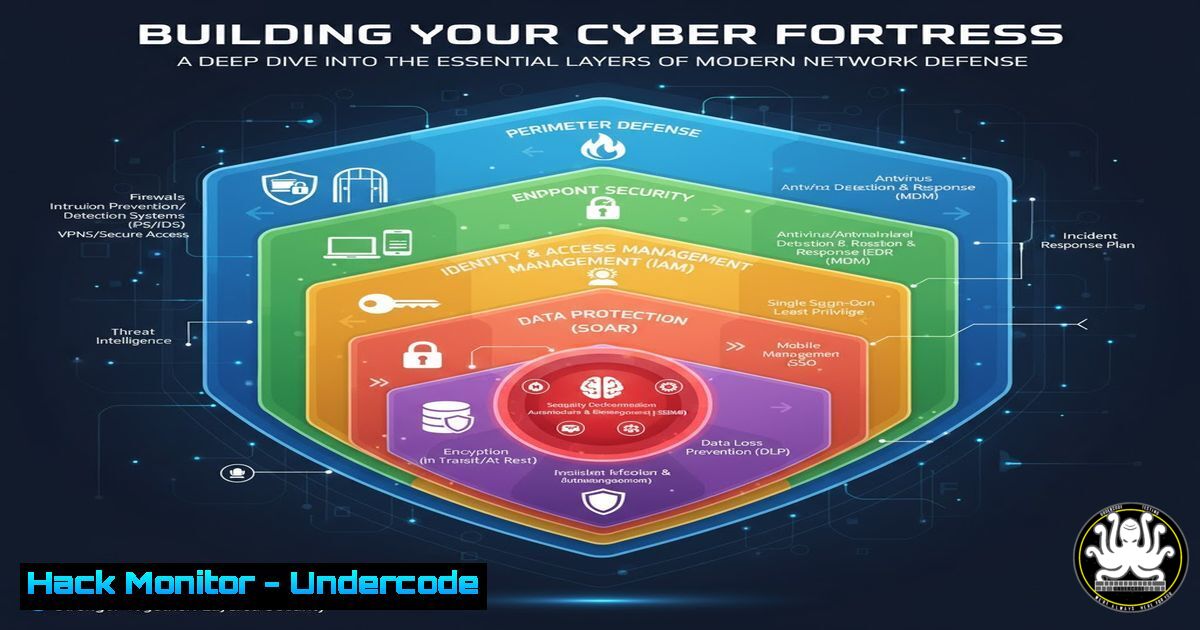
Introduction:
In the evolving landscape of cyber threats, relying on a single security product is a recipe for disaster. A robust defense requires a coordinated strategy of multiple layers, each serving a distinct purpose, much like the physical security of a high-security building. Understanding the role, configuration, and interaction of Firewalls, ACLs, IDS, IPS, SIEM, and the SOC is fundamental to building a resilient security posture that can detect, analyze, and respond to incidents effectively.
Learning Objectives:
- Understand the distinct function and placement of each core security component in a defense-in-depth strategy.
- Learn how to implement basic configurations for key technologies like Firewalls, ACLs, and IDS/IPS using common command-line and tool interfaces.
- Grasp the operational workflow of a SOC and how the SIEM acts as the central brain for correlating security events and enabling proactive threat hunting.
You Should Know:
1. The Foundation: Firewalls as Your Perimeter Gate
A firewall acts as the primary, stateful barrier between trusted and untrusted networks. It functions like the gate and outer wall of a fortress, controlling traffic based on a set of predefined security rules, including source/destination IP addresses, ports, and protocols. Modern next-generation firewalls (NGFWs) add deeper inspection capabilities.
Step-by-step guide:
What it does: A firewall filters traffic at the network layer (Layer 3) and transport layer (Layer 4). It maintains a state table to track the state of network connections, allowing it to make more intelligent decisions than simple packet filtering.
How to use it (Basic Linux iptables example):
The `iptables` utility is a common command-line firewall for Linux. The following commands create a basic rule set.
 Set default policies to DROP all traffic (be cautious!)
iptables -P INPUT DROP
iptables -P FORWARD DROP
iptables -P OUTPUT ACCEPT

Allow established and related traffic on the INPUT chain
iptables -A INPUT -m state --state ESTABLISHED,RELATED -j ACCEPT

Allow incoming SSH (port 22) and HTTP (port 80) traffic
iptables -A INPUT -p tcp --dport 22 -j ACCEPT
iptables -A INPUT -p tcp --dport 80 -j ACCEPT

Allow loopback interface traffic
iptables -A INPUT -i lo -j ACCEPT
This configuration blocks all incoming traffic by default, only permitting SSH, HTTP, and already-established connections.
- The Access Control List (ACL): The Security Guard’s Rulebook
While firewalls guard the perimeter, Access Control Lists (ACLs) are the rulebooks that dictate who can access what, and where, on a more granular level. They are often implemented on routers and switches within the network to enforce policy at the inter-VLAN or interface level.
Step-by-step guide:
What it does: ACLs are ordered sets of permit or deny statements that control traffic based on criteria like IP addresses, protocols, and port numbers. They are a fundamental form of network traffic control.
How to use it (Cisco IOS-like ACL example):
The following is a simplified example of an extended IP ACL on a Cisco router.
! Create an extended ACL named "INBOUND_FILTER"
ip access-list extended INBOUND_FILTER
! Deny any traffic from the 192.168.100.0/24 network to our web server (10.1.1.10)
deny ip 192.168.100.0 0.0.0.255 host 10.1.1.10
! Permit any other IP traffic to the web server
permit ip any host 10.1.1.10
! Apply the ACL inbound on the interface facing the untrusted network
interface GigabitEthernet0/0
ip access-group INBOUND_FILTER in
This ACL explicitly blocks a malicious subnet from accessing an internal web server while allowing all other traffic to it.
- Intrusion Detection System (IDS): The Surveillance Camera Network
An IDS is a passive monitoring system that scans network traffic or host activities for malicious patterns or policy violations. Like a surveillance camera, it observes, analyzes, and alerts security personnel but does not take direct action to block the threat.
Step-by-step guide:
What it does: An IDS uses signature-based detection (matching known attack patterns) and anomaly-based detection (identifying deviations from a baseline) to identify potential incidents. It is typically deployed in promiscuous mode, receiving a copy of the network traffic for analysis.
How to use it (Basic Suricata IDS Rule Execution):
Suricata is a popular open-source IDS/IPS. It uses rules to identify threats.
1. Install Suricata: `sudo apt-get install suricata` (on Debian/Ubuntu).
2. Configure Suricata: Edit `/etc/suricata/suricata.yaml` to specify the network interface and rule files.
3. Download Rules: Obtain community or commercial rulesets (e.g., Emerging Threats).
4. Run Suricata: sudo suricata -c /etc/suricata/suricata.yaml -i eth0. It will log alerts to /var/log/suricata/fast.log.
- Intrusion Prevention System (IPS): The Armed Rapid Response Unit
An IPS is an active version of an IDS. It sits inline on the network path and can automatically block or mitigate detected threats in real-time. It is the armed guard that can intervene directly.
Step-by-step guide:
What it does: An IPS combines the detection capabilities of an IDS with the ability to drop malicious packets, reset connections, or quarantine hosts. It requires careful tuning to avoid false positives that could block legitimate traffic.
How to use it (Enabling IPS mode in Suricata):
The same tool, Suricata, can be configured for IPS functionality using `nfqueue` or `af-packet` in inline mode.
1. Configure for IPS: In suricata.yaml, set the `af-packet` interface to `inline` mode.
2. Set up Network Taps/Bridges: The server running Suricata must be placed inline, often as a transparent bridge.
3. Enable Drop Rules: Use rules with a `drop` action. For example, a Suricata rule to block a known exploit might look like: `drop tcp any any -> $HOME_NET 80 (msg:”ET EXPLOIT Suspicious PHP Code”; flow:established,to_server; content:”eval(base64_decode”; nocase; classtype:attempted-admin; sid:2010001; rev:1;)`
4. Deploy: The system will now actively block traffic matching the “drop” rules.
- Security Information and Event Management (SIEM): The Central Command Center
A SIEM is the operational brain of the security infrastructure. It aggregates, normalizes, and correlates log and event data from all other security tools (Firewalls, IDS/IPS, servers, etc.) to provide a holistic view of the security landscape.
Step-by-step guide:
What it does: A SIEM performs log management, event correlation, and alerting. It helps analysts identify complex, multi-stage attacks that would be invisible when looking at logs from a single device.
How to use it (Basic SIEM Query Logic – Splunk SPL example):
While not a configuration step, understanding how to query a SIEM is critical. This Splunk Search Processing Language (SPL) query looks for a specific attack pattern.
 Find all failed login attempts from a single IP address, followed by a successful login within 5 minutes.
index=auth (action="failure" OR action="success")
| transaction src_ip maxspan=5m
| search eventcount>3 AND action="success"
| table src_ip, user, action, _time
This query could help identify a successful brute-force attack.
- Security Operations Center (SOC): The Tactical Response Team
The SOC is not a tool, but a team of people and processes that operate 24/7 to monitor, analyze, and respond to security incidents. They use the SIEM and other tools as their primary interface to the digital environment.
Step-by-step guide:
What it does: The SOC’s functions include continuous monitoring, threat hunting, incident analysis and triage, and coordinating remediation efforts. They follow a structured playbook for different types of incidents.
How to use it (Incident Response Workflow):
- Detection: An alert is generated by the SIEM from a correlated set of events.
- Triage: A Tier 1 analyst assesses the alert’s severity and fidelity.
- Investigation: A Tier 2 analyst investigates using tools like EDR (Endpoint Detection and Response), network forensics, and threat intelligence.
- Containment & Eradication: The team works to isolate affected systems and remove the threat.
- Recovery & Post-Mortem: Systems are restored, and a lessons-learned analysis is conducted to improve defenses.
7. Integrating the Layers: A Coherent Defense Ecosystem
The true power of these components is realized only when they are integrated. For example, an IDS detects a scan for a specific vulnerability, the SIEM correlates this with an exploit attempt logged by a web server, and the SOC uses this information to create a new, proactive block rule on the IPS.
Step-by-step guide:
What it does: Integration creates a feedback loop where intelligence from one layer strengthens the others. Automation via SOAR (Security Orchestration, Automation, and Response) can accelerate this process.
How to use it (Conceptual Workflow):
- IPS blocks an exploit attempt from IP
X.
2. IPS sends a log to the SIEM.
- The SOC analyst, via the SIEM, initiates a threat hunt for any prior activity from IP
X. - The hunt reveals IP `X` previously communicated with an internal host,
Y. - The SOC directs the Firewall/ACL team to block IP `X` at the perimeter and issues an investigation ticket for host `Y` to the endpoint security team.
This coordinated response is the essence of a mature security program.
What Undercode Say:
- Defense is a Symphony, Not a Solo: The most critical takeaway is that no single tool is a silver bullet. Security is an emergent property of a well-orchestrated system where each component communicates and augments the others. A failure in one layer should be caught by the next.
- Process and People Trump Technology: You can have the most expensive tools, but without a skilled SOC team and well-defined processes to act on the intelligence they provide, your security posture will be brittle. Investing in training and clear operational procedures is non-negotiable.
The analogy of physical security perfectly demystifies the complex interplay of cybersecurity technologies. It highlights a common failure mode: organizations purchasing advanced tools like SIEMs without the staffing or expertise to leverage them, rendering the “brain” of the operation inert. The future of defense lies not in chasing the next “magic box” but in deepening the integration between these established layers, leveraging AI within the SIEM for better correlation, and automating response actions to keep pace with the speed of modern attacks.
Prediction:
The convergence of these defensive layers will accelerate, driven by AI and machine learning. We will see the rise of fully integrated “security platforms” that combine FW, IPS, and SIEM capabilities into a single, self-healing system. These systems will use predictive analytics to shift the paradigm from reactive blocking to pre-emptive defense, automatically adjusting firewall rules and IPS signatures based on global threat intelligence and local anomaly detection. The role of the SOC will evolve from alert triage to overseeing and fine-tuning these autonomous defense systems, focusing on complex threat hunting and strategic response.
🎯Let’s Practice For Free:
IT/Security Reporter URL:
Reported By: Jean Fran%C3%A7ois – Hackers Feeds
Extra Hub: Undercode MoN
Basic Verification: Pass ✅


