
Listen to this Post
Introduction:
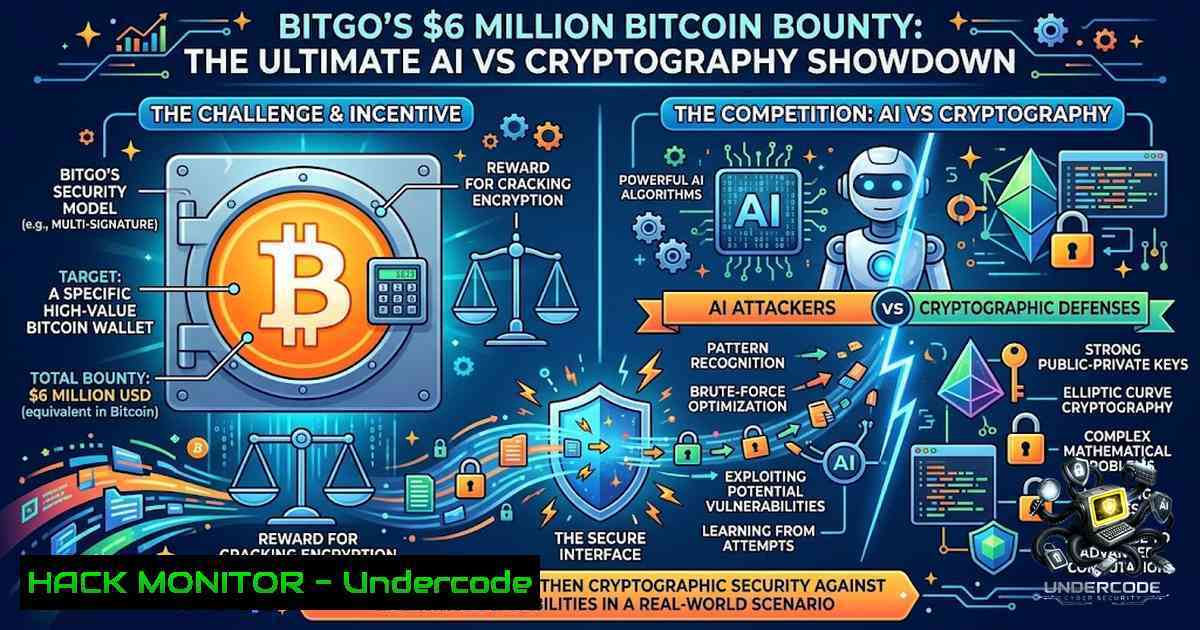
In a high-stakes public challenge, BitGo CEO Mike Belshe deposited 100 Bitcoin (valued at approximately $6 million) into a publicly visible wallet and dared Anthropic’s AI coding assistant, Claude Code, to crack it. This stunt directly challenges Anthropic’s bold claims that its new Mythos AI model can autonomously identify zero-day vulnerabilities and defeat cryptographic security with unprecedented efficiency. The event revives an age-old marketing tactic reminiscent of OpenAI’s 2019 GPT-2 release, where hyping an AI as “too dangerous to release” generates massive publicity while a watered-down commercial product is quietly sold. However, the core technical implication is profound: if an AI truly defeats a modern Bitcoin wallet, it signals a catastrophic failure of elliptic-curve cryptography (ECC) and SHA-256, fundamentally destabilizing the entire crypto economy.
Learning Objectives & Secrets:
- Objective 1: Understand the architecture of Bitcoin wallet security, including the role of ECDSA (Elliptic Curve Digital Signature Algorithm) and hierarchical deterministic (HD) wallets in safeguarding private keys.
- Objective 2 (Secret Tip): Leverage AI-driven fuzzing and static analysis for smart contract auditing, but recognize that exposing a live private key requires breaking discrete logarithm problems—a task currently infeasible for classical AI.
- Objective 3 (Secret Tip): Implement layered security monitoring to detect brute-force or side-channel attacks on hot wallets, using real-time system call analysis and anomaly detection to differentiate between legitimate access and AI-generated exploit payloads.
You Should Know:
- The Myth of AI Breaking ECDSA: A Reality Check
The post’s narrative hinges on the notion that Anthropic’s AI could “effortlessly” find a private key from a public Bitcoin address. In practice, this would require solving the Elliptic Curve Discrete Logarithm Problem (ECDLP) on the secp256k1 curve—a computational challenge that would demand an exponential time complexity far beyond current classical or quantum AI capabilities. To understand this, one must inspect the signature verification process:
- Bitcoin Transaction Flow: When Alice sends Bitcoin, she constructs a transaction and signs it with her private key using ECDSA. The signature (r, s) is generated, and the network verifies it against her public key.
- The Math: Given a public key `Q = d G` (where `d` is the private key and `G` is the generator point), an AI attempting to find `d` must perform a brute-force search over a 256-bit space. With 2^128 operations required on average, even a hypothetical AI with a quantum advantage (using Grover’s algorithm) would still need approximately 2^64 operations, which is far beyond current feasible timelines.
To test this locally, you can generate a Bitcoin key pair and attempt to brute-force it using a Python script to appreciate the exponential complexity:
 Generate a Bitcoin private key and public address for educational purposes
import os
import hashlib
import base58
from ecdsa import SECP256k1, SigningKey

Generate a random private key (warning: never use this for real funds)
private_key_bytes = os.urandom(32)
sk = SigningKey.from_string(private_key_bytes, curve=SECP256k1)
vk = sk.get_verifying_key()
public_key = b'\x04' + vk.to_string()
sha256_hash = hashlib.sha256(public_key).digest()
ripemd160_hash = hashlib.new('ripemd160', sha256_hash).digest()
network_byte = b'\x00' + ripemd160_hash
checksum = hashlib.sha256(hashlib.sha256(network_byte).digest()).digest()[:4]
address = base58.b58encode(network_byte + checksum)
print(f"Private Key: {private_key_bytes.hex()}")
print(f"Public Address: {address.decode()}")
Step‑by‑Step Guide:
- Run the script to generate a test address.
- Observe that the private key is a 64-character hex string—requiring 2^256 combinations.
- Attempt to write a loop that increments the private key by 1 and checks if the derived address matches the target.
- Calculate the time required using `timeit` for 1 million attempts; extrapolate to 2^128 to realize the impossibility of brute-force.
2. AI-Powered Static Analysis for Smart Contract Auditing
While the Mythos model may not break ECDSA, AI excels at identifying logic flaws in smart contracts that could lead to fund drainage. This is where the “security holes” claim gains traction. Tools like Slither and Mythril already use symbolic execution and taint analysis to detect reentrancy, integer overflows, and access control vulnerabilities. Anthropic’s AI could automate these checks at scale.
Step‑by‑Step Guide:
- Install Slither on a Linux Ubuntu 22.04 VM:
pip3 install slither-analyzer
- Download a vulnerable smart contract (e.g., a simple ERC-20 with a reentrancy bug).
3. Run static analysis:
slither ./vulnerable_contract.sol --print human-summary
4. Integrate with AI by feeding the contract source into a large language model (LLM) and prompting: “Identify all potential attack vectors in this Solidity code.” Compare the AI’s output with Slither’s findings.
5. Mitigate by adding a `nonReentrant` modifier from OpenZeppelin and re-analyze.
3. Cloud Security Hardening for Crypto Wallets
BitGo’s wallet is a “hot wallet” connected to the internet, making it susceptible to API attacks, credential theft, and infrastructure misconfigurations. AI could enumerate subdomains, scan for exposed ports, and attempt to exploit known vulnerabilities in the hosting environment (e.g., AWS or GCP). To defend, implement the following:
- AWS Security Group Restrictions: Limit inbound traffic to only necessary IPs.
aws ec2 authorize-security-group-ingress --group-id sg-123456 --protocol tcp --port 22 --cidr 203.0.113.0/24
- Enable AWS CloudTrail for logging all API calls and trigger Lambda functions for anomaly detection.
Step‑by‑Step Guide:
- Set up a Kubernetes cluster with a Bitcoin wallet pod.
- Use `kubectl` to expose the wallet service only via an internal load balancer.
- Deploy Falco (cloud-1ative runtime security) to monitor abnormal system calls:
helm install falco falcosecurity/falco --set falco.rules.verbose=true
- Configure Falco to alert on `execve` attempts within the wallet container that spawn a shell.
4. API Security: Preventing AI-Driven Automated Exploits
If Anthropic’s AI interacts with BitGo’s API endpoints, it could attempt to brute-force API keys or manipulate transaction parameters. Implement rate limiting and JWT authentication with short expiration times.
- Linux Rate Limiting with iptables:
iptables -A INPUT -p tcp --dport 443 -m connlimit --connlimit-above 50 -j REJECT
- Windows Firewall Advanced Security: Create a rule limiting connections to the wallet service’s port.
Step‑by‑Step Guide:
- Deploy an NGINX reverse proxy in front of the wallet API.
2. Configure `limit_req_zone` and `limit_conn_zone` to throttle requests.
- Use `jq` to parse AI-generated payloads and validate schema before passing to the backend.
- Set up a Web Application Firewall (WAF) rule to block SQL injection and XSS attempts.
5. Vulnerability Exploitation and Mitigation in Node.js Dependencies
BitGo’s wallet software likely relies on Node.js libraries. AI could identify outdated packages with known CVEs. Use `npm audit` and `snyk` to remediate.
Step‑by‑Step Guide:
1. Clone the wallet’s frontend repository.
- Run `npm install` and then `npm audit –json` to list vulnerabilities.
3. Use `npm update` to patch minor versions.
4. For critical CVEs, manually upgrade the package:
npm install package-1ame@latest
5. Implement a CI/CD pipeline that fails builds if `npm audit` returns a high-severity issue.
6. Windows-Based System Monitoring for Anomaly Detection
Assume the wallet’s signing mechanism runs on a Windows Server. Use PowerShell to monitor for suspicious processes:
 Monitor for unexpected process launches
Get-WmiObject -Class Win32_Process | Where-Object {$_.Name -1otin "explorer.exe", "taskmgr.exe", "svchost.exe"} | Select-Object Name, ProcessId
Set up Windows Event Forwarding to a SIEM solution like Splunk to correlate logs.
7. AI Model Security and Adversarial Inputs
If Anthropic’s AI is to interact with the wallet, it must process transaction data. An attacker could craft adversarial inputs to poison the AI’s training data, causing it to misclassify a malicious transaction as valid. Implement input sanitization and use a separate validation model to cross-check AI decisions.
What Undercode Say:
- Key Takeaway 1: The BitGo challenge is a masterstroke in marketing, but it fundamentally misunderstands the computational infeasibility of breaking ECDSA. No current AI, regardless of the “too powerful” hype, can solve the discrete logarithm problem within a reasonable timeframe.
- Key Takeaway 2: The real security risk isn’t AI breaking cryptography but AI accelerating the discovery of software vulnerabilities in wallet infrastructure, APIs, and dependencies. The “myth” is a distraction from concrete, patchable issues.
Analysis: Anthropic’s posture mirrors the classic “security through obscurity” narrative. By claiming their model is too dangerous, they create a mystique that drives investment and media coverage. However, this rhetoric may inadvertently undermine public trust in cryptography. The real takeaway for engineers is to focus on robust DevSecOps practices, regular dependency audits, and zero-trust architecture—not fear of a magical AI backdoor. If the Mythos model were to find a bug in the wallet’s custom code, it would be a testament to AI’s utility in fuzzing, not a collapse of cryptographic fundamentals.
Prediction:
- -1: If Anthropic fails to crack the wallet (almost certain), the hype will deflate, and the company’s credibility on “dangerous AI” may take a hit, leading to a short-term drop in investor confidence.
- -1: The challenge exposes a critical flaw in the AI marketing playbook—overpromising on capabilities leads to public skepticism and regulatory scrutiny, potentially delaying AI deployment in security-critical sectors.
- +1: The competition will drive innovation in AI-assisted fuzzing, resulting in more robust smart contract auditing tools and improved cloud security benchmarks.
- +1: The “Mythos vs. BitGo” event will serve as a case study in cybersecurity curricula, teaching students the difference between theoretical AI potential and practical cryptographic limits.
- -1: Should any AI inadvertently find a zero-day in the wallet’s API infrastructure, the resulting exploit could lead to substantial financial loss, albeit not due to breaking ECC but through traditional software bugs.
- +1: The challenge encourages open-source collaboration to verify AI claims, fostering transparency in AI benchmarking and security testing.
- +1: Organizations will accelerate the adoption of hardware security modules (HSMs) and multi-party computation (MPC) to mitigate the risk of AI-assisted side-channel attacks.
- -1: A persistent negative impact is the erosion of public trust in Bitcoin’s security, despite the mathematical proof of its resilience, causing market volatility.
- +1: Ultimately, this stunt will push the cybersecurity community to develop more rigorous testing frameworks for AI systems, ensuring that future claims are backed by verifiable evidence rather than marketing fluff.
- -1: The scenario highlights a dangerous precedent where companies prioritize publicity over responsible disclosure, potentially attracting malicious actors to probe the same systems with real destructive intent.
▶️ Related Video (86% Match):
🎯Let’s Practice For Free:
🎓 Live Courses & Certifications:
Join Undercode Academy for Verified Certifications
🚀 Request a Custom Project:
Secure, high-velocity infrastructure and disruptive technological engineering. Contact our engineering team for high-tier development and proprietary systems:
[email protected]
💎 Smart Architecture | 🛡️ Secure by Design | ⭐ Trusted by Thousands
IT/Security Reporter URL:
Reported By: https://lnkd.in/p/et9Npu6w – Hackers Feeds
Extra Hub: Undercode MoN
Basic Verification: Pass ✅


