Listen to this Post
Introduction:
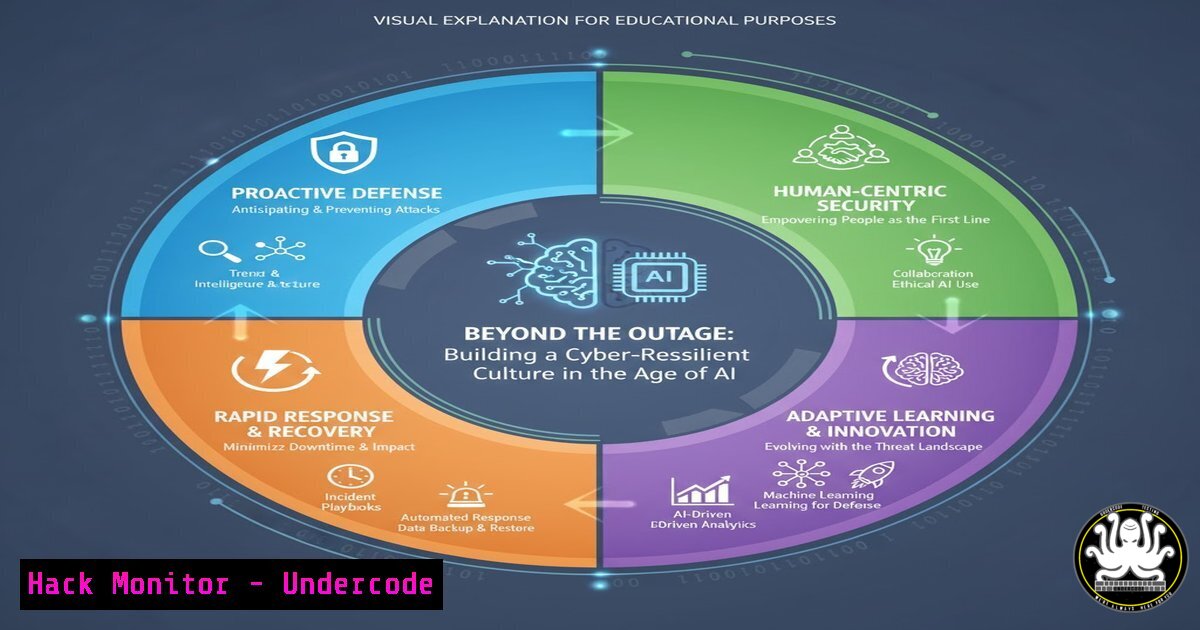
The recent AWS outage was more than a technical failure; it was a stress test for organizational culture in the cybersecurity and AI sectors. When critical infrastructure fails, the response protocol reveals a company’s core values, moving beyond SLAs to the principles of empathy, ownership, and relentless problem-solving. This incident underscores that in modern IT, resilience is not just engineered into systems but is cultivated within teams.
Learning Objectives:
- Understand the critical link between organizational culture and technical incident response.
- Learn key commands and techniques for hardening cloud environments and monitoring service health.
- Develop a framework for post-incident analysis to fortify systems against future disruptions.
You Should Know:
1. Cloud Infrastructure Health Monitoring
`aws cloudwatch describe-alarms –alarm-names “YourAlarmName” –region us-east-1`
`aws ec2 describe-instance-status –instance-ids i-1234567890abcdef0`
`nmap -sT -p 80,443,22 your-application-endpoint.com`
A multi-layered monitoring strategy is non-negotiable. The AWS CLI commands allow you to programmatically check the state of your CloudWatch alarms and specific EC2 instances, which are often the first line of defense in detecting degradation. Complement this with external vantage points using `nmap` to verify that critical ports (HTTP/80, HTTPS/443, SSH/22) are open and responsive from outside your cloud network, providing a customer-eye view of service availability.
2. Containerized Service Verification & Recovery
`docker ps –format “table {{.Names}}\t{{.Status}}\t{{.Ports}}”`
`docker logs –tail 50 –timestamps your_container_name`
`docker-compose -f production.yml restart web worker`
In a microservices architecture, knowing the state of your containers is paramount. The `docker ps` command provides a clean, formatted table of running containers, their status, and exposed ports. If a service is behaving erratically, `docker logs` fetches the most recent log entries with timestamps for immediate forensic analysis. For orchestrated services, `docker-compose` allows you to restart specific components (like the web frontend or a background worker) without a full infrastructure reboot.
3. Database Connectivity and Performance Diagnostics
`pg_isready -h your-rds-endpoint.rds.amazonaws.com`
`mysqladmin -h your-mysql-endpoint -u admin -p ping`
`SELECT count() FROM information_schema.processlist WHERE state != ”;` (Run within MySQL)
Database connectivity is a common failure point during cloud outages. Use `pg_isready` for PostgreSQL or `mysqladmin ping` for MySQL to perform a quick health check. For a deeper dive, the SQL query checks for non-idle database processes. A sudden spike in this count can indicate query deadlocks or resource saturation, guiding your recovery priorities.
4. AI Model Service Endpoint Validation
`curl -X POST -H “Content-Type: application/json” -H “Authorization: Bearer YOUR_API_KEY” -d ‘{“prompt”:”test”}’ https://api.your-ai-service.com/v1/completions`
`ab -n 1000 -c 10 -H “Authorization: Bearer YOUR_API_KEY” -p post_data.json https://api.your-ai-service.com/v1/completions`
For AI-as-a-Service companies, validating that the ML inference endpoints are functional is critical. The `curl` command tests basic connectivity and authentication. Following that, Apache Bench (ab) can be used to simulate a load of 1000 requests with 10 concurrent users, helping you verify not just that the service is up, but that it can handle the impending traffic surge as systems come back online.
5. Network Path and DNS Resolution Troubleshooting
`dig +short your-domain.com A`
`mtr –report –report-cycles 10 your-domain.com`
`tcpdump -i any -n port 53`
Often, the issue is not your application but the network path to it. `dig` provides a quick check of your DNS A records. `mtr` (My Traceroute) combines `ping` and traceroute, providing a continuous report of latency and packet loss at each hop to your destination. For advanced diagnostics, `tcpdump` can be used to capture and inspect DNS traffic on port 53, revealing resolution failures or delays.
6. System Resource and Security Posture Assessment
`htop`
`ss -tuln`
`sudo fail2ban-client status sshd`
During an incident, system resources can become exhausted. `htop` provides a dynamic, color-coded real-time view of CPU and memory usage. The `ss -tuln` command is a modern replacement for netstat, showing all listening TCP and UDP ports, which is crucial for verifying that your services are bound to the correct interfaces. Additionally, check security services like Fail2ban to ensure that recovery efforts haven’t triggered false positives that block legitimate admin traffic.
7. Automated Incident Response Scripting
`!/bin/bash
health_check.sh
if curl -s –retry 3 –max-time 5 http://localhost/health | grep -q ‘”status”:”OK”‘; then
echo “Service is healthy.”
exit 0
else
aws sns publish –topic-arn “arn:aws:sns:us-east-1:123456789:alerts” –message “CRITICAL: Service Health Check Failed”
exit 1
fi`
Automation is key to rapid response. This Bash script is a template for a robust health check. It uses `curl` with retry logic and a timeout to query a local health endpoint. If the check fails, it automatically triggers an alert via AWS SNS. This script can be scheduled with Cron or integrated into your CI/CD pipeline for continuous validation, embodying the principle of “relentlessly making things right” through automation.
What Undercode Say:
- Culture is Your Ultimate Fallback Mechanism: When automated systems and redundant infrastructure fail, the human element—defined by empathy, ownership, and a bias for action—becomes the most critical recovery tool.
- Transparency is a Technical Feature: Proactive, honest communication during an outage is not just PR; it’s a core component of customer trust and must be integrated into incident response playbooks.
The AWS outage was a stark reminder that in a deeply interconnected cloud ecosystem, no company is an island. The technical response—monitoring, failover, recovery—is table stakes. The differentiator, as highlighted by the leadership at Abnormal AI, is the cultural response. A team that is empowered to take ownership, communicate transparently, and learn with intellectual honesty transforms a service disruption into a trust-building exercise. This cultural framework is what prevents a single point of failure in the cloud from becoming a catastrophic failure in customer confidence.
Prediction:
Future cybersecurity and AI platform disruptions will be judged less on the mere fact of their occurrence and more on the transparency and efficacy of the response. We will see the rise of “Cultural SLAs,” where customers formally expect the principles of empathy, ownership, and relentless resolution as part of the service contract. Companies that engineer their culture with the same rigor as their cloud architecture will dominate, turning potential reputation-destroying events into powerful demonstrations of their operational integrity and customer commitment.
🎯Let’s Practice For Free:
IT/Security Reporter URL:
Reported By: Evanreiser The – Hackers Feeds
Extra Hub: Undercode MoN
Basic Verification: Pass ✅


