
Listen to this Post
Introduction:
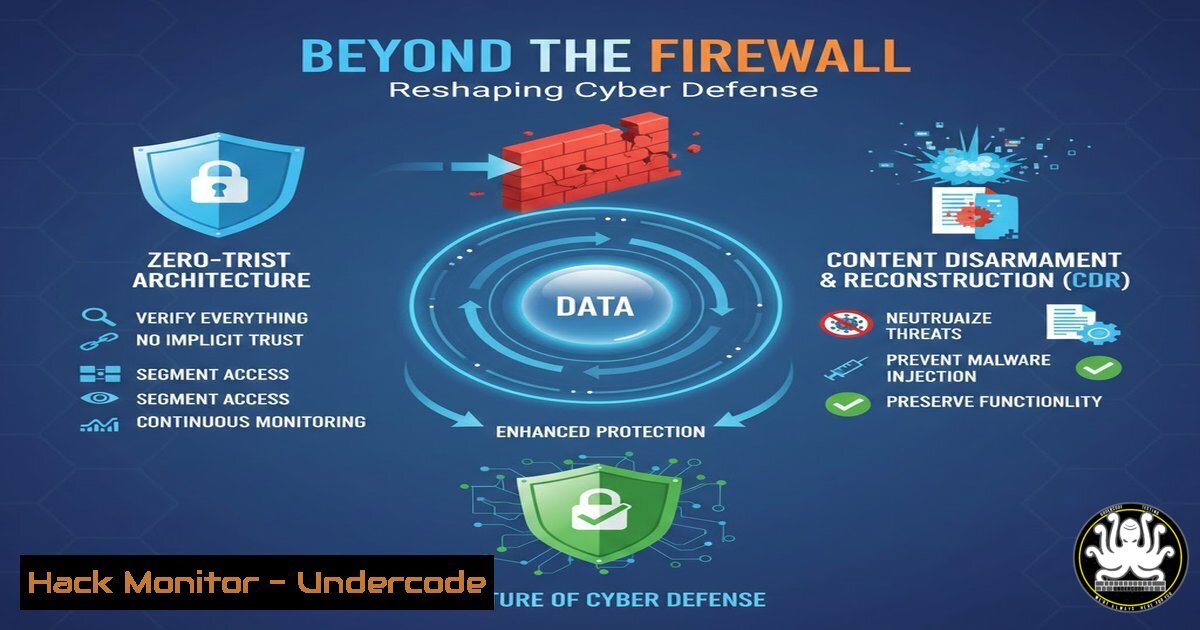
The traditional security perimeter is obsolete. As cyberattacks grow in sophistication, relying on legacy defenses like signature-based antivirus and hardened network borders is a recipe for disaster. The modern approach, exemplified by leaders like OPSWAT, involves a paradigm shift to zero-trust architecture and proactive content disarmament and reconstruction (CDR) to neutralize threats before they can execute.
Learning Objectives:
- Understand the critical limitations of legacy “castle-and-moat” security models.
- Define the core principles of a zero-trust architecture and its implementation.
- Master the concept of Content Disarmament and Reconstruction (CDR) as a proactive threat prevention measure.
- Learn practical steps for hardening cloud assets and API endpoints against modern attacks.
- Analyze a real-world exploit chain mitigated by these advanced technologies.
You Should Know:
- The Fall of the Perimeter: Why Legacy Security Fails
The classic security model, often called the “castle-and-moat,” operates on the flawed assumption that everything inside the network can be trusted. This internal trust is exploited by attackers daily. Once a single endpoint is compromised through a phishing email or a malicious download, the attacker can move laterally across the network with ease. Legacy antivirus solutions rely on known signatures, making them ineffective against zero-day exploits and polymorphic malware. The shift to cloud computing and remote work has dissolved the traditional perimeter, making a new strategy not just advisable but essential.
2. The Zero-Trust Mandate: “Never Trust, Always Verify”
Zero-trust is not a single product but a security framework. It mandates that no entity—user, device, or application—is trusted by default, whether inside or outside the network perimeter. Access to resources is granted on a per-session basis, based on strict identity verification and context-aware policies.
Core Principles:
- Verify Explicitly: Authenticate and authorize every access request using multiple data points (user identity, device health, location, etc.).
- Use Least Privilege Access: Grant users only the permissions they absolutely need to perform their tasks.
- Assume Breach: Design your architecture with the assumption that a breach has already occurred, minimizing the “blast radius” of any incident.
Step-by-Step Implementation Guide:
- Identify Your Crown Jewels: Conduct an audit to classify your most critical data, assets, and services (DAAS).
- Map Transaction Flows: Understand how traffic moves across your network to enforce policy effectively.
- Build a Zero-Trust Architecture: Implement micro-segmentation to create isolated zones within your network.
- Enforce Policy with a Policy Engine: Utilize tools like a Zero-Trust Network Access (ZTNA) gateway to enforce access controls based on the principles above.
-
Content Disarmament and Reconstruction (CDR): Neutralizing Threats Proactively
While zero-trust controls access, CDR tackles the threat hidden within files themselves. CDR operates on the assumption that any file entering your ecosystem could be malicious. Instead of scanning files for known threats (which can be evaded), CDR deconstructs files to their basic components, strips out all potentially dangerous elements like active scripts and macros, and then rebuilds a new, verified-safe version of the file.
What This Does: It prevents zero-day attacks and advanced persistent threats (APTs) that are embedded in common file types like PDFs, Word documents, and Excel spreadsheets.
Step-by-Step Guide to CDR Workflow:
- File Submission: A user uploads a file to a secure web portal or emails it to a protected address.
- Deconstruction: The CDR engine (e.g., OPSWAT’s technology) breaks the file down into its individual parts.
- Sanitization: All active content, embedded objects, and macros are removed. Only the core, safe data elements are preserved.
- Reconstruction: A new, functionally identical file is created from the sanitized components.
- Delivery: The safe, new file is delivered to the intended recipient.
4. Hardening Cloud and API Security
With data now residing in the cloud, API security becomes the new perimeter. Misconfigured cloud storage buckets and unsecured APIs are low-hanging fruit for attackers.
Step-by-Step Guide for Basic Cloud Hardening:
- Enable Logging and Monitoring: Ensure all access logs for cloud services (e.g., AWS S3, Azure Blob Storage) are activated and sent to a SIEM.
AWS CLI Command to enable S3 access logging: `aws s3api put-bucket-logging –bucket your-bucket-name –bucket-logging-status ‘{“LoggingEnabled”: {“TargetBucket”: “your-log-bucket”, “TargetPrefix”: “logs/”}}’`
2. Apply the Principle of Least Privilege: Use IAM roles and policies to restrict access. Never use root accounts for daily operations. - Encrypt Data at Rest and in Transit: Ensure all data is encrypted using managed keys (e.g., AWS KMS, Azure Key Vault).
- Secure APIs: Implement strong authentication (OAuth 2.0, API keys), rate limiting, and input validation for all API endpoints to prevent injection and DDoS attacks.
5. A Real-World Exploit Chain Mitigated
Consider a sophisticated phishing campaign targeting a financial institution:
– Step 1 (Initial Access): An employee receives a spear-phishing email with a weaponized PDF invoice.
– Step 2 (Exploitation): The PDF exploits a previously unknown (zero-day) vulnerability in a common PDF reader to execute a malicious payload.
– Step 3 (Persistence): The payload establishes a connection to a command-and-control server.
How Zero-Trust & CDR Mitigate This:
- The email gateway, integrated with a CDR solution, intercepts the PDF.
- The CDR process deconstructs the file, removing the exploit code, and rebuilds a safe PDF.
- The employee receives and opens the safe file. Even if the file were delivered, the zero-trust policy would prevent the initial payload from communicating externally without explicit verification, neutralizing the attack at multiple layers.
What Undercode Say:
- Legacy Defenses are a Liability: Relying solely on antivirus and firewalls is akin to leaving your front door unlocked because you have a loud dog. Proactive, assumption-of-breach models are non-negotiable.
- The Human Element is the Constant: Technology can only do so much. Continuous security training is critical to ensure employees are the first line of defense, not the weakest link.
The roundtable discussion highlighted by industry leaders confirms that the evolution from reactive to proactive security is well underway. The integration of zero-trust principles with deep-content inspection technologies like CDR represents the most robust defense against the evolving threat landscape. Organizations that fail to adopt this layered, “trust-no-one” approach will find themselves consistently outmaneuvered by adversaries who have long since learned to bypass traditional perimeter defenses.
Prediction:
The convergence of AI-powered attack tools and the expanding attack surface of IoT and OT environments will render signature-based defenses almost entirely obsolete. The future of cybersecurity lies in behavioral analysis, real-time anomaly detection powered by machine learning, and automated enforcement of zero-trust policies. Vendors who successfully integrate AI into their CDR and zero-trust platforms to predict and preempt attack vectors will lead the market, fundamentally changing the cyber defense cycle from reactive to predictive and preventative.
🎯Let’s Practice For Free:
IT/Security Reporter URL:
Reported By: Gilad Mor – Hackers Feeds
Extra Hub: Undercode MoN
Basic Verification: Pass ✅


