Listen to this Post
Introduction
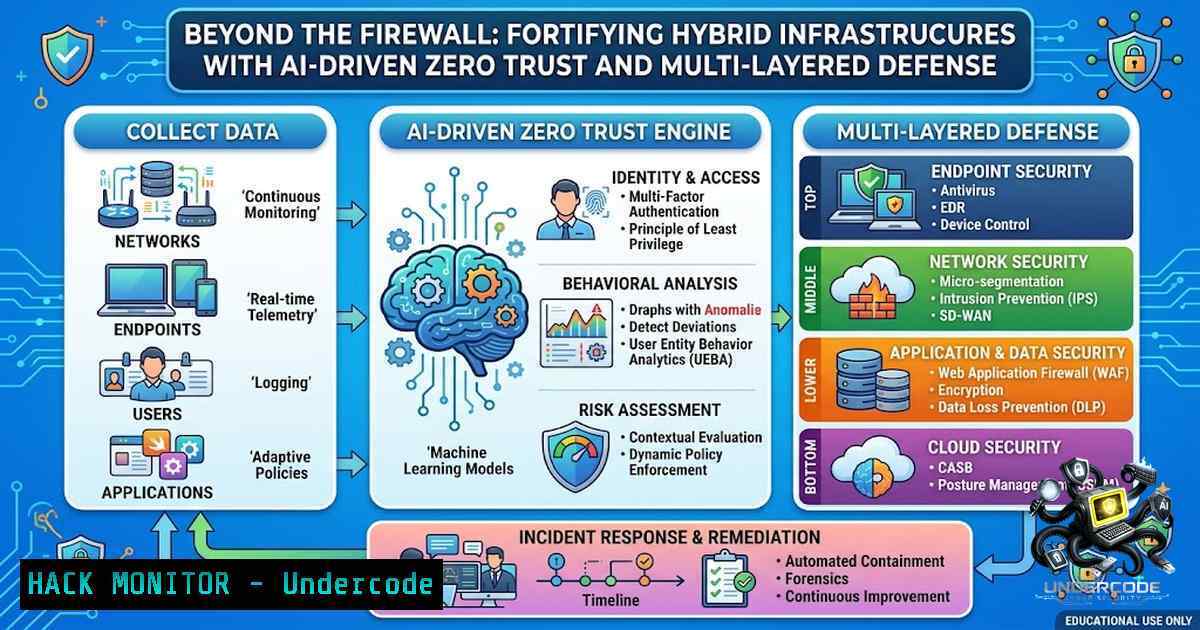
Modern network perimeters have dissolved into a sprawling mosaic of hybrid clouds, remote workforces, and interconnected critical infrastructure. Traditional firewall-centric security models are no longer sufficient to stop stealthy, adaptive threats that exploit trusted lateral movement and encrypted traffic blind spots. To address this reality, organizations are moving beyond legacy defenses and adopting a three-layered approach that synergizes Next-Generation Firewalls (NGFW), intelligent breach detection, and Zero Trust Network Access (ZTNA)—a strategy that reduces complexity while dramatically improving cyber resilience.
Learning Objectives
- Understand how to architect a multi-layered defense that integrates NGFW, breach detection, and ZTNA without operational overhauls.
- Implement AI-driven security operations to reduce alert fatigue and automate threat response.
- Configure dual-compliance frameworks that bridge global vulnerability standards (CVE) and local databases (CNNVD).
You Should Know
- Multi-Layered Defense: NGFW + Breach Detection + ZTNA
The cornerstone of Hillstone’s approach is a three-tiered security architecture that stops threats at the network layer, detects advanced persistent threats (APTs) inside the perimeter, and enforces zero-trust access controls.
Step‑by‑step guide to implementing a layered defense:
- Deploy Next-Generation Firewall (NGFW) at the network edge. Hillstone’s StoneOS leverages AI-powered machine learning to detect threats in encrypted traffic without decryption, preserving privacy while blocking 0-day attacks. The NGFW also performs intelligent DDoS protection and perimeter traffic filtering with extended blacklist capabilities.
-
Integrate Breach Detection System (BDS) for east‑west visibility. Once traffic passes the NGFW, deploy Hillstone’s BDS to monitor internal lateral movement. BDS combines signature-based detection, threat intelligence, and machine-learning-based user behavior analysis to identify ransomware, crypto-mining malware, and IOC events. It provides deep visibility into east‑west traffic and can automatically trigger mitigation actions in conjunction with the NGFW.
-
Enforce Zero Trust Network Access (ZTNA) for application-level control. Hillstone ZTNA eliminates implicit trust by continuously verifying every access request, regardless of the user’s location. Centralized management via Hillstone Security Management (HSM) allows you to define granular policies across multiple ZTNA gateways and clients.
Example CLI snippet (Hillstone NGFW – basic interface and admin configuration):
SG-6000 configure
SG-6000(config) interface ethernet0/1
SG-6000(config-if) ip address 192.168.1.1 255.255.255.0
SG-6000(config-if) enable
SG-6000(config-if) exit
SG-6000(config) admin user flowmon
SG-6000(config-admin) password YourSecurePass123
SG-6000(config-admin) role super-admin
Reference: Hillstone firewall CLI commands for basic setup and user creation.
2. AI-Powered Operations: Cutting Through the Noise
Alert fatigue is a cybersecurity epidemic—security teams overwhelmed by thousands of low-priority alerts experience desensitization, slower response times, and burnout. Hillstone’s AI OAM (Operations, Administration, and Maintenance) Assistant and smart operations tools directly address this by automating threat prioritization and streamlining workflows.
Step‑by‑step guide to reducing alert fatigue with AI:
- Automate workflow prioritization. Configure Hillstone’s XDR platform (iSource) to correlate massive security data sets, identify potential threats, and automatically orchestrate responses across multiple security products.
-
Implement AI-based alert filtering. Leverage machine learning models within StoneOS to distinguish true positives from false positives. The system can suppress repetitive alerts and escalate only those that require human intervention.
-
Integrate SIEM for centralized logging and monitoring. Hillstone recommends deploying SIEM solutions to make monitoring and logging effective, providing a single pane of glass for threat investigation.
Recommended Windows/PowerShell command for SIEM log forwarding (if using syslog):
 Configure Windows Event Log forwarding to a SIEM collector
wevtutil set-log "Microsoft-Windows-Sysmon/Operational" /enabled:true /retention:false /maxsize:1073741824
 Install and configure NXLog or Winlogbeat to forward logs to your SIEM server
Linux syslog-1g configuration snippet for forwarding firewall logs:
 /etc/syslog-1g/syslog-1g.conf
source s_net { udp(ip(0.0.0.0) port(514)); };
destination d_siem { tcp("192.168.100.50" port(514)); };
log { source(s_net); destination(d_siem); };
3. Zero Trust Network Access (ZTNA): Deployment Models
ZTNA is not a single product but a security model that replaces traditional VPNs with identity-centric, least-privilege access. Hillstone supports both agent‑based and clientless ZTNA deployments, offering flexibility for different use cases.
Step‑by‑step guide for clientless ZTNA deployment (ideal for BYOD and contractors):
- Set up a ZTNA gateway at the edge of your data center or cloud environment. The gateway acts as a reverse proxy for private applications.
-
Configure authentication via a centralized IAM platform with multi-factor authentication (MFA). Hillstone ZTNA supports a wide range of authentication schemes, including SAML, OAuth, and LDAP.
-
Deploy browser‑based access. Users access a web portal using their existing credentials; no agent software is required. The system creates a temporary, single-destination tunnel to the requested resource.
-
Apply least‑privilege access policies. Grant users the minimum permissions necessary to perform their tasks, using micro-segmentation and role-based access controls (RBAC).
Use cases for clientless ZTNA:
- BYOD environments where installing agents is impractical.
- Internal private apps that need protection from external intrusion.
- Temporary access for contractors or partners.
- Legacy applications not designed for cloud-1ative security.
4. Dual Compliance: Bridging Global and Local Standards
Organizations operating in multiple regions must comply with both international vulnerability databases (CVE) and local frameworks such as China’s CNNVD. Hillstone uniquely supports both simultaneously, enabling unified patch management and risk assessment.
Step‑by‑step guide to implementing dual‑compliance vulnerability management:
- Enable CVE and CNNVD feeds within Hillstone’s security management console. The system automatically pulls the latest vulnerability data from both sources.
-
Correlate vulnerability data with your asset inventory. Hillstone’s platform can map CVEs and CNNVD entries to specific device models and firmware versions (e.g., SG-6000 series).
-
Prioritize remediation based on severity scores from both databases. If a vulnerability is reported in both CVE and CNNVD, it receives higher priority.
-
Automate patching where possible using Hillstone’s centralized management tools. For manual patches, generate compliance reports that demonstrate coverage of both standards.
Example: Checking for known vulnerabilities on a Hillstone firewall (Linux-based OS):
 Connect via SSH and check the current StoneOS version
ssh [email protected]
SG-6000> show version
 Compare output against CVE and CNNVD advisories
 Example: CVE-2025-2239 - Absolute Path Disclosure in Hillstone NGFW
 Example: CVE-2026-1791 - Unrestricted File Upload in O&M Security Gateway
5. Cloud Hardening and Workload Protection
For hybrid and multi-cloud environments, Hillstone’s CloudArmour provides a Cloud Workload Protection Platform (CWPP) that defends against malware, zero-day attacks, and misconfigurations.
Step‑by‑step guide to hardening cloud workloads:
- Deploy Cloud Security Posture Management (CSPM) tools to continuously scan for misconfigurations (e.g., open S3 buckets, overly permissive IAM roles) and automatically remediate them.
-
Implement micro-segmentation using Hillstone CloudHive, which provides granular traffic visibility and least-privilege policies across virtual environments.
-
Integrate with EDR and DLP. Combine CWPP with endpoint detection and response (EDR) and data loss prevention (DLP) to protect sensitive data across the entire cloud estate.
Azure CLI command to restrict network access to a VM (example of implementing least privilege in the cloud):
 Create a network security group rule that only allows traffic from specific IPs
az network nsg rule create \
--resource-group MyResourceGroup \
--1sg-1ame MyNSG \
--1ame AllowSpecificIP \
--priority 100 \
--direction Inbound \
--access Allow \
--protocol Tcp \
--source-address-prefixes 203.0.113.0/24 \
--source-port-ranges '' \
--destination-address-prefixes '' \
--destination-port-ranges 443
6. Monitoring, Logging, and Incident Response
Continuous monitoring and logging are the bedrock of any security strategy. Hillstone’s NDR/BDS platform provides deep threat hunting capabilities, including attack chain reconstruction and forensic analysis.
Step‑by‑step guide to setting up effective monitoring:
- Deploy Hillstone BDS sensors at critical network junctions to capture east‑west and north‑south traffic.
-
Enable sandbox analysis for suspicious files and URLs. BDS can automatically detonate potential malware in a safe environment and correlate results with network activity.
-
Integrate with your SIEM to centralize logs from NGFW, BDS, ZTNA gateways, and cloud workloads.
-
Establish a regular threat-hunting cadence. Use BDS’s IOC detection and behavioral analytics to proactively search for signs of compromise.
Linux command to monitor network connections and detect anomalies (supplemental to BDS):
 Monitor active network connections in real-time
sudo ss -tulpn | grep LISTEN
 Check for unusual outbound connections
sudo netstat -antop | grep ESTABLISHED | awk '{print $5}' | cut -d: -f1 | sort | uniq -c | sort -1r
 Review system logs for authentication failures
sudo journalctl -u sshd --since "1 hour ago" | grep "Failed password"
What Undercode Say
- Key Takeaway 1: The three-layered approach—NGFW, breach detection, and ZTNA—is not about adding more tools but about integrating them intelligently. Each layer compensates for the weaknesses of the others: NGFW blocks known threats at the edge, BDS catches what slips through via behavioral analysis, and ZTNA ensures that even if a breach occurs, the attacker cannot move laterally.
-
Key Takeaway 2: AI and automation are no longer optional. Alert fatigue is a business risk that directly impacts incident response times. Organizations that fail to implement AI-driven operations will find their security teams drowning in noise while real attacks go unnoticed. Hillstone’s StoneOS 5.5R10, with over 300 new features including ML-based encrypted traffic detection and centralized ZTNA management, represents a significant leap toward autonomous security.
Analysis: The cybersecurity industry is at an inflection point. Traditional perimeter defenses are obsolete, and the shift to zero trust is accelerating. However, many organizations are struggling with the complexity of implementation. Hillstone’s strategy addresses this by offering a unified platform that reduces operational overhead while improving security posture. The dual-compliance capability (CVE + CNNVD) is particularly strategic for multinational enterprises operating in regulated markets, as it simplifies vulnerability management across different regulatory regimes. Looking ahead, we can expect AI-driven security operations to become the standard, with machine learning models handling the bulk of threat detection and response, leaving human analysts to focus on strategic decision-making and complex investigations. The integration of XDR platforms like iSource will further break down silos between network, endpoint, and cloud security, enabling a truly unified defense.
Prediction
- +1 The adoption of AI-powered NGFW with ML-based encrypted traffic detection will become a baseline requirement for enterprises within the next 24 months, as regulators begin mandating visibility into encrypted communications without breaking privacy.
-
+1 Clientless ZTNA will overtake agent-based solutions for external-facing applications, driven by the need to secure BYOD and contractor access without the operational burden of agent deployment.
-
-1 Organizations that delay implementing AI-driven alert management will suffer a 30–40% increase in mean time to detect (MTTD) and respond (MTTR) over the next 18 months, as threat volumes continue to grow exponentially.
-
+1 Dual-compliance frameworks (CVE + CNNVD) will become a competitive differentiator for security vendors, especially in APAC markets where local vulnerability databases are gaining regulatory teeth.
-
-1 The complexity of deploying ZTNA across hybrid environments will remain a significant barrier; Hillstone’s centralized HSM management is a step in the right direction, but the industry as a whole needs more automation and pre-built integrations to avoid implementation fatigue.
-
+1 Breach detection systems that combine signature-based, behavioral, and ML-based detection will become the new standard for internal network monitoring, as ransomware and crypto-mining malware continue to evade traditional signature-based tools.
-
-1 Without continuous training and upskilling, security teams will struggle to leverage the full potential of AI-driven tools, leading to underutilized investments and persistent gaps in defense.
▶️ Related Video (82% Match):
https://www.youtube.com/watch?v=44rVWjHpHFk
🎯Let’s Practice For Free:
🎓 Live Courses & Certifications:
Join Undercode Academy for Verified Certifications
🚀 Request a Custom Project:
Secure, high-velocity infrastructure and disruptive technological engineering. Contact our engineering team for high-tier development and proprietary systems:
[email protected]
💎 Smart Architecture | 🛡️ Secure by Design | ⭐ Trusted by Thousands
IT/Security Reporter URL:
Reported By: Hillstonenetworks Cybersecurity – Hackers Feeds
Extra Hub: Undercode MoN
Basic Verification: Pass ✅


