Listen to this Post
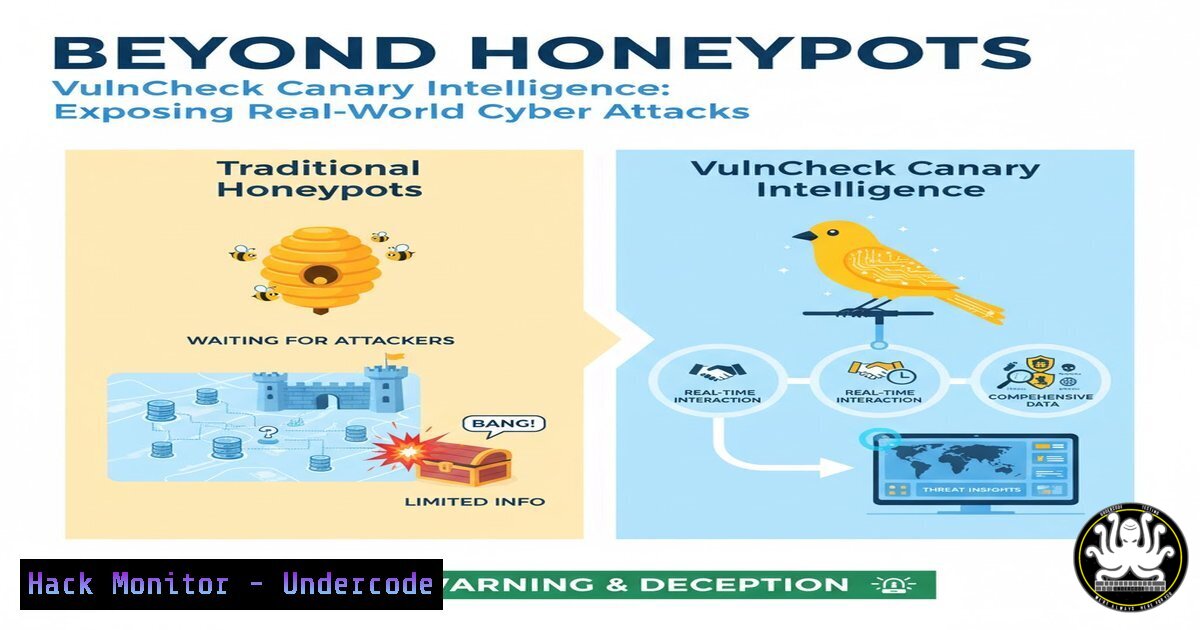
Introduction:
The cybersecurity landscape is shifting from theoretical threats to validated, real-world exploitation data. VulnCheck’s new Canary Intelligence product represents this evolution by deploying genuinely vulnerable systems across the internet to capture and analyze live attacker behavior, providing security teams with unprecedented visibility into active campaigns and exploitation techniques.
Learning Objectives:
- Understand the critical difference between traditional honeypots and canary intelligence systems.
- Learn how to leverage first-party exploitation data to prioritize vulnerability management.
- Discover methods for integrating real-time attack intelligence into security operations and threat hunting.
You Should Know:
- The Canary Intelligence Methodology: From Honeypots to Real Vulnerable Systems
Traditional honeypots often simulate services and vulnerabilities, which can be detected by sophisticated attackers. VulnCheck’s Canary Intelligence deploys actual vulnerable software instances, making them indistinguishable from real, misconfigured, or unpatched internet-facing assets. This approach captures authentic attacker interactions, from initial reconnaissance to full weaponization, providing a high-fidelity signal of what techniques and CVEs are being actively exploited in the wild. The data is not inferred; it’s recorded from successful compromises.
Step‑by‑step guide explaining what this does and how to use it.
Step 1: Deployment. VulnCheck strategically deploys a diverse fleet of internet-facing systems running software with known vulnerabilities (n-day) or recently discovered flaws (zero-day).
Step 2: Monitoring. These systems are instrumented with extensive logging and network monitoring tools to capture every interaction. This includes command-and-control (C2) callbacks, payload downloads, and post-exploitation activity.
Step 3: Data Correlation. Captured data is automatically correlated with threat intelligence feeds, such as VulnCheck’s own Known Exploited Vulnerabilities (KEV) catalog, to tie activity to specific threat actors or ransomware families.
- Actionable Data Feeds: UI, API, and Machine-Readable Streams
The raw data from canaries is processed and made available through multiple consumption methods, ensuring it can be integrated into any security team’s workflow. The API allows for automation, the UI provides a human-readable dashboard (like the mentioned “PewPew map”), and machine-readable feeds enable ingestion into SIEMs, SOAR platforms, and other security tools for real-time alerting and analysis.
Step‑by‑step guide explaining what this does and how to use it.
Step 1: Access the Platform. Security teams log into the VulnCheck platform or authenticate against its API using generated keys.
Step 2: Query for Specific Threats. Using the API, a team can programmatically check if a specific CVE, like CVE-2025-24893, has observed exploitation activity.
Example `curl` command to query the API:
`curl -H “Authorization: Bearer YOUR_API_KEY” https://api.vulncheck.com/v2/cve/CVE-2025-24893`
Step 3: Integrate into Defenses. The returned JSON data can be used to update firewall rules, IPS signatures, or create alerts in a SOAR platform. For instance, if a new payload variant is discovered, a YARA rule can be generated and deployed to endpoint detection tools.
3. Accelerating Zero-Day and N-Day Coverage
By analyzing the exact payloads and techniques used against its canaries, VulnCheck provides security vendors and enterprise defenders with the intelligence needed to create robust detection rules. This moves beyond signature-based detection to behavior-based and exploit-chain-aware defenses, dramatically reducing the window of exposure for novel and known vulnerabilities.
Step‑by‑step guide explaining what this does and how to use it.
Step 1: Analyze Captured Payloads. Security researchers examine the shellcode, binaries, and scripts uploaded to the canary systems.
Step 2: Develop and Test Detections. Using this information, they can create and refine detection logic. For example, a Suricata rule can be written to detect a specific network payload pattern.
Example Suricata rule snippet:
`alert tcp any any -> $HOME_NET any (msg:”VulnCheck Canary – Suspicious Exploit Pattern”; flow:to_server,established; content:”|90 90 90 e8 c0 ff ff|”; sid:1000001; rev:1;)`
Step 3: Deploy and Validate. These new rules are deployed and their efficacy is measured against the real-world traffic patterns confirmed by Canary Intelligence.
4. Validating the KEV Catalog and Prioritization
The VulnCheck KEV catalog lists vulnerabilities known to be exploited, but Canary Intelligence provides the empirical evidence. The platform has already confirmed exploitation for 231 KEV entries, including 20 that had no previously public evidence. This allows security teams to move these vulnerabilities to the very top of their patching priority list with absolute confidence.
Step‑by‑step guide explaining what this does and how to use it.
Step 1: Review the KEV. Regularly pull the latest VulnCheck KEV list.
Step 2: Cross-Reference with Canary Data. Filter the KEV list to show only those vulnerabilities where Canary Intelligence has recorded active exploitation events in the last 30 days.
Step 3: Triage and Patch. Immediately initiate patching procedures or implement virtual patches (e.g., via WAF) for systems affected by these validated, actively exploited vulnerabilities.
5. Threat Actor and Ransomware Correlation
The intelligence gathered goes beyond the “what” to uncover the “who.” By analyzing TTPs (Tactics, Techniques, and Procedures), infrastructure, and payloads, the platform can link exploitation events to specific threat groups or ransomware operations. This enables proactive defense and hunting for related IOCs (Indicators of Compromise) within an organization’s network.
Step‑by‑step guide explaining what this does and how to use it.
Step 1: Identify a Campaign. The platform identifies a cluster of attacks using a unique exploit chain and a specific C2 protocol.
Step 2: Attribute the Activity. Through intelligence analysis, this cluster is linked to a known ransomware-as-a-service (RaaS) group.
Step 3: Hunt Proactively. Defenders can then use IOCs (IPs, domains, file hashes) and TTPs associated with that group to search their own logs for signs of a breach. A sample hunt command using `Sigma` rules in a SIEM can be created to look for the group’s specific lateral movement techniques.
What Undercode Say:
- The era of passive, simulated threat intelligence is over. The future belongs to active, empirical data collection from live internet threats.
- Prioritization in vulnerability management must be driven by data confirming active exploitation, not just CVSS scores or theoretical risk.
VulnCheck’s Canary Intelligence marks a significant maturation in the threat intelligence market. By providing verified, first-party data on attacks, it cuts through the noise of unverified third-party reports and low-fidelity honeypot data. This empowers defenders to make high-confidence decisions on resource allocation for patching and threat hunting. The value is not just in knowing a CVE exists, but in knowing it is being used right now by real adversaries, complete with the context of how and by whom. This shifts the defender’s advantage from reactive to proactively informed.
Prediction:
The adoption of canary-style intelligence will become a standard practice for leading security teams and vendors within three years. This methodology will rapidly expand beyond software vulnerabilities to include deceptive cloud misconfigurations, API endpoints, and IoT device firmware, creating a dynamic, self-updating map of the live attack surface. This will force attackers to develop new OPSEC techniques to avoid these traps, fundamentally changing the economics of broad, automated exploitation.
🎯Let’s Practice For Free:
IT/Security Reporter URL:
Reported By: Awenzel Vulncheck – Hackers Feeds
Extra Hub: Undercode MoN
Basic Verification: Pass ✅


