Listen to this Post
Introduction:
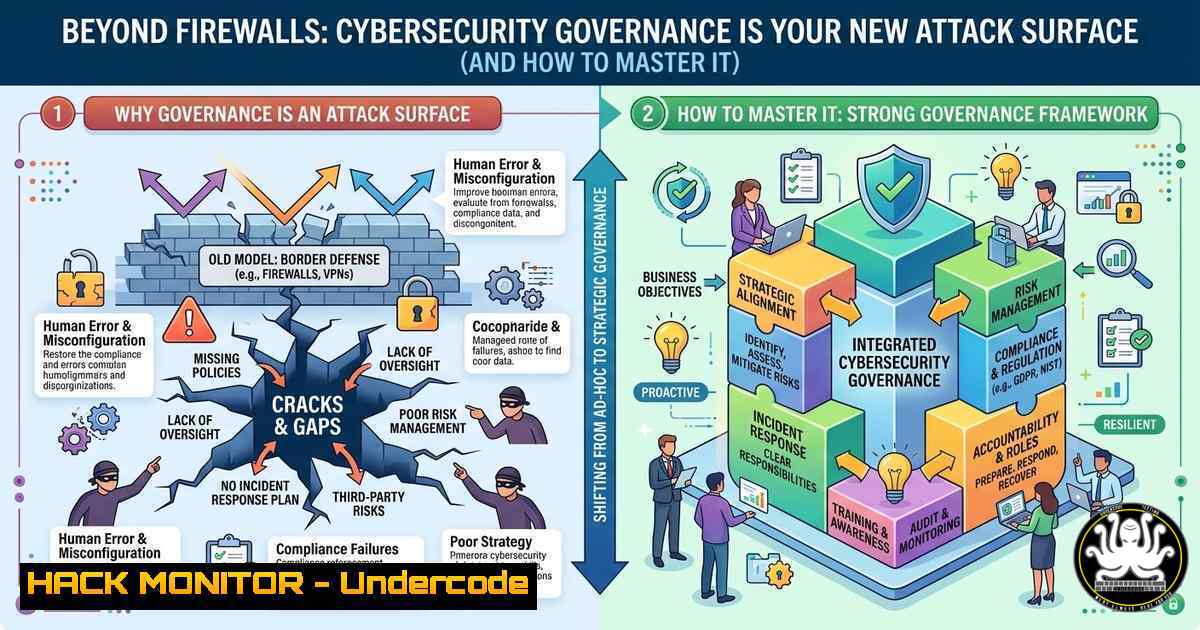
While technical vulnerabilities often dominate headlines, the true root cause of most security failures lies in flawed governance—the absence of structured decision-making, accountability, and risk management. The recent announcement of a special edition of MISC magazine dedicated to governance highlights a critical shift: effective cybersecurity is no longer solely about deploying tools but about orchestrating them through a robust framework of policies, compliance, and executive oversight.
Learning Objectives:
- Define the core components of cybersecurity governance and distinguish it from mere technical management.
- Identify key regulatory frameworks (ISO 27001, NIST, GDPR) and how to map them to organizational controls.
- Implement practical governance workflows using both Linux/Windows administrative tools and cloud-native policy engines.
You Should Know:
- Establishing a Risk Register: The Cornerstone of Governance
Governance begins with understanding what you are protecting. A Risk Register is a formal document that lists identified risks, their likelihood, impact, mitigation strategies, and owners. Without this, security efforts are reactive rather than strategic.
Step‑by‑step guide explaining what this does and how to use it:
1. Inventory Assets: Use standard OS tools to generate a baseline. On Linux, use `nmap -sn 192.168.1.0/24` to discover live hosts or `lshw -short` to list hardware. On Windows, use `Get-WmiObject -Class Win32_ComputerSystem` in PowerShell to enumerate assets.
2. Create the Register: Use a structured format (CSV/JSON). Below is a PowerShell snippet to create a template:
$RiskTemplate = [bash]@{
ID = "RISK-001"
Asset = "Domain Controller"
Threat = "Ransomware Encryption"
Vulnerability = "Unpatched SMB vulnerability (MS17-010)"
Likelihood = "High"
Impact = "Critical"
Owner = "IT Security Team"
Mitigation = "Patch deployment & EDR monitoring"
Status = "Open"
}
$RiskTemplate | Export-Csv -Path "C:\Security\RiskRegister.csv" -NoTypeInformation
3. Assign Owners: Governance fails without accountability. Use Active Directory (Windows) or FreeIPA (Linux) to assign explicit ownership groups for asset remediation.
- Implementing Policy-as-Code with Azure Policy & AWS Config
Governance is enforced when policies are automated. Manual checklists are obsolete. Using cloud-native tools allows you to enforce compliance (e.g., encryption at rest, private endpoints) programmatically.
Step‑by‑step guide explaining what this does and how to use it:
1. Azure Policy: Define a policy to restrict VM sizes to approved SKUs to control costs and security baselines. Use the Azure CLI:
az policy definition create --name 'allowed-vm-sku' --rules '{
"if": {
"allOf": [
{ "field": "type", "equals": "Microsoft.Compute/virtualMachines" },
{ "field": "Microsoft.Compute/virtualMachines/sku.name", "notIn": ["Standard_D2s_v3", "Standard_D4s_v3"] }
]
},
"then": { "effect": "deny" }
}'
2. AWS Config: Create a managed rule to enforce EC2 instances are not publicly accessible. This translates governance decisions into automated remediation.
3. Linux Hardening with Ansible: Automate governance compliance (like CIS Benchmarks) across Linux servers. Ansible playbooks ensure that the “policy” of server hardening is enforced consistently:
- name: Ensure password aging is configured
lineinfile:
path: /etc/login.defs
regexp: '^PASS_MAX_DAYS'
line: 'PASS_MAX_DAYS 90'
- Auditing Compliance with NIST or ISO 27001 Controls
Governance requires proof of compliance. This involves auditing logs and configurations against frameworks like NIST Cybersecurity Framework (CSF) or ISO 27001 Annex A.
Step‑by‑step guide explaining what this does and how to use it:
1. Centralized Logging: Configure `auditd` on Linux to track file access changes, which maps to NIST control AU-3 (Content of Audit Records).
 Edit /etc/audit/rules.d/audit.rules
-w /etc/passwd -p wa -k identity_changes
-w /etc/shadow -p wa -k identity_changes
-w /etc/sudoers -p wa -k sudo_changes
2. Windows Advanced Audit: Use Group Policy (gpedit.msc) to enable “Audit Process Creation” (4688 events). This allows tracking of executed commands, critical for incident response governance.
3. Reporting: Use `Get-WinEvent` in PowerShell to extract specific audit logs for compliance officers.
Get-WinEvent -FilterHashtable @{LogName='Security'; ID=4624} | Where-Object { $_.Properties[bash].Value -eq 10 } | Select-Object TimeCreated, Message
(This filters for successful logons via RDP, a key indicator in access governance audits.)
4. Incident Response Playbooks: Governing the Chaos
A governance structure must define who does what when a breach occurs. An Incident Response (IR) plan is a governance document that prevents ad-hoc panic.
Step‑by‑step guide explaining what this does and how to use it:
1. Define the Playbook: Create a Markdown document stored in a version-controlled repository (e.g., GitHub).
 IR-001: Ransomware Response
Trigger: Alert from EDR or user report of encrypted files.
Step 1: Isolate host (Network level).
Command: `Get-NetAdapter | Disable-NetAdapter -Name "Ethernet0" -Confirm:$false` (Windows)
Step 2: Capture forensic image.
Command: `dd if=/dev/sda of=/mnt/forensics/image.dd bs=4M status=progress` (Linux)
Step 3: Escalate to Legal/PR (if data exfiltration confirmed).
2. Test the Playbook: Governance is not a static document. Use tools like `Chaos Monkey` for cloud resilience or `Caldera` for breach simulation to test if the governance structure holds under stress.
3. Post-Mortem (Lessons Learned): A governance requirement. After an incident, use `grep` to analyze logs and identify why controls failed.
grep "Failed password" /var/log/auth.log | awk '{print $11}' | sort | uniq -c | sort -nr
5. The Governance of APIs and AI Models
Modern IT governance must extend to APIs and AI usage. Unmanaged APIs are a top attack vector; ungoverned AI leads to data leakage.
Step‑by‑step guide explaining what this does and how to use it:
1. API Discovery: Use `ffuf` or `kiterunner` to discover hidden API endpoints, then document them in a governance inventory.
ffuf -u https://target.com/FUZZ -w /usr/share/wordlists/api_list.txt -ac
2. API Security Policies: Implement rate limiting using a WAF or an API gateway (like Kong or Tyk). Define policies that reject unauthenticated traffic.
3. AI Governance (DLP): To prevent employees from pasting source code into public AI chatbots, configure Windows Defender Firewall or Linux proxy rules to block requests to specific AI domains (e.g., chat.openai.com), or use a Data Loss Prevention (DLP) tool to inspect clipboard contents for sensitive patterns (e.g., regex for `AKIA[0-9A-Z]{16}` for AWS keys).
What Undercode Say:
- Governance is not bureaucracy; it is the blueprint for resilience. Without defined roles, policies, and automated enforcement, even the best security tools fail.
- Automation is the execution arm of governance. Manual spreadsheets and quarterly reviews are obsolete. Policy-as-Code (Azure Policy, AWS Config, Ansible) ensures security is enforced at the speed of DevOps.
The shift highlighted by the MISC special edition is profound: we are moving from “hero culture” security (where one engineer fixes a crisis) to “structured security” where the organization survives the departure of key personnel. Governance ensures that compliance (ISO, NIST) is not just a checkbox for auditors but a live system that actively prevents breaches. It bridges the gap between the C-suite (risk appetite) and the SOC analyst (technical execution). For IT professionals, this means mastering not just `iptables` and PowerShell, but also frameworks like COBIT and understanding how to translate technical risk into business language. The future of cybersecurity lies in quantifiable risk management, not just vulnerability patching.
Prediction:
As AI-generated code and autonomous agents proliferate, governance will evolve from controlling human actions to controlling machine identities and AI decision-making. Within two years, we will see the rise of “AI Governance Officers” and mandatory SBOMs (Software Bill of Materials) for AI models. Organizations that fail to implement strict governance on their AI pipelines will face catastrophic data leaks and regulatory penalties surpassing today’s GDPR fines. The “wild west” of shadow IT will shift to a “shadow AI” crisis, making governance the single most critical competency for security teams in 2026 and beyond.
▶️ Related Video (78% Match):
🎯Let’s Practice For Free:
IT/Security Reporter URL:
Reported By: Alinehof La – Hackers Feeds
Extra Hub: Undercode MoN
Basic Verification: Pass ✅


