Listen to this Post
Introduction
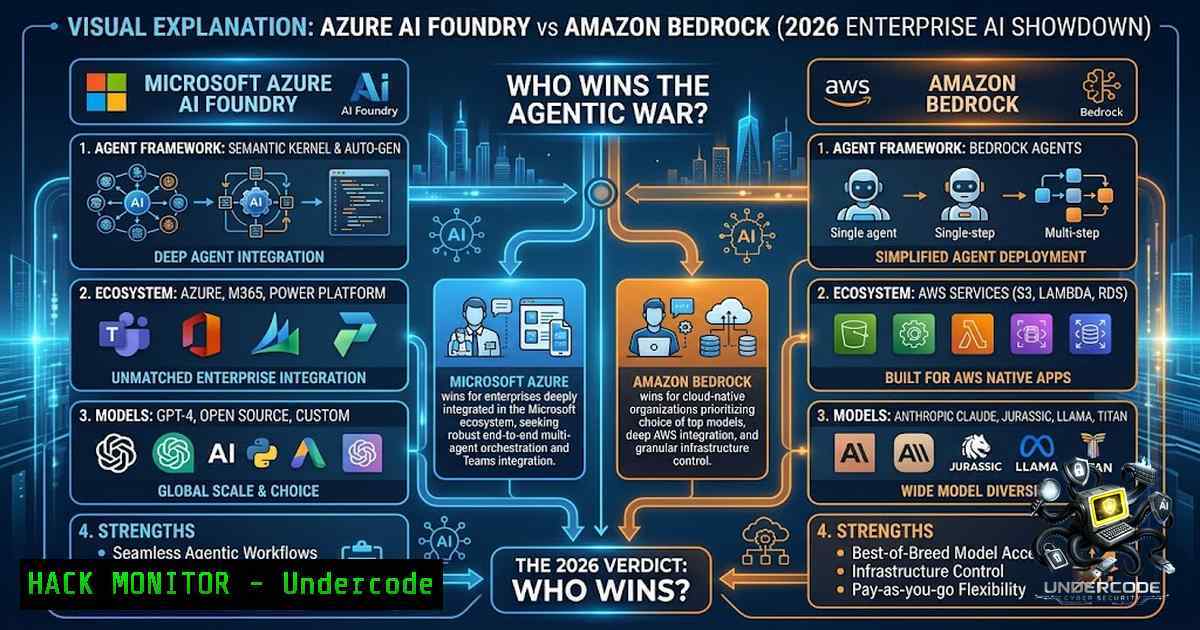
Enterprise AI has officially exited the experimental phase. Organizations are no longer asking “if” they should build AI agents—they’re asking “which platform” and “how fast.” Azure AI Foundry (formerly Azure AI Studio) and Amazon Bedrock have emerged as the two dominant hyperscaler platforms for building, deploying, and operating production-grade generative AI and agentic systems. Both offer multi-model access, governed environments, and enterprise-grade security, but the architectural philosophy, identity integration, and operational tooling differ in ways that fundamentally impact your go-to-market velocity and long-term total cost of ownership. This article dissects the control plane, security posture, RAG and agentic capabilities, observability, and FinOps strategies across both platforms—and gives you the commands and configurations to implement each in your own environment.
Learning Objectives
- Architect an enterprise-grade AI control plane using Azure AI Foundry or Amazon Bedrock with Zero Trust security principles
- Implement Retrieval-Augmented Generation (RAG) and agentic AI patterns with dynamic tool calling and multi-step reasoning
- Configure identity, governance, observability, and FinOps controls to operationalize AI workloads at scale
1. Control Plane Architecture: Hub-and-Spoke vs. Account-Level IAM
Azure AI Foundry and Amazon Bedrock take fundamentally different approaches to the control plane. Azure AI Foundry operates as a full development platform with project-level organization, agent lifecycle management, and deep Microsoft Entra ID (formerly Azure Active Directory) integration. Resources are organized into Hubs and Projects, with fine-grained RBAC applied at each layer. Amazon Bedrock, by contrast, relies on AWS account-level IAM for most access controls, with Bedrock Studio workspaces providing a lighter-weight collaboration layer.
Step‑by‑step: Setting Up Azure AI Foundry Hub and Project
 Azure CLI - Create a Foundry Hub
az ml workspace create --1ame "ai-foundry-hub-prod" \
--resource-group "rg-ai-prod" \
--location "eastus" \
--kind "hub"

Create a Project within the Hub
az ml workspace create --1ame "rag-agent-project" \
--resource-group "rg-ai-prod" \
--location "eastus" \
--kind "project" \
--hub "ai-foundry-hub-prod"

Assign RBAC roles
az role assignment create --assignee "[email protected]" \
--role "Azure AI Developer" \
--scope "/subscriptions/{sub-id}/resourceGroups/rg-ai-prod/providers/Microsoft.MachineLearningServices/workspaces/rag-agent-project"
Step‑by‑step: Configuring Amazon Bedrock with Least-Privilege IAM
// IAM Policy - Bedrock Agent Least Privilege
{
"Version": "2012-10-17",
"Statement": [
{
"Effect": "Allow",
"Action": "bedrock:InvokeModel",
"Resource": "arn:aws:bedrock:us-east-1::foundation-model/anthropic.claude-3-sonnet-20240229"
},
{
"Effect": "Allow",
"Action": "bedrock:Retrieve",
"Resource": "arn:aws:bedrock:us-east-1:123456789012:knowledge-base/kb-12345"
},
{
"Effect": "Allow",
"Action": "lambda:InvokeFunction",
"Resource": "arn:aws:lambda:us-east-1:123456789012:function:bedrock-action-group-"
}
]
}
Critical: Scope each permission by ARN. Never use `bedrock:` or wildcard actions. Sonrai research shows over 90% of cloud permissions across human and non-human identities go unused—don’t let your agent become a standing identity with unnecessary blast radius.
- Zero Trust Security: Identity, Secrets, and Prompt Protection
Security in AI agent platforms requires defense-in-depth across identity, data, and model layers. Azure AI Foundry leverages Microsoft Entra ID for fine-grained access control, Azure Key Vault for secrets management, and content safety filters to block prompt injection and malicious instructions. Amazon Bedrock relies on IAM least privilege, VPC isolation with AWS PrivateLink, and Bedrock Guardrails for policy enforcement.
Step‑by‑step: Hardening Azure AI Foundry Agents (Zero Trust Checklist)
- Enforce Entra ID authentication for all agent tool calls and knowledge base access
- Store all secrets in Azure Key Vault—never hard-code credentials in agent definitions
- Enable Prompt Shields to detect and block prompt injection attempts before they reach the model
- Configure Managed Private Endpoints to keep all traffic within the Azure backbone
- Implement red teaming as a deployment gate—require every new agent to pass a red teaming scan before production approval
Step‑by‑step: Locking Down Amazon Bedrock Agent Permissions Before Go-Live
 AWS CLI - Create a Bedrock agent with scoped execution role
aws bedrock-agent create-agent \
--agent-1ame "secure-rag-agent" \
--foundation-model "anthropic.claude-3-sonnet-20240229" \
--instruction "You are a secure RAG assistant..." \
--agent-resource-role-arn "arn:aws:iam::123456789012:role/bedrock-execution-role-scoped" \
--idle-session-ttl-in-seconds 3600

Set a permissions boundary to cap maximum permissions
aws iam put-role-permissions-boundary \
--role-1ame "bedrock-execution-role-scoped" \
--permissions-boundary "arn:aws:iam::123456789012:policy/bedrock-max-permissions-boundary"
Critical: Use `aws:SourceArn` condition keys in IAM policies to prevent the confused deputy problem—this ensures Bedrock can only assume roles for specific resources.
- RAG and Agentic AI: From Fixed Pipelines to Autonomous Reasoning
Standard RAG follows a fixed sequence: accept query, run search, assemble context, call the model. Agentic RAG changes this entirely—the AI agent treats retrieval as a tool it can invoke on demand, reasoning about the query, deciding which tools to call, evaluating intermediate results, and iterating until it has enough context. This enables multistep reasoning, dynamic source selection, query decomposition, and iterative refinement.
Azure AI Foundry implements agentic RAG through the Microsoft Agent Framework and Foundry Agent Service, with Azure AI Search powering the retrieval layer. Amazon Bedrock offers Bedrock Agents and AgentCore, with Knowledge Bases providing managed RAG and serverless scaling.
Step‑by‑step: Building an Agentic RAG System on Azure AI Foundry
 Python - Microsoft Agent Framework Agent with RAG tools
from semantic_kernel import Kernel
from semantic_kernel.connectors.ai.open_ai import AzureChatCompletion
from semantic_kernel.planning import SequentialPlanner
from azure.ai.search import SearchClient

Initialize kernel with Azure OpenAI
kernel = Kernel()
kernel.add_service(AzureChatCompletion(
deployment_name="gpt-4o",
endpoint="https://your-foundry.openai.azure.com/",
api_key="your-key"
))

Define search tool
async def search_knowledge_base(query: str) -> str:
search_client = SearchClient(
endpoint="https://your-search.search.windows.net",
index_name="product-catalog",
credential=AzureKeyCredential("your-key")
)
results = await search_client.search_async(query, top=5)
return "\n".join([doc["content"] for doc in results])

Register tool with agent
kernel.add_function("search_knowledge_base", search_knowledge_base)

Agent reasons, calls tools iteratively, produces grounded answer
planner = SequentialPlanner(kernel)
plan = await planner.create_plan("Which of our product SKUs have open recalls in the last 90 days?")
result = await plan.invoke()
Step‑by‑step: Deploying an Agentic RAG System on Amazon Bedrock
 AWS CLI - Create Knowledge Base for RAG
aws bedrock-agent create-knowledge-base \
--1ame "product-knowledge-base" \
--role-arn "arn:aws:iam::123456789012:role/bedrock-kb-role" \
--knowledge-base-configuration '{
"type": "VECTOR",
"vectorKnowledgeBaseConfiguration": {
"embeddingModelArn": "arn:aws:bedrock:us-east-1::foundation-model/amazon.titan-embed-text-v2:0"
}
}' \
--storage-configuration '{
"type": "OPENSEARCH_SERVERLESS",
"opensearchServerlessConfiguration": {
"collectionArn": "arn:aws:aoss:us-east-1:123456789012:collection/rag-collection",
"vectorIndexName": "product-index",
"fieldMapping": {
"metadataField": "metadata",
"textField": "text"
}
}
}'

Create Bedrock Agent with knowledge base attached
aws bedrock-agent create-agent \
--agent-1ame "agentic-rag-agent" \
--foundation-model "anthropic.claude-3-sonnet-20240229" \
--knowledge-bases '[{"knowledgeBaseId": "kb-12345", "description": "Product catalog"}]'
When to use agentic RAG: Standard RAG works for queries that map to a single search against a single index. Choose agentic RAG when you need multistep reasoning, dynamic source selection, or iterative refinement. Each reasoning step adds latency and token cost—use it only when the flexibility justifies the expense.
- Observability and FinOps: Monitoring Tokens, Costs, and Performance
AI workloads introduce new cost drivers: token consumption, model inference, retrieval operations, and agent orchestration. Both platforms provide observability tooling, but Azure AI Foundry integrates deeply with Azure Monitor, Log Analytics, and Microsoft Cost Management, with Foundry Observability capturing prompts, responses, token consumption, latency, and errors. Amazon Bedrock provides CloudTrail for governance, CloudWatch for metrics, and Cost Explorer for spend analysis.
Step‑by‑step: Implementing FinOps on Azure AI Foundry
 Azure CLI - Enable diagnostic settings for Foundry
az monitor diagnostic-settings create \
--1ame "foundry-observability" \
--resource "/subscriptions/{sub-id}/resourceGroups/rg-ai-prod/providers/Microsoft.MachineLearningServices/workspaces/rag-agent-project" \
--logs '[{"category": "ModelInference", "enabled": true}]' \
--workspace "/subscriptions/{sub-id}/resourceGroups/rg-monitor/providers/Microsoft.OperationalInsights/workspaces/ai-logs"

Set up budget alerts for token spend
az consumption budget create \
--budget-1ame "ai-token-budget" \
--amount 5000 \
--time-grain Monthly \
--time-period start=2026-08-01,end=2027-08-01 \
--category Cost \
--subscription "{sub-id}" \
--1otifications '[{"enabled": true, "operator": "GreaterThan", "threshold": 80, "contactEmails": ["[email protected]"]}]'
Step‑by‑step: Monitoring Amazon Bedrock with CloudWatch and Cost Explorer
 AWS CLI - Enable CloudWatch metrics for Bedrock
aws cloudwatch put-metric-alarm \
--alarm-1ame "bedrock-token-throttle" \
--comparison-operator "GreaterThanThreshold" \
--evaluation-periods 1 \
--metric-1ame "InvocationCount" \
--1amespace "AWS/Bedrock" \
--period 300 \
--statistic "Sum" \
--threshold 10000 \
--actions-enabled \
--alarm-actions "arn:aws:sns:us-east-1:123456789012:ai-ops-topic"

Use AWS Cost Explorer for token-based chargeback
aws ce get-cost-and-usage \
--time-period Start=2026-08-01,End=2026-08-08 \
--granularity DAILY \
--metrics "BlendedCost" \
--filter '{"Dimensions": {"Key": "SERVICE", "Values": ["Amazon Bedrock"]}}'
Key Insight: AI FinOps must look across the entire workload, not only the model endpoint. Include retrieval costs, storage, compute, and networking in your cost allocation models.
5. Platform Selection: The Decisive Factors
The model catalogue is no longer the differentiator. All three platforms keep pace on major commercial models—GPT, Claude, Llama, Mistral. The real decision factors are:
| Factor | Azure AI Foundry | Amazon Bedrock |
|–||-|
| Identity | Microsoft Entra ID + Purview | AWS IAM + CloudTrail |
| Model Strength | Deepest GPT-family integration | Widest open-source + niche model coverage |
| Pricing | Per-token + Azure compute; flexible commits | Per-token consumption + Provisioned Throughput |
| Best For | Microsoft 365/Azure-1ative enterprises | AWS-1ative enterprises with S3 data gravity |
Step‑by‑step: Decision Framework
- Audit your existing cloud footprint—if 75% of your workloads are on Azure, Foundry is the natural choice
- Map your identity provider—Entra ID shops get unmatched governance integration with Foundry
- Evaluate your data gravity—S3-heavy? Bedrock’s operational fit is excellent
- Test both with a representative workload—measure token cost, latency, and developer productivity
What Undercode Say:
- The model catalogue is table stakes—the real differentiator is how each platform handles identity, governance, and observability across the entire agent lifecycle
- Zero Trust must be designed in, not bolted on—every agent tool call, knowledge base query, and model invocation should be authenticated, authorized, and audited
- Agentic RAG is not a silver bullet—it adds latency and cost; use it only when multistep reasoning or dynamic source selection is genuinely required
- FinOps for AI requires granular telemetry—you cannot optimize what you cannot measure; implement token-level chargeback from day one
- The platform choice is a 3–5 year commitment—switching costs are high; evaluate based on your existing cloud estate, identity stack, and data gravity, not just model availability
Prediction:
- +1 Over the next 18 months, Azure AI Foundry and Amazon Bedrock will converge on feature parity, with the competitive battleground shifting to agent orchestration, multi-agent systems, and autonomous workflow execution
- +1 The rise of agentic AI will accelerate demand for AI-specific security tooling—expect Microsoft Defender for Cloud and AWS Security Hub to add deeper AI workload protection capabilities by Q1 2027
- -1 Organizations that deploy AI agents without implementing least-privilege IAM, content filtering, and red teaming gates will face data breaches and regulatory fines as AI-specific attack vectors (prompt injection, data leakage, agent hijacking) become mainstream
- +1 FinOps for AI will mature into a standalone discipline, with cloud providers offering AI-specific reserved capacity, spot inference, and commitment-based discounts that reduce token costs by 40–60% at scale
- -1 The complexity of managing multi-model, multi-cloud AI estates will drive a new wave of vendor lock-in, as organizations standardize on a single hyperscaler’s AI platform to avoid operational fragmentation
▶️ Related Video (78% Match):
🎯Let’s Practice For Free:
🎓 Live Courses & Certifications:
Join Undercode Academy for Verified Certifications
🚀 Request a Custom Project:
Secure, high-velocity infrastructure and disruptive technological engineering. Contact our engineering team for high-tier development and proprietary systems:
[email protected]
💎 Smart Architecture | 🛡️ Secure by Design | ⭐ Trusted by Thousands
IT/Security Reporter URL:
Reported By: Palaniram Ai – Hackers Feeds
Extra Hub: Undercode MoN
Basic Verification: Pass ✅


