Listen to this Post
Introduction:
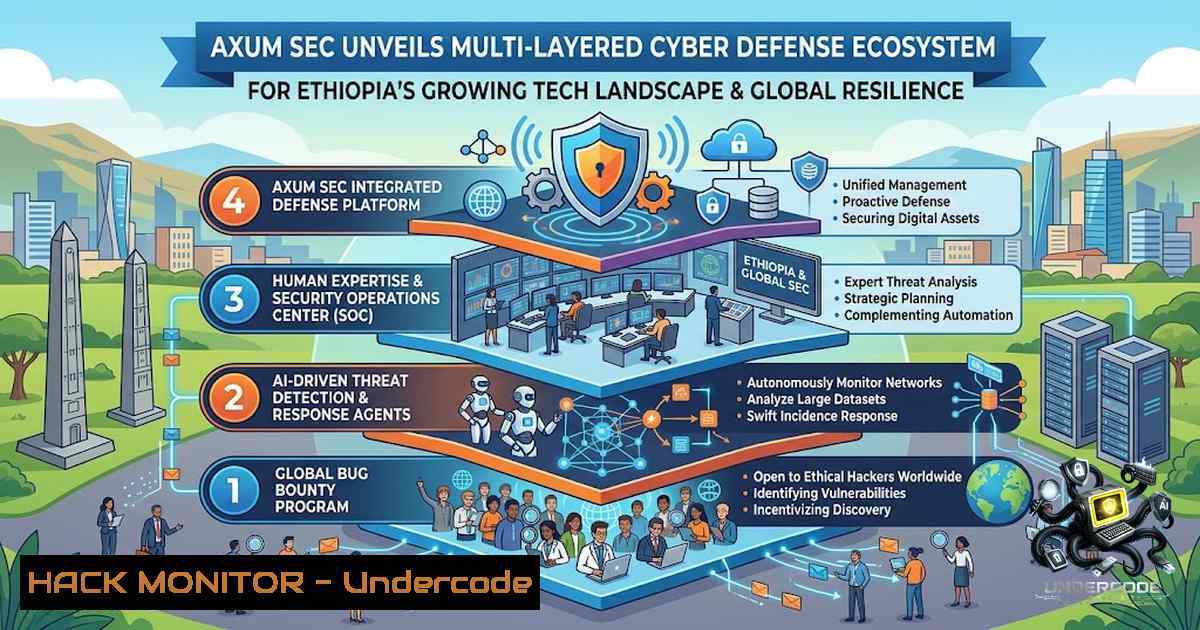
The cybersecurity industry has long grappled with a fundamental asymmetry: defenders must secure every entry point, while attackers only need to find one. In response, AXUM SEC has introduced a three-pronged defense model that combines crowdsourced ethical hacking, autonomous AI-driven reconnaissance, and human-led validation. This approach, unveiled in a recent social media announcement, reflects a broader shift toward continuous, intelligence-led security testing—moving beyond compliance checklists to real-time vulnerability management that spans global talent pools and machine-speed detection.
Learning Objectives & Secrets:
- Objective 1: Understand the architecture of multi-layered security meshes and how they reduce mean time to remediation (MTTR) by integrating human and AI findings.
- Objective 2 (Secret Tip): Leverage bug bounty platforms not just for discovery, but for continuous red-team simulation—rotate testers to avoid tunnel vision and ensure fresh attack vectors are probed weekly.
- Objective 3 (Secret Tip): Combine AI scanners with manual penetration testing to filter false positives; train AI models on proprietary vulnerability data to improve detection of business-logic flaws that automated tools often miss.
You Should Know:
- Building a Global Bug Bounty Community: Setup and Vetting
AXUM SEC’s claim of “500+ vetted ethical hackers” underscores the importance of rigorous onboarding. To replicate this, organizations must establish clear rules of engagement, scoping documents, and secure communication channels.
- Step-by-Step Guide:
- Define the scope (IP ranges, domains, API endpoints) and exclusions (e.g., sensitive customer data).
- Use a vulnerability disclosure policy (VDP) template aligned with ISO 29147.
- Onboard hackers via platforms like HackerOne or Bugcrowd, or build a private program with background checks and NDAs.
- Implement a triage system: prioritize critical vulnerabilities (CVSS ≥ 7.0) for immediate patching.
- Linux Command (for scoping): `nmap -sV -p- -T4 target.com` to map open ports and services before sharing scope with hackers.
- Windows Command (for patch verification): `wmic qfe list brief /format:table` to check installed updates post-fix.
- Deploying Autonomous AI Agents: AXGNT and AXUMIS in Action
The post highlights AI agents that “never sleep.” These are typically comprised of automated scanners, fuzzers, and behavioral analyzers. Implementing such agents requires orchestration.
- Step-by-Step Guide:
- Integrate open-source scanners (e.g., OWASP ZAP, Nuclei) into a CI/CD pipeline.
- Use AI to correlate findings from multiple scans (e.g., combining static application security testing (SAST) and dynamic application security testing (DAST) results).
- Schedule scans during off-peak hours to avoid performance degradation; use webhooks to trigger scans after code commits.
- Linux Command (for scheduling): `crontab -e` then add `0 2 /usr/bin/nuclei -u https://target.com -o daily_scan.txt` for daily 2 AM scans.
- API Security Tip: Configure agents to test for OWASP API Top 10 risks—use `curl -X POST https://api.target.com/v1/login -d ‘{“user”:”admin”,”pass”:”‘ OR ‘1’=’1″}’` to simulate SQL injection on APIs.
3. Continuous Scanning and Adaptive Testing (24/7/365)
The promise of never-sleeping agents implies continuous monitoring, not just periodic pentests. This requires resilient infrastructure and log aggregation.
- Step-by-Step Guide:
- Deploy a SIEM (e.g., Elastic Stack, Splunk) to ingest scan results and system logs.
- Set up alerting rules for anomalous behaviors (e.g., repeated 404 errors indicating directory brute-forcing).
- Use machine learning to baseline normal traffic and detect deviations indicative of zero-day exploits.
- Linux Command (log tailing): `tail -f /var/log/nginx/access.log | grep “404”` to monitor real-time errors.
- Windows PowerShell (for event monitoring): `Get-WinEvent -LogName Security | Where-Object { $_.Id -eq 4625 }` to track failed login attempts.
4. Validation by In-House Experts: Eliminating False Positives
AXUM SEC emphasizes that their experts “validate every finding.” This human-in-the-loop process is critical because AI agents produce high noise.
- Step-by-Step Guide:
- Establish a ticketing system (e.g., Jira, TheHive) where AI findings are automatically logged.
- Assign a senior pentester to review each finding, reproduce the issue in a staging environment, and document the exploit path.
- Create a knowledge base of false-positive patterns (e.g., scanners flagging default Apache headers as exposed server info).
- Linux Command (for reproduction): `curl -k -v https://target.com/admin` to test for exposed admin panels flagged by AI.
– Mitigation: If a vulnerability is confirmed, use `iptables -A INPUT -s attacker_ip -j DROP` for immediate network-level blocking while patching.
- Cloud Hardening and Infrastructure as Code (IaC) Security
While not explicitly stated, multi-layered defense extends to cloud environments. AXUM SEC’s model likely includes scanning IaC templates (Terraform, CloudFormation) for misconfigurations.
- Step-by-Step Guide:
- Use `tfsec` or `checkov` to scan Terraform scripts for overly permissive security groups (e.g., 0.0.0.0/0 on port 22).
- Enforce least-privilege IAM policies—automate with AWS Config rules.
- Linux Command: `checkov -d /path/to/terraform/` to generate a report of cloud misconfigurations.
- Windows/Azure: Use `Az PowerShell` module: `Get-AzNetworkSecurityGroup -1ame “NSG-FrontEnd” | Select-Object -ExpandProperty SecurityRules` to audit inbound rules.
- Mitigation: For an open S3 bucket, use `aws s3api put-bucket-acl –bucket mybucket –acl private` to restrict access.
6. Vulnerability Exploitation and Mitigation Workflow
When a critical vulnerability is found—e.g., an unauthenticated RCE in a web app—the response must be swift and coordinated.
- Step-by-Step Guide:
- Containment: Isolate affected instances using network segmentation (e.g., move to a quarantine VLAN).
- Eradication: Apply vendor patches or, if unavailable, implement WAF rules to block exploit attempts.
- Recovery: Restore from clean backups and verify integrity.
- Linux Command (for WAF): `sudo nginx -t && sudo systemctl reload nginx` after adding `deny 192.168.1.0/24;` to block malicious subnets.
- Windows Command (for IIS): Use `appcmd.exe set config /section:system.webServer/security/ipSecurity /+”[ipAddress=’192.168.1.0′,subnetMask=’255.255.255.0′]”` to block IP ranges.
What Undercode Say:
- Key Takeaway 1: The synergy between global bug bounty hunters and autonomous AI agents creates a “defense-in-depth” that outperforms siloed approaches—humans catch logic flaws, AI catches scale and speed.
- Key Takeaway 2: Validation by in-house experts is not a luxury; it’s a necessity. Without it, organizations drown in alerts and risk ignoring critical issues. This triage layer is the most underrated component of modern security operations.
- Analysis: AXUM SEC’s announcement, while promotional, mirrors the maturation of cybersecurity in emerging markets like Ethiopia, where digital transformation is accelerating. The model democratizes access to world-class talent—but success hinges on integration with local incident response playbooks and regulatory frameworks (e.g., NIST CSF, ISO 27001). The “one window” metaphor is apt; however, the real challenge lies in maintaining the mesh’s integrity as attack surfaces expand with IoT and cloud adoption. The inclusion of PTaaS (Penetration Testing as a Service) signals a move toward subscription-based security, which could lower barriers for SMEs. However, over-reliance on any single layer—even AI—remains a risk; human oversight and continuous improvement cycles are paramount.
Prediction:
- +1 The integration of AI agents with bug bounty programs will become standard for enterprises by 2027, reducing average breach identification time from 200+ days to under 48 hours.
- +1 Ethiopia’s tech sector will see a 300% increase in cybersecurity job creation, driven by localized PTaaS providers like AXUM SEC, fostering a new generation of African security researchers.
- -1 Autonomous AI agents, if not rigorously validated, may introduce new attack vectors—adversarial machine learning could poison training data, leading to false negatives. Organizations must budget for AI-specific red teaming.
- -1 Over-reliance on continuous scanning may lull security teams into complacency, ignoring the human element of social engineering and physical security threats that AI cannot yet address.
- +1 The “mesh” approach will encourage regulatory harmonization across African Union member states, promoting cross-border collaboration on cyber threat intelligence sharing.
- -1 Without proper governance, bug bounty programs risk exposing sensitive IP to foreign hackers; robust legal frameworks and encryption of findings-in-transit are non-1egotiable.
- +1 As machine speed outperforms human reaction, the next frontier will be autonomous patch deployment—where AI not only finds but fixes vulnerabilities in real time, reducing the window of exposure to minutes.
- -1 The cost of maintaining 24/7/365 AI agents and a global hacker community may be prohibitive for smaller firms, widening the security gap between large enterprises and SMBs—unless managed security service providers (MSSPs) step in.
- +1 Ethiopia’s digital economy stands to benefit from this localized security expertise, attracting foreign investment by assuring data protection standards comparable to GDPR-level maturity.
- -1 However, the rapid adoption of AI in cybersecurity may outpace ethical guidelines; without clear accountability for AI-driven decisions (e.g., automated blocking of legitimate traffic), legal liability could become a major deterrent.
▶️ Related Video (66% Match):
🎯Let’s Practice For Free:
🎓 Live Courses & Certifications:
Join Undercode Academy for Verified Certifications
🚀 Request a Custom Project:
Secure, high-velocity infrastructure and disruptive technological engineering. Contact our engineering team for high-tier development and proprietary systems:
[email protected]
💎 Smart Architecture | 🛡️ Secure by Design | ⭐ Trusted by Thousands
IT/Security Reporter URL:
Reported By: https://lnkd.in/p/e5YVFknQ – Hackers Feeds
Extra Hub: Undercode MoN
Basic Verification: Pass ✅


