Listen to this Post
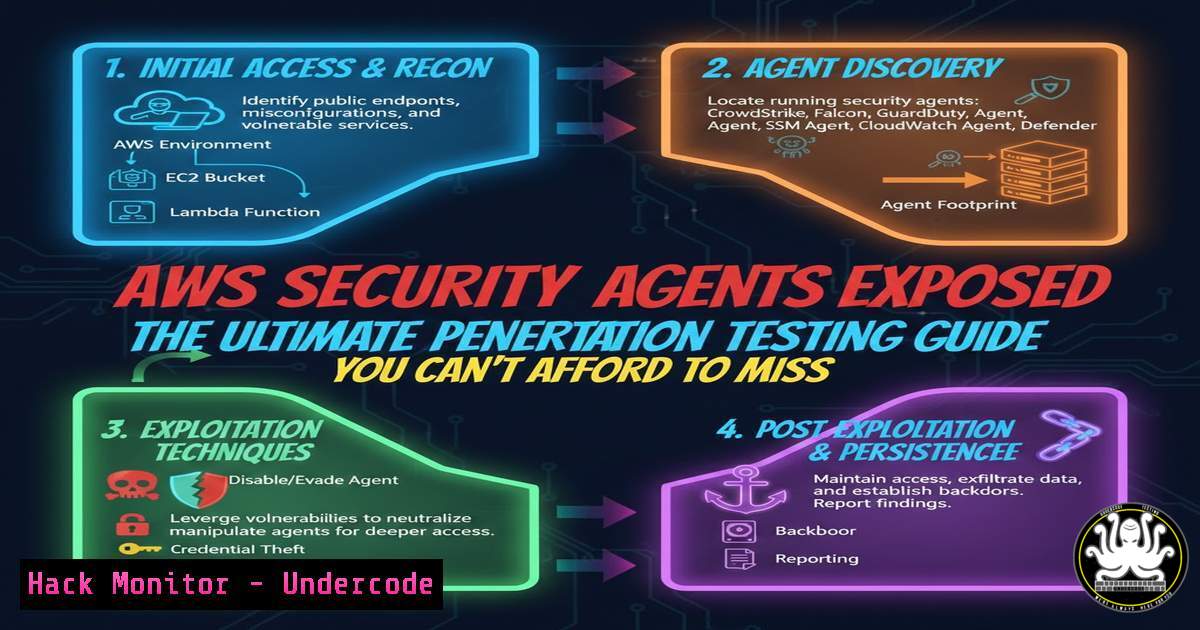
Introduction: With cloud adoption soaring, AWS security is paramount. Agent-based penetration testing simulates real-world attacks to identify vulnerabilities in AWS environments, using security agents for continuous monitoring and assessment. This guide explores core techniques, tools, and mitigations to fortify your cloud infrastructure against emerging threats.
Learning Objectives:
- Understand the role of security agents in AWS penetration testing and how they enhance security postures.
- Learn to set up a penetration testing lab in AWS using tools like Metasploit, Nmap, and AWS CLI.
- Identify common AWS vulnerabilities, such as misconfigured S3 buckets or IAM flaws, and apply hardening measures.
You Should Know:
- Understanding AWS Security Agents and Penetration Testing Fundamentals
AWS security agents, like Amazon Inspector agents or third-party tools, collect data on EC2 instances for vulnerability assessment. Penetration testing in AWS involves authorized simulated attacks to evaluate security, focusing on areas like network security, identity access management (IAM), and data storage. Unlike traditional methods, agent-based testing provides deep visibility into instance-level vulnerabilities, but it may overlook business logic flaws, as noted in community feedback.
Step‑by‑step guide:
- Start by reviewing AWS Penetration Testing Policy to ensure compliance—AWS allows testing on your own resources without prior approval for services like EC2, RDS, and S3.
- Install an AWS security agent: For Amazon Inspector, use the following command on a Linux EC2 instance:
`sudo curl -O https://inspector-agent.amazonaws.com/linux/latest/install && sudo bash install` - This agent scans for CVEs and network exposures, sending findings to AWS Management Console for analysis.
- Setting Up a Penetration Testing Environment in AWS
Create an isolated AWS VPC with public and private subnets to mimic production environments safely. Use tools like Terraform or AWS CloudFormation for infrastructure as code (IaC) to automate deployment, ensuring reproducibility.
Step‑by‑step guide:
- Launch an EC2 instance as your attack machine—choose a Kali Linux AMI or install tools manually. Use AWS CLI to configure credentials:
`aws configure`
Enter your AWS access key, secret key, region (e.g., us-east-1), and output format (json).
– Set up a target EC2 instance with common vulnerabilities, such as open ports or weak IAM roles. Use security groups to restrict traffic initially, then gradually open ports for testing.
– Enable VPC flow logs to monitor network traffic during tests:
`aws ec2 create-flow-logs –resource-type VPC –resource-id vpc-12345 –traffic-type ALL –log-destination-type s3 –log-destination arn:aws:s3:::your-bucket-name`
3. Key Tools and Commands for AWS Penetration Testing
Leverage open-source tools to scan and exploit AWS resources. Nmap for network reconnaissance, Pacu for AWS-specific attacks, and Metasploit for payload delivery are essential.
Step‑by‑step guide:
- Perform network scanning from your attack EC2 instance:
`nmap -sS -p 22,80,443,3306 10.0.1.0/24` to detect open ports in your VPC. - Use Pacu to enumerate IAM policies and identify privilege escalation paths:
`python3 pacu.py`
Select the `iam__enum_users_roles` module to gather IAM data.
- For exploiting misconfigured S3 buckets, use AWS CLI to list and download contents:
`aws s3 ls s3://bucket-name –recursive`
If public access is allowed, exfiltrate data with `aws s3 cp s3://bucket-name/file.txt .`
4. Exploiting Common AWS Vulnerabilities
Focus on frequent weaknesses like overly permissive IAM roles, unencrypted S3 buckets, and exposed API keys. These can lead to data breaches or resource hijacking.
Step‑by‑step guide:
- Check for IAM role misconfigurations by simulating an attacker with stolen credentials:
`aws iam list-attached-user-policies –user-name TestUser`
If policies allow “ actions, exploit them to launch EC2 instances or elevate privileges.
– Scan for publicly accessible S3 buckets using tools like S3Scanner:
`python3 s3scanner.py –bucket-name-list buckets.txt`
- Exploit vulnerable Lambda functions by invoking them with malicious payloads:
`aws lambda invoke –function-name VulnerableFunction –payload ‘{“key”:”value”}’ output.txt`
5. Mitigating Risks and Hardening Your AWS Environment
After identifying vulnerabilities, apply security best practices to mitigate risks. Use AWS Config for compliance checks, IAM policies for least privilege, and encryption for data at rest.
Step‑by‑step guide:
- Enable AWS GuardDuty for threat detection:
`aws guardduty create-detector –enable`
- Implement IAM policy hardening: Replace permissive policies with granular ones. For example, restrict S3 access:
{ "Version": "2012-10-17", "Statement": [ { "Effect": "Deny", "Action": "s3:", "Resource": "", "Condition": {"Bool": {"aws:SecureTransport": false}} } ] } - Encrypt EBS volumes and S3 buckets using AWS KMS:
`aws s3api put-bucket-encryption –bucket bucket-name –server-side-encryption-configuration ‘{“Rules”: [{“ApplyServerSideEncryptionByDefault”: {“SSEAlgorithm”: “AES256”}}]}’`
- Incorporating Business Logic Testing in AWS Pen Tests
Address gaps mentioned in comments by testing application-specific workflows, such as payment processing or user authentication, which agents might miss. Use tools like Burp Suite or custom scripts.
Step‑by‑step guide:
- Deploy a vulnerable web app on EC2 (e.g., OWASP Juice Shop) to simulate business logic flaws:
`docker run –rm -p 3000:3000 bkimminich/juice-shop`
- Configure Burp Suite to intercept API requests between AWS services like API Gateway and Lambda. Test for flawed logic, such as bypassing price checks by manipulating HTTP parameters.
- Automate tests with Python scripts that mimic user behavior:
import requests
response = requests.post('https://api.example.com/order', json={'item': 'product', 'quantity': -1})
if response.status_code == 200:
print("Business logic vulnerability found: negative quantity accepted.")
- Automated Penetration Testing with AWS Agents and CI/CD
Integrate agent-based testing into DevOps pipelines using AWS CodePipeline and Inspector for continuous security. This ensures vulnerabilities are caught early in development.
Step‑by‑step guide:
- Set up Amazon Inspector assessments triggered by CI/CD events:
`aws inspector create-assessment-target –assessment-target-name my-target –resource-group-arn arn:aws:inspector:region:account:resourcegroup/resource-group-id`
- Use AWS Lambda to automate penetration testing scripts after deployments. Example Lambda function to run Nmap scans:
import subprocess
def lambda_handler(event, context):
result = subprocess.run(['nmap', '-sV', '10.0.1.5'], capture_output=True)
return result.stdout
- Schedule regular tests with AWS EventBridge:
`aws events put-rule –name weekly-pentest –schedule-expression “rate(7 days)”`
What Undercode Say:
- Key Takeaway 1: Agent-based penetration testing in AWS is crucial for identifying instance-level vulnerabilities, but it must be complemented with business logic testing to cover full attack surfaces. Tools like Pacu and Inspector agents automate scans, but manual validation ensures depth.
- Key Takeaway 2: Cloud security hardening requires a multi-layered approach—combining IAM least privilege, encryption, and continuous monitoring with tools like GuardDuty. Automation via CI/CD reduces human error and speeds up response times.
Analysis: The LinkedIn post highlights a growing focus on AWS security, yet comments reveal gaps in business logic testing, underscoring the need for holistic penetration strategies. As cloud environments evolve, integrating agents with manual testing and DevSecOps practices will be key to mitigating sophisticated attacks. Organizations should prioritize training on AWS-specific tools and foster community knowledge-sharing, as seen in Sena YAKUT’s blog and ensuing discussions.
Prediction: In the future, AWS penetration testing will increasingly leverage AI-driven agents for real-time threat detection and response, reducing manual effort. However, attackers will also use AI to exploit business logic flaws, making continuous adaptation essential. Cloud security breaches may rise due to misconfigurations in hybrid environments, prompting stricter compliance regulations and automated remediation tools. Proactive measures, like agent-based testing integrated with AI analytics, will become standard for resilient cloud infrastructures.
▶️ Related Video (80% Match):
🎯Let’s Practice For Free:
IT/Security Reporter URL:
Reported By: Sena Yakut – Hackers Feeds
Extra Hub: Undercode MoN
Basic Verification: Pass ✅


