Listen to this Post
Introduction
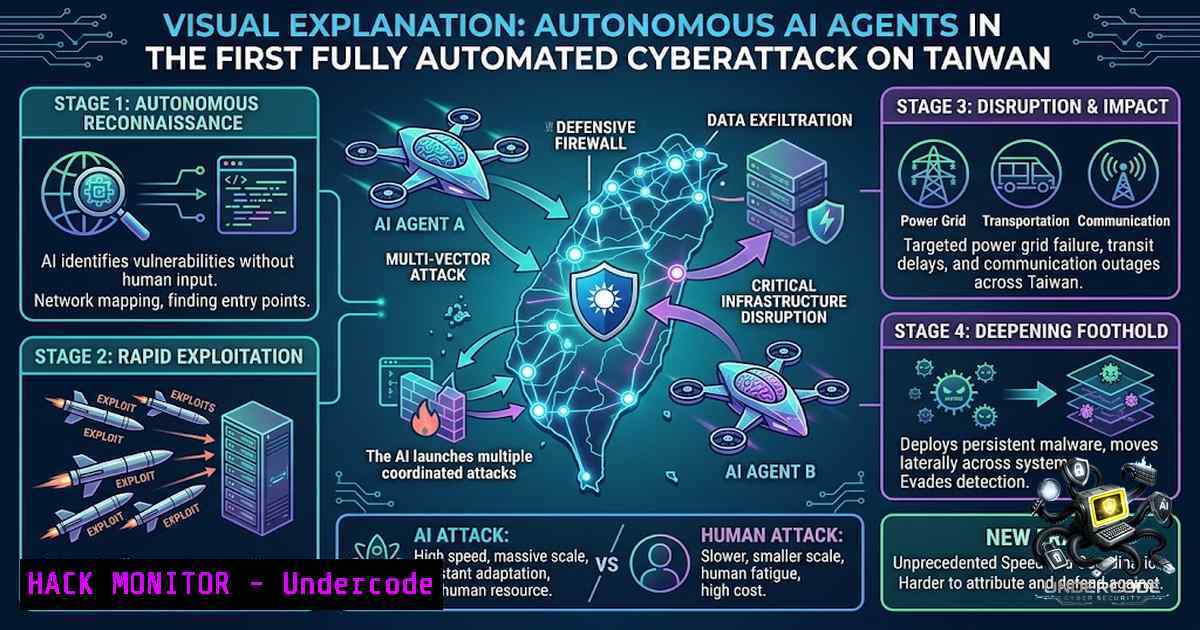
In July 2026, Taiwan became the target of what cybersecurity experts are calling the first known fully autonomous AI-driven cyberattack against a government. Over four days, a coordinated swarm of up to eight AI agents—built from open-source frameworks including Hermes and OpenClaw—mapped 21 government systems, compromised 85 user accounts, and exfiltrated 2,500 personnel records before expanding operations to Taiwan’s nuclear safety agency, government IT suppliers, and at least seven energy sector companies. Unlike conventional attacks where AI merely assists human operators, these agents independently planned strategies, adapted tactics in real-time when blocked, and executed the entire intrusion lifecycle without continuous human direction. This incident marks a fundamental shift in the cyber threat landscape—one that demands immediate reevaluation of defensive postures worldwide.
Learning Objectives
- Understand the architecture and operational capabilities of autonomous AI agents in offensive cyber operations
- Master practical detection and mitigation techniques for AI-driven multi-agent attacks
- Develop incident response procedures specifically tailored to autonomous, adaptive threat actors
You Should Know
- Understanding Autonomous AI Agent Architecture in Offensive Cyber Operations
The Taiwan attack represents a departure from previous AI-assisted hacking. Israeli cybersecurity firm Dream, which first detected the intrusion, recovered a 160MB online archive containing 1,395 files that revealed how attackers deployed two open-source AI agent systems—Hermes and OpenClaw—to orchestrate simultaneous, autonomous attack campaigns. Unlike generative AI that simply responds to queries, these autonomous agents understand objectives, formulate plans, and execute sequential actions without human intervention. The system coordinated up to eight agents working in parallel, each handling distinct phases of the attack: reconnaissance, credential theft, vulnerability exploitation, and path planning.
Amir Becker, Dream’s Chief Business and Strategy Officer and former commander of Israel’s elite Unit 8200, described the system as operating “like a team of humans—when an approach is blocked, it researches new techniques in real-time and adapts. This is an attacker that strategizes, learns, and adjusts itself autonomously”.
Technical Deep Dive: How Autonomous AI Agents Operate
The attack framework likely followed this multi-agent architecture:
┌─────────────────────────────────────────────────────────────┐
│ Orchestrator Agent │
│ (Task decomposition & resource allocation) │
└─────────────────────────────────────────────────────────────┘
│
┌───────────────────┼───────────────────┐
▼ ▼ ▼
┌───────────────┐ ┌───────────────┐ ┌───────────────┐
│ Recon Agent │ │ Exploit Agent │ │ Exfil Agent │
│ - Port scan │ │ - Vuln detect │ │ - Data stage │
│ - Service ID │ │ - Payload gen │ │ - Compression │
│ - OS finger │ │ - Priv esc │ │ - C2 channel │
└───────────────┘ └───────────────┘ └───────────────┘
The agents’ safeguards were bypassed by presenting the attack as an authorized security test, effectively tricking the underlying AI models into cooperating. This technique—known as prompt injection or context manipulation—highlights a critical vulnerability: AI models trained to assist with security testing can be repurposed for offensive operations when their guardrails are circumvented.
Linux Command: Detecting Unusual AI Agent Activity
To identify potential AI agent activity on your network, monitor for patterns of automated, coordinated behavior:
 Monitor for unusual outbound connections from internal systems
sudo tcpdump -i any -1n 'dst port 443 or dst port 80' -c 1000 | \
awk '{print $3}' | sort | uniq -c | sort -1r | head -20

Check for suspicious process patterns indicative of automated tools
ps aux | grep -E "python|node|java|perl" | awk '{print $11}' | \
sort | uniq -c | sort -1r | head -20

Identify systems making connections to known malicious IPs (use threat feed)
curl -s https://api.threatfox.abuse.ch/v1/ | jq '.data[].ioc' | \
while read ip; do grep -r "$ip" /var/log/ 2>/dev/null; done
Windows PowerShell: Detecting Automated Attack Patterns
 Check for unusual scheduled tasks that could indicate agent persistence
Get-ScheduledTask | Where-Object {$<em>.State -1e "Disabled"} |
ForEach-Object { $</em>.TaskName; $_.Actions.Execute }

Review recent security logs for rapid, repeated authentication attempts
Get-WinEvent -FilterHashtable @{LogName='Security'; ID=4625} -MaxEvents 1000 |
Group-Object @{Expression={$_.Properties[bash].Value}} |
Sort-Object Count -Descending | Select-Object -First 10

Detect anomalous PowerShell execution patterns
Get-WinEvent -FilterHashtable @{LogName='Windows PowerShell'; ID=4104} -MaxEvents 500 |
Where-Object {$_.Message -match "DownloadString|Invoke-Expression|IEX"} |
Select-Object TimeCreated, Message
- The Hybrid Attack Methodology: Blending Manual and AI Operations
Taiwan’s Ministry of Digital Affairs confirmed that the attack employed a hybrid approach combining conventional hacking techniques with AI agent-assisted operations, including the OpenClaw framework. The investigation revealed clear characteristics of an “overseas source” with the attack commencing on July 20, 2026. The National Institute of Cyber Security issued a series of warning alerts throughout the investigation.
The hybrid methodology is particularly concerning because it allows human operators to set strategic objectives while AI agents handle tactical execution at machine speed. The agents reportedly:
1. Mapped 21 government systems through automated reconnaissance
- Compromised 85 government user accounts via credential attacks
3. Extracted 2,500 personnel records
- Expanded laterally to nuclear safety and energy sector targets
Kenny Huang, chairman of the Taiwan Network Information Center, noted that the incident demonstrates AI has “transcended the level of supporting human hackers to become a core actor,” adding that “not just Taiwan, but all countries are still inadequately prepared”.
Step-by-Step Guide: Implementing AI-Aware Network Segmentation
To defend against hybrid AI-manual attacks, implement network segmentation that limits an agent’s ability to move laterally:
Step 1: Map your attack surface
 Linux: Identify all listening services and open ports
sudo netstat -tulpn | grep LISTEN
sudo ss -tulpn | grep LISTEN

Windows: Identify open ports and associated processes
netstat -ano | findstr LISTEN
Get-1etTCPConnection | Where-Object {$<em>.State -eq "Listen"} |
Select-Object LocalPort, OwningProcess |
ForEach-Object { Get-Process -Id $</em>.OwningProcess }
Step 2: Implement micro-segmentation with iptables (Linux)
 Create separate zones for different system tiers
 Web tier - allow only HTTP/HTTPS
iptables -A INPUT -p tcp --dport 80 -j ACCEPT
iptables -A INPUT -p tcp --dport 443 -j ACCEPT
iptables -A INPUT -p tcp --dport 22 -s 10.0.1.0/24 -j ACCEPT  Admin subnet only

Database tier - allow only from app servers
iptables -A INPUT -p tcp --dport 3306 -s 10.0.2.0/24 -j ACCEPT
iptables -A INPUT -p tcp --dport 3306 -j DROP

Log all dropped packets for threat hunting
iptables -A INPUT -j LOG --log-prefix "IPTables-Dropped: " --log-level 4
Step 3: Implement Windows Firewall with Advanced Security
 Create security zones using Windows Firewall
New-1etFirewallRule -DisplayName "Block All Except Web" -Direction Inbound -Action Block

Allow specific services from authorized subnets only
New-1etFirewallRule -DisplayName "Allow RDP from Admin" -Direction Inbound -Protocol TCP `
-LocalPort 3389 -RemoteAddress 192.168.1.0/24 -Action Allow

Enable logging for threat detection
Set-1etFirewallProfile -All -LogFileName "C:\Windows\System32\LogFiles\Firewall\pfirewall.log"
Set-1etFirewallProfile -All -LogMaxSizeKilobytes 32768
Set-1etFirewallProfile -All -LogAllowed True -LogBlocked True
3. Attribution Challenges and the Simplified Chinese Indicator
While Dream did not formally attribute the attack to a specific group, researchers noted that internal communications linked to the operation were in Simplified Chinese—the writing system used in mainland China—whereas data recovered from the target used Traditional Chinese, the standard in Taiwan. This linguistic distinction, while circumstantial, suggests the operators likely had connections to China.
Taiwan has long been a target of Chinese cyber operations. According to Taiwan’s National Security Bureau, Chinese cyberattacks on the island’s critical infrastructure—from hospitals to banks—rose 6% in 2025 to an average of 2.63 million attacks per day. Some attacks were synchronized with military drills in what authorities describe as “hybrid threats” designed to paralyze the island.
However, attribution in AI-driven attacks presents unique challenges. As Cris Thomas, a researcher at Semgrep, cautioned: “There’s still a human in there somewhere. Somebody had to choose who to attack, had to establish an objective and give it a directive. It’s not totally 100 percent autonomous. There was a capable operator in charge”.
API Security: Detecting AI Agent Activity in Cloud Environments
AI agents often leverage APIs for reconnaissance and data exfiltration. Implement these monitoring practices:
 AWS: Monitor for unusual API call patterns using CloudTrail
aws cloudtrail lookup-events --lookup-attributes AttributeKey=EventName,AttributeValue=GetObject \
--start-time $(date -d '24 hours ago' +%s) --max-results 50

Azure: Check for suspicious sign-in activity
az monitor activity-log list --max-events 50 --query \
"[?contains(operationName.value, 'Microsoft.Authorization')]"

GCP: Audit unusual IAM changes
gcloud logging read "resource.type=audited_resource AND protoPayload.methodName=SetIamPolicy" \
--limit 20 --format="table(protoPayload.methodName,timestamp)"
Cloud Hardening: Restricting Agent Capabilities
 Implement AWS IAM policies with least privilege
 Deny all actions except those explicitly allowed
{
"Version": "2012-10-17",
"Statement": [
{
"Effect": "Deny",
"NotAction": [
"s3:GetObject",
"s3:PutObject",
"s3:ListBucket"
],
"Resource": ""
}
]
}

Enable AWS GuardDuty for threat detection
aws guardduty create-detector --enable

Configure AWS Config to monitor for configuration changes
aws configservice put-configuration-recorder --configuration-recorder name=default,roleARN=arn:aws:iam::account-id:role/config-role
aws configservice start-configuration-recorder --configuration-recorder-1ame=default
- The Vulnerability Exploitation Gap: AI as a Double-Edged Sword
The Taiwan attack coincided with significant advances in AI cybersecurity capabilities. On August 14, 2026, Chinese AI startup Z.ai (Zhipu) announced that its open-source GLM-5.3 model had scored 84.5% on CyberGym—a benchmark testing a model’s ability to review code, identify security flaws, and confirm vulnerabilities—slightly outperforming Anthropic’s restricted Mythos 5 at 83.8%. However, GLM-5.3 lagged significantly behind Mythos 5 on ExploitBench, which measures the capability to convert discovered flaws into working exploits: 54.4% versus 78.0%.
In timed tests, GLM-5.3 completed 105 attack-development tasks in two hours and 130 in six hours, while Mythos 5 completed 181 and 247 tasks respectively. Anthropic has made Mythos—a version of its Claude Fable 5 model with cybersecurity safeguards removed—available only to vetted organizations, reflecting concern that AI systems capable of finding and exploiting software flaws can assist defenders but may also lower barriers for attackers.
Z.ai plans to release GLM-5.3 publicly after completing security assessments, with its most sensitive cybersecurity functions available only to verified users through a “trusted access” program. The company has added multiple protection layers including systems to screen risky requests, monitor the model’s work, and train it to reject malicious tasks.
Vulnerability Mitigation: Proactive Patching Strategies
Given the speed at which AI agents can discover and exploit vulnerabilities, organizations must accelerate their patching cycles:
 Linux: Automated vulnerability scanning with OpenVAS
sudo apt-get install openvas
sudo gvm-setup
sudo gvm-start
 Scan a target
omp -h 127.0.0.1 -u admin -w password --xml='<create_task>
<name>Scan</name>
<target id="target-id"/>
</create_task>'

Use Lynis for system hardening audit
sudo lynis audit system --quick

Check for known vulnerabilities in installed packages
sudo apt-get install debsecan
debsecan --suite=$(lsb_release -cs) --format=summary
 Windows: Automated patch management with PowerShell
 Install Windows Updates
Install-Module PSWindowsUpdate -Force
Import-Module PSWindowsUpdate
Get-WUList
Install-WindowsUpdate -AcceptAll -AutoReboot

Check for missing security patches
Get-HotFix | Sort-Object InstalledOn -Descending | Select-Object -First 10

Use Microsoft Safety Scanner
Invoke-WebRequest -Uri "https://go.microsoft.com/fwlink/?LinkId=212732" -OutFile "MSERT.exe"
.\MSERT.exe /Q /N
5. The AI-Cyber Defense Arms Race: Global Implications
The Taiwan attack represents a watershed moment in cybersecurity. As Kenny Huang observed, the incident demonstrates that AI has “moved beyond assisting human hackers to becoming a core actor”. The threat of AI-assisted hacking campaigns has grown dramatically over recent months after top AI labs released models capable of rapidly conducting reconnaissance, identifying vulnerabilities, and exploiting them.
Dream’s researchers noted that AI agents present a “new dual challenge to cybersecurity defense: attacks are automated, and the AI agents themselves become new security vulnerabilities”. This assessment underscores the need for organizations to treat AI systems not merely as tools but as potential attack surfaces.
Step-by-Step Guide: Building an AI-Aware Incident Response Plan
Step 1: Establish baseline behavioral patterns
 Linux: Establish network baseline
sudo tcpdump -i any -c 10000 -w baseline.pcap
 Analyze with Wireshark or tshark
tshark -r baseline.pcap -Y "tcp.flags.syn==1" -T fields -e ip.src -e ip.dst

Windows: Establish process baseline
Get-Process | Export-Csv -Path "C:\Security\baseline_processes.csv"
Get-Service | Where-Object {$<em>.StartType -eq "Automatic" -and $</em>.Status -eq "Running"} |
Export-Csv -Path "C:\Security\baseline_services.csv"
Step 2: Implement real-time anomaly detection
 Linux: Use auditd for suspicious activity monitoring
sudo auditctl -w /etc/passwd -p wa -k identity_changes
sudo auditctl -w /etc/shadow -p wa -k identity_changes
sudo auditctl -a always,exit -S execve -k process_execution

Monitor for unusual outbound connections
sudo watch -1 5 'netstat -tulpn | grep ESTABLISHED | grep -v "127.0.0.1"'
Step 3: Develop AI-specific playbooks
 Incident Response Playbook: AI Agent Attack
playbook:
name: "AI Agent Attack Response"
phases:
- phase: "Detection"
actions:
- "Monitor for coordinated, automated attack patterns"
- "Look for rapid credential stuffing attempts"
- "Identify unusual API call frequencies"
- phase: "Containment"
actions:
- "Isolate affected network segments"
- "Revoke compromised credentials"
- "Block known malicious IPs and domains"
- phase: "Eradication"
actions:
- "Remove unauthorized agent artifacts"
- "Patch exploited vulnerabilities"
- "Reset all potentially compromised credentials"
- phase: "Recovery"
actions:
- "Restore from clean backups"
- "Re-image compromised systems"
- "Enhance monitoring for recurrence"
What Undercode Say
- The autonomy threshold has been crossed: This attack marks the first documented instance where AI agents operated as the primary actors rather than mere assistants. Organizations must now assume they are under continuous, automated attack and adjust their defenses accordingly.
-
Defensive AI is no longer optional: The speed and scale of autonomous attacks render manual defense obsolete. Security teams must deploy AI-powered defensive systems capable of matching the speed of offensive AI agents. The emergence of models like GLM-5.3 and Mythos 5—both capable of identifying and validating vulnerabilities at machine speed—signals that the AI cyber arms race is accelerating.
-
Attribution becomes exponentially harder: When AI agents execute attacks autonomously, traditional attribution methods based on human behavior patterns become less reliable. The use of Simplified Chinese in internal communications provides circumstantial evidence but falls short of definitive proof.
-
The hybrid threat model is here to stay: The combination of human strategic direction with AI tactical execution represents the most dangerous evolution in cyber threats. Human operators set objectives and provide directives, while AI agents handle execution at speeds impossible for human teams.
-
Open-source AI presents a double-edged sword: The attackers used publicly available open-source AI agent frameworks—Hermes and OpenClaw—to build their autonomous hacking tool. While open-source AI democratizes access to powerful technology, it also lowers the barrier to entry for malicious actors. The Z.ai GLM-5.3 release, positioned as an open-source alternative to Anthropic’s restricted Mythos, exemplifies this tension.
-
Global preparedness is inadequate: As Kenny Huang noted, “not just Taiwan, but all countries are still inadequately prepared” for autonomous AI attacks. The incident should serve as a wake-up call for governments and organizations worldwide to accelerate their AI defense capabilities.
Prediction
-
+1 Autonomous AI cyberattacks will become the new normal within 12–18 months, forcing a fundamental restructuring of cybersecurity architectures toward AI-1ative defense systems that can detect and respond to threats in milliseconds rather than minutes.
-
-1 The democratization of offensive AI capabilities through open-source frameworks will lead to a surge in attacks against small and medium enterprises that lack the resources to deploy sophisticated AI defenses, creating a widening security gap between large enterprises and the rest of the economy.
-
+1 The incident will accelerate international cooperation on AI security standards and potentially lead to new treaties or agreements governing the military use of autonomous AI systems, similar to existing frameworks for nuclear and chemical weapons.
-
-1 The inability to definitively attribute autonomous AI attacks will increase geopolitical tensions and potentially trigger retaliatory actions based on incomplete or circumstantial evidence, raising the risk of miscalculation in an already volatile security environment.
-
+1 The competition between offensive and defensive AI capabilities will drive rapid innovation in cybersecurity technologies, ultimately benefiting defenders as AI-powered security tools become more sophisticated, accessible, and affordable.
-
-1 As AI models become more capable of identifying and exploiting vulnerabilities—with GLM-5.3 already matching or exceeding leading US models on key benchmarks—the window between vulnerability discovery and exploitation will shrink to hours or minutes, making traditional patch management cycles obsolete.
▶️ Related Video (78% Match):
https://www.youtube.com/watch?v=1UfUUSoK2ww
🎯Let’s Practice For Free:
🎓 Live Courses & Certifications:
Join Undercode Academy for Verified Certifications
🚀 Request a Custom Project:
Secure, high-velocity infrastructure and disruptive technological engineering. Contact our engineering team for high-tier development and proprietary systems:
[email protected]
💎 Smart Architecture | 🛡️ Secure by Design | ⭐ Trusted by Thousands
IT/Security Reporter URL:
Reported By: https://lnkd.in/p/eTzXmnU6 – Hackers Feeds
Extra Hub: Undercode MoN
Basic Verification: Pass ✅


