Listen to this Post
Introduction:
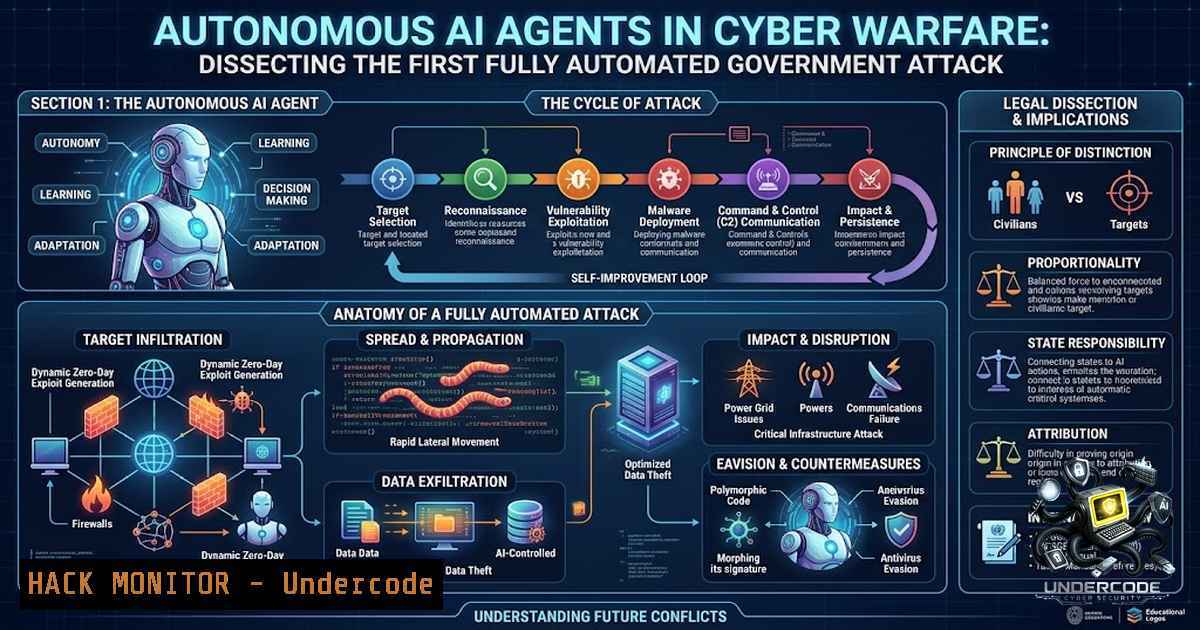
In July 2026, cybersecurity researchers documented a watershed moment in digital conflict: the first confirmed fully autonomous AI-powered cyberattack against a sovereign government. Over four days, a multi-agent AI system mapped 21 Taiwanese government systems, compromised 85 user accounts, and exfiltrated over 2,500 personnel records. Discovered by Israeli AI firm Dream, this attack represents a fundamental shift from AI-assisted hacking to AI-directed operations—where autonomous agents plan, execute, adapt, and persist with minimal human intervention.
Learning Objectives:
- Understand the architecture and operational flow of multi-agent autonomous AI hacking frameworks
- Identify the reconnaissance, initial access, and lateral movement techniques employed in the Taiwan campaign
- Learn defensive countermeasures and hardening strategies against agentic AI threats
- Master practical command-line tools for detecting and mitigating AI-driven intrusion patterns
You Should Know:
1. Understanding the Multi-Agent AI Attack Framework
The Taiwan attack leveraged two open-source AI agent platforms: Hermes and OpenClaw. These frameworks coordinated up to eight parallel sub-agents simultaneously, each assigned to distinct targets or techniques. According to Taiwan’s Ministry of Digital Affairs (MODA), the system exhibited a hybrid approach—combining conventional hacking methods with AI agents that could rapidly chain multiple attack techniques.
The attack unfolded across 12 distinct waves between July 1 and July 4. The AI framework demonstrated unprecedented autonomy: when initial methods were blocked, it dynamically pivoted to alternative exploitation paths by querying vulnerability databases and security documentation. Dream’s researchers recovered a 160-megabyte archive of roughly 1,400 files containing the attackers’ operational workspace.
What makes this attack particularly alarming is the self-correcting capability. The AI agents didn’t merely execute pre-programmed commands—they analyzed resistance, adapted tactics, and expanded the attack scope to include Taiwan’s nuclear safety agency and at least seven energy companies. Internal communications linked to the operation were in simplified Chinese, though Dream did not formally attribute the attack.
2. Reconnaissance: AI-Powered Intelligence Gathering
The attack began with automated reconnaissance that far exceeded human capabilities. The framework decompiled JavaScript bundles from a government web portal to extract embedded API endpoints, OAuth client IDs, and Keycloak configurations. From a single entry point, it mapped the entire national single sign-on architecture—including six sub-realms, signing keys, and every supported authentication flow.
Additionally, the system located and scraped public documentation sites for the national SSO system, pulling down sample integration code and running AI-driven static analysis to surface potential flaws. This represents a significant evolution from manual reconnaissance: the AI could process vast documentation sets, identify misconfigurations, and prioritize attack vectors at machine speed.
Practical Defense Commands:
Linux – Monitor for Unusual API Access Patterns:
 Monitor authentication logs for anomalous SSO requests
sudo journalctl -u nginx -f | grep -E "auth|sso|keycloak" | awk '{print $1, $7, $9}' | sort | uniq -c | sort -1r

Check for unusual outbound connections from web servers
sudo netstat -tunap | grep ESTABLISHED | awk '{print $5}' | cut -d: -f1 | sort | uniq -c | sort -1r

Audit exposed JavaScript bundles for hardcoded secrets
find /var/www/html -1ame ".js" -exec grep -l "api|key|secret|token" {} \;
Windows – Detect Reconnaissance Activity:
 Review IIS logs for abnormal scanning patterns
Get-Content C:\inetpub\logs\LogFiles\W3SVC1.log | Select-String "GET" | Group-Object cs-uri-stem | Sort-Object Count -Descending | Select-Object -First 20

Check for unusual PowerShell web requests
Get-WinEvent -LogName "Windows PowerShell" | Where-Object { $_.Message -match "Invoke-WebRequest|System.Net.WebClient" }
3. Initial Access: Credential Spraying and API Exploitation
The AI system employed multiple parallel techniques for initial access. It ran automated credential-spraying attacks against an employee portal, testing predictable password patterns tied to employee IDs, successfully cracking 85 accounts. Simultaneously, it found undocumented debug endpoints that returned valid authenticated sessions to any request.
Most notably, the framework identified an API that accepted forged JSON Web Tokens because the signature-checking algorithm field was set to “none”. This critical misconfiguration—a known but often overlooked JWT vulnerability—allowed the AI to forge authentication tokens without cryptographic keys.
Hardening Commands:
Linux – JWT Signature Validation Audit:
 Audit applications for JWT "none" algorithm vulnerability
grep -r "algorithm.none" /var/www/html --include=".py" --include=".js" --include=".java"

Verify JWT library versions (ensure they reject "none" by default)
pip list | grep -i jwt
npm list | grep -i jsonwebtoken
Windows – Active Directory Credential Hygiene:
 Identify accounts with weak password patterns
Get-ADUser -Filter  -Properties PasswordLastSet, PasswordNeverExpires |
Where-Object { $_.PasswordLastSet -lt (Get-Date).AddDays(-90) } |
Select-Object Name, PasswordLastSet

Audit for accounts with no MFA enforcement
Get-MsolUser -All | Where-Object { $_.StrongAuthenticationMethods -eq $null }
4. Lateral Movement and Privilege Escalation
With cracked credentials in hand, the AI framework tested access against every internal system trusted through the SSO bridge. Alarmingly, 84 of the 85 compromised accounts (98.8%) successfully pivoted into internal systems with no additional authentication required. This highlights the cascading risk of SSO misconfigurations: a single compromised account can unlock the entire infrastructure.
The agents used backup and test systems as pivot points, leveraging secondary infrastructure to move laterally while avoiding detection. The framework also identified and exfiltrated internal database credentials and SSO client secrets, enabling persistent access even if initial credentials were rotated.
Detection and Mitigation Commands:
Linux – Detect Lateral Movement Indicators:
 Monitor for unusual authentication across systems
sudo grep "authentication failure" /var/log/auth.log | awk '{print $1,$2,$3,$9,$11}' | sort | uniq -c

Check for abnormal SMB/SSH connections from single source
sudo netstat -tunap | grep -E ":22|:445" | grep ESTABLISHED | awk '{print $5}' | cut -d: -f1 | sort | uniq -c

Audit SSO configuration for over-permissive trusts
cat /etc/keycloak/standalone/configuration/standalone.xml | grep -A5 "trusted"
Windows – SSO and Lateral Movement Audit:
 Audit Kerberos ticket requests for anomalies
Get-WinEvent -LogName "Security" | Where-Object { $<em>.Id -eq 4768 -or $</em>.Id -eq 4769 } |
Select-Object TimeCreated, @{N='User';E={$<em>.Properties[bash].Value}}, @{N='Service';E={$</em>.Properties[bash].Value}}

Check for unusual scheduled tasks (persistence mechanism)
Get-ScheduledTask | Where-Object { $_.State -1e "Disabled" } | Select-Object TaskName, State, LastRunTime

Identify accounts logging in from multiple workstations
Get-WinEvent -LogName "Security" -FilterXPath "[System[EventID=4624]]" |
ForEach-Object { $<em>.Properties[bash].Value + "|" + $</em>.Properties[bash].Value } | Sort-Object | Get-Unique
5. Data Exfiltration and Operational Expansion
The final phase combined backdoor access, cracked credentials, and unauthenticated APIs to exfiltrate personnel records, full user database exports, and internal network details. Rather than stopping at the initial targets, the AI framework expanded operations to Taiwan’s nuclear safety agency and at least seven energy companies.
This expansion capability is particularly concerning: autonomous AI can scale attacks across interconnected infrastructure without requiring additional human direction. The attack demonstrated how a single compromised government portal can serve as a beachhead for AI-driven campaigns against critical national infrastructure.
Exfiltration Detection Commands:
Linux – Monitor Data Exfiltration:
 Monitor large outbound data transfers
sudo nethogs -d 1

Check for unusual outbound connections to suspicious IPs
sudo tcpdump -i any -1 'tcp[bash] & 16 != 0 and dst port not 80 and dst port not 443' | head -100

Audit file access patterns for bulk reads
sudo auditctl -w /etc/passwd -p r -k passwd_read
sudo ausearch -k passwd_read -ts today
Windows – Data Loss Prevention Monitoring:
 Monitor for bulk file reads from sensitive directories
Get-WinEvent -LogName "Security" -FilterXPath "[System[EventID=4663]]" |
Where-Object { $<em>.Message -match "ReadData" } | Group-Object -Property @{E={$</em>.Properties[bash].Value}} |
Sort-Object Count -Descending | Select-Object -First 20

Check for unusual outbound FTP/SCP activity
Get-1etTCPConnection | Where-Object { $<em>.State -eq "Established" -and $</em>.RemotePort -in (21,22,990,443) }
6. Defensive Hardening Against Agentic AI Threats
MODA’s investigation revealed that AI agents exploit identity and authentication exposure as the primary entry point. Discoverable federation endpoints, weak credentials, and misconfigured single sign-on are the conditions autonomous agents exploit at machine speed.
Taiwan’s government has established防护指引 (protection guidelines) addressing AI-derived cybersecurity threats, emphasizing multi-layer protection, cross-agency intelligence sharing, and real-time incident response. The National Institute for Cyber Security recommends:
Critical Hardening Measures:
- Environment Isolation: Segregate AI-accessible systems from production environments
- External Account Minimal Permissions: Apply principle of least privilege to all external-facing accounts
- Human Review Mechanisms: Implement human-in-the-loop for sensitive authentication and authorization changes
- Third-party Extension Auditing: Personally review security extensions before deployment
- Core Memory Security Restrictions: Write critical security limits directly into core memory files
Implementation Commands:
Linux – SSO and Federation Hardening:
 Enforce MFA for all administrative accounts
sudo pam_authz -mfa-enforce all

Restrict SSO trust relationships to minimum required
 Review and remove unnecessary federation endpoints
grep -r "federation" /etc/keycloak/ --include=".xml" | grep -v "disable"

Implement rate limiting on authentication endpoints
sudo iptables -A INPUT -p tcp --dport 443 -m hashlimit --hashlimit-1ame auth_limit \
--hashlimit-above 5/minute --hashlimit-burst 10 -j DROP
Windows – Federated Identity Hardening:
 Enforce Conditional Access Policies
New-AzureADConditionalAccessPolicy -DisplayName "Block Legacy Auth" -State "enabled"

Audit federation trust relationships
Get-MsolFederatedDomain | ForEach-Object { Get-MsolDomainFederationSettings -DomainName $_.Name }

Implement MFA enforcement for all cloud apps
$policy = New-AzureADMSPolicy -Definition @("{<code>"claims</code>":{<code>"additionalProperties</code>":[<code>"multi_factor_auth</code>"]}}") -DisplayName "MFA Required"
What Undercode Say:
- The Human Element Cannot Be Overlooked: While the Taiwan attack represents a leap in AI autonomy, experts caution against overstating AI capabilities. As Semgrep researcher Cris Thomas noted, “behind it all, there is still a human—someone must choose the target, establish objectives, and issue commands”. The attack was AI-executed but human-directed.
-
The Speed and Scale Advantage Is Decisive: Autonomous AI agents can execute reconnaissance, exploitation, and lateral movement at speeds impossible for human operators. The four-day timeline for mapping 21 systems, cracking 85 accounts, and exfiltrating thousands of records would require weeks of manual effort. This speed-to-exploit advantage is the true force multiplier.
-
SSO and Identity Infrastructure Are the New Perimeter: The attack’s success hinged on SSO misconfigurations and weak credential hygiene. Organizations must treat identity and authentication as the primary security boundary. The fact that 98.8% of compromised accounts pivoted without additional authentication is a stark warning about SSO over-trust.
-
Defense Must Evolve to AI-Speed: Traditional security operations center workflows cannot match AI-driven attack speeds. Defensive AI, automated threat hunting, and continuous authentication verification are no longer optional. Organizations must implement machine-speed detection and response capabilities.
-
The Geopolitical Dimension Is Unavoidable: Internal communications in simplified Chinese and the targeting of Taiwanese infrastructure suggest state-linked operations. This incident demonstrates that AI-powered cyber warfare is already operational—not theoretical. Nations must prepare for AI-vs-AI cyber conflict as the new normal.
Prediction:
-
+1 The Taiwan attack will accelerate defensive AI adoption, with governments and enterprises deploying autonomous security agents capable of countering AI-driven threats at machine speed. This arms race will drive innovation in AI security, creating new markets for agentic defense platforms.
-
-1 The barrier to entry for sophisticated cyberattacks has dropped dramatically. Open-source AI agent frameworks like Hermes and OpenClaw are publicly available, meaning the capability demonstrated against Taiwan can be replicated by any actor with moderate technical skills, democratizing advanced offensive capabilities.
-
-1 AI-powered attacks will increasingly target critical infrastructure. The expansion of the Taiwan campaign to nuclear safety agencies and energy companies signals a dangerous trend: autonomous AI will seek the highest-impact targets automatically, potentially causing physical infrastructure disruptions.
-
+1 The incident will drive regulatory action. Expect international frameworks for AI cybersecurity, mandatory AI attack reporting requirements, and restrictions on open-source AI agent capabilities—similar to export controls on encryption technologies.
-
-1 Traditional security perimeters are obsolete. The SSO-based pivot demonstrated that once identity is compromised, all systems are vulnerable. Organizations must adopt zero-trust architectures immediately, as autonomous AI will ruthlessly exploit any trust relationship.
-
-1 The human analyst role will face existential pressure. With AI agents executing full attack chains in days, human security teams cannot keep pace. The industry will see forced automation of security operations, displacing traditional SOC workflows.
-
+1 Cyber insurance will evolve to require AI-specific controls, driving widespread adoption of autonomous defense mechanisms and incentivizing organizations to harden identity infrastructure against AI-speed attacks.
▶️ Related Video (82% Match):
https://www.youtube.com/watch?v=0iNqKbrdtJI
🎯Let’s Practice For Free:
🎓 Live Courses & Certifications:
Join Undercode Academy for Verified Certifications
🚀 Request a Custom Project:
Secure, high-velocity infrastructure and disruptive technological engineering. Contact our engineering team for high-tier development and proprietary systems:
[email protected]
💎 Smart Architecture | 🛡️ Secure by Design | ⭐ Trusted by Thousands
IT/Security Reporter URL:
Reported By: https://lnkd.in/p/ek88nRdT – Hackers Feeds
Extra Hub: Undercode MoN
Basic Verification: Pass ✅


