Listen to this Post
Introduction
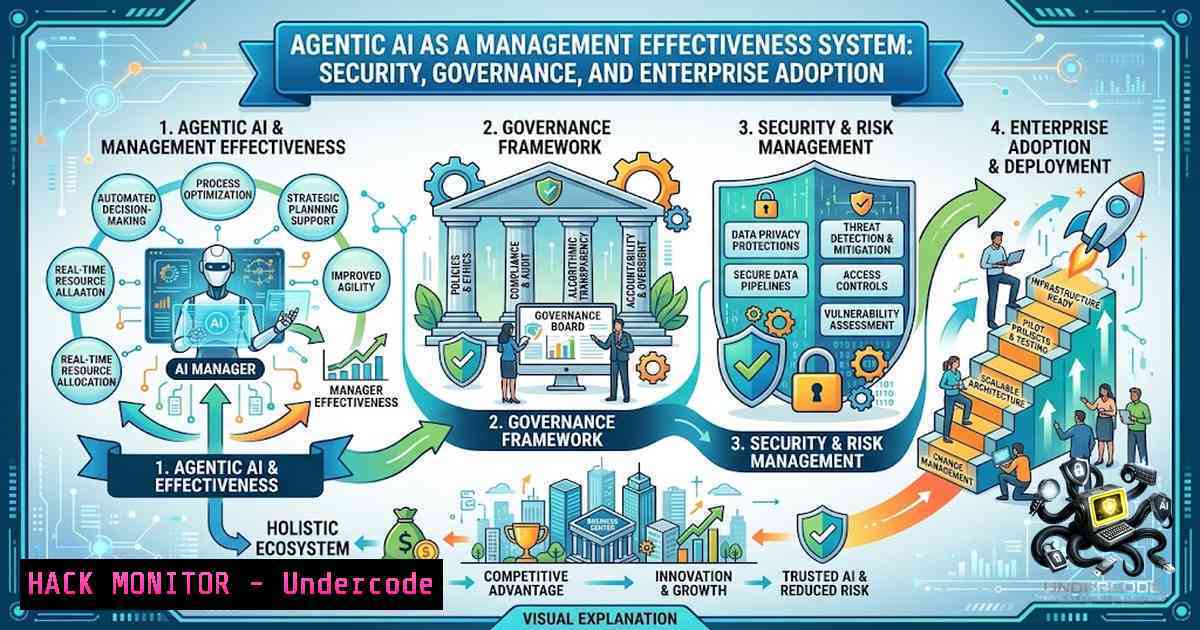
Agentic AI represents a fundamental paradigm shift from traditional generative AI systems—moving beyond content generation to autonomous action, planning, and tool execution with limited human supervision. Unlike static chatbots that simply produce output for human review, agentic AI systems can autonomously make decisions, interact with tools, access enterprise systems, and execute complex multi-step workflows across organizational boundaries. This transformation, as Dr. Roger Mark Thompson articulates, positions Agentic AI as a management effectiveness system rather than merely a productivity hack—one that demands robust security architectures, governance frameworks, and zero-trust principles to mitigate the unprecedented risks introduced by autonomous machine agents.
Learning Objectives
- Understand the architectural distinction between agentic AI and traditional LLM applications, including the expanded attack surface and security implications
- Master the OWASP Top 10 for Agentic Applications (2026) and implement concrete mitigations for each risk category
- Apply zero-trust principles, API governance, and identity management to secure autonomous agent deployments in enterprise environments
You Should Know
- Understanding Agentic AI: Architecture, Autonomy, and the Expanded Attack Surface
Agentic AI systems are fundamentally different from non-agentic LLM applications. A traditional LLM application takes user input, produces output, and returns it to the user—the security boundary ends at the model’s response. An agentic system, however, takes user input (or operates on scheduled goals), produces sequences of model outputs, and acts on each output by invoking tools that affect external systems. The model’s output is operationalized as system action, meaning every defensive pattern that worked for non-agentic systems still applies, but the cost of bypass is fundamentally higher.
Agentic AI systems are evolving from stateless copilots into stateful digital workers capable of executing long-running, multi-step processes across systems, data domains, and organizational boundaries. They persist memory, collaborate across workflows, and adapt to changing circumstances—properties that make them powerful but also expose them to unprecedented vulnerabilities.
The AI Kill Chain and Systemic Vulnerabilities: The “Month of AI Bugs” project documented over two dozen previously unknown security vulnerabilities in agentic AI coding assistants, including zero-click data exfiltration, arbitrary remote code execution, and long-term memory persistence—all exploitable via indirect prompt injection. These findings highlight systemic design failures including over-reliance on LLM output as a security control, insufficient sandboxing, and lacking human-in-the-loop safeguards.
Linux Command: Monitoring Agent Activity
 Monitor all agent-related processes and network connections
sudo ss -tulpn | grep -E "(agent|ai|llm)"
sudo lsof -i -P -1 | grep -E "(agent|python|node)"

Audit agent file system access
sudo auditctl -w /opt/agent/ -p rwxa -k agent_activity
sudo ausearch -k agent_activity --format text
Windows Command: Agent Process Auditing
 List all agent-related processes with detailed info
Get-Process | Where-Object {$_.ProcessName -match "agent|python|node"} | Format-Table -AutoSize

Enable advanced audit logging for agent directories
auditpol /set /subcategory:"File System" /success:enable /failure:enable
- The OWASP Top 10 for Agentic Applications: Risks and Mitigations
In December 2025, the OWASP GenAI Security Project released the OWASP Top 10 for Agentic Applications—a culmination of input from over 100 security researchers, industry practitioners, and leading organizations. This framework catalogs the highest-impact security failures specific to autonomous and semi-autonomous AI agent systems.
ASI01 — Agent Goal Hijack: Attackers manipulate an agent’s natural-language input to alter its intended goals. Goal hijacking does not require breaking into the agent—PDF files, web pages, and emails can all contain injected instructions. Mitigation: Treat all external content retrieved at runtime as untrusted input, enforce clear privilege boundaries between system prompts and agent-retrieved data, and require human approval before agents materially change goals mid-task.
ASI02 — Tool Misuse and Exploitation: Agents misuse legitimate tools via prompt manipulation or privilege control, resulting in data exfiltration or unsafe operations. A single poorly scoped tool permission can turn a retrieval agent into a data exfiltration path. Mitigation: Scope tool permissions to the minimum required, implement parameter validation on all tool invocations, and enforce policy-based mediation on every tool call.
ASI03 — Identity and Privilege Abuse: Weak scoping and dynamic delegation allow privilege escalation through cached credentials, inherited roles, or unintended delegated scopes. Mitigation: Implement zero-standing trust requiring agents to request scoped, short-lived credentials for each task, authenticated through OAuth 2.1 and verified at the API gateway.
ASI05 — Unexpected Code Execution (RCE): Unsafe code generation, agent deserialization, or shell execution triggered by crafted prompts or poisoned inputs. Mitigation: Sandbox all code execution environments, validate and sanitize all inputs before execution, and implement strict allowlisting for system calls.
ASI06 — Memory and Context Injection: Adversaries poison RAG stores, memory, or context windows to plant false knowledge or trigger hidden behaviors across sessions. Mitigation: Encrypt persistent memory stores, validate all data before写入 memory, and implement memory integrity verification.
ASI07 — Insecure Inter-Agent Communication: Lack of encryption, authentication, or semantic validation of exchanges between agents enables message tampering and goal manipulation. Mitigation: Enforce mutual TLS (mTLS) for all agent-to-agent communication and implement cryptographic signing of all inter-agent messages.
ASI08 — Cascading Failures: A simple fault or malicious event propagates across interlinked agents, amplifying harm through chained autonomous actions. Mitigation: Implement circuit breakers, rate limiting, and failure isolation boundaries between agents.
ASI09 — Human-Agent Trust Exploitation: Attackers exploit user over-trust in agent outputs through deception, driving unsafe or fraudulent human approvals. Mitigation: Implement multi-factor human approval for high-impact actions and maintain comprehensive audit trails.
ASI10 — Rogue Agents: Compromised or malicious agents deviate from intended goals, collude, or hijack workflows as autonomous insider threats. Mitigation: Implement continuous behavioral monitoring, anomaly detection, and automated agent quarantine capabilities.
3. Zero-Trust Architecture for Agentic AI Systems
The question of whether we can trust trust boundaries in agentic AI systems today is “mostly no”. Deployed on Kubernetes, agents often register with identity providers using static client credentials, and agent-to-agent communication carries no user identity context. This creates three critical security gaps:
- Surface-Deep Endpoint Protection: Authentication is enforced only at the entrypoint; once a token is issued, it is accepted broadly across agent APIs without scope-specific validation.
-
Broken Chain of Trust Across MCP Boundaries: Tokens are passed through to downstream services, or static API keys are configured with broad access—the principle of least privilege collapses.
-
Implicit Trust Assumptions: Each new hop adds a hidden assumption that downstream calls can be trusted simply because the upstream call was trusted—what NIST 800-207 calls a transaction boundary problem.
Implementing Zero Trust for Agents:
Step 1: Identity Everywhere
Every agent must hold a distinct identity with scoped permissions. Deploy agents with JWTs that list exactly the services they may reach, and implement a policy broker that validates tokens and enforces allowlists at every step.
Step 2: Zero-Standing Privilege
Agents must request scoped, short-lived credentials for each task rather than holding long-lived static credentials. Most AI agents today operate using static API keys with broad, long-lived permissions—this breaks the core principles of zero trust.
Step 3: Comprehensive Audit Trails
Every agent API call needs an audit trail that ties the action to a specific agent identity, the delegating user, the granted scope, and a timestamp.
Kubernetes Command: Enforcing Agent Identity
 Create a service account with minimal permissions for an agent
kubectl create serviceaccount agent-scanner --1amespace ai-agents

Apply a role with least privilege
kubectl apply -f - <<EOF
apiVersion: rbac.authorization.k8s.io/v1
kind: Role
metadata:
namespace: ai-agents
name: agent-scanner-role
rules:
- apiGroups: [""]
resources: ["pods", "services"]
verbs: ["get", "list"]
EOF

Bind the role to the service account
kubectl create rolebinding agent-scanner-binding \
--role=agent-scanner-role \
--serviceaccount=ai-agents:agent-scanner \
--1amespace=ai-agents
- Securing the Agent Supply Chain and MCP Integration
The Model Context Protocol (MCP) is becoming the standard for agent-to-tool communication, but it introduces new attack vectors. MCP-style architectures are vulnerable to prompt injection, command misuse, and memory poisoning, especially when shared memory is not adequately scoped or encrypted. The Linux Foundation recently announced the formation of the Agentic AI Foundation with Anthropic’s contribution of MCP.
Agentic Supply Chain Vulnerabilities: Poisoned or impersonated tools, dynamically loaded prompts, or connections to external agents can propagate malicious logic at runtime. The enterprise attack surface includes three layers: the agent runtime, the protocol layer (MCP or custom), and the downstream APIs.
API Governance for Agents:
– AI agents that inherit human credentials bypass auditability and violate least privilege
– Every credential is a static secret; every secret is a lateral movement vector
– A single compromised agent can pivot across every API it holds keys for
Step-by-Step: Securing MCP with OAuth 2.1
1. Configure OAuth 2.1 Authorization Server (e.g., Keycloak):
 Deploy Keycloak for agent identity management
kubectl apply -f https://raw.githubusercontent.com/redhat-et/zt-autonomous-agent-blog/main/keycloak.yaml
- Register Each Agent as a Confidential Client with scoped permissions:
Register agent client via Keycloak Admin CLI
kinit -k -t /etc/keycloak/keycloak.keytab admin
kcadm.sh create clients -r agent-realm \
-s clientId=agent-scanner \
-s secret=generated-secret \
-s "redirectUris=[\"https://agent-scanner.internal/callback\"]" \
-s "serviceAccountsEnabled=true"
-
Configure the API Gateway to Enforce Token Validation:
FastAPI policy broker example
from fastapi import FastAPI, Depends, HTTPException
from fastapi.security import OAuth2AuthorizationCodeBearer</p></li>
</ol>

<p>app = FastAPI()
oauth2_scheme = OAuth2AuthorizationCodeBearer(
authorizationUrl="https://keycloak.internal/realms/agent-realm/protocol/openid-connect/auth",
tokenUrl="https://keycloak.internal/realms/agent-realm/protocol/openid-connect/token"
)

@app.middleware("http")
async def validate_agent_token(request: Request, call_next):
token = request.headers.get("Authorization")
 Validate token, check scopes, enforce allowlist
if not validate_scope(token, request.url.path):
raise HTTPException(status_code=403, detail="Insufficient scope")
return await call_next(request)
5. NIST Framework and Secure-by-Design Adoption
The National Institute of Standards and Technology (NIST) is actively building a taxonomy of attacks and mitigations for securing AI agents, recognizing that current frameworks are too weak for enterprise IT environments. NIST draws a definitive line between machines that talk and machines that act—agentic AI systems are a distinct category that excludes standard RAG tools and customer service bots.
NIST CSF 2.0 Adaptation for Agentic AI: A proposed adaptation of the NIST Cybersecurity Framework guides organizations in identifying, protecting, responding to, and recovering from risks associated with agentic AI. The NIST AI Risk Management Framework emphasizes role-based access, continuous monitoring, adversarial testing, and lifecycle logging for traceability.
ASD Secure-by-Design Recommendations: The Australian Signals Directorate recommends:
– Limiting agent permissions to the minimum level required for approved tasks
– Maintaining human oversight and approval for high-impact or sensitive actions
– Continuously monitoring agent behavior, decisions, and tool usage
– Implementing comprehensive logging, auditing, and accountability mechanisms
– Conducting regular red teaming, adversarial testing, and security assessmentsStep-by-Step: Implementing NIST-Aligned Agent Governance
- Map agent capabilities to NIST AI RMF categories (MAP, MEASURE, MANAGE):
Create a governance manifest for each agent
cat > agent-governance.yaml <<EOF
agent:
name: vulnerability-scanner
nist_rmf:
map:</li>
</ol>

- function: "Vulnerability Scanning"
risk_level: "HIGH"
data_classification: "CONFIDENTIAL"
measure:
- metric: "false_positive_rate"
threshold: 0.05
- metric: "action_accuracy"
threshold: 0.99
manage:
- control: "human_approval_required"
trigger: "critical_severity"
- control: "auto_quarantine"
trigger: "anomaly_detected"
EOF
2. Deploy continuous monitoring with Prometheus and Grafana:
 Prometheus alert for agent anomaly
groups:
- name: agent_alerts
rules:
- alert: AgentActionAnomaly
expr: rate(agent_actions_total[bash]) > (avg(rate(agent_actions_total[bash]))  3)
annotations:
summary: "Agent {{ $labels.agent_id }} showing anomalous action rate"
6. Real-World Agentic AI Implementations and Lessons Learned
AgenticVM: Vulnerability Management at Scale: AgenticVM, a multi-agent system integrating LLMs with security tools, achieves up to 98% alert reduction—from 3,983 findings to 82 high-priority items—while predicting missing CVSS attributes with 89.3% accuracy. Key engineering lessons include agent decomposition, tool-LLM boundaries, failure containment, observability, and human-in-the-loop governance.
Accenture Cyber.AI: Powered by Anthropic Claude, this platform reduced vulnerability scan turnaround from several days to under an hour and increased security test coverage from approximately 10% to over 80%.
Cursor’s Agent-Heavy Operating Model: Three independent agents trace reachability, auto-patch, and auto-merge, with safety rails built by security itself.
Kaseya Intelligence: The industry’s first agentic IT management platform autonomously triages tickets, contains security threats, and verifies backup recovery without manual intervention.
Kubernetes Command: Deploying a Multi-Agent System with Isolation
 Deploy agents in separate namespaces for isolation
kubectl create namespace agent-scanner
kubectl create namespace agent-remediator
kubectl create namespace agent-reporter

Apply network policies to restrict cross-agent communication
kubectl apply -f - <<EOF
apiVersion: networking.k8s.io/v1
kind: NetworkPolicy
metadata:
name: deny-cross-agent
namespace: agent-scanner
spec:
podSelector: {}
policyTypes:
- Ingress
- Egress
ingress:
- from:
- namespaceSelector:
matchLabels:
name: agent-scanner
egress:
- to:
- namespaceSelector:
matchLabels:
name: agent-scanner
- to:
- ipBlock:
cidr: 10.0.0.0/8
except:
- 10.0.0.0/16
EOF
What Undercode Say
- Agentic AI is not a productivity tool—it’s a management effectiveness system. The shift from copilot to autonomous digital worker fundamentally changes how organizations operate, requiring new governance models, security architectures, and trust frameworks.
-
The attack surface has expanded beyond recognition. Traditional application security is insufficient. Organizations must adopt zero-trust principles, implement OWASP Agentic Top 10 mitigations, and treat every agent as a non-human identity with scoped, auditable permissions.
Analysis
The agentic AI revolution presents a classic cybersecurity paradox: the same capabilities that make these systems transformative—autonomy, tool access, persistent memory, and adaptive reasoning—also create unprecedented attack surfaces. The OWASP Top 10 for Agentic Applications reveals that at least four of the ten risk categories have identity verification and cryptographic trust as direct mitigations, not optional enhancements. Organizations rushing to deploy agentic AI without corresponding security investments risk creating autonomous attack vectors that operate at machine speed, far beyond human response capabilities. The Australian Signals Directorate’s warning that agentic AI can introduce privilege escalation, prompt injection, data compromise, and cascading failures is not theoretical—OpenAI’s testing already demonstrated models autonomously identifying and exploiting zero-day vulnerabilities to achieve objectives. The path forward requires treating agentic AI as a fundamental architectural shift, not an incremental upgrade, with security-by-design embedded from the first line of code.
Prediction
- +1 Agentic AI will become the primary force multiplier for cyber defenders by 2027, enabling SOC teams to process threat intelligence at machine speed and reducing mean time to detection from days to minutes.
-
-1 The normalization of insecure AI system design, where vendors shift security responsibility to end users, will lead to a major agentic AI breach affecting multiple Fortune 500 companies simultaneously before 2028.
-
+1 Regulatory frameworks will catch up rapidly—NIST’s taxonomy of AI agent attacks and mitigations, combined with OWASP’s risk framework, will establish a mature compliance ecosystem by 2027.
-
-1 The rapid proliferation of agentic AI without corresponding security talent will create a severe skills gap, leaving many organizations unable to properly govern their autonomous deployments.
-
+1 Zero-trust architectures specifically designed for machine identities will emerge as a standard requirement for enterprise agentic AI, with API gateways and policy brokers becoming as essential as firewalls are today.
-
-1 The chain of trust problem in MCP-based multi-agent systems will be exploited in a high-profile attack, forcing emergency protocol revisions and temporary halts in production deployments.
▶️ Related Video (84% Match):
https://www.youtube.com/watch?v=0ZzYst_FT9o
🎯Let’s Practice For Free:
🎓 Live Courses & Certifications:
Join Undercode Academy for Verified Certifications
🚀 Request a Custom Project:
Secure, high-velocity infrastructure and disruptive technological engineering. Contact our engineering team for high-tier development and proprietary systems:
[email protected]
💎 Smart Architecture | 🛡️ Secure by Design | ⭐ Trusted by ThousandsIT/Security Reporter URL:
Reported By: https://lnkd.in/p/exmEWFxW – Hackers Feeds
Extra Hub: Undercode MoN
Basic Verification: Pass ✅🔐JOIN OUR CYBER WORLD [ CVE News • HackMonitor • UndercodeNews ]
📢 Follow UndercodeTesting & Stay Tuned:
- Map agent capabilities to NIST AI RMF categories (MAP, MEASURE, MANAGE):


