Listen to this Post
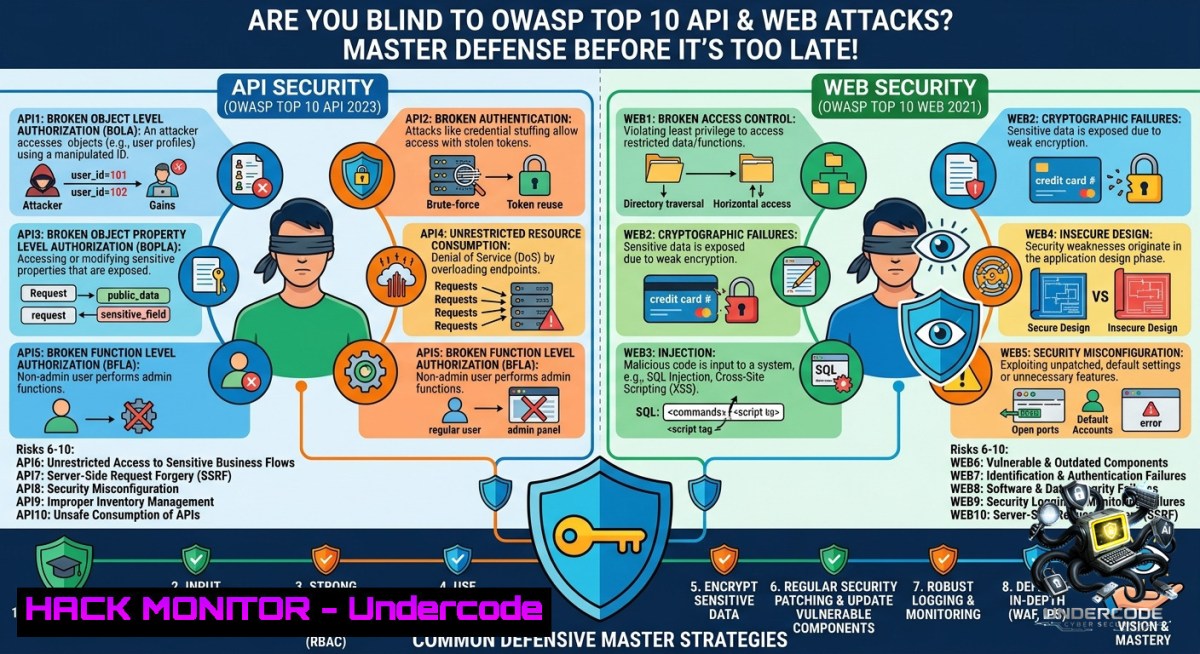
Introduction:
APIs drive modern web applications, but they also expose a sprawling attack surface that most security teams fail to fully monitor. The OWASP Top 10 for APIs and Web Applications—including Broken Object Level Authorization (BOLA), Broken Authentication, and Excessive Data Exposure—represents the most critical risks exploited daily. Without hands-on knowledge of how attackers abuse these flaws and how to harden systems against them, your organization remains dangerously vulnerable.
Learning Objectives:
– Identify and exploit (in a lab) the OWASP Top 10 API vulnerabilities using open-source tools like Burp Suite, OWASP ZAP, and custom scripts.
– Implement mitigation techniques including proper rate limiting, JWT validation, and cloud-1ative WAF rules across AWS/Azure.
– Build a reusable API security testing checklist and automate scans within CI/CD pipelines.
You Should Know:
1. Reconnaissance & API Discovery – Mapping the Unseen Attack Surface
Attackers begin by discovering hidden API endpoints, parameters, and versioning patterns. Use the following commands to simulate passive and active reconnaissance against your own test environment.
Linux / macOS Commands:
 Passive: Extract endpoints from JavaScript files
curl -s https://target.com/app.js | grep -Eo '"/api/[^"]"' | sort -u

 Active: Fuzz for common API paths using ffuf
ffuf -u https://target.com/FUZZ -w /usr/share/wordlists/api-common.txt -c -t 50

 Enumerate OpenAPI/Swagger docs
curl -s https://target.com/v2/api-docs | jq '.paths | keys'
Windows PowerShell:
 Fetch and parse JS for endpoints
Invoke-WebRequest -Uri "https://target.com/app.js" | Select-Object -ExpandProperty Content | Select-String '/api/[^"]' -AllMatches | ForEach-Object {$_.Matches.Value} | Sort-Object -Unique
Step‑by‑step guide:
1. Identify the target’s main web application and any subdomains.
2. Download JavaScript bundles and scan for hardcoded API routes.
3. Use wordlists tailored to API patterns (e.g., `/v1/users`, `/api/admin/config`).
4. Document discovered endpoints with methods (GET, POST, PUT, DELETE).
5. Automate this discovery in a pre-engagement reconnaissance phase.
2. Exploiting Broken Object Level Authorization (BOLA) – The 1 API Risk
BOLA occurs when an API accepts a user-supplied ID without verifying ownership. Attackers change `id=123` to `id=124` to access another user’s data.
Testing with Burp Suite / OWASP ZAP:
– Intercept a request like `GET /api/orders/123`
– Send to Repeater, change to `124`, `125`, etc.
– If you receive another user’s order data, BOLA is confirmed.
Linux command-line simulation (using jq for JSON):
 Authenticate and grab token
TOKEN=$(curl -s -X POST https://target.com/login -d '{"user":"attacker","pass":"test"}' -H "Content-Type: application/json" | jq -r '.token')

 Attempt BOLA
for id in {100..200}; do
curl -s -H "Authorization: Bearer $TOKEN" https://target.com/api/user/$id | jq '.email'
done
Mitigation: Implement resource‑level checks on the server. Use random, unguessable IDs (UUIDs) instead of sequential integers. Deploy a middleware that validates `req.user.id == req.params.id`.
3. Broken Authentication – JWT Weaknesses and Session Hijacking
JSON Web Tokens are often misconfigured: `none` algorithm, missing signature verification, or long expiration times.
Exploit steps:
1. Capture a JWT from an authenticated session.
2. Decode it at https://jwt.io – check the `alg` header.
3. If `alg` is `HS256` but the server expects `RS256`, try an algorithm confusion attack.
4. Attempt to change the payload (e.g., `”role”:”admin”`) and re-encode with `alg: none`.
Linux – test JWT vulnerabilities with jwt_tool:
git clone https://github.com/ticarpi/jwt_tool
cd jwt_tool
python3 jwt_tool.py <JWT_TOKEN> -t -a -X a  test 'none' algorithm
Windows – using PowerShell with custom script:
 Decode JWT (split into parts)
$jwt = "eyJhbGciOiJIUzI1NiIsInR5cCI6IkpXVCJ9..."
$payload = [System.Text.Encoding]::UTF8.GetString([System.Convert]::FromBase64String(($jwt.Split('.')[bash]).Replace('-','+').Replace('_','/')))
Write-Host $payload
Hardening:
– Always validate signature. Reject `alg: none`.
– Use short expiration (15-30 min) with refresh tokens.
– Store tokens securely (HttpOnly cookies, never localStorage).
4. Excessive Data Exposure – How Attackers Harvest Sensitive Fields
APIs often return more data than needed (e.g., user profile includes `ssn`, `credit_card_last4`, `internal_id`). Intercept the response and look for over‑fetching.
Using mitmproxy or Burp Suite:
– Forward a normal request and examine the JSON response.
– If you see fields not rendered on the frontend, those are leaked.
Command-line extraction with curl and jq:
curl -s -H "Authorization: Bearer $TOKEN" https://target.com/api/profile | jq 'keys'  list all returned fields
curl -s -H "Authorization: Bearer $TOKEN" https://target.com/api/profile | jq '.ssn, .credit_card'
Fix: Apply GraphQL `@auth` directives or REST field selectors. Never serialize entire database objects. Use DTOs (Data Transfer Objects) to whitelist fields.
5. Lack of Rate Limiting & Resource Exhaustion – Brute Force and DoS
Without rate limiting, attackers can brute force OTPs, passwords, or API keys.
Testing rate limits with a simple bash loop:
for i in {1..100}; do
curl -s -o /dev/null -w "%{http_code}\n" -X POST https://target.com/login -d '{"user":"admin","pass":"guess$i"}'
sleep 0.1
done
If you see 200 OK for many attempts, no rate limit exists.
Linux mitigation with iptables (connection limiting):
sudo iptables -A INPUT -p tcp --dport 443 -m connlimit --connlimit-above 50 --connlimit-mask 32 -j DROP
Cloud hardening (AWS WAF rate‑based rule):
resource "aws_wafv2_web_acl" "api_waf" {
default_action { allow {} }
rule {
name = "rate-limit-api"
priority = 1
action { block {} }
statement {
rate_based_statement {
limit = 2000
aggregate_key_type = "IP"
}
}
visibility_config { cloudwatch_metrics_enabled = true }
}
}
Step‑by‑step guide for cloud:
1. Navigate to AWS WAF > Web ACLs > Create.
2. Add a rate-based rule with limit = 100 requests per 5 minutes per IP.
3. Attach the ACL to your API Gateway or ALB.
4. Monitor CloudWatch for blocks and adjust thresholds.
6. API Security Hardening in CI/CD – Automated Scanning with OWASP ZAP
Shift left by integrating API security tests into your pipeline.
Dockerized OWASP ZAP baseline scan:
docker run -t owasp/zap2docker-stable zap-api-scan.py \
-t https://target.com/swagger.json \
-f openapi \
-r api_report.html
GitHub Actions example (Linux runner):
- name: ZAP API Scan
run: |
docker run -v $(pwd):/zap/wrk owasp/zap2docker-stable zap-api-scan.py \
-t https://staging-api.company.com/v3/api-docs \
-f openapi \
-r report.html
- name: Upload Report
uses: actions/upload-artifact@v3
with:
name: zap-report
path: report.html
Windows (using Docker Desktop):
Same commands work in PowerShell with Docker installed. Additionally, use `Invoke-WebRequest` to fetch the OpenAPI spec and feed it to a local ZAP instance via its REST API.
What Undercode Say:
– Key Takeaway 1: Attackers don’t break in; they log in – using legitimate API calls with manipulated IDs or tokens. Your monitoring must focus on abnormal access patterns (e.g., a single user requesting thousands of distinct resource IDs).
– Key Takeaway 2: Free training like the OWASP Top 10 webinar is essential, but theory alone won’t stop breaches. You need hands-on labs where developers and security engineers actually exploit BOLA, replay JWTs, and bypass rate limits in a controlled environment.
Analysis (10 lines):
The post highlights a pervasive blind spot: most organizations still prioritize network perimeter defenses while APIs—often undocumented and forgotten—become the easiest entry point. The OWASP Top 10 for APIs is not just a checklist; it’s a living attack catalog updated from real-world incidents. Many teams falsely assume that using a JWT or an API gateway automatically secures them. In reality, misconfigurations like overly broad CORS, lack of object-level checks, and verbose error messages (revealing stack traces) are rampant. The free webinar mentioned is a positive first step, but follow-up investment in interactive training tools (e.g., OWASP Juice Shop, crAPI) is critical. Without continuous, automated testing in CI/CD, new API endpoints will reintroduce old flaws. The commands and configurations provided above give immediate, actionable ways to assess and harden your own systems. Remember: if you haven’t tested your APIs for BOLA today, assume they’re already breached.
Prediction:
– -1 By 2026, over 70% of data breaches will involve an API vulnerability, with BOLA and excessive data exposure responsible for the majority of leaked records—driven by rapid microservices adoption without corresponding security maturity.
– +1 Demand for “API Security Engineer” roles will triple, and automated runtime protection (e.g., API firewalls with behavioral analytics) will become standard in cloud-1ative stacks, reducing manual review overhead.
– -1 Regulatory bodies (GDPR, CCPA, PCI DSS) will begin mandating quarterly OWASP API Top 10 assessments and proof of rate limiting, leading to fines for non‑compliant organizations.
– +1 Open‑source tools like ZAP and custom fuzzing frameworks will integrate LLM‑assisted test generation, making it easier for developers to write security tests without deep exploitation expertise.
▶️ Related Video (74% Match):
🎯Let’s Practice For Free:
🎓 Live Courses & Certifications:
[Join Undercode Academy for Verified Certifications](https://undercode.co.uk/certifications/)
🚀 Request a Custom Project:
Secure, high-velocity infrastructure and disruptive technological engineering. Contact our engineering team for high-tier development and proprietary systems:
[[email protected]](mailto:[email protected])
💎 Smart Architecture | 🛡️ Secure by Design | ⭐ Trusted by Thousands
IT/Security Reporter URL:
Reported By: [Are You](https://www.linkedin.com/posts/are-you-blind-to-%F0%9D%97%A2%F0%9D%97%AA%F0%9D%97%94%F0%9D%97%A6%F0%9D%97%A3-%F0%9D%97%A7%F0%9D%97%BC%F0%9D%97%BD-%F0%9D%9F%AD%F0%9D%9F%AC-api-ugcPost-7468185688329326593-q4Vs/) – Hackers Feeds
Extra Hub: Undercode MoN
Basic Verification: Pass ✅
🔐JOIN OUR CYBER WORLD [ CVE News • HackMonitor • UndercodeNews ]
[💬 Whatsapp](https://undercode.help/whatsapp) | [💬 Telegram](https://t.me/UndercodeCommunity)
📢 Follow UndercodeTesting & Stay Tuned:
[𝕏 formerly Twitter 🐦](https://x.com/undercodeupdate) | [@ Threads](https://www.threads.net/@undercodetesting) | [🔗 Linkedin](https://www.linkedin.com/company/undercodetesting/) | [🦋BlueSky](https://bsky.app/profile/undercode.bsky.social)


