
Listen to this Post
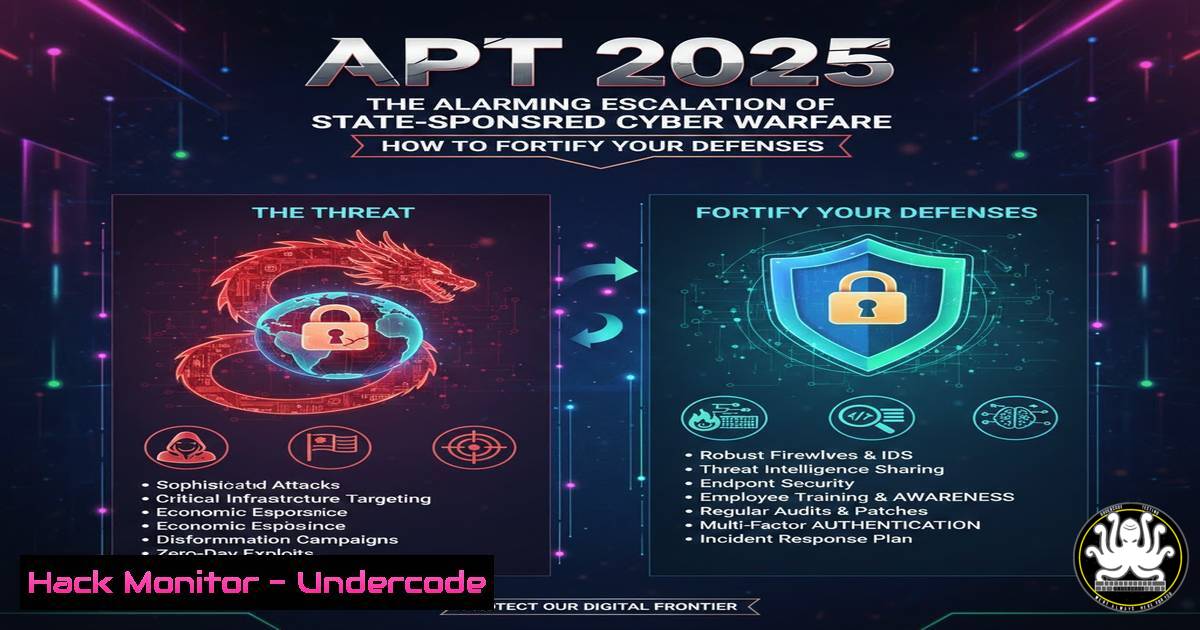
Introduction:
The Advanced Persistent Threat (APT) landscape is evolving at a breakneck pace, with nation-states increasingly weaponizing cyberspace for espionage, sabotage, and strategic dominance. The year 2025 is poised to witness an unprecedented surge in sophisticated campaigns from China, Russia, North Korea, and Iran, targeting critical infrastructure, government entities, and global supply chains. Understanding these threats and proactively hardening defenses is no longer optional; it is a critical imperative for organizational survival.
Learning Objectives:
- Identify the key Tactics, Techniques, and Procedures (TTPs) employed by major state-sponsored APT groups.
- Implement defensive measures to detect and mitigate common initial access vectors like AiTM phishing and software supply chain attacks.
- Harden critical infrastructure systems against disruptive wiper malware and zero-day exploitation.
You Should Know:
- The Chinese Playbook: AiTM Phishing and Update Hijacking
Chinese APT groups like FamousSparrow and SinisterEye are refining their methods for maximum stealth and impact. Adversary-in-the-Middle (AiTM) phishing attacks bypass traditional multi-factor authentication (MFA) by intercepting session cookies. Furthermore, the hijacking of legitimate software update channels represents a severe software supply chain threat, compromising thousands of users simultaneously.
Step-by-step guide to detecting suspicious network activity:
AiTM attacks often rely on rogue proxies. You can look for anomalous SSL/TLS certificate issuers on your network.
Linux (using tcpdump and openssl):
 Capture TLS handshake packets on your network interface
sudo tcpdump -i eth0 -A 'tcp port 443 and (tcp[((tcp[bash]>>2)+5):1] = 0x16)'

For a specific IP, you can check the certificate (replace with target IP)
openssl s_client -connect example.com:443 -servername example.com < /dev/null | openssl x509 -noout -issuer -subject
Monitor for certificates from unknown or unexpected Certificate Authorities (CAs). On Windows, this can be reviewed via the Event Viewer under `Windows Logs > Security` for Schannel events (Event IDs 36872, 36874).
2. The Iranian Threat: Defending Against Internal Spearphishing
Groups like MudddyWater have demonstrated the high efficacy of compromising an internal email account and launching attacks from within the trusted network perimeter. This makes detection by traditional edge security controls nearly impossible.
Step-by-step guide to enhancing internal mail server security:
Enable and review detailed mail flow logs to spot anomalous sending patterns from compromised accounts.
Microsoft Exchange PowerShell:
 Get a report of messages sent from internal users to external domains
Get-MessageTrackingLog -Start "01/01/2025 00:00" -End "01/31/2025 23:59" -EventId "SEND" -ResultSize Unlimited | Where-Object {$<em>.Sender -like "@yourdomain.com" -and $</em>.Recipients -like "@externaldomain.com"} | Select-Object Timestamp, Sender, Recipients, MessageSubject
Implement DMARC, DKIM, and SPF records to prevent domain spoofing. Additionally, deploy User and Entity Behavior Analytics (UEBA) solutions to baseline normal user activity and flag anomalies, such as a user logging in from two geographically distant locations in a short time frame.
- The North Korean Shift: Supply-Chain and macOS Targeting
Lazarus and Konnni are expanding beyond Windows, actively targeting macOS users and executing software supply-chain attacks, particularly in South Korea. This underscores the need for a multi-OS security strategy.
Step-by-step guide to basic macOS hardening for enterprise:
Disable automatic execution of files from unidentified developers and enforce application allow-listing.
macOS Terminal Commands:
 Check the Gatekeeper setting (should be 'spctl --status' returning 'assessments enabled')
sudo spctl --status

Enable Gatekeeper to only allow App Store and identified developers
sudo spctl --master-enable

To explicitly allow an application from an unidentified developer (use with extreme caution)
sudo spctl --add /Path/To/Application.app
Utilize Mobile Device Management (MDM) solutions to enforce these policies across a fleet of macOS devices and monitor for the execution of unsigned or non-notarized software.
- The Russian Menace: Mitigating Zero-Days and Wiper Malware
Groups like Sandworm pose a direct threat to critical infrastructure with their destructive wiper malware (e.g., targeting energy and agriculture). RomCom’s use of a WinRAR 0-day highlights the critical importance of rapid patch management.
Step-by-step guide to creating a wiper malware mitigation strategy:
Implement strict integrity controls and backups to ensure operational resilience.
Windows Command Prompt (Using Windows Defender Application Control):
 Use PowerShell to create a Code Integrity policy (on a reference machine)
New-CIPolicy -FilePath C:\Temp\BasePolicy.xml -Level FilePublisher -UserPEs -Fallback Hash
This policy can be deployed to lock down systems and prevent the execution of unauthorized binaries, including wipers. For immediate defense, use File Server Resource Manager (FSRM) on Windows servers to detect and block the creation of files with known wiper extensions or ransom notes.
5. Global Vulnerabilities: Patching the Roundcube CVE-2024-42009
The massive exploitation of Roundcube webmail vulnerabilities (CVE-2024-42009) demonstrates how ubiquitous applications become primary attack vectors for APT initial access.
Step-by-step guide to verifying the Roundcube patch:
Immediately patch all Roundcube instances to the latest version. After patching, verify that the vulnerability is closed.
Linux Bash Commands:
 Navigate to your Roundcube root directory
cd /var/www/roundcube/

Check the current version (ensure it's patched beyond 1.6.4)
grep "Version" version.php

The vulnerability involves XSS in the `_mbox` parameter. A simple test can be done by checking if input is properly sanitized.
 You can also use a vulnerability scanner like Nuclei to test:
nuclei -u https://your-roundcube-domain.com -t /path/to/cve-2024-42009.yaml
Ensure that your Web Application Firewall (WAF) is configured with rules to block cross-site scripting (XSS) payloads targeting the `_mbox` parameter.
What Undercode Say:
- The Perimeter is Dead. The convergence of internal spearphishing, AiTM attacks, and supply-chain compromises means the traditional network boundary is irrelevant. Security must focus on identity, data, and application integrity.
- Cyber is Now Hybrid Warfare. Sandworm’s attacks on grain and energy are not espionage; they are acts of economic and logistical warfare designed to cripple a nation’s stability. Corporate defense is now national defense.
The analysis indicates a fundamental shift from cybercrime to cyber-conflict. The militarization of cyberspace by nation-states means that private sector organizations, especially in critical infrastructure, are now strategic targets on a digital battlefield. The cooperation between groups like Gamaredon and Turla suggests a more organized, campaign-based approach akin to military operations. Defenders must adopt intelligence-driven security postures, leveraging CTI to anticipate these groups’ next moves rather than merely reacting to them.
Prediction:
By late 2025, we predict the first major, successful AI-driven APT campaign that autonomously adapts its social engineering lures and payloads in real-time based on target interaction, dramatically increasing the scale and success rate of breaches. Furthermore, as the conflict in Ukraine evolves, Russian APT activity will almost certainly expand westward, targeting the political and critical infrastructure of NATO allies with disruptive and destructive attacks designed to test alliance cohesion and response protocols. The era of AI-powered, persistent, and destructive cyber conflict has arrived.
🎯Let’s Practice For Free:
IT/Security Reporter URL:
Reported By: Beta Delta – Hackers Feeds
Extra Hub: Undercode MoN
Basic Verification: Pass ✅


