Listen to this Post
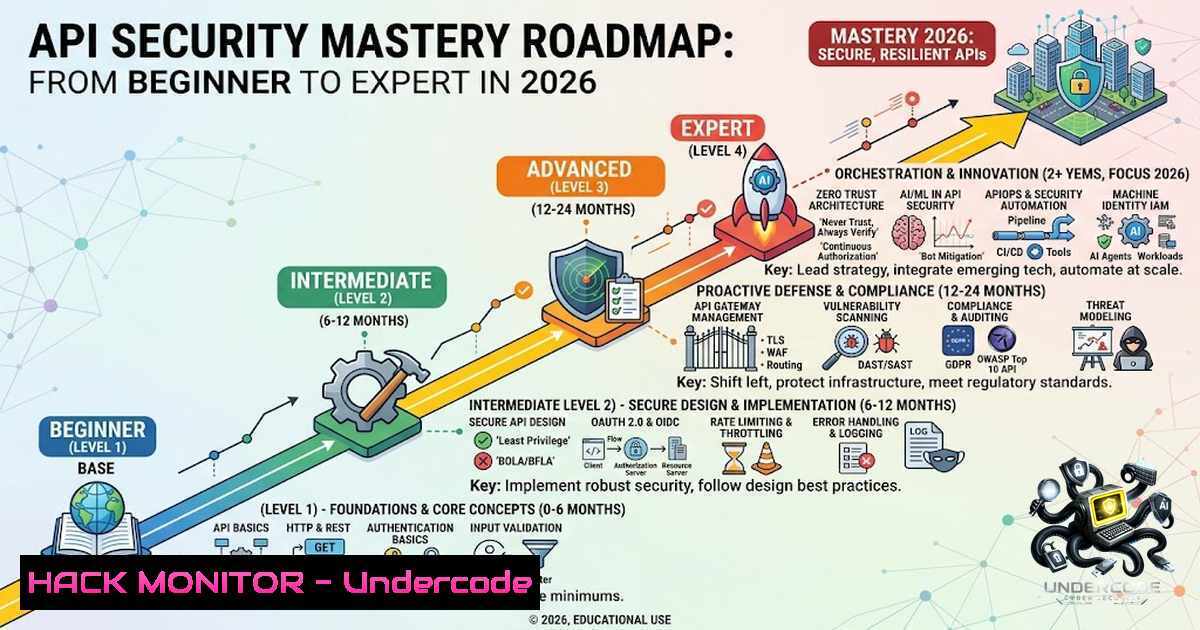
Introduction:
The exponential growth of microservices, serverless architectures, and AI-driven applications has dramatically expanded the attack surface, making API security a critical pillar of modern cybersecurity. As organizations rapidly adopt REST, GraphQL, and gRPC to power their digital ecosystems, the OWASP API Security Top 10 has become the de facto standard for identifying and mitigating critical vulnerabilities. This roadmap provides a comprehensive, phase-based guide to building a career in API security, covering everything from foundational authentication concepts to advanced runtime protection and AI-era threats.
Learning Objectives & Secrets:
- Objective 1: Master the core API security fundamentals, including a deep dive into OAuth 2.0, OIDC, JWT, and the common pitfalls of misconfigured authentication mechanisms. Secret Tip: Focus on RFC 8705 (OAuth 2.0 Mutual-TLS) and RFC 9700 (OAuth 2.0 Best Current Practice) early to understand enterprise-grade security.
- Objective 2: Achieve hands-on proficiency in exploiting and mitigating the OWASP API Top 10, particularly Broken Object Level Authorization (BOLA) and Mass Assignment. Secret Tip: Learn to manipulate not just `GET` request IDs but also `PUT` and `PATCH` methods to test for property-level authorization bypasses (BOPLA).
- Objective 3: Develop a professional penetration testing methodology using Burp Suite and specialized tools like Akto and 42Crunch, culminating in the ability to pass certifications like the API Security Certified Professional (ASCP). Secret Tip: Build a custom Burp extension to automate the detection of JWT algorithm confusion or weak secrets as a portfolio project.
You Should Know:
- Phase 1: Building the Foundation (API Basics & Lab Setup)
Start by understanding the architectural styles that define modern APIs. While REST is ubiquitous, GraphQL and gRPC present unique security challenges. Begin by using OpenAPI/Swagger to generate a local specification.
– Step 1: Set up your virtual lab. I recommend using a combination of Docker and a dedicated VM.
– Step 2: Install `crapi` as your primary vulnerable target. Run the following Docker command to spin it up instantly:
docker run -p 8888:8888 -p 8025:8025 --1ame crapi -d crapi/crapi:latest
– Step 3: Configure your proxy. Use `mitmproxy` or Burp Suite to intercept traffic. To view the current proxy route, use:
netstat -tulpn | grep :8888
– Step 4: Verify the API endpoints. Use `curl` to check if the lab is running:
curl -X GET http://localhost:8888/identity/api/v1/user/dashboard
If you receive a 401 error, the API is live and ready for interaction. This initial setup is critical for applying the rest of the roadmap.
- Phase 2: Core Exploitation – The OWASP API Top 10
This phase focuses on hands-on exploitation. The most critical issue remains Broken Object Level Authorization (BOLA/IDOR).
– Step 1: Identify BOLA. Intercept a GET request like /api/v1/invoice/{id}. Change the ID to a sequential number (e.g., `1001` to 1002). If you get a 200 OK with another user’s data, the vulnerability exists.
– Step 2: Test for JWT attacks. Use a Python script to brute-force weak HMAC secrets:
import jwt
token = "your.jwt.token.here"
secret = "secret"  Common weak secret
try:
decoded = jwt.decode(token, secret, algorithms=["HS256"])
print(f"Decoded: {decoded}")
except Exception as e:
print(f"Failed: {e}")
– Step 3: Configure rate limiting on your own API to prevent Denial of Service (DoS) and business logic abuse. On Linux, you can simulate rate-limiting rules using `iptables` for a quick test environment:
iptables -A INPUT -p tcp --dport 8080 -m limit --limit 10/min -j ACCEPT
iptables -A INPUT -p tcp --dport 8080 -j DROP
This creates a rudimentary “stateful” rate limit for testing.
- Phase 3: Intermediate – Secure Design & Testing Methodologies
Shift from hunting bugs to architecting secure APIs. The principle of least privilege must be applied to token scopes and user roles.
– Step 1: Implement Scoped Tokens. In a Secure-by-Design pattern, issue tokens with limited scopes. For example, a read-only token cannot execute `DELETE` operations.
– Step 2: Use 42Crunch to perform a spec (OpenAPI) audit to find misconfigurations before writing code. In a CI/CD pipeline, you can run:
audit -o openapi.json
– Step 3: Master contract testing. Ensure that the API definition matches the implementation. On Windows, you can use PowerShell to test fuzzing inputs on a local endpoint:
Invoke-WebRequest -Uri "http://localhost:5000/api/user/1" -Method GET -Headers @{Authorization = "Bearer <token>"}
– Step 4: Error handling is critical. Ensure you aren’t leaking stack traces. In a Spring Boot application, disable verbose errors by setting `server.error.include-stacktrace=never` in application.properties.
- Phase 4: Advanced – Runtime, AI-Era, and GraphQL Security
Modern attacks target GraphQL introspection and AI agent credential leakage. Runtime protection requires visibility into the “East-West” traffic.
– Step 1: Explore a GraphQL endpoint. Use a tool like GraphQL Voyager to detect introspection. To introspect manually via curl:
curl -X POST -H "Content-Type: application/json" -d '{"query": "query { __schema { types { name } } }"}' http://localhost:4000/graphql
If the response lists the entire schema, disable introspection in production.
– Step 2: Test for query depth complexity to prevent resource exhaustion. A batching attack allows attackers to nest queries 20+ levels deep. Implement depth limiting middleware (like `graphql-depth-limit` in Node.js).
– Step 3: Deploy an API Gateway like Kong. Configure a rate-limiting plugin for AI endpoints (to prevent scraping of LLM outputs):
curl -X POST http://localhost:8001/services/my-api/plugins \
--data "name=rate-limiting" \
--data "config.minute=5"
– Step 4: Security for Agentic AI. Ensure that MCP (Machine Control Protocols) are secured with mTLS and that API keys are not hardcoded in scripts pushed to code repositories.
- Phase 5: Professional – Certifications and Career Growth
Validation through certifications is key to career progression.
- Step 1: Enroll in APIsec University. The CASA (Certified API Security Analyst) course is free and foundational.
- Step 2: Book the ASCP exam ($450). This is a 12-hour hands-on test where you must hack multiple API configurations and write a comprehensive report.
- Step 3: Expand adjacent knowledge by taking the PortSwigger BSCP (Burp Suite Certified Practitioner), which covers complex API logic, or the OSWE (OffSec Web Expert) for white-box API exploitation.
- Step 4: Build a public Portfolio. Write a detailed penetration test report for crAPI or a bug bounty submission for an API program. Use a structured template (Executive Summary, Methodology, Findings, Remediations). Publish it as a PDF on LinkedIn.
What Undercode Say:
- Key Takeaway 1: The transition from “API Security Specialist” to “Cybersecurity Engineer” requires mastering the CI/CD pipeline. You cannot just perform point-in-time scans; you must implement “shift-left” security gates that block builds if OWASP-aligned tests find critical issues like BOLA.
- Key Takeaway 2: The industry is moving beyond standard REST. The emergence of GraphQL and AI-agentic workflows is changing the threat model. Professionals who specialize in query depth analysis and API-gateway policy enforcement (specifically for AI models) will become the highest-paid consultants.
Prediction:
- +1 The demand for certified API security experts (especially ASCP holders) will triple by 2027 as regulations (like DORA) mandate specific security testing for financial APIs.
- -1 The lack of standardization in GraphQL security is creating a Wild West scenario; we will likely see a major breach in the next 18 months involving deep GraphQL introspection leading to massive data leaks.
- +1 Integration of AI into API security platforms (like Salt and Noname) will reduce false positives by 40%, allowing engineers to focus on complex logic bugs rather than config errors.
- -1 Shadow APIs (undeclared endpoints) will continue to bypass most traditional WAFs and scanners, making runtime discovery platforms a necessity rather than a luxury.
- +1 The evolution of OAuth and JWT security standards (like RFC 9700) will lead to more secure authentication flows, reducing credential stuffing attacks against APIs significantly.
- -1 State-sponsored actors are increasingly targeting API endpoints for espionage rather than ransomware, leading to “quiet” breaches that go undetected for months.
- +1 API security will converge with SRE (Site Reliability Engineering) as rate-limiting and DoS prevention become intertwined, creating new hybrid roles.
- -1 The rising cost of AI token abuse may force organizations to prioritize implementing strong rate limiting and anomaly detection, potentially at the expense of other development features.
▶️ Related Video (88% Match):
🎯Let’s Practice For Free:
🎓 Live Courses & Certifications:
Join Undercode Academy for Verified Certifications
🚀 Request a Custom Project:
Secure, high-velocity infrastructure and disruptive technological engineering. Contact our engineering team for high-tier development and proprietary systems:
[email protected]
💎 Smart Architecture | 🛡️ Secure by Design | ⭐ Trusted by Thousands
IT/Security Reporter URL:
Reported By: https://lnkd.in/p/eyxEEsYS – Hackers Feeds
Extra Hub: Undercode MoN
Basic Verification: Pass ✅


