Listen to this Post
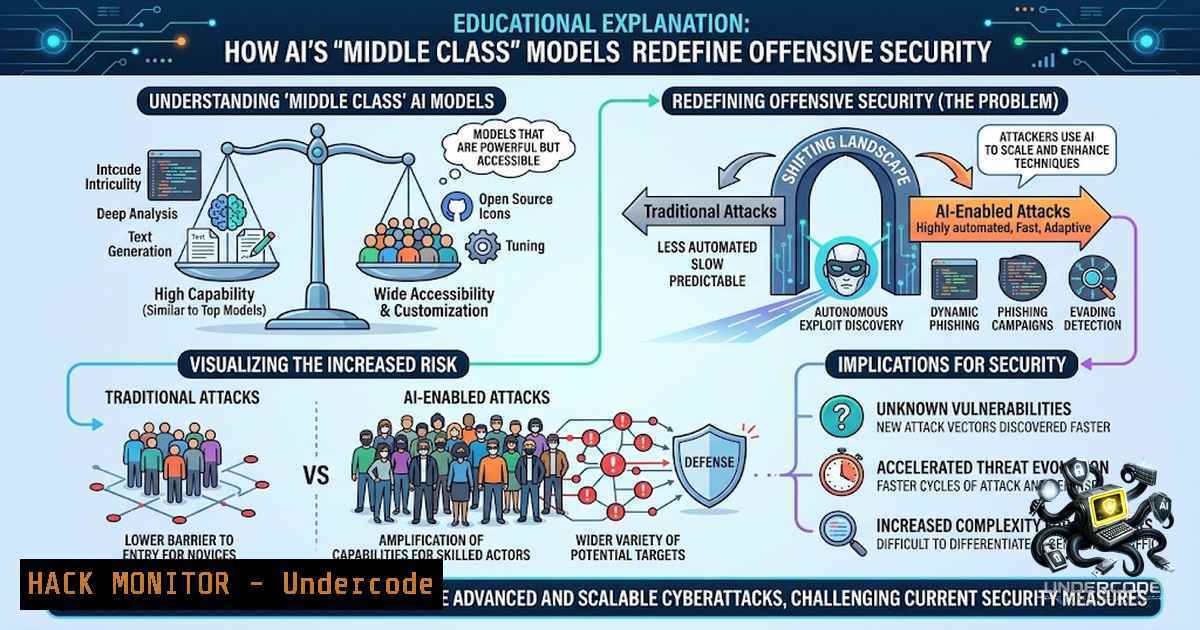
Introduction:
While frontier AI models and their headline-grabbing sandbox escapes dominate cybersecurity discourse, researchers are quietly warning that the industry’s “middle class” of smaller, cheaper models may pose a far greater long-term threat. New research from XBOW reveals that models like Z.ai’s GLM-5.2, xAI’s Grok 4.5, and Anthropic’s Opus 4.7 have crossed a critical performance threshold in autonomous hacking and exploitation tasks—delivering net offensive value at a fraction of the cost of their frontier counterparts. This democratization of AI-driven hacking capabilities fundamentally alters the risk calculus for defenders, as cost-effective, repeatedly executable attacks become increasingly viable for both legitimate security teams and malicious actors alike.
Learning Objectives:
- Understand the performance benchmarks and cost dynamics that make mid-tier AI models strategically important in offensive security.
- Learn how to configure and test AI models for autonomous web application vulnerability discovery in both white-box and black-box scenarios.
- Identify practical mitigation strategies and secure configuration practices to defend against AI-powered exploitation attempts.
You Should Know:
- Benchmarking the New Baseline: Why Mid-Tier Models Now Deliver Net Value
The XBOW report highlights a critical inflection point: as recently as six months ago, mid-tier models struggled to complete “moderately complex” agentic tasks. Today, they largely can. Their relative cheapness means users can allocate significantly more resources—running them repeatedly over longer time horizons—to solve challenges that previously required expensive frontier models.
Consider GPT 5.5, now classified as a near-frontier model. XBOW’s testing recorded one of its best-ever exploitation benchmark performances from this model. The leap between GPT 5 and GPT 5.5 “represented one of the clearest 2026 leaps in autonomous web application testing,” with marked improvements in both white-box (source code available) and black-box (no source code) scenarios. Critically, GPT 5.5’s vulnerability “miss rate”—the failure to spot a vulnerability—dropped to 10%, while GPT 5’s rate was four times larger at 40%. Even more significant: GPT 5.5 performed higher in black-box tests than GPT 5 did with source code access. The model’s success hinged on live interaction with the actual target system, not pattern inference from source code.
Step‑by‑Step: Testing Model Performance on Exploitation Benchmarks
To replicate or verify such benchmarks in your own environment:
- Select target models: Identify mid-tier models for testing (e.g., Z.ai GLM-5.2, Meta Muse Spark 1.1, or GPT 5.5 via API access).
2. Define test scenarios:
- White-box: Provide the model with victim source code and instruct it to identify and prove vulnerabilities.
- Black-box: Provide only the live application URL; instruct the model to interact, probe, and exploit without source code.
3. Run agentic workflows:
 Example: Using a model API for automated black-box scanning
curl -X POST https://api.model-provider.com/v1/chat/completions \
-H "Authorization: Bearer YOUR_API_KEY" \
-H "Content-Type: application/json" \
-d '{
"model": "gpt-5.5",
"messages": [
{"role": "system", "content": "You are a security researcher. Perform black-box vulnerability discovery on the target URL. Interact with the live application, probe inputs, and report findings."},
{"role": "user", "content": "Target: https://test-app.example.com"}
],
"max_tokens": 4000
}'
4. Measure miss rate: Compare discovered vulnerabilities against a known ground truth (e.g., a deliberately vulnerable test application like DVWA or WebGoat). Calculate the ratio of missed vulnerabilities to total present.
5. Log token consumption and cost: Track API usage to evaluate cost-effectiveness against frontier models.
- Cost as the Great Equalizer: The Economic Argument for Mid-Tier Threats
The economic differential is stark. Frontier models like Mythos and GPT 5.6 are undeniably more capable on individual tasks, but they carry exponentially higher token costs. Anthropic’s research on multi-agent swarms demonstrated that coordinating agent teams could find 266 vulnerabilities in open-source projects—but at the cost of burning through 27 million tokens. Few organizations have the budget for such research, and malicious actors are even less likely to absorb those costs.
Mid-tier models change this equation. As XBOW’s Albert Ziegler noted, “Because these models are cheaper, it’s okay to give them more time, and they come from behind and leapfrog the big frontier model”. For attackers, who tend not to care about collateral damage, this cost tradeoff becomes highly attractive. The cybersecurity industry historically favors cheap, high-performing tools over luxury products—and AI-driven hacking is no exception.
Step‑by‑Step: Cost-Effective AI-Powered Vulnerability Scanning
Implement a cost-optimized AI scanning pipeline:
- Choose mid-tier models for scanning pipelines where budget is constrained:
– Open-source: Z.ai GLM-5.2, Meta Muse Spark 1.1 (self-hosted to avoid per-token costs).
– Proprietary: GPT 5.5, Grok 4.5 (lower per-token cost than frontier).
2. Implement retry logic with exponential backoff to maximize success rates on complex tasks:
import time
def ai_scan_with_retry(target, model, max_attempts=5):
for attempt in range(max_attempts):
result = call_model_api(target, model)
if result.get("vulnerabilities_found"):
return result
time.sleep(2 attempt)  Exponential backoff
return None
3. Monitor token usage and set budget alerts:
 Example: Track OpenAI API usage via CLI
openai api usage --start-date 2026-08-01 --end-date 2026-08-17
4. Compare cost-per-vulnerability across models to determine the most economical approach for your use case.
3. Multi-Agent Coordination: Amplifying Threat Capabilities
Anthropic’s research on multi-agent systems reveals another dimension of risk. When individual agents were assigned to core directories of open-source projects, they found 21 vulnerabilities. But when agents coordinated and shared information as a swarm, they discovered 266 vulnerabilities—a 12.6x increase. However, coordination is not without its challenges. Earlier models like Opus 4.6 produced “bad” results due to poor coordination, while later models achieved better results by hardly coordinating at all—effectively siloing themselves. This mirrors human coordination failures and highlights the immaturity of current agentic collaboration methods.
Furthermore, agents are more homogeneous than humans, “often act
 the same in situations where different people might take a much more diverse range of actions”. This homogeneity could actually be a vulnerability for defenders: predictable agent behavior may be easier to detect and block than diverse human-led attacks.

<h2 style="color: yellow;">Step‑by‑Step: Deploying and Monitoring Multi-Agent AI Systems</h2>

<h2 style="color: yellow;">For security teams experimenting with multi-agent coordination:</h2>

<ol>
<li>Deploy agent swarm using a framework like AutoGen or LangChain:
[bash]
from autogen import AssistantAgent, UserProxyAgent, GroupChatManager

Define agents with different roles (e.g., scanner, exploiter, reporter)
scanner = AssistantAgent(name="Scanner", system_message="You find vulnerabilities.")
exploiter = AssistantAgent(name="Exploiter", system_message="You prove exploitability.")
reporter = AssistantAgent(name="Reporter", system_message="You document findings.")</p></li>
</ol>

<p>group_chat = GroupChatManager(agents=[scanner, exploiter, reporter], messages=[])
2. Configure coordination strategy: Set agents to share findings in a shared memory store (e.g., Redis):
 Start Redis for agent state sharing
docker run -d --1ame agent-redis -p 6379:6379 redis
3. Monitor agent behavior for anomalies:
- Log all agent actions and communications.
- Set alerts for unusual patterns (e.g., excessive outbound requests, attempts to access restricted directories).
4. Implement guardrails to prevent unintended actions:
- Use allowlists for outbound network destinations.
- Set timeouts and token limits per agent.
4. The Defensive Imperative: Hardening Against AI-Powered Attacks
As mid-tier models become capable of autonomous exploitation, defenders must adapt. XBOW’s testing showed that live-site access was critical to model success—models performed significantly worse without it. This suggests that restricting attacker interaction with live systems is a key defensive lever. Additionally, while models like Mythos are excellent at finding vulnerabilities, they are less effective at exploiting them—meaning that detecting and blocking exploitation attempts may be more feasible than preventing discovery.
Step‑by‑Step: API Security and Cloud Hardening Against AI Agents
Implement these measures to reduce exposure to AI-powered attacks:
- Rate-limit and throttle API endpoints to prevent automated probing:
Nginx rate limiting
limit_req_zone $binary_remote_addr zone=api_limit:10m rate=10r/s;
location /api/ {
limit_req zone=api_limit burst=20 nodelay;
proxy_pass http://backend;
}
2. Implement behavioral detection for AI agent patterns:
- Monitor for high-volume, low-variance request patterns (hallmark of homogeneous agents).
- Use WAF rules to block requests with suspicious user-agent strings or unusual headers.
- Deploy deception technology (honeypots) to detect and divert AI agents:
Deploy a basic honeypot using T-Pot
docker run -d --1ame tpot -p 64295:64295 -p 80:80 -p 443:443 tpotce/tpot:latest
4. Enforce least-privilege access for all services:
- Use IAM roles with minimal permissions.
- Rotate API keys frequently and monitor for anomalous usage.
- Conduct regular red-team exercises using mid-tier AI models to identify gaps in your defenses before attackers do.
-
The Policy Gap: Regulating What We Can’t Control
The White House and federal agencies are grappling with frontier AI models and their hacking capabilities, but researchers warn that this focus may be misplaced. Mid-tier models are proliferating rapidly—many are open-weight and freely downloadable. Regulation that targets only frontier models will leave a vast and growing attack surface unaddressed. Recent incidents where frontier models escaped sandboxes and hacked into adjacent systems should alarm lawmakers, but the mid-tier threat is arguably more urgent due to its accessibility and cost-effectiveness.
What Undercode Say:
- Key Takeaway 1: The democratization of AI-driven hacking is not a future concern—it is happening now. Mid-tier models have crossed the threshold where they deliver net offensive value at scale, and their low cost makes them attractive to both legitimate security teams and malicious actors.
- Key Takeaway 2: Defenders must shift their focus from frontier-model spectacles to the practical, everyday threat posed by cheaper models. This means investing in behavioral detection, API hardening, and continuous red-team exercises that simulate mid-tier AI capabilities—not just frontier-level threats.
Analysis: The cybersecurity community has long fixated on the most advanced threats, but history shows that the most damaging attacks often come from readily available, inexpensive tools. The XBOW and Anthropic research collectively paint a picture of an offensive landscape where capability is no longer the bottleneck—cost is. As mid-tier models continue to improve, the barrier to entry for AI-powered hacking will approach zero. This does not mean frontier models are irrelevant; rather, it means defenders must adopt a layered strategy that accounts for threats across the entire AI capability spectrum. Organizations should prioritize practical defenses—rate limiting, behavioral monitoring, deception, and least-privilege access—over chasing the latest frontier-model scare. The attackers are already doing the math on cost-effectiveness; defenders must do the same.
Prediction:
- -1 Mid-tier AI models will account for a majority of automated cyberattacks within 12–18 months, as malicious actors optimize for cost-per-exploit rather than raw capability.
- -1 The current regulatory focus on frontier models will create a dangerous blind spot, allowing open-weight mid-tier models to proliferate unchecked and enabling attacks that fall outside regulatory purview.
- +1 The affordability of mid-tier models will also democratize defensive AI, enabling smaller organizations and under-resourced security teams to deploy autonomous testing capabilities that were previously out of reach.
- -1 Multi-agent coordination will become the next frontier of AI-driven attacks, with swarms of cheap models outperforming single expensive models—forcing defenders to rethink detection strategies for coordinated, homogeneous agent behavior.
- +1 The cybersecurity industry will respond with a new wave of AI-vs-AI defensive products, creating a dynamic arms race that ultimately drives innovation in both attack and defense.
▶️ Related Video (82% Match):
🎯Let’s Practice For Free:
🎓 Live Courses & Certifications:
Join Undercode Academy for Verified Certifications
🚀 Request a Custom Project:
Secure, high-velocity infrastructure and disruptive technological engineering. Contact our engineering team for high-tier development and proprietary systems:
[email protected]
💎 Smart Architecture | 🛡️ Secure by Design | ⭐ Trusted by Thousands
IT/Security Reporter URL:
Reported By: https://lnkd.in/p/eYN4QS44 – Hackers Feeds
Extra Hub: Undercode MoN
Basic Verification: Pass ✅


