
Listen to this Post
Introduction:
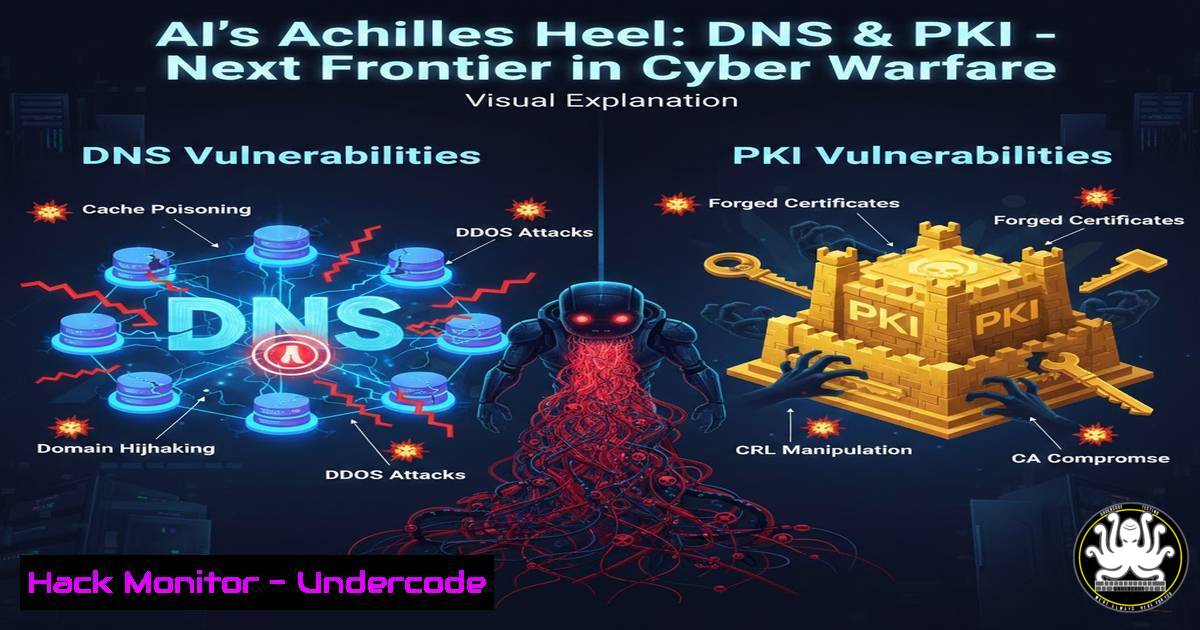
As artificial intelligence becomes the central nervous system of government, finance, and defense, its security is only as strong as the foundational protocols it rests upon. While headlines focus on AI model poisoning or data leakage, a more insidious threat lurks in the aging infrastructure of the internet: DNS, TLS, and the Public Key Infrastructure (PKI). These core trust mechanisms, plagued by decades of cache poisoning, mis-issued certificates, and BGP hijacks, represent a structural fragility that, when exploited, can blind or redirect AI systems without triggering a single alert within the “hardened” cloud environments where these models run.
Learning Objectives:
- Understand the technical interplay between DNS/PKI failures and AI system dependencies.
- Learn to map an AI application’s attack surface through its external internet asset dependencies.
- Identify command-line techniques to audit certificate validity and DNS resolution paths.
- Analyze historical attack vectors (e.g., DNS cache poisoning) and their modern implications for machine learning operations (MLOps).
You Should Know:
- Mapping the AI Supply Chain: Discovering External Dependencies
Before securing an AI system, you must understand what it talks to. AI models, particularly those integrated via APIs (like OpenAI, or custom LLMs), rely on DNS resolution to function. They also depend on external repositories for model updates, training data lakes, and authentication endpoints.
To audit this, start with passive reconnaissance from a Linux host to map the dependencies of a target AI application.
Step-by-step guide:
First, identify the external calls made by a process or container.
 Using 'ss' to see established connections from a specific AI service PID
sudo ss -tunap | grep <PID_OF_AI_PROCESS>
Next, perform manual DNS lookups on the identified domains to understand the resolution path and TTLs.
 Query the authoritative name servers for a domain used by the AI
dig <api.openai.com> NS +short

Trace the full resolution path to check for unusual delegation
dig +trace <custom-model-registry.example.com>

Use 'nslookup' on Windows for similar checks
nslookup <api.anthropic.com> 8.8.8.8
This reveals the “roots” the AI trusts. If these domains are vulnerable to hijacking, the AI’s traffic is vulnerable.
- Auditing the Chain of Trust: PKI and Certificate Validation
The post highlights that TLS is designed to prevent silent interception, but mis-issuance is a recurring theme. An attacker with a rogue certificate for an AI provider’s domain can perform a man-in-the-middle (MITM) attack on the data flowing into the model (prompts) and out of the model (responses).
Step-by-step guide to validate certificate security:
From a Linux attack box or administration console, verify the certificate chain presented by an AI endpoint.
 Use openssl to view the full certificate chain and validity
openssl s_client -connect <your-ai-endpoint.com>:443 -showcerts

Check for Certificate Transparency (CT) logs to see if any unauthorized certs were issued
 Search for the domain on https://crt.sh using curl
curl -s "https://crt.sh/?q=<your-ai-endpoint.com>&output=json" | jq .
Look for anomalies: self-signed certs in the chain, expired root CAs, or certificates issued by unexpected Certificate Authorities (CAs). This directly addresses the “certificate mis-issuance events” mentioned in the source post.
3. DNS Cache Poisoning: The Silent Redirector
Manipulating the DNS cache can redirect AI traffic to a malicious server that mirrors the legitimate service, stealing API keys and sensitive data. This bypasses application-layer firewalls because the connection appears valid to the host OS.
Simulating the risk (educational use only):
On a local test network, an attacker with man-in-the-middle position could use a tool like `dnsspoof` (part of dsniff suite) to redirect traffic.
 On an attacker machine (Linux), set up IP forwarding
echo 1 > /proc/sys/net/ipv4/ip_forward

Spoof DNS replies for a specific AI domain
dnsspoof -i eth0 -f hosts.txt
 Where hosts.txt contains: <attacker_ip> api.victim-ai.com
While this is an attack simulation, the defensive measure is to implement DNSSEC and use DNS over TLS (DoT) or DNS over HTTPS (DoH) on client machines to validate responses.
 On Ubuntu, configure systemd-resolved for DNS-over-TLS
sudo nano /etc/systemd/resolved.conf
 Set DNSOverTLS=yes
4. BGP Hijacking: Routing Layer Blindness
The source mentions “BGP-assisted hijack.” This is the nuclear option where an attacker announces more specific IP routes for the AI’s servers, sucking global traffic into their network.
Defense-in-depth strategy:
Network defenders cannot control BGP on the internet, but they can monitor for anomalies. Using `whois` and looking at route advertisements is a starting point.
 Check which ASN advertises your AI's IP range
whois <AI_Server_IP> | grep -i origin

Use a tool like 'bgpmap' or online services (e.g., CIDR-report) to monitor for route leaks.
The mitigation involves strict Resource Public Key Infrastructure (RPKI) filtering and demanding that your cloud provider and upstream ISPs implement it. For critical AI traffic, consider VPN tunnels or dedicated circuits that bypass the public BGP mesh for control plane traffic.
- Hardening the AI Host: Local DNS and Certificate Stores
The final mile is the host running the AI model. Misconfigurations here are common. A local hosts file poisoning or an ignored certificate revocation can compromise the entire system.
Step-by-step host hardening:
On Windows, the hosts file is a prime target for persistence.
 Check Windows hosts file for unauthorized entries
Get-Content C:\Windows\System32\drivers\etc\hosts
On Linux, ensure the system trusts the correct CAs and updates them regularly.
 Update CA certificates store
sudo update-ca-certificates --fresh

Check for expiring certificates in the system trust store
awk -v cmd='openssl x509 -noout -subject -dates' '/BEGIN/{close(cmd)};{print | cmd}' < /etc/ssl/certs/ca-certificates.crt | grep -B 2 "not-after"
Ensure the AI application’s runtime (Python, Java, Node.js) is configured to use the system’s trust store and not a hardcoded, outdated bundle.
6. Implementing Certificate Transparency Monitoring
Given the risk of “certificate mis-issuance,” proactive monitoring is essential. You cannot wait for a browser warning; you must know the moment a certificate is issued for your AI domain.
Automated monitoring script snippet (Python):
import requests
import json

domain = "your-ai-api.com"
url = f"https://crt.sh/?q={domain}&output=json"
try:
response = requests.get(url)
if response.status_code == 200:
data = response.json()
for entry in data[:5]:  Check recent entries
print(f"Cert issued: {entry['name_value']} on {entry['entry_timestamp']}")
 Add logic to alert if issuer is unexpected
except Exception as e:
print(f"Error querying CT logs: {e}")
This script can be integrated into a SIEM or a cron job to alert security teams of potential fraud before a malicious certificate is used in an attack.
What Undercode Say:
- Key Takeaway 1: The attack surface of AI extends far beyond the model weights and training data; the internet’s core routing and trust protocols (DNS/BGP/PKI) are the new battleground. Securing AI requires a fundamental audit of these layers, not just cloud permissions.
- Key Takeaway 2: Automation is a double-edged sword. While AI systems automatically resolve DNS and validate certificates, they rarely question the results. This implicit trust in the “internet fabric” is the vulnerability that nation-state actors are most likely to exploit, as it provides silent, persistent access.
The analysis presented by Andy Jenkinson underscores a critical pivot in cybersecurity strategy. For years, we have focused on application-layer vulnerabilities. However, as applications become AI-driven and hyper-connected, the underlying protocols, once considered “good enough,” are becoming the path of least resistance for sophisticated adversaries. The assumption that the internet’s routing and trust mechanisms are robust is a fallacy exposed by decades of infrastructure-level incidents. Defenders must now adopt an “infrastructure-first” mindset, treating DNS queries and certificate revocations with the same severity as malware alerts. The tools to exploit these layers are mature and proven; the tools to defend them, such as RPKI and widespread DNSSEC adoption, are available but tragically under-deployed, leaving a gaping hole in the fabric of our digital future.
Prediction:
Within the next 18 months, we will witness a major cyber incident targeting a financial or governmental AI system not through a sophisticated model jailbreak, but via a coordinated BGP hijack combined with a fraudulent TLS certificate. This attack will successfully intercept data streams for a period exceeding 24 hours before discovery, leading to a fundamental regulatory overhaul of how AI providers must validate their internet routing and certificate hygiene, ultimately forcing the adoption of RPKI and MFA for BGP announcements.
▶️ Related Video (78% Match):
🎯Let’s Practice For Free:
IT/Security Reporter URL:
Reported By: Andy Jenkinson – Hackers Feeds
Extra Hub: Undercode MoN
Basic Verification: Pass ✅


