Listen to this Post
Introduction:
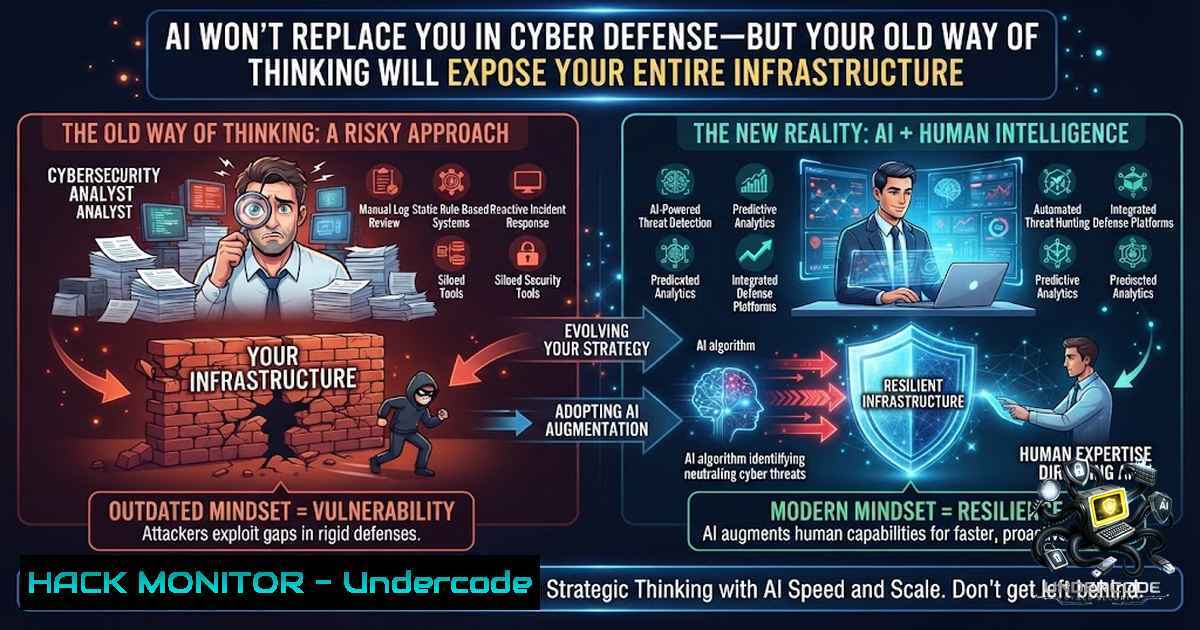
The rapid adoption of generative AI has created a dangerous paradox in enterprise security: while defenders scramble to integrate large language models (LLMs) and automation, attackers are using the same tools to accelerate reconnaissance, craft hyper-personalized phishing campaigns, and exploit human cognitive biases faster than ever before. The critical distinction in the coming years will not be between organizations that use AI and those that do not, but between security teams that use AI merely as a productivity tool and those that weaponize it as an adversarial thinking partner to preempt breaches, harden cloud environments, and outmaneuver sophisticated threat actors.
Learning Objectives:
- Master a practical framework to integrate AI as a strategic thinking partner across incident response, vulnerability management, and security operations.
- Implement AI-driven decision coaching and scenario simulation to reduce cognitive bias and improve risk assessment accuracy during active breaches.
- Construct a personal and organizational AI knowledge management system that transforms logs, threat intelligence, and compliance data into actionable defense strategies.
- AI as Your Second Brain for Security Operations
Most security analysts drown in data—SIEM alerts, endpoint logs, vulnerability feeds, and threat intelligence reports. The old way involves manual correlation and tribal knowledge. The AI-driven way involves creating a unified, queryable knowledge base that connects disparate data points into emergent threat patterns.
Step‑by‑step guide:
- Aggregate: Use a vector database (like Pinecone or Milvus) to store embeddings from your security documentation, past incident reports, and known IoCs (Indicators of Compromise).
- Index: Leverage an open-source RAG (Retrieval-Augmented Generation) framework to index this data.
- Query: Instead of traditional SIEM queries, prompt the AI with natural language like, “Show me all incidents in the last quarter that involved lateral movement from a finance department workstation.”
- Automate: Use Python to script this querying process and feed the results into a dashboard.
Command line example for extracting logs and feeding them into a local AI model using `curl` and `jq` on Linux:
 Extract recent authentication logs and format for AI ingestion
sudo journalctl -u sshd --since "1 hour ago" | jq -R '{timestamp: now, event: .}' | curl -X POST http://localhost:11434/api/generate -d '{"model": "llama3", "prompt": "Analyze these logs for brute force patterns", "stream": false}'
Windows PowerShell equivalent for exporting event logs:
Get-WinEvent -LogName Security -MaxEvents 50 | ConvertTo-Json | Invoke-RestMethod -Uri "http://localhost:11434/api/generate" -Method Post -Body '{"model":"llama3","prompt":"Summarize security anomalies"}'
- AI as Your Decision Coach During Incident Response
In a security crisis, cognitive biases like “anchoring” and “confirmation bias” lead to misdiagnosis. Using AI as a devil’s advocate forces you to consider alternative attack paths.
Step‑by‑step guide:
- Input context: Paste the current incident ticket, including affected systems, network diagrams, and initial forensic findings.
- Prompt for adversarial thinking: Ask, “Argue for and against the hypothesis that this is ransomware. What evidence would prove me wrong?”
- Generate decision trees: Request the AI to outline three potential courses of action (Isolate, Observe, or Contain) and simulate the probable outcomes based on historical data.
- Cross-reference: Validate the AI’s suggestions against your pre-existing playbooks using a similarity search.
Tutorial: Create a bash function to query an AI API for rapid decision support during a potential breach:
function ai_incident_advisor() {
read -p "Describe current incident status: " incident
curl -s -X POST http://localhost:11434/api/generate -d "{\"model\":\"mistral\", \"prompt\":\"You are a CISO advisor. Provide 3 opposing strategies for: $incident. Rate each by risk level.\", \"stream\":false}" | jq '.response'
}
This approach ensures your team doesn’t just “shoot from the hip” but uses data-driven adversarial reasoning to make containment decisions.
3. AI-Powered Scam Detection and Phishing Analysis
Traditional email filters fail against AI-generated phishing lures that mimic executive writing styles. The new defense is a continuous AI query layer that analyzes message context and metadata for red flags.
Step‑by‑step guide:
- Extract headers: Use `curl` to fetch email headers and body via API.
- Prompt engineering: Feed the raw email into an AI model with a specific system prompt like, “Identify 10 red flags in this email: urgency, spoofed domain, unusual grammar, etc. Provide a confidence score.”
- API integration: Build a lightweight Python script that monitors your inbox via IMAP and flags suspicious items.
Linux command to analyze a suspicious email file:
cat suspicious_email.eml | curl -X POST http://localhost:11434/api/generate -d '{"model":"llama3", "prompt":"Analyze this email for phishing indicators. Check for malicious links, sense of urgency, and grammatical errors.", "stream":false}'
4. Health Explainer (Applied to Cloud Security Posture)
While originally intended for medical reports, this concept translates directly to interpreting cloud security posture dashboards. Many executives don’t understand the implications of misconfigurations.
Step‑by‑step guide:
- Fetch cloud compliance reports: Use AWS CLI or Azure CLI to get security findings.
- Translate: Feed the raw JSON findings into an AI model with a prompt asking for a simplified risk summary.
- Prioritize: Ask the AI to map findings to MITRE ATT&CK tactics and identify which misconfigurations lead to the highest risk of data exfiltration.
AWS CLI command to fetch findings and parse them:
aws configservice describe-compliance-by-config-rule --output json | jq '.ComplianceByConfigRules[] | select(.Compliance.ComplianceType=="NON_COMPLIANT")' | curl -X POST http://localhost:11434/api/generate -d '{"model":"llama3", "prompt":"Explain these AWS compliance failures to a non-technical board member. Highlight business risk.", "stream":false}'
5. Learning Accelerator for Threat Intelligence
Turning a 100-page threat intelligence report into actionable queries and detection rules is time-consuming. Use AI to extract and operationalize the data.
Step‑by‑step guide:
- Input document: Use `pdftotext` to extract text from a PDF report.
- Summarize: Ask the AI to generate YARA rules or Sigma rules based on the newly discovered TTPs.
- Test rules: Automatically run generated rules against a sample of known malware to verify false positives.
Command to generate detection rules from a threat report:
pdftotext threat_report.pdf - | head -1 100 | curl -X POST http://localhost:11434/api/generate -d '{"model":"llama3", "prompt":"Based on this threat intel, suggest 3 Sigma detection rules.", "stream":false}'
- Personal CFO for Cloud Cost and Resource Optimization
Security budgets are under scrutiny. Using AI to identify waste (e.g., unattached EBS volumes, orphaned Snapshots) and calculate cost savings can justify security investments.
Step‑by‑step guide:
- Export billing data: Use AWS Cost Explorer or Azure Cost Management to export CSV reports.
- Analyze: Query the AI to find patterns in spike costs associated with specific events (e.g., backup jobs).
- Recommend: Ask the AI to generate a 6-month savings plan by recommending migration to Reserved Instances or changing storage tiers.
AWS CLI script to check for idle resources and alert via AI:
aws ec2 describe-instances --filters "Name=instance-state-1ame,Values=stopped" | jq '.Reservations[].Instances[].InstanceId' | while read id; do
curl -X POST http://localhost:11434/api/generate -d "{\"model\":\"llama3\", \"prompt\":\"This instance $id is idle. Should I terminate or keep? Estimate cost savings.\", \"stream\":false}"
done
7. Career Coach for SOC Analysts
Security professionals need to evolve. AI can create custom career roadmaps by analyzing job descriptions and the analyst’s current skills.
Step‑by‑step guide:
- Extract skills: Use `pdftotext` to parse your current resume.
- Benchmark: Feed the resume and desired job description into the AI.
- Generate: Ask for specific training courses (like SANS or Offensive Security) and labs to bridge the skill gap.
Recommended training commands: Set up a local lab environment using Vagrant and Ansible for automated vulnerability testing, simulating real-world attack scenarios to build practical skills.
What Undercode Say:
- Key Takeaway 1: The biggest cybersecurity risk in 2026 is not zero-day exploits but the failure of security teams to adapt their mental frameworks and decision-making processes to the speed of AI-driven attacks.
- Key Takeaway 2: Organizations that succeed will treat AI as a “thinking partner” rather than a “typing assistant,” using it to generate hypotheses, challenge assumptions, and simulate breach outcomes before they happen.
Analysis:
The core of the original post emphasizes personal transformation, but in a cybersecurity context, this transformation is critical for survival. Attackers are already using AI to automate reconnaissance and generate polymorphic malware. If defenders only use AI to speed up manual tasks—like writing reports—they fall behind. The real advantage lies in using AI for cognitive offloading. For instance, when a critical vulnerability like CVE-2026-XXXX emerges, using an AI to simulate exploitation attempts against your specific network architecture and then generating step-by-step mitigation scripts is far more valuable than simply patching blindly. This approach turns AI into a digital “war room” advisor, capable of processing petabytes of network telemetry to suggest containment strategies that a human analyst might overlook due to fatigue or bias. Furthermore, the integration of AI in cloud hardening—analyzing IAM roles for privilege escalation paths—automates the most tedious part of a security engineer’s job. This isn’t automation; it’s augmentation. It empowers junior analysts to operate at a senior level by providing them with contextual intelligence derived from collective global attack data. Ultimately, the organizations that will survive the next wave of cyberattacks are those that have embedded AI into their decision-making loops, not just their reporting pipelines.
Prediction:
- +1: Organizations that adopt AI as a “decision coach” will see a 40% reduction in Mean Time to Containment (MTTC) by 2027, as AI-driven simulation models will predict attacker movements minutes in advance.
- +1: AI-driven knowledge management systems will become the de facto standard for ISO 27001 compliance, automatically mapping internal controls to regulatory frameworks and reducing audit preparation time by 60%.
- -1: The widening gap between AI-augmented defenders and traditional defenders will create a severe talent shortage, with a projected deficit of 2 million cybersecurity professionals who lack the cognitive agility to operate alongside AI.
- -1: Over-reliance on AI without proper governance will lead to “automation blindness,” where security teams fail to detect novel attack vectors that don’t fit the AI’s training data, leading to massive breaches in 2028.
▶️ Related Video (74% Match):
🎯Let’s Practice For Free:
🎓 Live Courses & Certifications:
Join Undercode Academy for Verified Certifications
🚀 Request a Custom Project:
Secure, high-velocity infrastructure and disruptive technological engineering. Contact our engineering team for high-tier development and proprietary systems:
[email protected]
💎 Smart Architecture | 🛡️ Secure by Design | ⭐ Trusted by Thousands
IT/Security Reporter URL:
Reported By: Arun Mishra – Hackers Feeds
Extra Hub: Undercode MoN
Basic Verification: Pass ✅


