Listen to this Post
Introduction:
The integration of Artificial Intelligence into cybersecurity workflows has been heralded as a paradigm shift, promising to automate the tedious aspects of vulnerability discovery. However, a critical debate is emerging within the ethical hacking community regarding the efficacy of AI in bug bounty programs, specifically concerning the risk of false positives and reputational damage. As security professionals increasingly rely on large language models to parse code and generate reports, the fundamental question remains: can we trust automation without a human in the loop to validate findings?
Learning Objectives & Secrets:
- Objective 1: Automating Reconnaissance Efficiently. Learn to set up lightweight automation for monitoring new scopes and programs without risking automated vulnerability detection.
- Objective 2: The “False Positive” Trap. Understand how to configure AI tools to flag potential issues without automatically submitting reports, preserving your reputation on platforms like HackerOne and Bugcrowd.
- Objective 3: Hybrid Workflow Mastery. Discover the secret to combining the speed of AI with the analytical depth of manual testing to maximize payout efficiency while minimizing risk.
You Should Know:
- The Danger of Full Automation in Bug Bounty
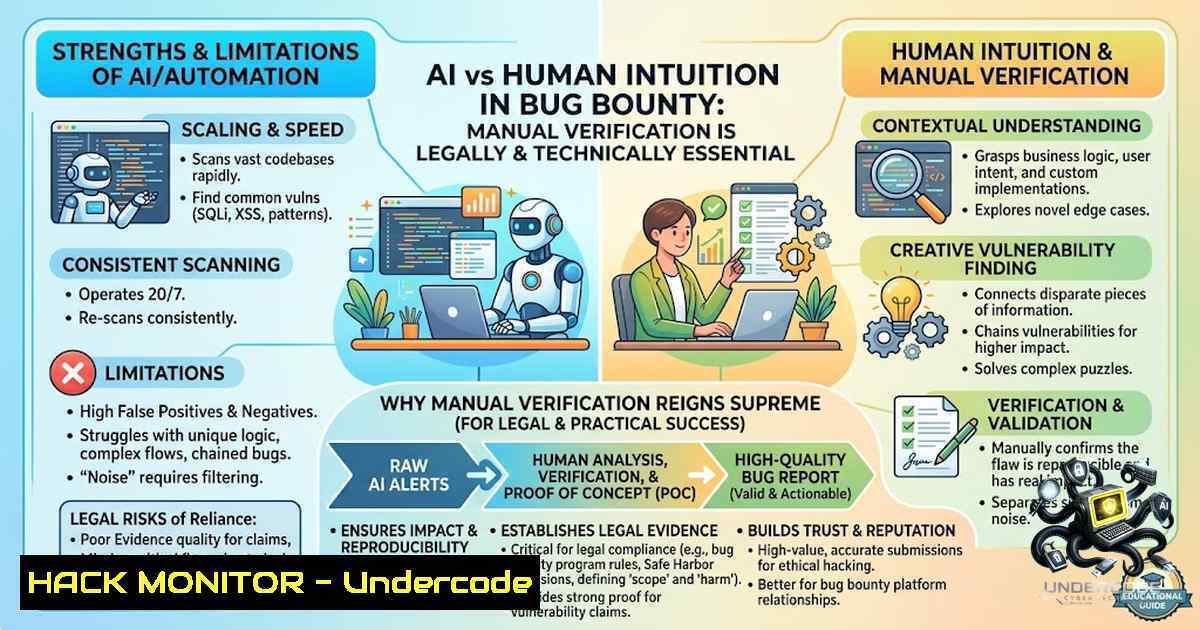
The allure of passive income through fully automated AI bug hunting is strong, but it is fraught with peril. Unlike internal penetration testing where risk is managed internally, bug bounty programs are public arenas where your professional reputation is on the line. Submitting a low-quality or false positive report not only wastes the triage team’s time but can lead to being banned from the platform. While AI excels at pattern recognition, it lacks the contextual reasoning required to determine if a SQL injection is actually exploitable or merely a reflection of unsanitized input in a non-critical function. The core issue is that Large Language Models (LLMs) are statistical parrots; they generate plausible text based on training data, but they often hallucinate vulnerabilities, leading researchers down rabbit holes of non-existent exploits.
Step‑by‑step guide to implementing a Safe AI Workflow:
- Isolate Intelligence: Use AI (like Claude or ChatGPT) only as a code-review assistant for code you have already manually analyzed, not as a primary scanner.
- Scripted Alerts: Follow the strategy of the original post: use simple scripts to scrape for new program additions or scope changes, sending alerts to Telegram.
- Verification Protocol: Before any AI-generated report leaves your environment, you must replicate the exploit manually. If you cannot manually trigger the vulnerability, the AI is likely wrong.
-
The Power of Human Intuition vs. Machine Logic
The human brain is wired to recognize logical fallacies and complex business logic flaws—a domain where AI currently flounders. In the post, the author noted that AI findings often lead to “excitement” which can cloud judgment. This emotional aspect is crucial; AI cannot simulate the adversary mindset required to chain a minor misconfiguration into a critical data leak. For example, AI might identify a missing HttpOnly flag on a cookie, but it takes a human to deduce that this could be combined with a Cross-Site Scripting (XSS) vulnerability in a subdomain to steal a high-privilege session.
Linux/Windows Commands for Deeper Analysis:
If you are analyzing a web application, use the following command to quickly check for subdomain takeovers, a common bug often misidentified by AI:
– Linux (Dig): `dig
– Windows (Nslookup): `nslookup -type=CNAME
3. Setting Up a Secure Alerting Infrastructure
Rather than automating the exploit, automate the awareness. The user mentions using bots to check for new scopes and sending Telegram alerts. This is the gold standard for integrating AI/automation safely. By automating the data aggregation phase, you reduce the cognitive load of scanning for new targets, allowing you to focus your manual efforts where they matter most.
Step‑by‑step guide for Telegram Alerts:
- Create a Bot: Talk to BotFather on Telegram to get a unique API token.
- Script (Python): Write a Python script using the `requests` library to check the HackerOne or Bugcrowd API for new programs.
- Cron Job (Linux): Schedule the script with `crontab -e` and add `0 /2 /usr/bin/python3 /path/to/your_script.py` to run every 2 hours.
- Send Message: Use `https://api.telegram.org/bot
/sendMessage?chat_id= &text= ` to push alerts.
4. Validating AI-Generated Payloads
One of the biggest pitfalls is assuming the payloads generated by AI are safe or effective. AI often generates payloads that are blocked by Web Application Firewalls (WAF) or are syntactically incorrect for the specific database backend.
Step‑by‑step guide for Payload Validation:
- Base64 Encoding: If a payload is blocked, encode it.
– Linux: `echo “payload” | base64`
2. Case Mutation: Change the case of SQL keywords (e.g., `SeLeCt` instead of SELECT) to bypass regex filters.
3. Command Injection: Test simple latency-based checks (e.g., sleep 5) before attempting data exfiltration. This ensures the vector exists without triggering excessive alarms.
5. The “Reputation Tax” of Automated Reporting
Bug bounty platforms calculate reputation points based on the severity and accuracy of your reports. A single “Informative” (False Positive) report can require three “Critical” reports to balance out. The risk-reward ratio for AI automation is heavily skewed toward risk. The author’s realization that manual testing yields “better reputation and better payouts” is a statistical reality. Triagers respect researchers who provide clear, concise, and exploitable proof-of-concepts (PoCs), which AI typically fails to generate accurately.
6. API Security and Configuration Hardening
If using AI to analyze API documentation, ensure you are manually verifying the authentication mechanisms. AI might miss that a JWT token is missing the `aud` (audience) claim, but a human tester can quickly deduce the attack vector.
– Windows Command: `curl -X GET “https://api.target.com/v1/data” -H “Authorization: Bearer
7. Securing Your Own AI Infrastructure
If you are running local AI models (e.g., Llama 2) to review code, ensure that model is isolated from your production environments. AI models can be poisoned or used as a vector for data exfiltration if not properly sandboxed.
– Linux Sandbox: Use `firejail` or `docker` to run your AI tools in a container with limited network access: docker run --1etwork none my-ai-container.
What Undercode Say:
- Key Takeaway 1: Full automation in bug bounty is a reputational suicide mission; AI cannot replace the contextual reasoning required for exploit validation.
- Key Takeaway 2: The best use of AI is not for hunting, but for intelligence gathering—scraping, parsing, and alerting on scope changes to free up time for manual deep dives.
Analysis:
The sentiment expressed in the original post reflects a growing maturity in the cybersecurity community. While vendors push AI as a replacement for human labor, practitioners recognize that bug hunting is as much an art as it is a science. The “excitement” generated by AI findings often leads to confirmation bias, where researchers try to fit the evidence to the AI’s claim rather than objectively assessing the risk. The community is shifting toward a “Human-in-the-Loop” model where AI is a powerful note-taker and data sorter, but the final decision-making authority remains strictly human. This hybrid approach ensures that the high signal-to-1oise ratio required for successful bug bounties is maintained.
Prediction:
- +1: We will see the rise of “AI-Validation” platforms that specifically train models to identify false positives, helping researchers filter out bad leads before they reach the triage stage.
- -1: As AI adoption increases, bug bounty triage teams will become overwhelmed with low-quality submissions, leading platforms to implement stricter “trust” scoring systems that favor manual testers, effectively pricing AI-only researchers out of the market.
- -1: The reliance on AI will create a generation of “script-kiddies” who understand how to generate a request but lack the foundational knowledge of networking or assembly, leading to a skill gap in the industry.
- +1: However, the demand for senior-level manual testers will skyrocket, as companies realize that human intuition is the only defense against sophisticated logic-bypass attacks that AI currently cannot conceptualize.
▶️ Related Video (82% Match):
🎯Let’s Practice For Free:
🎓 Live Courses & Certifications:
Join Undercode Academy for Verified Certifications
🚀 Request a Custom Project:
Secure, high-velocity infrastructure and disruptive technological engineering. Contact our engineering team for high-tier development and proprietary systems:
[email protected]
💎 Smart Architecture | 🛡️ Secure by Design | ⭐ Trusted by Thousands
IT/Security Reporter URL:
Reported By: https://lnkd.in/p/eFcBmycr – Hackers Feeds
Extra Hub: Undercode MoN
Basic Verification: Pass ✅


